Best Ways to Learn Chinese in 2026 (Apps, Plans, Tips)
Last updated: April 29, 2026

I've spent years watching people try (and fail) at learning Mandarin, and I've also seen what actually works. The good news? Learning Mandarin in 2026 is way easier than it was even five years ago. We've got AI tutors, better apps, and tons of free resources. This guide covers everything you need to know to start learning Mandarin effectively. We'll talk about the best apps, daily study plans, how to tackle those scary Chinese characters, and the fastest path from beginner to conversational.
- Understanding what makes Chinese language different
- Start with pinyin, the romanization system for Mandarin
- Learn Mandarin tones and pronunciation
- Learn Chinese characters without losing your mind
- Grammar: Less scary than you think
- Flashcards and spaced repetition for memorizing characters
- Best apps for learning Mandarin
- Get Chinese online tutors
- Use online language exchange platforms
- Use AI tools in 2026
- Learn Mandarin Chinese with immersion
- Your first 30 days: A beginner roadmap
- Top 6 tips for advanced learners
- FAQs
Understanding what makes Chinese language different
Before you dive in, you should know what you're getting into. Mandarin has a few unique challenges that make it different from learning Spanish or French.
First up: tones. Mandarin is a tonal language, which means the same syllable can mean completely different things depending on how you say it. The word "ma" () can mean mother, hemp, horse, or scold depending on whether you use the first, second, third, or fourth tone. Yeah, it's confusing at first.
Then there are the characters. Chinese doesn't use an alphabet. Instead, you've got thousands of Chinese characters to memorize. Each character represents a word or part of a word. The character means "good." The character means "you." Put them together as and you get "hello."
But don't freak out. You don't need to know thousands of characters to be functional. Around 1,000 characters will get you pretty far, and 2,500 will let you read newspapers comfortably.
Start with pinyin, the romanization system for Mandarin
This lets you read and pronounce Chinese words before you tackle characters. Apps like HelloChinese do a great job introducing pinyin to absolute beginners. You'll learn that means "thank you" and how to pronounce it correctly.
Once you've got pinyin down (give it about two weeks of daily practice), start learning characters alongside your speaking practice. Don't wait until you're "ready." You'll never feel ready.
Learn Mandarin tones and pronunciation
Tones are the hardest part of learning Mandarin for most people. You can't ignore them and hope for the best. Bad tones make you incomprehensible.
The best way to learn tones is through mimicking.
- Find native speakers (YouTube, apps, language exchange partners) and repeat exactly what they say.
- Record yourself and compare. It feels awkward, but it works.
Tone pairs are where people really struggle. It's one thing to say a single syllable with the right tone. It's another to string together multiple tones in a sentence. Practice common two-character words until the tone combinations feel natural.
Learn Chinese characters without losing your mind
Chinese characters look intimidating. There are tens of thousands of them. But here's what nobody tells you: characters follow patterns. Once you learn the building blocks (called radicals), new characters start making sense.
The character means "mother." It's made up of two parts: (woman) and (horse). The part gives you the meaning (related to women), and the part hints at the pronunciation (mā).
Start with the most common characters. The top 100 characters make up about 42% of written Chinese. The top 500 get you to around 75%. Focus on high-frequency characters first.
Use Skritter or a similar app that teaches proper stroke order. Writing characters by hand (even on a screen) helps them stick in your memory way better than just reading them.
Grammar: Less scary than you think
Chinese grammar is actually pretty straightforward compared to European languages. No verb conjugations, no gendered nouns, no plural forms.
Basic sentence structure is Subject-Verb-Object, just like English. means "I eat rice" (or "I eat a meal"). is "I," is "eat," and is "rice/meal."
The tricky parts are things like measure words (you can't just say "three books," you need to say "three (measure word) books") and aspect markers that show whether an action is completed or ongoing.
Don't stress about grammar too much in the beginning. Focus on learning useful phrases and patterns. Grammar understanding comes naturally as you see more examples.
Flashcards and spaced repetition for memorizing characters
Anki is your best friend for vocabulary. Download a good Chinese deck (there are tons of free ones) or make your own cards.
Good Chinese flashcards should show:
- The character:
- The pinyin: nǐ hǎo
- The English meaning: hello
- Audio of native pronunciation
Review your Anki deck every single day. Spaced repetition works, but only if you're consistent. Ten minutes daily beats an hour once a week.
As you get more advanced, add sentence cards instead of just vocabulary cards. Seeing words in context helps them stick better.
Best apps for learning Mandarin
Let's talk apps. There are tons out there, but most of them suck. Here are the ones worth your time in 2026:
- HelloChinese remains the best all-around app for beginners. It teaches you pinyin, pronunciation, basic grammar, and characters in a logical order. The free version gives you plenty of content to get started. The lessons are short (5-10 minutes each), so you can stick with it.
- Duolingo added some decent Mandarin content recently. It's not as comprehensive as HelloChinese, but it's good for building a daily habit. The gamification keeps you coming back. Just don't rely on it as your only resource.
- Skritter is hands-down the best app for learning to write Chinese characters. It teaches you proper stroke order and uses spaced repetition to drill characters into your brain. The handwriting recognition is pretty solid. Worth the subscription if you're serious about reading and writing.
- Anki with a good Chinese deck is essential for vocabulary building. More on this later.
- LingQ lets you read Chinese content with instant translations. Great for intermediate learners who want to start reading real Chinese texts.
Get Chinese online tutors
Getting a tutor changes everything. Even one hour per week with a native speaker accelerates your learning like crazy.
iTalki is the easiest way to find affordable Chinese tutors. You can find community tutors (native speakers without formal teaching credentials) for $10-15 per hour. Professional teachers cost more but provide structured lessons.
Use your tutor time for conversational practice and pronunciation correction. Don't waste it on things you can learn solo (like vocabulary or grammar rules). Come prepared with specific questions.
A good tutor will push you to speak, correct your tones, and explain cultural context that apps miss. The feedback is invaluable.
Use online language exchange platforms
Apps like HelloTalk and Tandem connect you with native Chinese speakers learning English. You help them with English, they help you with Mandarin.
This is free conversational practice. Pretty cool! But you need to be proactive. Send messages, start voice calls, and actually practice speaking. Don't just text back and forth in English.
Some people find language exchange partners become friends. Others prefer the clear structure of paid tutors. Both work. Try both and see what fits your style.
Use AI tools in 2026
AI has gotten really good at new language learning. Here are the best ways to use it:
- ChatGPT as a conversation partner. You can have full conversations in Chinese, and it'll correct your mistakes and explain grammar. Ask it to roleplay scenarios like ordering food or asking for directions.
- AI voice tools for pronunciation feedback. Apps like Speechling use AI to analyze your pronunciation and give specific feedback.
- AI-generated content at your level. Tools can create reading passages or dialogues specifically matched to your vocabulary level.
The AI tutoring space is exploding right now. By the end of 2026, we'll probably have even better tools with real-time conversation and virtual reality immersion.
Learn Mandarin Chinese with immersion
You can't fly to Beijing every weekend, but you can create Chinese immersion in your daily life.
- Change your phone language to Chinese. Seriously. It's uncomfortable for about three days, then you adapt. You'll learn tons of everyday vocabulary this way.
- Watch Chinese shows with Chinese subtitles. English subtitles let you zone out. Chinese subtitles force you to connect the sounds with characters. Start with shows for kids or teen dramas. The language is simpler.
- Listen to Chinese podcasts during your commute. Even if you don't understand much at first, your brain starts recognizing patterns and sounds.
- Join Chinese social media. Follow accounts on 小红书 (Xiǎohóngshū, Rednote) or watch Chinese creators on Douyin (Chinese TikTok).
The goal is to make Chinese a normal part of your day, not something you only do during "study time."
Your first 30 days: A beginner roadmap
Here's a realistic daily plan for your first month. This assumes you can dedicate 30-45 minutes per day.
Week 1-2: Foundation
- 15 minutes: HelloChinese lessons (focus on pinyin and tones)
- 15 minutes: Pronunciation practice with YouTube videos
- 10 minutes: Anki flashcards for basic vocabulary
Start with survival phrases. Learn , , which means "sorry," and basic numbers. Speaking of which, here are the numbers 1-10 in Chinese: , , , , , , , , , .
Week 3-4: Building Momentum
- 20 minutes: HelloChinese lessons (introducing characters)
- 15 minutes: Skritter for character writing practice
- 10 minutes: Anki reviews
By the end of month one, you should recognize about 100 characters and be able to introduce yourself in Mandarin.
Top 6 tips for advanced learners
Once you're past the beginner stage, these strategies accelerate your learning:
- Read extensively. Use apps like Du Chinese or The Chairman's Bao that provide graded reading content. Start easy and gradually increase difficulty.
- Shadow native speakers. Play audio of native speakers and try to speak simultaneously with them, matching their rhythm, tones, and intonation exactly.
- Learn words in context, not isolation. Instead of memorizing that means "to look," learn phrases like which means "to read a book" and which means "to watch a movie."
- Focus on your specific goals. If you want to do business in China, learn business vocabulary. If you want to read Chinese novels, focus on literary vocabulary. Customize your learning to what you'll actually use.
- Track your progress visibly. Keep a list of characters you've learned, record yourself speaking every month to hear improvement, or maintain a journal in Chinese.
- Remember why you started. Whether it's career opportunities, connecting with family, travel plans, or just loving the challenge, keep your "why" front and center.
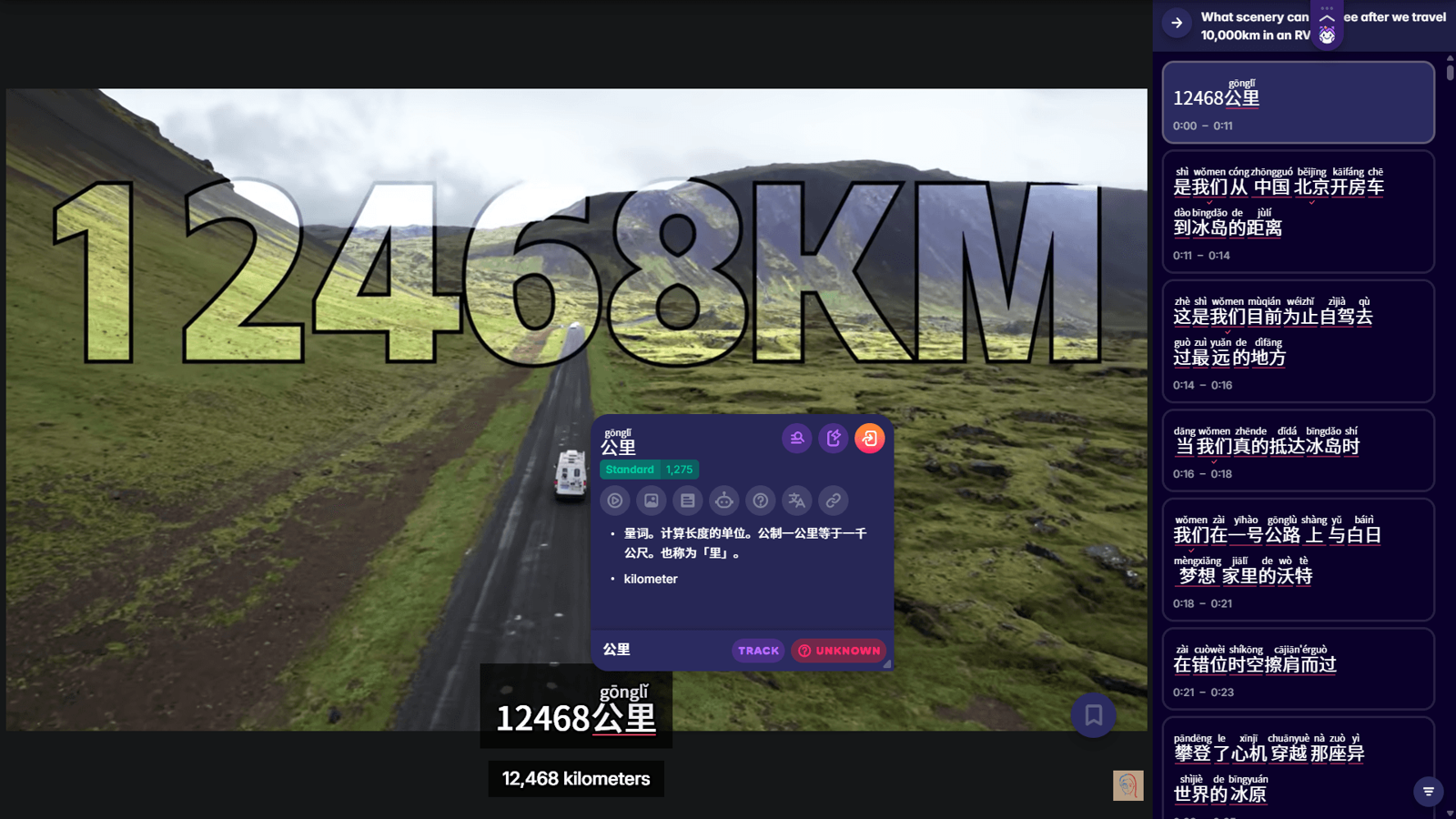
Anyway, if you want to level up your Chinese learning with real content, Migaku's browser extension and app let you look up Chinese words instantly while watching shows or reading articles. The popup dictionary shows you the character, pinyin, and meaning without breaking your flow. There's a 10-day free trial if you want to check it out.
FAQs
Your next steps
If you're starting from zero, here's what to do this week:
- Download HelloChinese and complete the first five lessons
- Download Anki and find a beginner Chinese deck
- Watch a few YouTube videos on Mandarin pronunciation and tones
- Change one device (maybe your tablet or a spare phone) to Chinese
- Find one Chinese YouTube channel or show that looks interesting
Learning Mandarin in 2026 is totally doable with the right approach and resources. You've got better tools available than ever before. The question is whether you'll actually use them consistently.
If you consume media in Chinese, and you understand at least some of the messages and sentences within that media, you will make progress. Period.
That's it. Don't overthink it. Just start.📖