# Cantonese Particles: Master Sentence Final Particles Guide
> Learn how Cantonese sentence final particles work with practical examples of 啦, 呀, 咩, and more. Essential guide for natural, fluent Cantonese speech.
**URL:** https://migaku.com/blog/chinese/cantonese-particles-sentence-final-guide
**Last Updated:** 2026-03-12
**Tags:** fundamentals, vocabulary, grammar
---
If you are [learning Cantonese](https://migaku.com/learn-cantonese), you've probably noticed these little sounds tacked onto the end of sentences. They're called sentence final particles, and honestly, they're what make Cantonese sound so expressive and different from Mandarin. These tiny syllables completely change how a sentence feels, turning a neutral statement into a question, a command into a polite request, or adding emotions like surprise, impatience, or agreement. Learning how to use Cantonese particles properly is the difference between sounding like a textbook and actually talking like a real person.
----
## What are Cantonese sentence final particles
Sentence final particles in Cantonese are short syllables that come at the very end of a sentence to convey the speaker's attitude, emotion, or intention. Think of them as flavor packets for your sentences. The same basic statement can mean totally different things depending on which particle you stick on the end.
In Cantonese, these particles are absolutely everywhere in casual conversation. You'll hear them way more than in Mandarin, and they carry much more nuanced meanings. While Mandarin has some sentence-final particles too (like 吗 ma for questions or 了 le for completed actions), Cantonese takes this system to a whole different level with dozens of particles and even more combinations.
The tricky part? There's no perfect English translation for most of these. A particle like 啦 (laa3) might soften a statement in one context, show obviousness in another, or express mild exasperation depending on the tone and situation. This is why so many Cantonese learners struggle with particles even after they've got the basic grammar down.
----
## Common Cantonese final particles you need to know
Let me break down the most frequently used particles you'll encounter. These show up in pretty much every conversation.
### 啦 (laa3)
This is probably the most versatile particle in Cantonese. The particle 啦 appears in tons of different contexts and can express several meanings depending on what you're saying.
1. Most commonly, laa3 **softens statements** and makes them sound more natural or obvious. It's like saying "you know" or "obviously" in English, but way more subtle. Example: 係啦 (hai6 laa3) means "yes" or "that's right," but with an agreeable, confirmatory feeling. Just saying 係 (hai6) alone sounds too abrupt.
2. You'll also hear laa3 **at the end of suggestions or gentle commands**: 食飯啦 (sik6 faan6 laa3) means "let's eat" or "time to eat," with a casual, non-pushy vibe. Without the particle, it would sound more like a blunt statement.
3. The particle laa3 can also express **a change of state or new realization**, similar to how Mandarin uses 了 (le). 我明白啦 (ngo5 ming4 baak6 laa3) means "I understand now" or "okay, I get it."
### 呀 (aa3)
The aa3 particle turns statements into questions or adds a questioning tone. It's super common in everyday speech.
1. When you want to **ask a yes/no question**, just stick aa3 at the end: 係唔係呀 (hai6 m4 hai6 aa3) means "is it or isn't it?" The 呀 makes it feel like a genuine question rather than a rhetorical one.
2. You'll also see aa3 used to **soften questions** and make them more polite or friendly. 你去邊度呀 (nei5 heoi3 bin1 dou6 aa3) means "where are you going?" and sounds way friendlier than without the particle.
3. Sometimes aa3 appears in exclamations too, **expressing surprise or realization**: 係佢呀 (hai6 keoi5 aa3) can mean "oh, it's him!" with a tone of recognition.
### 咩 (me1)
This particle me1 specifically marks questions, often with a sense of doubt or seeking confirmation. It's like adding "really?" or "is that so?" to the end of a sentence.
1. If someone tells you something surprising, you might respond with 係咩 (hai6 me1), meaning "really?" or "is that true?" The me1 shows you're **questioning or doubting** what you just heard.
2. You can also use me1 to **ask what something is**: 做咩 (zou6 me1) means "what are you doing?" or simply "why?" in casual speech. This is super common in Cantonese conversations.
### 喎 (wo3)
1. The wo3 particle expresses **mild surprise** or a new realization. It's like saying "oh!" or "I see" when you notice something you didn't know before. 好靚喎 (hou2 leng3 wo3) means "oh, that's pretty!" with a sense of pleasant surprise. You're noticing something for the first time or didn't expect it to be that nice.
2. This particle helps **convey that the information is new to the speaker or somewhat unexpected**. 原來係你喎 (jyun4 loi4 hai6 nei5 wo3) means "oh, so it's you!" with that realization tone.
### 啊 (aa1)
Don't confuse this with aa3. The aa1 particle (with a high flat tone) appears at the end of statements to make them sound gentler or more obvious.
1. It often shows up in imperatives to **make commands sound less harsh**: 坐低啊 (co5 dai1 aa1) means "sit down" but in a friendly, inviting way rather than a strict command.
2. You'll also hear aa1 in statements where the speaker is **pointing out something obvious** or reminding someone: 小心啊 (siu2 sam1 aa1) means "be careful" with a caring, warning tone.
### 㗎 (gaa3)
1. This particle emphasizes that something is **definitely true or explains a fact**. It's assertive without being aggressive. 我唔知㗎 (ngo5 m4 zi1 gaa3) means "I don't know" but with emphasis, like "I really don't know" or "I'm telling you, I don't know." The gaa3 adds conviction to your statement.
2. When explaining something, gaa3 makes it clear **you're stating a fact**: 佢係老師㗎 (keoi5 hai6 lou5 si1 gaa3) means "he's a teacher" with a matter-of-fact tone, maybe correcting a misunderstanding.
----
## Particle combinations
Once you've got individual particles down, Cantonese speakers love combining two or even three particles together. These combinations create even more specific meanings and emotional nuances.
- One super common combination is 㗎啦 (gaa3 laa3), which adds both emphasis and a softening effect. It's often used when explaining something that should be obvious: 我話咗㗎啦 (ngo5 waa6 zo2 gaa3 laa3) means "I already told you" with a slightly exasperated but not angry tone.
- Another frequent combo is 啊嘛 (aa1 maa3), which makes statements sound gentler and more obvious, often used when reassuring someone or stating something that shouldn't be a problem.
- The combination 咯喎 (lo3 wo3) expresses a realization with some surprise, like "oh, so that's how it is!" It shows you've just figured something out or noticed a change.
Learning these combinations takes time because you need to develop an ear for when they sound natural. The good news is you'll hear them constantly in real conversations, so immersion really helps.
----
## How particles work in different sentence types
Cantonese particles function differently depending on whether you're making a statement, asking a question, or giving a command. Understanding these patterns helps you choose the right particle for the situation.
1. In statements, particles typically soften the tone or add the speaker's attitude. A bare statement without any particle sounds too direct or even rude in many contexts. Adding laa3, gaa3, or aa1 makes your speech sound more natural and considerate.
2. For questions, certain particles like aa3 and me1 are essential. While you can form questions through intonation alone, using the appropriate particle makes the question clearer and often more polite. The particle choice also shows what kind of answer you expect.
3. Commands and requests really benefit from particles. Without them, imperatives sound harsh or bossy. Adding laa3 or aa1 transforms a command into a friendly suggestion or polite request that people are much more likely to respond positively to.
----
## Differences between Cantonese and Mandarin particles
If you've studied Mandarin before tackling Cantonese, you'll notice the particle systems are pretty different. [Mandarin has sentence-final particles](https://migaku.com/blog/chinese/chinese-question-particles-ma-ba-ne) too, but they're less varied and carry different meanings.
- Mandarin's 吗 (ma) for yes/no questions doesn't really have a direct Cantonese equivalent. Instead, Cantonese uses aa3, me1, or sometimes no particle at all with just rising intonation.
- Mandarin's 了 (le) indicates completed actions or change of state, but Cantonese spreads this function across several particles like laa3, lo3, and others, each with slightly different nuances.
The sheer number of particles in Cantonese is much higher than in Mandarin. Cantonese relies on these particles more heavily for expressing emotion and attitude in everyday speech. This makes Cantonese sound more expressive and varied to many people's ears.
Interestingly, some particles exist in both languages but mean different things. The character 啦 appears in both, but its usage and feeling differ between the two languages.
----
## Tips for learning and using particles naturally
The biggest challenge with Cantonese final particles is that you can't really learn them from textbooks alone. You need to hear them in context, repeatedly, to internalize when each one feels right.
1. [Watching Cantonese TV shows](https://migaku.com/blog/chinese/best-cantonese-shows-for-language-learners), movies, or YouTube videos helps tremendously. Pay attention to which particles characters use in different emotional situations. You'll start noticing patterns, like how people use laa3 when making casual suggestions or wo3 when they're surprised.
2. As a learner, start with the most common particles like laa3, aa3, and me1. Get comfortable using these in basic sentences before worrying about the more subtle ones or combinations. Even just adding these three to your speech will make you sound way more natural.
3. Recording yourself speaking and comparing it to native speakers can help too. You'll hear whether your particle usage sounds natural or forced. The rhythm and flow matter just as much as choosing the right particle.
----
## Common mistakes learners make with particles
1. One mistake I see all the time is overusing the same particle in every sentence. If you end everything with laa3 because it's the first one you learned, you'll sound repetitive and weird. Mix it up based on what you're actually trying to express.
2. Another issue is using particles in formal or written Cantonese where they don't belong. These particles are primarily for spoken, casual conversation. In formal speeches, business writing, or news broadcasts, you'll hear far fewer particles. Using too many in the wrong context sounds unprofessional.
3. Some learners also try to translate particles directly into English equivalents in their heads. This doesn't work because particles don't translate cleanly. You need to think about the feeling or attitude you want to convey, not find a word-for-word match.
4. Getting the tone wrong on particles changes their meaning entirely. The difference between aa1, aa3, and aa6 is just the tone, but they function completely differently. Make sure you're practicing the correct tone for each particle.
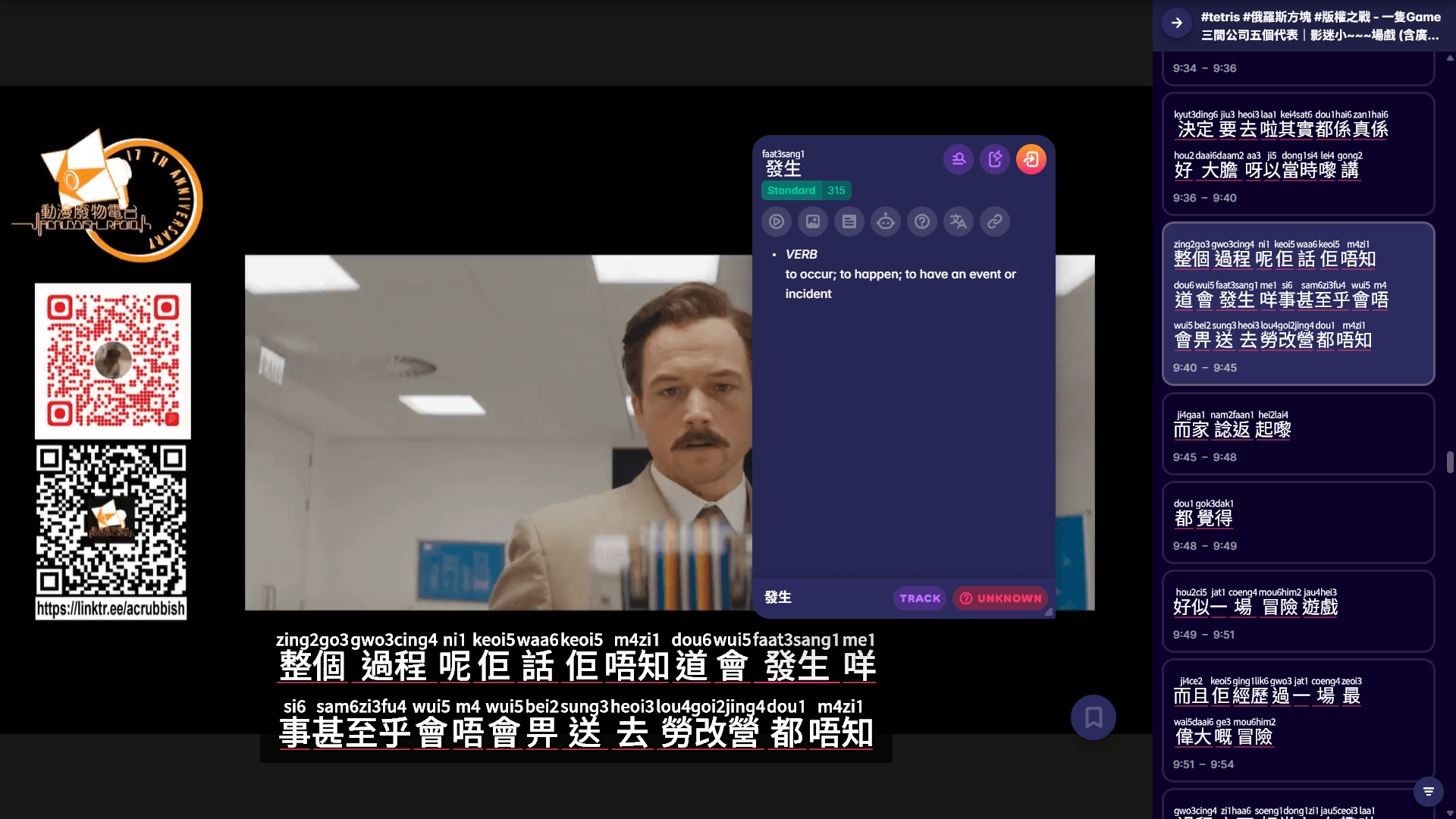
Anyway, if you want to practice picking up particles from real Cantonese content, Migaku's browser extension and app let you watch shows or read articles with instant word lookups, so you can see particles in context and learn how they're actually used. There's a 10-day free trial if you want to check it out.
 ----
## FAQs
叔叔 (suk1 suk1) means "uncle," specifically your father's younger brother or a respectful term for older men roughly your parents' age. It's a common way to address family friends or acquaintances politely.
[Cantonese traditionally has six tones](https://migaku.com/blog/language-fun/cantonese-tones) (some linguists count nine if you include entering tones separately). These tones are: high flat, high rising, mid flat, low falling, low rising, and low flat. Each tone completely changes word meaning, making Cantonese one of the more tonally complex Chinese languages.
----
## If you're just beginning to learn Cantonese, don't let particles intimidate you
Start simple with the [basic vocabulary and grammar](https://migaku.com/blog/chinese/cantonese-verb-tenses), then gradually add in the most common particles as you get comfortable. Focus on listening to native Cantonese speakers, and pay attention to Cantonese sentence-final particles when you are consuming media. Videos like vlogs, dramas, and movies can teach you faster than other materials, because you can see how the particles are used to express nuances in real life.
> If you consume media in Cantonese, and you understand at least some of the messages and sentences within that media, you will make progress. _Period_.
The journey takes time, but it's one of the most rewarding parts of learning the language.
----
## FAQs
叔叔 (suk1 suk1) means "uncle," specifically your father's younger brother or a respectful term for older men roughly your parents' age. It's a common way to address family friends or acquaintances politely.
[Cantonese traditionally has six tones](https://migaku.com/blog/language-fun/cantonese-tones) (some linguists count nine if you include entering tones separately). These tones are: high flat, high rising, mid flat, low falling, low rising, and low flat. Each tone completely changes word meaning, making Cantonese one of the more tonally complex Chinese languages.
----
## If you're just beginning to learn Cantonese, don't let particles intimidate you
Start simple with the [basic vocabulary and grammar](https://migaku.com/blog/chinese/cantonese-verb-tenses), then gradually add in the most common particles as you get comfortable. Focus on listening to native Cantonese speakers, and pay attention to Cantonese sentence-final particles when you are consuming media. Videos like vlogs, dramas, and movies can teach you faster than other materials, because you can see how the particles are used to express nuances in real life.
> If you consume media in Cantonese, and you understand at least some of the messages and sentences within that media, you will make progress. _Period_.
The journey takes time, but it's one of the most rewarding parts of learning the language.