# How Personal Pronouns in Cantonese Work (Simple Guide)
> Cantonese personal pronouns have no gender distinction. Read through this to know the simple plural forms and possessive particles with clear examples.
**URL:** https://migaku.com/blog/chinese/cantonese-personal-pronouns
**Last Updated:** 2026-03-25
**Tags:** fundamentals, vocabulary, grammar
---
If you're [learning Cantonese](https://migaku.com/learn-cantonese), you'll be happy to know that personal pronouns are way simpler than what you'd find in languages like French or German. There's no gender to memorize for third-person pronouns, no complicated case changes, and the same form works whether you're talking about a subject or object. Pretty cool! But there are some quirks you need to understand, like how plurals work and why possessive forms need an extra particle. Let's break down exactly how Cantonese personal pronouns function so you can start using them confidently.
----
## The basic singular pronouns in Cantonese
Cantonese has three main singular personal pronouns that you'll use constantly.
- **The first person pronoun** 我 (ngo5) means "I" or "me" in English. You'll use this one all the time when talking about yourself in any context.
- **The second person pronoun** 你 (nei5) means "you" and works for both formal and informal situations in most cases. There's also a more formal version 您 (nei5) with a different character, but honestly, most Cantonese speakers stick with 你 in everyday conversation.
- **The third person pronoun** 佢 (keoi5) means "he," "she," or "it" depending on context. Yep, just one pronoun for all genders and even objects sometimes. The language doesn't force you to specify gender when you're talking about someone, which makes things much easier when you're starting out.
These pronouns work the same whether they're subjects or objects in a sentence. So 我 means both "I" and "me," 你 means both "you" (subject) and "you" (object), and 佢 covers "he/she/it" as well as "him/her/it." No case distinction to worry about.
----
## How plural pronouns work with dei6
Making pronouns plural in Cantonese uses a specific particle rather than completely different words like English does with "I" versus "we." The pluralizer 哋 (dei6) gets added after the singular pronoun to create the plural form.
- So 我哋 (ngo5 dei6) means "we" or "us." You take the singular 我 and add 哋 to show you're talking about multiple people including yourself. Same pattern applies across the board.
- For second person plural, 你哋 (nei5 dei6) means "you all" or "you guys" in English. This one's super useful because English doesn't have a standard plural "you" form, so some regions say "y'all" or "youse" to fill that gap. Cantonese just adds dei6 and you're done.
- Third person plural becomes 佢哋 (keoi5 dei6), meaning "they" or "them." Again, no gender distinction here either. Whether you're talking about a group of men, women, or mixed company, you use the same pronoun.
The particle 哋 only shows up in spoken Cantonese. In written Chinese, you'll often see different characters like 們 (used in Mandarin), but when you're actually speaking Cantonese, dei6 is what you need to remember.
----
## Possessive forms require ge3
Cantonese doesn't modify the pronoun itself to show possession like English does with "my" versus "I." Instead, you add the [possessive particle 嘅 (ge3)](https://migaku.com/blog/chinese/cantonese-particles-sentence-final-guide) after the pronoun.
- So "my" becomes 我嘅 (ngo5 ge3). If you want to say "my book," you'd say 我嘅書 (ngo5 ge3 syu1). The structure is always pronoun plus ge3 plus the thing being possessed.
- "Your" is 你嘅 (nei5 ge3).
- "His/Her/Its" is 佢嘅 (keoi5 ge3). Notice how even in possessive form, there's still no gender distinction for third person. The context tells you whether 佢嘅 means "his," "her," or "its."
For plural possessives, you combine what you already know.
- "Our" becomes 我哋嘅 (ngo5 dei6 ge3).
- "Your" (plural) is 你哋嘅 (nei5 dei6 ge3).
- "Their" is 佢哋嘅 (keoi5 dei6 ge3).
The pattern stays consistent: pronoun, optional dei6 for plural, then ge3 for possession.
Sometimes in casual speech, Cantonese speakers drop the ge3 particle when the possession is obvious from context, but as a learner, you're safer including it until you develop a natural feel for when it's optional.
----
## Understanding reflexive pronouns
Reflexive pronouns in Cantonese follow a different pattern than what you might expect from English. When you want to say "myself," "yourself," or "himself," Cantonese uses 自己 (zi6 gei2) after the regular pronoun.
- The phrase 我自己 (ngo5 zi6 gei2) means "myself." You can use this in sentences like 我自己做 (ngo5 zi6 gei2 zou6), which means "I do it myself" or "I'll do it on my own."
- 你自己 (nei5 zi6 gei2) means "yourself."
- 佢自己 (keoi5 zi6 gei2) means "himself/herself/itself."
- 我哋自己 (ngo5 dei6 zi6 gei2) is for "ourselves."
Sometimes you'll hear just 自己 without a pronoun before it, especially when the subject is already clear from context. The word literally means "self" or "oneself," so it's pretty flexible in actual usage.
----
## Cultural usage with jan4 dei6
One interesting cultural aspect of Cantonese pronouns involves the term 人哋 (jan4 dei6). This literally translates to "other people" but gets used as a humble way to refer to oneself, particularly by women or when being modest.
You might hear someone say 人哋唔識 (jan4 dei6 m4 sik1), which technically means "other people don't know," but they're actually saying "I don't know" in a cute or humble way. This usage shows up more in informal contexts and carries a softer, more modest tone than using 我 directly.
The term can also genuinely mean "others" or "other people" depending on context, so you need to pay attention to the situation to understand which meaning applies. When a speaker uses it to refer to themselves, there's usually a playful or self-effacing quality to the conversation.
This kind of pronoun substitution reflects broader cultural values around humility and indirect communication in Chinese culture. While you don't need to use jan4 dei6 this way as a learner, understanding it helps you catch the nuance when native speakers do.
----
## Sentence examples with personal pronouns
Seeing pronouns in actual sentence context helps way more than just memorizing isolated words. Here's how they work in real usage.
- 我鍾意飲咖啡。
*I like to drink coffee.* (The pronoun 我 functions as the subject of the sentence.)
- 你去邊度。
*Where are you going?* (Here 你 is the subject performing the action of going.)
- 佢係我嘅朋友。
*He/She is my friend.* (This sentence shows both 佢 as subject and 我嘅 as possessive.)
- 我哋聽日見。
*We'll see each other tomorrow / See you tomorrow.* (The plural 我哋 indicates multiple people including the speaker.)
- 你哋想食乜嘢。
*What do you guys want to eat?* (This uses the plural second person pronoun.)
- 佢哋都好忙。
*They are all very busy.* (佢哋 refers to a group of people.)
----
## Common mistakes when learning personal pronouns in Cantonese
1. A lot of English speakers try to apply gender to 佢 because they're used to choosing between "he" and "she." Remember that Cantonese doesn't make this distinction, so you can relax and just use 佢 for everyone.
2. Another common mistake is forgetting the ge3 particle for possessives. You might want to say 我書 (ngo5 syu1) for "my book," but that's incomplete. You need 我嘅書 (ngo5 ge3 syu1). The particle is essential for clear possessive meaning.
3. Mixing up the tones is probably the biggest practical mistake. All three basic pronouns use similar tones in many Cantonese tone systems, but getting them exactly right matters for comprehension. Record yourself and compare to native audio to catch these errors.
----
## Tips for learning Cantonese pronouns effectively
1. Start by getting really comfortable with the three basic singular pronouns: 我, 你, and 佢. Use them in simple sentences until they become automatic. Don't worry about all the variations at first.
2. Once those feel natural, add the plural forms with dei6. Practice switching between singular and plural in similar sentences so you internalize the pattern. Say things like "I go" and "We go" using 我去 and 我哋去 to build the muscle memory.
3. Audio practice is super important because the tones matter. The pronoun 我 uses tone 5 (low falling), 你 uses tone 5 as well, and 佢 uses tone 5 in most Cantonese romanization systems. Getting the tones wrong can make you hard to understand, so listen to native speakers and mimic their pronunciation.
4. Make flashcards or practice sheets that show the pronoun, its romanization, and example sentences. Seeing them in context helps way more than just memorizing isolated words.
5. Pay attention to when native speakers drop pronouns versus when they include them. [Watch Cantonese shows or listen](https://migaku.com/blog/chinese/best-cantonese-shows-for-language-learners) to conversations and note the patterns. Over time, you'll develop an intuition for when the pronoun is necessary and when context makes it optional.
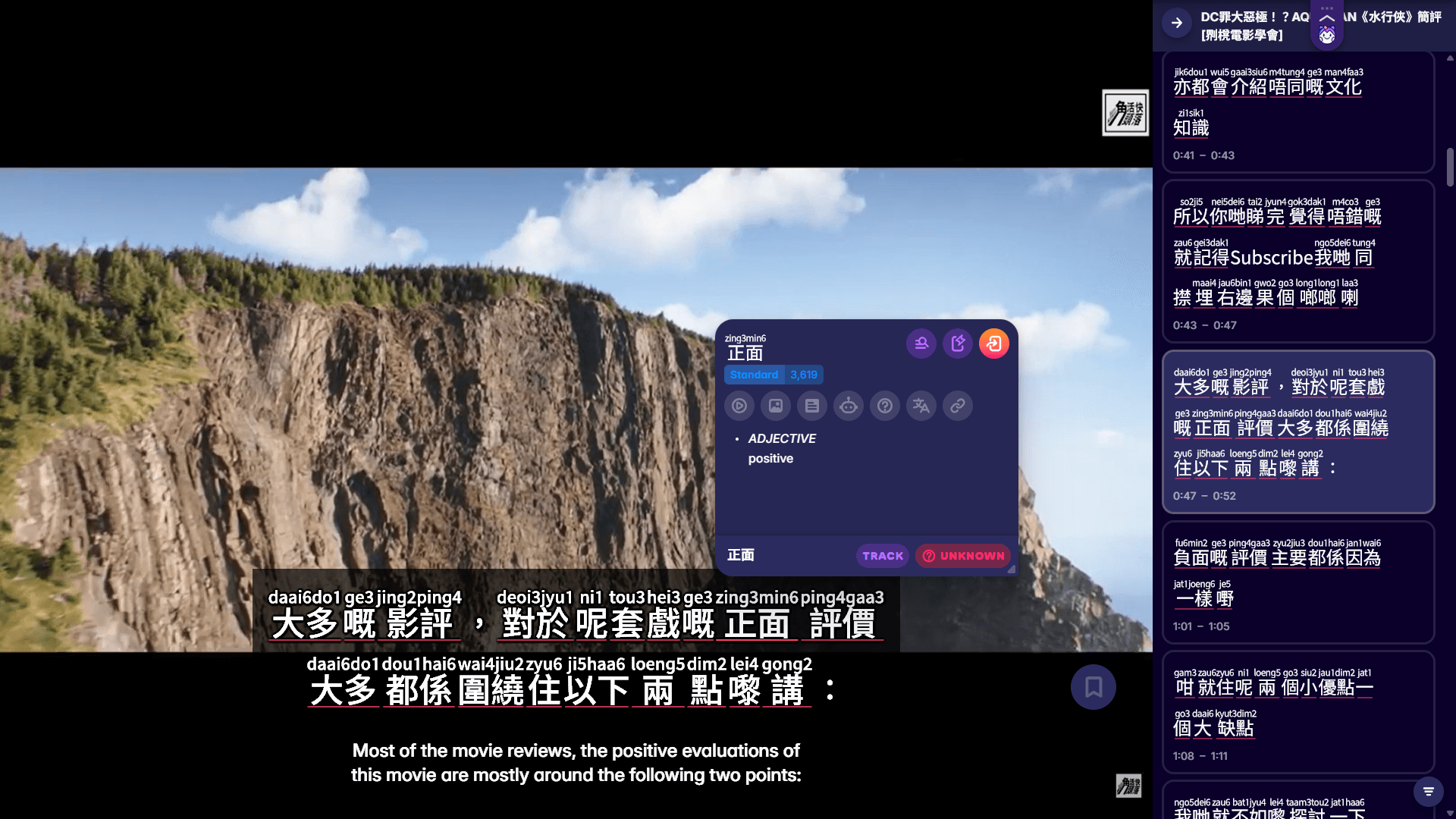
Anyway, if you want to practice these pronouns with real Cantonese content, Migaku's browser extension and app let you look up words and phrases instantly while watching shows or reading articles. Makes learning from actual usage way more practical. There's a 10-day free trial if you want to check it out.
 ----
## What about demonstrative pronouns and interrogative pronouns?
Once you've mastered personal pronouns in Cantonese, you'll want to explore other pronoun types that come up in conversation. Demonstrative pronouns like 呢個 and 嗰個 are super common for pointing things out. Interrogative pronouns like 邊個 and 乜嘢 are essential for asking questions and having conversations beyond just making statements. The most important thing is to find your own ways to learn grammar rules like these efficiently. Start with rules, and consume Cantonese media extensively to observe how native speakers use them.
> If you consume media in Cantonese, and you understand at least some of the messages and sentences within that media, you will make progress. _Period_.
Pronouns don't exist in isolation, they're part of the larger system of how the language builds meaning.✒️📖
----
## What about demonstrative pronouns and interrogative pronouns?
Once you've mastered personal pronouns in Cantonese, you'll want to explore other pronoun types that come up in conversation. Demonstrative pronouns like 呢個 and 嗰個 are super common for pointing things out. Interrogative pronouns like 邊個 and 乜嘢 are essential for asking questions and having conversations beyond just making statements. The most important thing is to find your own ways to learn grammar rules like these efficiently. Start with rules, and consume Cantonese media extensively to observe how native speakers use them.
> If you consume media in Cantonese, and you understand at least some of the messages and sentences within that media, you will make progress. _Period_.
Pronouns don't exist in isolation, they're part of the larger system of how the language builds meaning.✒️📖