# Cantonese Sentence Structure: Grammar Basics for Beginners
> Learn basic Cantonese sentence structure with clear examples. Master SVO word order, particles, negation, and questions to start speaking Cantonese faster.
**URL:** https://migaku.com/blog/chinese/cantonese-sentence-structure-grammar-basics
**Last Updated:** 2026-03-26
**Tags:** fundamentals, grammar
---
If you're [learning Cantonese](https://migaku.com/learn-cantonese), you've probably noticed that grammar guides can get pretty confusing pretty fast. The good news? Basic Cantonese sentence structure actually follows patterns that English speakers will find familiar. Once you understand the core building blocks, you can start forming sentences way faster than you might think. This guide breaks down everything you need to know about Cantonese grammar basics, from simple statements to questions and negatives, with plenty of examples to get you speaking.
----
## The basic sentence pattern in Cantonese
Cantonese follows a **Subject-Verb-Object (SVO)** word order, just like English. This makes it way easier for English speakers compared to languages that put the verb at the end. When you want to say "I eat rice," the structure stays the same in both languages.
Here's a simple example:
- 我食飯。
*I eat rice.*
Breaking it down:
- 我 (ngo5) = I
- 食 (sik6) = eat
- 飯 (faan6) = rice
Pretty straightforward, right? The subject comes first, then the verb, then the object. This basic sentence structure forms the foundation for most of what you'll say in Cantonese.
Let's look at a few more examples:
- 佢睇書。
*He/She reads a book.*
- 我哋去香港。
*We go to Hong Kong.*
- 你飲茶。
*You drink tea.*
The consistency here is your friend. Once you've got this pattern down, you can swap in different subjects, verbs, and objects to create tons of different sentences.
----
## Adding time, place, and manner to your sentences
Here's where Cantonese grammar gets a bit different from English. When you want to add information about when, where, or how something happens, the placement follows specific rules.
**[Time expressions](https://migaku.com/blog/chinese/cantonese-time-expressions) typically come right after the subject, before the verb:**
- 我今日食飯。
*I eat today.*
- 佢聽日去。
*He/She goes tomorrow.*
**Place expressions also come before the verb:**
- 我喺屋企食飯。
*I eat at home.*
You can even combine them:
- 我今日喺屋企食飯。
*I eat at home today.*
> 💡The pattern becomes: **Subject + Time/Place + Verb + Object**
**Manner (how you do something) usually comes right before the verb:**
- 我快啲食飯。
*I eat quickly.*
Getting comfortable with these placements takes practice, but the rules stay consistent. Unlike English where we might say "I quickly eat" or "I eat quickly," Cantonese keeps the manner expression before the verb.
----
## Getting comfortable with word order
> 💡 Remember This General Pattern 💡
Word order in Cantonese stays pretty consistent once you learn the rules. The basic pattern is: **Subject + (Time) + (Place) + (Manner) + Verb + (Object) + (Particle)**
Not every sentence needs all these elements, but when they appear, this is generally the order they follow.
----
## How negation works in Cantonese
Making negative sentences in Cantonese is actually simpler than in English. You don't need helping verbs like "don't" or "doesn't." Just stick 唔 (m4) right before the verb.
- 我唔食飯。
*I don't eat rice.*
- 佢唔去。
*He/She doesn't go.*
- 我哋唔飲茶。
*We don't drink tea.*
The 唔 particle works for most verbs and makes negation super consistent. There's no conjugation to worry about, no switching between "don't" and "doesn't" based on the subject. Just add 唔 before any verb and you've got your negative sentence.
For the verb "to have" (有, jau5), the negation is slightly different. You use 冇 (mou5) instead:
- 我有錢。
*I have money.*
- 我冇錢。
*I don't have money.*
Past tense negation uses the same 唔 pattern. You just need to understand that Cantonese doesn't mark tense the way English does. Context and time words tell you when something happened:
- 我尋日唔食飯。
*I didn't eat yesterday.*
The verb stays the same whether you're talking about now or yesterday. The time word 尋日 (cam4 jat6, yesterday) handles the past tense meaning.
----
## Asking questions in Cantonese
Cantonese has a few different ways to form questions, and they're all pretty logical once you see the patterns.
The most common method uses the **verb-not-verb** structure. You basically offer both options in the question:
- 你食唔食飯?
*Do you eat rice?*
- 佢去唔去?
*Does he/she go?*
This pattern works because you're presenting both possibilities. The person answering just picks one:
- 食。
*Yes.* (literally: Eat.)
- 唔食。
*No.* (literally: Not eat.)
For questions with question words like "what," "where," or "who," **the question word goes where the answer would go**:
- 你食咩?
*What do you eat?*
- 佢去邊度?
*Where does he/she go?*
- 邊個去?
*Who goes?*
Notice how 邊個 (bin1 go3, who) sits in the subject position because that's what the question is asking about.
You can also add 嗎 (maa3) or 呀 (aa3) to the end of a statement to turn it into a yes/no question:
- 你食飯呀?
*Do you eat rice?*
These final particles add a questioning tone. They're super common in casual speech.
----
## Guide to Cantonese particles
Cantonese uses particles way more than English does, and they're honestly one of the trickiest parts of the grammar. These little words don't translate directly but add meaning, tone, and context to sentences.
Final particles come at the very end of sentences and change the feel of what you're saying:
| Particle | Usage |
| - | - |
| 啦 (laa1) | Indicates a change or new situation |
| 喇 (laa3) | Indicates completion or emphasis |
| 㗎 (gaa3) | Emphasizes or seeks confirmation |
| 咩 (me1) | Turns statements into questions with surprise |
| 囉 (lo1) | Indicates obviousness |
Here are some examples:
- 我去啦。
*I'm going now.* (implies a decision or change)
- 我食咗飯喇。
*I've eaten already.*
- 係㗎。
*That's right!* (emphatic)
The particle 咗 (zo2) deserves special mention because it marks completed actions. It comes right after the verb:
- 我食咗飯。
*I have eaten.*
- 佢去咗香港。
*He/She went to Hong Kong.*
The possessive particle 嘅 (ge3) works like English "of" or the possessive 's:
- 我嘅書
*my book* (literally: I's book)
- 香港嘅茶餐廳
*Hong Kong's cha chaan teng restaurants*
Learning when to use which particle takes time and exposure to real Cantonese. The meanings can be subtle, and native speakers use them instinctively based on context and emotion.
----
## Using pronouns and nouns
Cantonese pronouns are simpler than English in some ways. There's no distinction between "he" and "she" in speech, they're both 佢 (keoi5). The written forms differ (他 for he, 她 for she), but when speaking, it's the same sound.
Common pronouns:
| Cantonese | English |
| - | - |
| 我 (ngo5) | I / Me |
| 你 (nei5) | You |
| 佢 (keoi5) | He / Him, She / Her |
| 我哋 (ngo5 dei6) | We / Us |
| 你哋 (nei5 dei6) | You all |
| 佢哋 (keoi5 dei6) | They / Them |
The 哋 (dei6) particle makes pronouns plural. Super consistent.
Nouns in Cantonese don't have articles like "a" or "the" in the same way English does. Context tells you whether something is specific or general:
- 我睇書。
*I read a book. / I read books. / I'm reading the book.*
When you need to specify "one" of something, you use the number 一 (jat1) plus a measure word. [Measure words](https://migaku.com/blog/chinese/cantonese-classifiers-guide) (classifiers) are required between numbers and nouns:
- 一個人
*one person*
- 一本書
*one book*
- 一杯茶
*one cup of tea*
The measure word changes based on the type of noun. 個 (go3) is the most common and works for many things, but you'll encounter others as you progress.
----
## Comparing Cantonese and Mandarin grammar
People often ask if Cantonese has different grammar from Mandarin. The answer is yes, definitely. While both languages share the SVO structure and use measure words, they differ significantly in particles, negation, and sentence patterns.
- Cantonese uses way more final particles than Mandarin. The particle system in Cantonese is richer and more complex, adding layers of meaning that Mandarin handles differently or not at all.
- Negation differs too. Cantonese uses 唔 (m4) for most verbs, while Mandarin uses 不 (bù). The Cantonese 冇 (mou5) for "don't have" corresponds to Mandarin 沒有 (méiyǒu), but the usage patterns aren't identical.
- Completed action markers work differently. Cantonese 咗 (zo2) and Mandarin 了 (le) both indicate completion, but their placement and nuances vary.
If you're learning both languages, you'll notice these differences pretty quickly. Don't assume that knowing one automatically gives you the other's grammar.
----
## Common mistakes beginners make
When you're first learning Cantonese, certain grammar mistakes pop up again and again. Knowing them ahead of time helps you avoid bad habits.
1. Forgetting measure words is super common. You can't just say 一書 (jat1 syu1) for "one book." You need the measure word: 一本書 (jat1 bun2 syu1).
2. Mixing up 唔 (m4) and 冇 (mou5) happens a lot. Remember that 冇 is specifically for negating 有 (to have), while 唔 works for other verbs.
3. Putting time expressions in the wrong place trips people up. Remember they come after the subject but before the verb, not at the end like in English.
4. Overusing or misusing particles is basically inevitable when you start. Native speakers can tell when particles feel off, even if the sentence is technically correct. This one just takes exposure and practice.
5. Assuming Cantonese grammar works exactly like Mandarin if you've studied that first. While there's overlap, the differences are significant enough to cause problems.
----
## Resources for practicing Cantonese grammar
Honestly, the best way to get good at Cantonese sentence structure is through exposure to real content. Textbooks give you the rules, but watching shows, listening to podcasts, and reading actual Cantonese text shows you how people really use the language.
1. Look for content with Cantonese subtitles (in characters) so you can see the sentence structure written out while hearing it spoken. YouTube has tons of Cantonese learning channels that break down grammar with examples.
2. Language exchange partners can help too. When you're actually trying to communicate, you'll quickly figure out which sentence patterns you need to practice more.
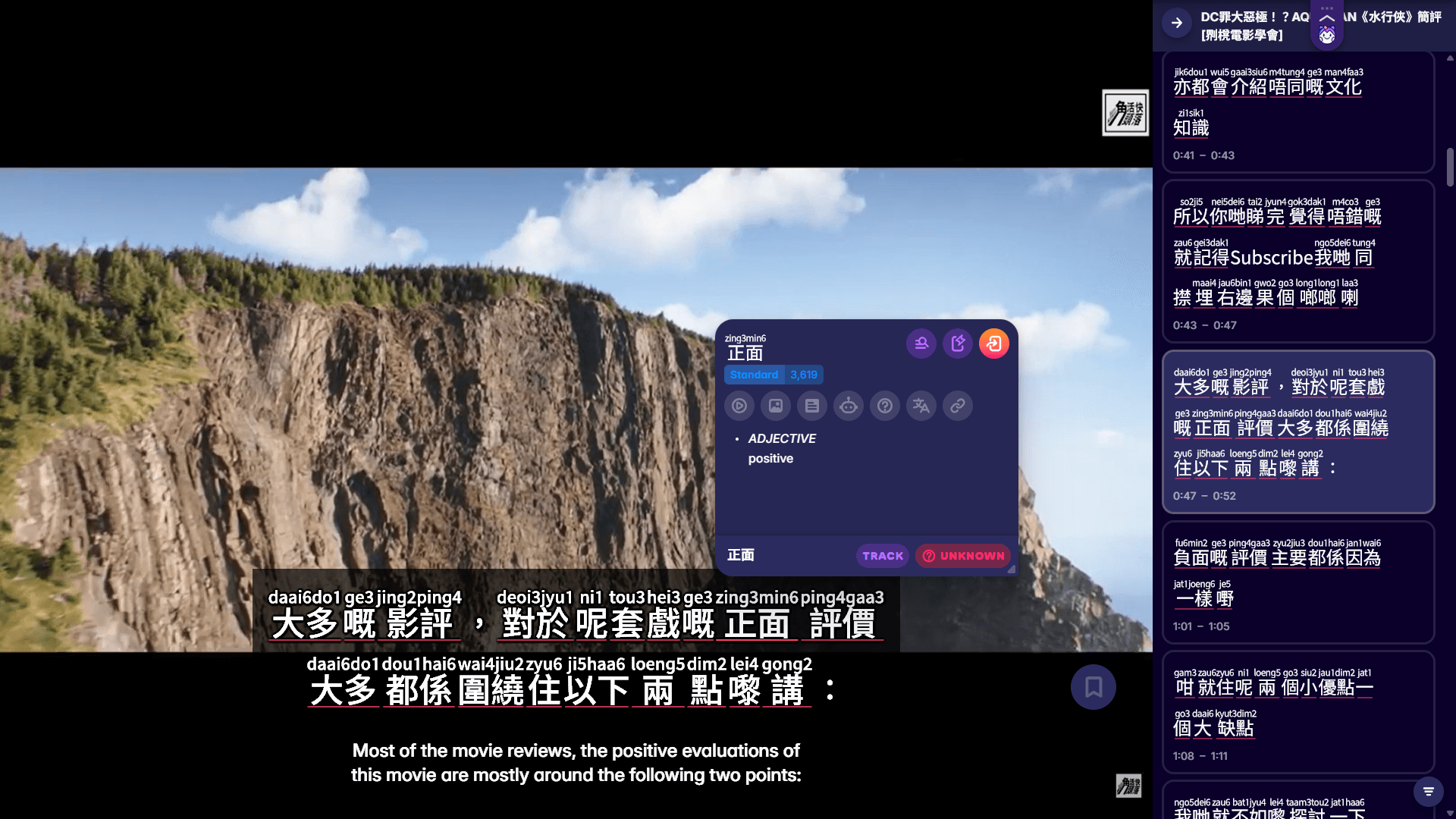
If you want to practice with actual native content, Migaku's browser extension and app let you look up Cantonese words instantly while watching videos or reading articles. Makes the whole immersion thing way more practical since you're not constantly switching to a dictionary. There's a 10-day free trial if you want to check it out.
 ----
## Understanding Cantonese sentence structure isn't just about passing tests
It actually makes speaking way easier because you're not translating word-by-word from English in your head. When you internalize these patterns, you can focus on vocabulary and meaning instead of constantly wondering where words go. You'll also understand native speakers better when you are watching Cantonese dramas, vlogs, movies and others, because you'll recognize the structure of what they're saying, even if you don't know every word.
> If you consume media in Cantonese, and you understand at least some of the messages and sentences within that media, you will make progress. _Period_.
Consistent practice builds the muscle memory you need.
----
## Understanding Cantonese sentence structure isn't just about passing tests
It actually makes speaking way easier because you're not translating word-by-word from English in your head. When you internalize these patterns, you can focus on vocabulary and meaning instead of constantly wondering where words go. You'll also understand native speakers better when you are watching Cantonese dramas, vlogs, movies and others, because you'll recognize the structure of what they're saying, even if you don't know every word.
> If you consume media in Cantonese, and you understand at least some of the messages and sentences within that media, you will make progress. _Period_.
Consistent practice builds the muscle memory you need.