Cantonese Time Expressions: Guide to Tell Time in Cantonese
Last updated: March 22, 2026

Learning how to tell time in Cantonese is one of those fundamental skills that'll come up constantly in real conversations. Whether you're asking when the MTR arrives, making dinner plans, or just trying to figure out what time the dim sum place opens, you need to know how Cantonese time expressions work. Let me walk you through everything from asking what time it is to talking about days, weeks, and all those relative time expressions you should know as a Cantonese learner.
How Cantonese time expressions work
Here's the thing about Cantonese time expressions: they follow a really consistent pattern that's actually easier than English in some ways. The basic structure goes from largest time unit to smallest, which is the opposite of how we do it in English.
When you're telling time in Cantonese, you build it like this: number + 點 (dim2) for hours, then number + 分 (fan1) for minutes. So 3:15 becomes 三點十五分 (saam1 dim2 sap6 ng5 fan1), literally "three o'clock fifteen minutes." The word 點 (dim2) means "point" or "dot," and it's what marks the hour.
The cool part is that Cantonese uses the same number system for time that you'd use for counting anything else. You don't have special time numbers like we do in English with "quarter past" or "half past" (though there are shortcuts for those, which I'll get to). Once you know your Cantonese numbers from 1-60, you're basically set for telling time.
For the 12-hour clock, Cantonese speakers add 上晝 (soeng6 zau3) for a.m. times and 下晝 (haa6 zau3) for p.m. times, though in casual conversation, context usually makes it clear. The 24-hour system is also common, especially for formal schedules and transportation.
Asking for the time in Cantonese
The most common way to ask what time it is in Cantonese is 幾點呀? (gei2 dim2 aa3?), which literally means "how many points?" or "what o'clock?" Super straightforward.
You might also hear 而家幾點? (ji4 gaa1 gei2 dim2?), which adds "now" to the beginning, making it "what time is it now?" Both work perfectly fine in everyday situations.
If you want to be more formal or polite, you can say 請問而家幾點? (cing2 man6 ji4 gaa1 gei2 dim2?), adding 請問 (cing2 man6) which means "may I ask." This is good for asking strangers or in professional settings.
When someone asks you the time, you'd respond with 而家 (ji4 gaa1) meaning "now" followed by the time. So a complete answer might be 而家三點半 (ji4 gaa1 saam1 dim2 bun3), "It's 3:30 now."
How to tell time in Cantonese
Let me break down the essential time vocabulary you'll need. The word for "hour" or "o'clock" is 點 (dim2), and "minute" is 分 (fan1). These are your building blocks.
For "half past," Cantonese uses 半 (bun3), so 3:30 is 三點半 (saam1 dim2 bun3). This is way more common in everyday speech than saying 三十分 (saam1 sap6 fan1) for the full thirty minutes.
The word for "quarter" is 個字 (go3 zi6), literally "the character," but honestly, most people just say 十五分 (sap6 ng5 fan1) for fifteen minutes. You might hear older speakers use quarter expressions, but it's less common than in English.
For "less" or "to" the hour, you use 差 (caa1), which means "lacking" or "short of." So 2:55 can be expressed as 差五分三點 (caa1 ng5 fan1 saam1 dim2), literally "lacking five minutes to three o'clock." Though in practice, most people just say 兩點五十五分 (loeng5 dim2 ng5 sap6 ng5 fan1).
Understanding time of the day expressions
Daily time periods in Cantonese are pretty specific and follow the natural rhythm of the day.
- Morning is 朝早 (ziu1 zou2) or 早晨 (zou2 san4), though 早晨 doubles as a morning greeting. For the general morning period, 上晝 (soeng6 zau3) covers the a.m. hours.
- Afternoon is 下晝 (haa6 zau3), which technically covers from noon until evening.
- If you want to be specific about noon, that's 中午 (zung1 ng5) or 晏晝 (aan3 zau3).
- Evening is 黃昏 (wong4 fan1), though this refers more to dusk or twilight. For the general evening time when people are having dinner and winding down, you'd say 夜晚 (je6 maan5).
- Night, especially late night, is also 夜晚 (je6 maan5) or you can say 深夜 (sam1 je6) for the really late hours.
- Midnight is 半夜 (bun3 je6) or 午夜 (ng5 je6), both work fine.
These expressions get combined with specific times to give context, like 朝早八點 (ziu1 zou2 baat3 dim2) for "8 a.m."
Days of the week in Cantonese
The Cantonese system for days of the week is beautifully simple. The word for "week" is 星期 (sing1 kei4) or 禮拜 (lai5 baai3), and you just add the number of the day.
Cantonese | Jyutping | English |
|---|---|---|
星期一 | sing1 kei4 jat1 | Monday |
星期二 | sing1 kei4 ji6 | Tuesday |
星期三 | sing1 kei4 saam1 | Wednesday |
星期四 | sing1 kei4 sei3 | Thursday |
星期五 | sing1 kei4 ng5 | Friday |
星期六 | sing1 kei4 luk6 | Saturday |
星期日 | sing1 kei4 jat6 | Sunday |
You can also use 禮拜 (lai5 baai3) instead of 星期 (sing1 kei4) for any day. So Monday could be 禮拜一 (lai5 baai3 jat1). Both are equally common, though 星期 might be slightly more standard in Hong Kong.
To ask what day it is, you'd say 今日星期幾? (gam1 jat6 sing1 kei4 gei2?), literally "today is what week number?" The word 幾 (gei2) here means "which" or "what number."
Months and years
Months in Cantonese follow the same numbered pattern.
- The word for "year" is 年 (nin4).
- The word for "month" is 月 (jyut6), and you just put the number in front. January is 一月 (jat1 jyut6), February is 二月 (ji6 jyut6), all the way to December, which is 十二月 (sap6 ji6 jyut6).
- For "day" or "date", you typically use 號 (hou6) or 日 (jat6). Both work, though 號 is more common in Hong Kong Cantonese when talking about calendar dates.
When you're writing or saying dates, Cantonese follows the year-month-day order, which is the opposite of American English but matches the logical big-to-small pattern. So January 15, 2026 would be expressed as 2026年1月15號 (ji6 ling4 ji6 luk6 nin4 jat1 jyut6 sap6 ng5 hou6).
Relative time expressions
These are the time expressions that come up constantly in real conversations.
Cantonese | Jyutping | English |
|---|---|---|
而家 / 宜家 | ji4 gaa1 | Now |
今日 | gam1 jat6 | Today |
琴日 | kam4 jat6 | Yesterday |
聽日 | ting1 jat6 | Tomorrow |
前日 | cin4 jat6 | The day before yesterday |
後日 | hau6 jat6 | The day after tomorrow |
今個星期 | gam1 go3 sing1 kei4 | This week |
上個星期 | soeng6 go3 sing1 kei4 | Last week |
下個星期 | haa6 go3 sing1 kei4 | Next week |
今個月 | gam1 go3 jyut6 | This month |
上個月 | soeng6 go3 jyut6 | Last month |
下個月 | haa6 go3 jyut6 | Next month |
今年 | gam1 nin4 | This year |
舊年 / 去年 | gau6 nin4 / heoi3 nin4 | Last year |
出年 | ceot1 nin4 | Next year |
Common time-related phrases in conversation
Cantonese | Jyutping | English |
|---|---|---|
遲啲 | ci4 di1 | Later / In a while (literally "a bit late") |
啱啱 / 頭先 | ngaam1 ngaam1 / tau4 sin1 | Just now / A moment ago |
成日 | seng4 jat6 | Always / Often (literally "whole day") |
有時 | jau5 si4 | Sometimes |
少 / 好少 | siu2 / hou2 siu2 | Seldom / Rarely |
準時 | zeon2 si4 | On time |
遲 | ci4 | Late |
早 | zou2 | Early |
等陣 | dang2 zan6 | Wait a moment / Later |
How to practice and remember time expressions
The best way to learn Cantonese time expressions is to use them in real situations.
- Try setting your phone or computer to display time in Chinese characters. When you check the time, read it out loud in Cantonese.
- Make it a habit to tell yourself the time in Cantonese throughout the day. When you wake up, when you eat lunch, when you finish work. The number practice alone will help you get faster at constructing time expressions.
- Watch Cantonese TV shows or YouTube videos and pay attention to how people naturally use time expressions in context. You'll notice that casual conversation often drops the 分 (fan1) for minutes or uses shortcuts like 半 (bun3) for half past instead of the full expression.
- Practice asking and answering time questions with a language partner or tutor. The back-and-forth of 幾點呀? (gei2 dim2 aa3?) and responding with the actual time will make it stick way faster than just memorizing vocabulary lists.
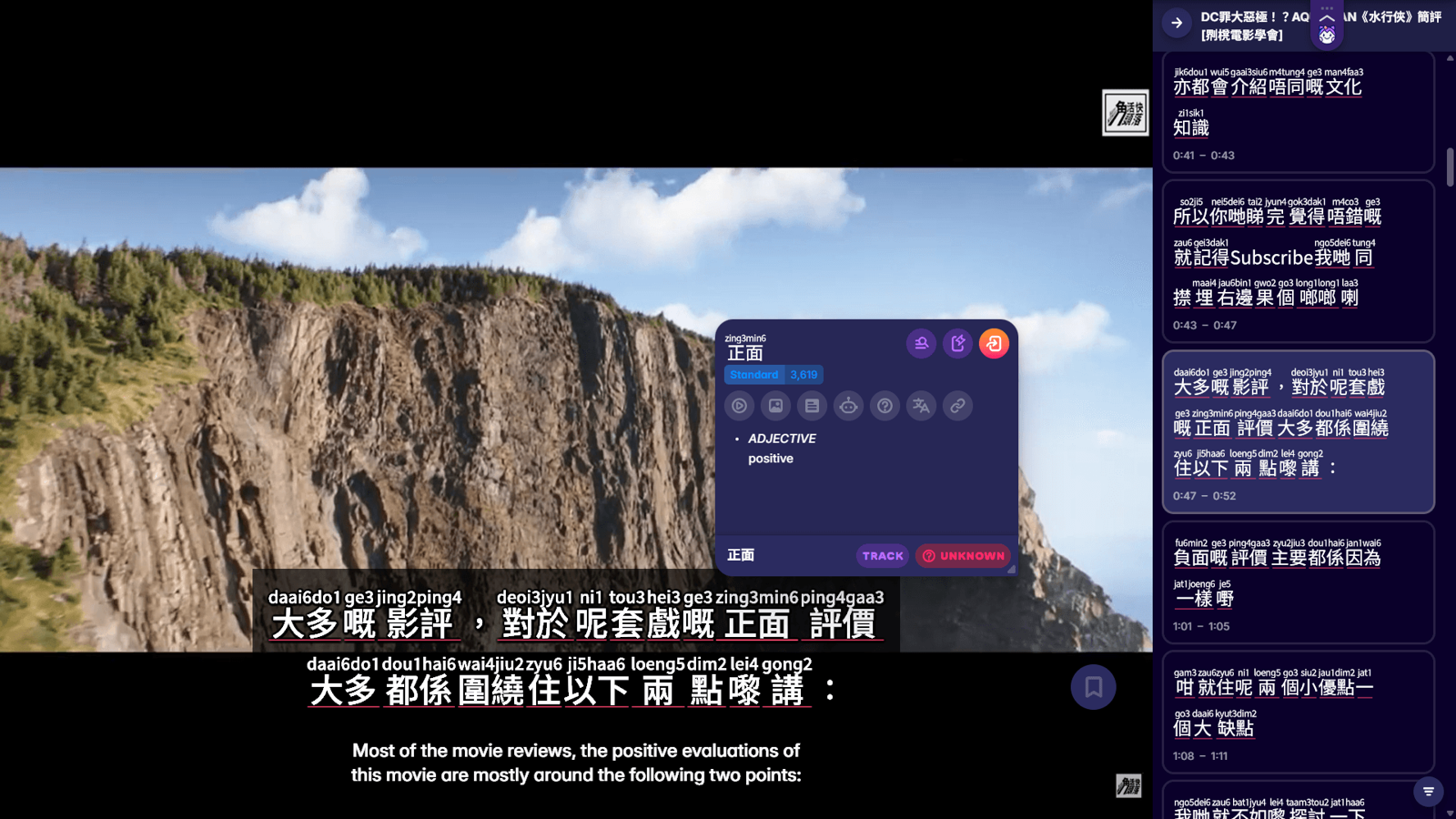
If you want to level up your Cantonese learning with real content, Migaku's browser extension and app let you look up words and phrases instantly while watching Cantonese shows or reading Hong Kong news sites. Makes immersion learning way more practical. There's a 10-day free trial if you want to check it out.
Form sentences for real conversations
Once you've got the basics down, you'll want to combine time expressions with other vocabulary to make complete, natural sentences. For example, 我聽日三點有會議 (ngo5 ting1 jat6 saam1 dim2 jau5 wui6 ji5) means "I have a meeting tomorrow at 3 o'clock." When consuming Cantonese media, you can also pause and mine the sentences whenever there is a time-related expression.
If you consume media in Cantonese, and you understand at least some of the messages and sentences within that media, you will make progress. Period.
The more you practice, the more natural the time expressions will become.