# Chinese Conjunctions: Link Sentences Like a Native Speaker
> Learn how Chinese connectors work to link sentences smoothly. Master conjunctions for causal, sequential, and conditional relationships in Chinese speech.
**URL:** https://migaku.com/blog/chinese/chinese-connectors-linking-words
**Last Updated:** 2026-03-31
**Tags:** fundamentals, grammar
---
Have you ever felt confused about how to connect sentences smoothly in Chinese? You're definitely not alone. When you're learning Chinese, you might notice that your sentences sound choppy or disconnected, kind of like reading a grocery list instead of having an actual conversation. The secret to sounding more natural lies in mastering Chinese connectors, those little linking words that make your speech flow like a native speaker's. Once you get the hang of these, your Chinese will sound way more sophisticated and natural.
----
## What are Chinese connectors and how do they work
Chinese connectors are basically the glue that holds your sentences together. They're words or phrases that **show the relationship between different parts of your sentence or between multiple sentences.** Think of them like traffic signals for your thoughts, directing the listener from one idea to the next in a logical way. Are you showing cause and effect? Adding information? Contrasting two ideas? Each relationship has its own set of connectors.
The [grammar](https://migaku.com/blog/chinese/chinese-grammar-guide) structure usually follows a pattern where the connector appears at the beginning of a clause or between two clauses. Some connectors come in pairs, where you use one word in the first clause and another in the second clause.
----
## Basic Chinese conjunctions you need to know first
Let's start with the simple stuff. These are the connectors you'll hear constantly in everyday Chinese conversation.
- **和 ** (hé) is your basic "and" for connecting nouns. You'd say 我和你 (wǒ hé nǐ) for "you and me." Super straightforward.
- **但是 ** (dànshì) means "but" or "however." This is probably one of the first conjunctions you learned in [Chinese class](https://migaku.com/blog/chinese/best-chinese-textbooks). The meaning is exactly what you'd expect, it introduces a contrast or contradiction to what was just said.
- **因为……所以…… ** (yīnwèi...suǒyǐ...) is your go-to for "because...therefore..." This is a paired connector, and Chinese people use both parts even though in English we'd often just say "because" without the "therefore." You might say 因为下雨,所以我没去 (yīnwèi xiàyǔ, suǒyǐ wǒ méi qù), meaning "because it rained, I didn't go."
- **还是 ** (háishi) works as "or" in questions. When you're asking someone to choose between options, this is your word. 你要茶还是咖啡?(nǐ yào chá háishi kāfēi?) means "Do you want tea or coffee?"
- **或者 ** (huòzhě) is another "or," but you use this one in statements rather than questions. It shows alternatives or possibilities.
----
## Causal connectors that show cause and effect
Causal relationships are important in Chinese. You're constantly explaining why things happen, so these connectors get a serious workout. Beyond the basic 因为……所以…… pattern, you've got some other options.
- **由于 ** (yóuyú) is a more formal way to express "due to" or "because of." You'll see this in news articles or formal writing more than casual conversation.
- **既然……就…… ** (jìrán...jiù...) means "since...then..." or "now that...then..." This connector shows that because a certain condition exists, a logical result follows. Like 既然你来了,就留下吃饭吧 (jìrán nǐ lái le, jiù liúxià chīfàn ba), which means "since you're here, stay for dinner."
----
## Sequential and time-based connectors
When you're telling a story or explaining a process, you need connectors that show the order of events.
- **先……然后…… ** (xiān...ránhòu...) means "first...then..." This is super useful for giving instructions or describing what you did during your day. 我先吃饭,然后去散步 (wǒ xiān chīfàn, ránhòu qù sànbù) means "I first eat, then go for a walk."
- **接着 ** (jiēzhe) means "next" or "then," continuing a sequence of events. It keeps your narrative moving forward.
- **最后 ** (zuìhòu) wraps things up with "finally" or "lastly." Every good story needs an ending, right?
- **同时 ** (tóngshí) shows that two things happen at the same time, meaning "simultaneously" or "at the same time." The meaning here is about parallel actions rather than sequential ones.
- **一……就…… ** (yī...jiù...) expresses "as soon as" or "once...then..." Like 我一回家就睡觉了 (wǒ yī huíjiā jiù shuìjiào le), meaning "as soon as I got home, I went to sleep." This connector shows immediate succession.
----
## Conditional connectors for if-then situations
Conditional relationships are all about hypotheticals and possibilities.
- **如果……就…… ** (rúguǒ...jiù...) is your standard "if...then..." construction. 如果明天下雨,我就不去了 (rúguǒ míngtiān xiàyǔ, wǒ jiù bù qù le) means "if it rains tomorrow, I won't go."
- **要是 ** (yàoshi) is a more casual way to say "if." You'll hear this a lot in spoken Chinese. It has basically the same meaning as 如果 but feels more conversational.
- **除非 ** (chúfēi) means "unless," introducing the only condition under which something would happen. This conjunction adds a specific exception to a general statement.
- **不管 ** (bùguǎn) or **无论 ** (wúlùn) both mean "no matter" or "regardless of." These show that the result stays the same regardless of the condition. Like 不管多累,我都要完成 (bùguǎn duō lèi, wǒ dōu yào wánchéng), meaning "no matter how tired, I must finish."
----
## Progressive and supplementary connectors
These connectors help you build on ideas or add emphasis.
- **而且 ** (érqiě) means "moreover" or "furthermore." It adds additional information that supports or extends what you just said. The sentence flows naturally from one supporting point to another.
- **另外 ** (lìngwài) introduces additional information, meaning "in addition" or "besides." It's similar to 而且 but can feel a bit more like starting a new point.
- **不但……而且…… ** (bùdàn...érqiě...) is the "not only...but also..." pattern. This paired connector emphasizes that there's more to the situation than just the first point. 他不但聪明而且努力 (tā bùdàn cōngmíng érqiě nǔlì) means "he's not only smart but also hardworking."
- **甚至 ** (shènzhì) means "even" or "to the point that," showing an extreme case or surprising addition. It adds emphasis and often introduces something unexpected.
----
## Transitional and contrastive connectors
Sometimes you need to show contrast or shift the direction of your argument.
- **虽然……但是…… ** (suīrán...dànshì...) gives you "although...but..." Yes, Chinese uses both parts even though English typically drops the "but." 虽然很贵,但是质量好 (suīrán hěn guì, dànshì zhìliàng hǎo) means "although it's expensive, the quality is good."
- **然而 ** (rán'ér) is a more formal "however" or "yet." You'll see this in written Chinese more than everyday speech.
- **可是 ** (kěshì) is another way to say "but" or "however," similar to 但是 but slightly more colloquial. The meaning is essentially the same, just a different flavor.
----
## How to practice using Chinese connectors
Reading this article is one thing, but using these connectors naturally is where the real learning happens.
1. Start by picking three to five connectors from different categories and actively try to use them in your Chinese conversations or writing this week. Don't overwhelm yourself trying to master everything at once. Maybe focus on 因为……所以……, 虽然……但是……, and 先……然后…… for starters.
2. Pay attention when you're watching Chinese shows or reading [Chinese content](https://migaku.com/blog/chinese/chinese-reading-practice). Notice which connectors pop up frequently and how native speakers actually use them. Sometimes the grammar book explanation doesn't quite match how people really talk, and immersion helps you catch those nuances.
3. Try writing short paragraphs about your day using different connectors. Force yourself to connect your sentences instead of just listing events. Your writing will sound way more natural, and this practice translates directly to speaking.
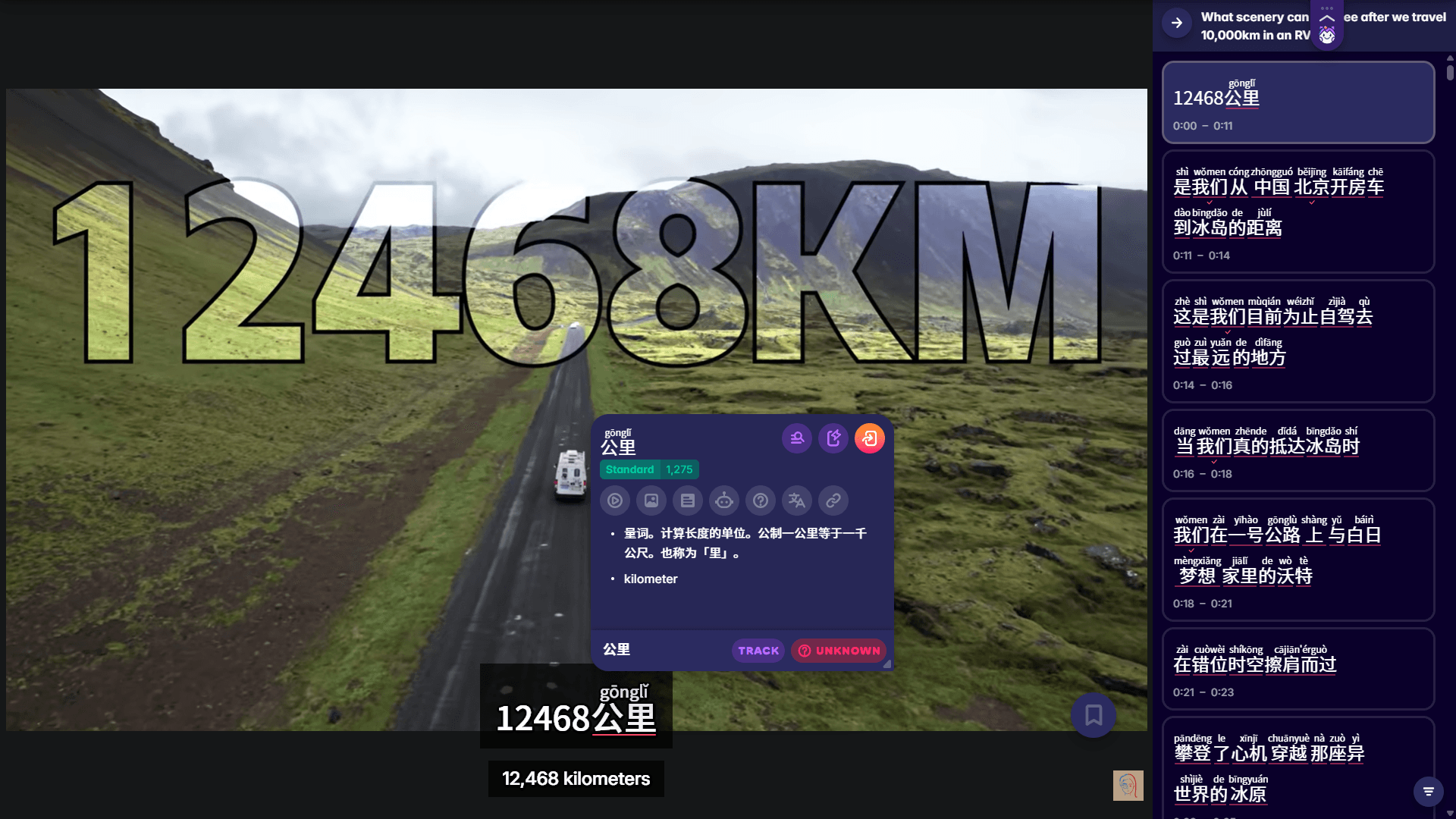
If you want to practice spotting these connectors in real Chinese content, Migaku's browser extension and app let you look up any word instantly while watching shows or reading articles. Makes learning from immersion way more practical. There's a 10-day free trial if you want to check it out.
 ----
## Chinese conjunction words are used more flexibly than you think
The grammar patterns might feel awkward at first, especially those paired connectors, but they'll become second nature with practice. Once you get used to the standard way of using the conjunction words, you can consume more Chinese dramas, browse through social media, and watch vlogs to explore how native speakers use them flexibly. "虽然但是", for example, can be used together as a slang to express hesitation before saying the rest of the sentence. There is so much more for you to explore.
> If you consume media in Chinese, and you understand at least some of the messages and sentences within that media, you will make progress. Period.
The beauty of a language appears in the colorful ways people use it.
----
## Chinese conjunction words are used more flexibly than you think
The grammar patterns might feel awkward at first, especially those paired connectors, but they'll become second nature with practice. Once you get used to the standard way of using the conjunction words, you can consume more Chinese dramas, browse through social media, and watch vlogs to explore how native speakers use them flexibly. "虽然但是", for example, can be used together as a slang to express hesitation before saying the rest of the sentence. There is so much more for you to explore.
> If you consume media in Chinese, and you understand at least some of the messages and sentences within that media, you will make progress. Period.
The beauty of a language appears in the colorful ways people use it.