Chinese Directional Words: Position and Location Words for Better Communication
Last updated: March 20, 2026

Getting around in a Chinese-speaking city can feel overwhelming when you're just starting to learn Chinese. You ask someone for directions, they point and rattle off a string of words, and you're left nodding politely while having no idea which way to actually go. The good news? Chinese directional vocabulary follows pretty logical patterns once you understand the basics. This guide breaks down the essential Chinese directional words you need to navigate real conversations, from cardinal directions to relative positions and the practical phrases that can help you find your way.
Understanding cardinal directions in Chinese
The four cardinal directions in Chinese are surprisingly straightforward compared to some other vocabulary you'll encounter. Each direction gets a single character, and they're used constantly in everyday conversation, not just for navigation.
北 (běi) means north, 南 (nán) means south, 东 (dōng) means east, and 西 (xī) means west. These characters show up everywhere in Chinese, from street names to restaurant names to describing which part of a city you're talking about.
Here's something interesting: Chinese speakers often use cardinal directions where English speakers might use relative directions. Instead of saying "the left side of the building," you might hear "the east side of the building." This makes sense in cities where streets follow a grid pattern, but it can throw you off at first.
When you combine these directions, you get the intermediate directions. Northeast is 东北 (dōngběi), literally "east-north." Southeast is 东南 (dōngnán), southwest is 西南 (xīnán), and northwest is 西北 (xīběi). The pattern is consistent: east or west comes first, then north or south.
You'll see these combinations in place names all the time. The northeastern provinces of China are collectively called 东北 (dōngběi).
Relative position words in Chinese
While cardinal directions are important, relative position words are what you'll use most when asking for or giving directions. These describe where something is in relation to you or another object.
Chinese | Pinyin | English |
|---|---|---|
左 | zuǒ | Left |
右 | yòu | Right |
左边 / 左面 | zuǒbian / zuǒmiàn | Left side |
右边 / 右面 | yòubian / yòumiàn | Right side |
前 | qián | Front / Ahead |
后 | hòu | Back / Behind |
前面 | qiánmian | In front / Ahead |
后面 | hòumian | Behind / In back |
上 | shàng | Up / Above (also used for getting on/onto) |
下 | xià | Down / Below (also used for getting off) |
里 | lǐ | Inside |
外 | wài | Outside |
里面 | lǐmian | Inside |
外面 | wàimian | Outside |
旁边 | pángbiān | Beside / Next to |
对面 | duìmiàn | Opposite / Across from |
中间 | In the middle / Between |
Combine Chinese direction words with location markers
This is where Chinese direction vocabulary gets really practical. You can't just say a direction word by itself in most cases. You need to combine them with other elements to create complete location descriptions.
The suffixes 边 (biān) and 面 (miàn) both mean "side" or "surface," and they're mostly interchangeable in modern Mandarin. Some regions prefer one over the other, but you'll be understood either way. Northern speakers tend to use 边 more, while southern speakers might lean toward 面.
💡Here's a pattern you'll use constantly: (place) + 的 + (direction word) + 边/面.
For example, "to the left of the bank" is 银行的左边 (yínháng de zuǒbian). The 的 (de) particle connects the place to the direction.
You can also stack these. "In front of the building on the left" would be 左边的楼的前面 (zuǒbian de lóu de qiánmian). It sounds clunky in English, but it flows naturally in Chinese.
How to ask for directions
Knowing vocabulary is one thing, but you need sentence structures to ask for help when you're lost. These patterns work in pretty much any situation.
- The most basic question is "Where is (place)?" In Chinese, that's (place) + 在哪里? (zài nǎlǐ?). For example, "Where is the subway station?" is 地铁站在哪里?(dìtiězhàn zài nǎlǐ?). A more polite version adds 请问 (qǐngwèn) at the beginning, which means "may I ask." So 请问,地铁站在哪里?(qǐngwèn, dìtiězhàn zài nǎlǐ?) sounds more courteous.
- If you want to ask how to get somewhere, use 怎么走 (zěnme zǒu), which literally means "how to walk" but really means "how do I get there." The pattern is 去 (place) 怎么走? (qù (place) zěnme zǒu?). "How do I get to the museum?" becomes 去博物馆怎么走?(qù bówùguǎn zěnme zǏu?).
- Another useful pattern asks if something is far: 远不远? (yuǎn bu yuǎn?) or 远吗? (yuǎn ma?). "Is the hospital far?" is 医院远吗?(yīyuàn yuǎn ma?).
- You can ask if you're going the right direction with 这样走对吗? (zhèyàng zǒu duì ma?), which means "Is this the right way?"
How to give directions in Chinese
When someone asks you for directions in Chinese, you'll need these patterns to help them out. Chinese directions tend to be very specific about sequences and landmarks.
- Start with 直走 (zhízǒu), which means "go straight." This is your bread and butter for basic directions. You can add distance or time: 直走五分钟 (zhízǒu wǔ fēnzhōng) means "go straight for five minutes."
- For turns, use 转 (zhuǎn) or 拐 (guǎi), both meaning "turn." 往左转 (wǎng zuǒ zhuǎn) means "turn left" and 往右转 (wǎng yòu zhuǎn) means "turn right." The 往 (wǎng) means "toward" and makes the direction clearer.
- 到 (dào) means "arrive at" or "reach," and it's super common in directions. 到红绿灯 (dào hónglǜdēng) means "when you reach the traffic light." You can chain these together: 一直走到红绿灯,然后往左转 (yìzhí zǒu dào hónglǜdēng, ránhòu wǎng zuǒ zhuǎn) means "go straight until the traffic light, then turn left."
- 过 (guò) means "pass" or "cross." 过马路 (guò mǎlù) means "cross the street." 过桥 (guò qiáo) means "cross the bridge."
- For landmarks, use 看到 (kàndào), meaning "when you see." 看到银行就到了 (kàndào yínháng jiù dào le) means "when you see the bank, you've arrived."
Chinese directional vocabulary in other contexts
Learning directional vocabulary early in your Chinese studies pays off in multiple ways. These words appear constantly in everyday conversation, not just when you're asking for directions.
- Direction words show up in time expressions. 上个月 (shàng gè yuè) means "last month" (literally "up month"), and 下个月 (xià gè yuè) means "next month" (literally "down month"). 上午 (shàngwǔ) is morning and 下午 (xiàwǔ) is afternoon.
- They're used in abstract concepts too. 上网 (shàngwǎng) means "go online" (literally "go up net"). 下载 (xiàzài) means "download" (literally "down load").
- Place names incorporate directions constantly. Beijing (北京 , Běijīng) literally means "northern capital." Nanjing (南京 , Nánjīng) means "southern capital." Understanding the directional components helps you remember and understand place names.
Common mistakes with location words
English speakers make some predictable mistakes when learning chinese directional words. Being aware of these helps you avoid them.
- One big mistake is forgetting the location marker 边 or 面. You can't just say 左 (zuǒ) by itself in most contexts. You need 左边 (zuǒbian) to make it a complete location phrase. Think of it like how English needs "on the left" rather than just "left."
- Another issue is word order. In English, we might say "the store on the left." In Chinese, the direction comes after the place: 左边的商店 (zuǒbian de shāngdiàn). Getting this backwards sounds weird to native speakers.
- Mixing up 在 (zài) and 到 (dào) trips people up. 在 indicates static location (where something is), while 到 indicates movement toward a destination (arriving at). "The bank is on the left" uses 在: 银行在左边 (yínháng zài zuǒbian). "Turn left at the bank" uses 到: 到银行往左转 (dào yínháng wǎng zuǒ zhuǎn).
- Don't confuse 往 (wǎng) with 在 (zài). 往 means "toward" and is used for directions of movement. 往左走 (wǎng zuǒ zǒu) means "walk toward the left."
Anyway, if you want to practice these directional words with real Chinese content, Migaku's browser extension and app let you look up vocabulary instantly while watching shows or reading articles. You can save the direction words you encounter and review them in context. There's a 10-day free trial if you want to check it out.
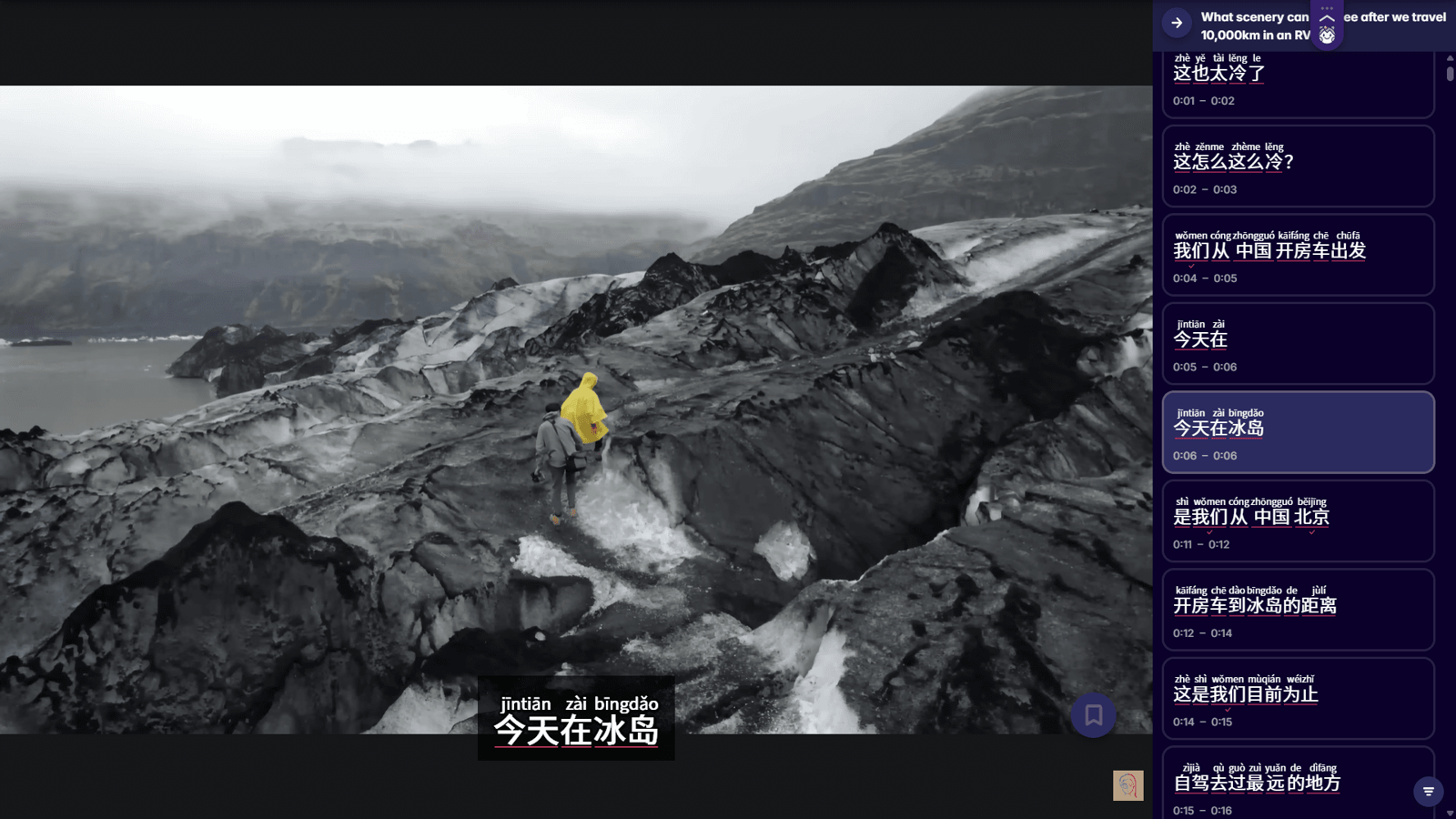
Learn how to ask for and give directions with natural sentences!
A realistic direction dialogue usually covers multiple modes of transport, turns, landmarks, and levels. The best way to master all these words is to observe how native speakers ask for and give directions in media content, which can be a travel vlog, a one-day trip blog, shows, and documentaries. Going through Chinese map apps is another shortcut to learn all the high-frequency directional words.
If you consume media in Chinese, and you understand at least some of the messages and sentences within that media, you will make progress. Period.
Look for manageable ways to learn!🔍