# Chinese Professions Vocabulary: Jobs and Occupations in Mandarin Chinese
> Learn essential Chinese professions vocabulary for talking about jobs and occupations. Includes pinyin, patterns, and practical examples for conversations.
**URL:** https://migaku.com/blog/chinese/chinese-professions-vocabulary
**Last Updated:** 2026-03-02
**Tags:** vocabulary, phrases
---
Learning job and profession vocabulary in Chinese opens up way more than just casual conversation topics. Whether you're planning to work in a Chinese-speaking environment, want to understand what people do for a living when you meet them, or just need to explain your own career, knowing these terms is super practical. Plus, professions come up constantly in everyday Chinese, from TV shows to news articles to small talk. Let's dig into the essential vocabulary you need to talk about jobs and careers in [Mandarin learning](https://migaku.com/learn-chinese).
---
## Understanding the basics of profession vocabulary in Chinese
The foundation of talking about jobs in Chinese starts with a few key words.
1. The most common term you'll encounter is , which means both "work" and "job" depending on context. When someone asks "?", they're literally asking "What work do you do?" This is the standard way to ask about someone's occupation.
2. Another essential word is , which specifically means "profession" or "occupation" in a more formal sense. You'll see this term on forms, official documents, and in professional settings.
3. The word refers to an industry or field of work, which is useful when talking about broader career categories.
Here's the thing about Chinese profession vocabulary. Many job titles follow predictable patterns once you know the basic components.
1. A lot of professions use the suffix , which indicates a skilled professional or master of something.
2. Others use , which roughly translates to "member" or "personnel." Understanding these patterns makes learning new profession terms way easier.
---
## Professional titles with specific patterns
Once you start paying attention, you'll notice that Chinese profession vocabulary follows some pretty consistent patterns.
| Suffix | Chinese Example | English |
| - | - | - |
| **师** | | Lawyer |
| | | Chef |
| | | Hairdresser |
| **员** | | Flight attendant |
| | | Police officer |
| | | Salesperson |
| **家** | | Scientist |
| | | Artist |
| | | Writer |
---
## Common jobs and occupations in Chinese: Doctors, accountants, teachers, etc.
Let's start with the professions that come up most frequently in conversation.
| Chinese | English | Explanation |
| - | - | - |
| | Teacher | One of the first profession words you'll learn. Teachers have significant respect in Chinese culture. You'll also hear it used as a polite way to address someone whose name you don't know, similar to "sir" or "ma'am." |
| | Doctor | The character 医 means "medical" and 生 can mean "person" or "life" in this context. |
| | Nurse | |
| | Dentist | Literally "tooth doctor." |
| | Accountant | You'll encounter this frequently since accounting is a common profession. |
| | Secretary | |
| | Manager | Shows up constantly in workplace contexts and Chinese business dramas. |
| | Engineer | Uses the 师 suffix indicating a skilled professional. |
| | Programmer / Software engineer | Uses the 员 pattern instead of 师. |
| | Architect | Another example of the 师 suffix. |
---
## Service industry and trade professions
The service sector has its own set of vocabulary that's super useful for everyday situations.
| Chinese | English | Explanation |
| - | - | - |
| | Waiter / Server | Literally "service personnel" |
| | Driver | You'll need this if taking taxis or talking about transportation jobs |
| | Shop assistant / Clerk | |
| | Carpenter | |
| | Electrician | The character 工 means "worker" and appears in many manual labor professions |
| | Plumber | |
| | Construction worker | |
| | Farmer | Combines "agriculture" and "people"; reflects China's long agricultural history |
| | Fisherman | Follows the same pattern as 农民 |
---
## Modern and creative professions in Chinese
As Chinese society has evolved, so has the language around newer professions.
| Chinese | English |
| - | - |
| | Designer |
| | Graphic designer |
| | Interior designer |
| | Actor |
| | Singer |
| | Director |
| | Journalist |
| | Photographer |
| | Athlete |
| | Basketball player |
---
## Asking and answering about professions
Knowing how to ask about someone's job is just as important as knowing the vocabulary itself.
1. The most common question is "?", which translates to "What work do you do?"
2. You might also hear "?", which is more formal and means "What is your profession?"
When answering:
1. You can use the pattern "" followed by the profession. For example, "" means "I am a teacher."
2. Alternatively, you can say "" plus the job, like "" for "I work as an accountant."
3. If you want to talk about where you work, you can say "". For instance, "" means "I work at a hospital." This construction is really useful for providing more context about your job.
---
## Professions in different contexts in Mandarin Chinese
The way you talk about professions can change depending on the formality of the situation. In casual conversation, people often use shortened versions or colloquial terms. A doctor might just be called in everyday speech, which is a more informal term than .
Regional variations exist too. What people call certain professions in mainland China might differ slightly from Taiwan or Singapore. A taxi driver might be in mainland China but in Taiwan, even though both refer to the same job.
---
## Building your profession vocabulary strategically
1. When you're learning Chinese profession vocabulary, start with the Chinese word for your job. If you work in tech, prioritize learning , , and related terms. If you're in healthcare, focus on , , and medical specialties.
2. Group professions by their patterns. Learn all the professions together, then tackle the professions, then the professions. This makes it way easier to remember them because your brain can connect related items. You'll start recognizing the patterns naturally when you encounter new profession words.
3. Practice using these terms in full sentences, not just as isolated vocabulary. Instead of just memorizing " means teacher," create sentences like "" meaning "My mom is a teacher." This contextual learning sticks way better than rote memorization.
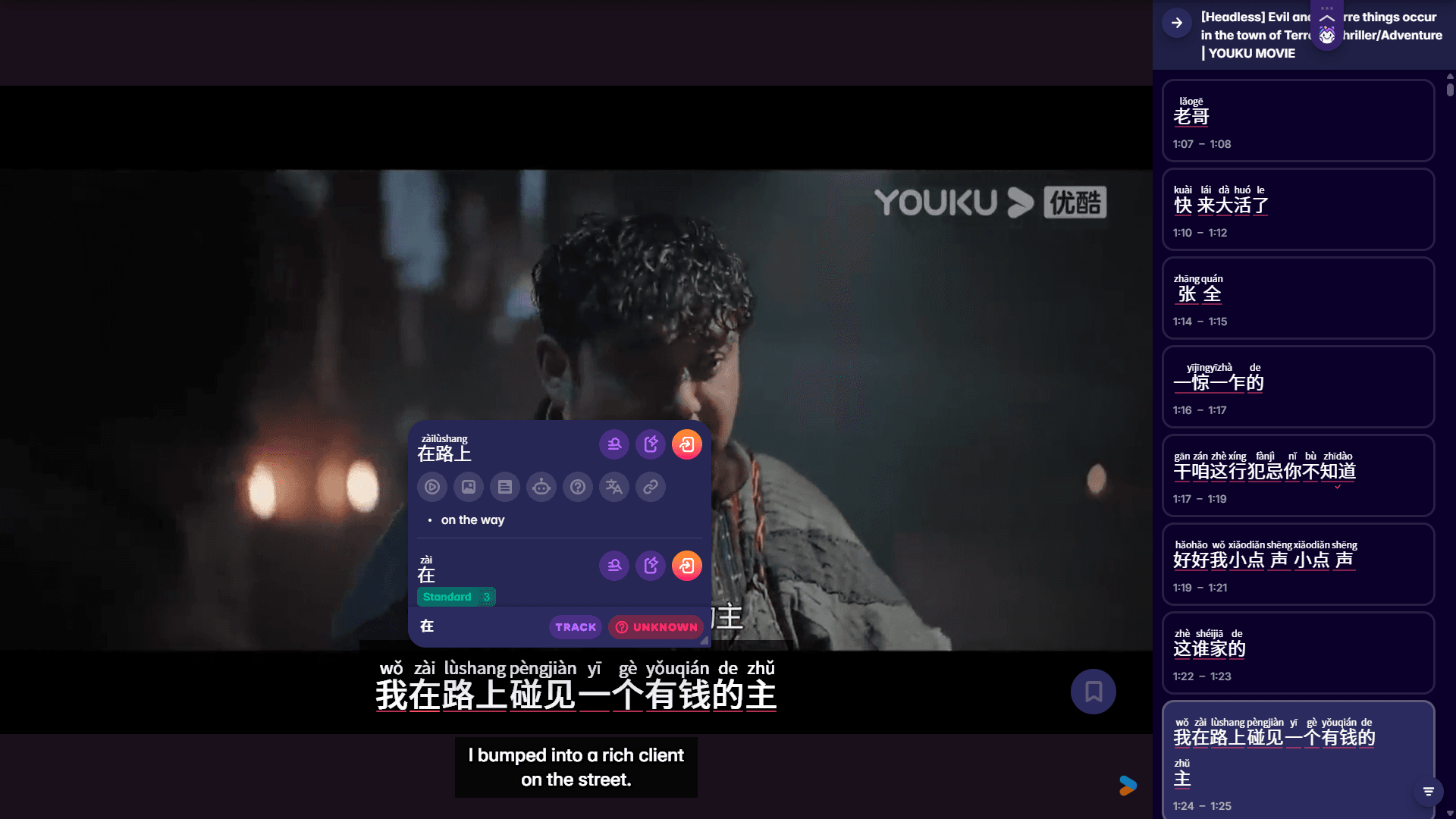
Anyway, if you want to actually practice this vocabulary with real Chinese content and improve your language skills, Migaku's browser extension and app let you look up profession terms instantly while watching shows or reading articles. You can save words directly to your study deck and review them with spaced repetition. There's a 10-day free trial if you want to check it out.
 ---
## Real-world application of profession vocabulary
You'll use profession vocabulary constantly once you start consuming Chinese media. Job titles come up in introductions, character descriptions, and plot points. When watching Chinese shows or reading articles, pay attention to how people [introduce themselves](https://migaku.com/blog/chinese/how-to-introduce-yourself-in-chinese) and their occupations. You'll pick up natural usage patterns that [textbooks](https://migaku.com/blog/chinese/best-chinese-textbooks) don't always cover.
> If you consume media in Chinese, and you understand at least some of the messages and sentences within that media, you will make progress. _Period_.
Discover new words in media!
---
## Real-world application of profession vocabulary
You'll use profession vocabulary constantly once you start consuming Chinese media. Job titles come up in introductions, character descriptions, and plot points. When watching Chinese shows or reading articles, pay attention to how people [introduce themselves](https://migaku.com/blog/chinese/how-to-introduce-yourself-in-chinese) and their occupations. You'll pick up natural usage patterns that [textbooks](https://migaku.com/blog/chinese/best-chinese-textbooks) don't always cover.
> If you consume media in Chinese, and you understand at least some of the messages and sentences within that media, you will make progress. _Period_.
Discover new words in media!