Chinese Sports Vocabulary With Examples for Learners
Last updated: April 2, 2026

Learning Chinese sports vocabulary opens up conversations with millions of fans across China who are absolutely passionate about basketball, football, and traditional sports like table tennis. Whether you're planning to watch a game with Chinese friends, discuss the latest Olympic events, or just want to understand sports commentary in Mandarin, knowing the right terms makes everything more enjoyable. This guide covers essential sports vocabulary in Chinese with practical examples you can start using today.
- Why Chinese sports vocabulary matters in 2026
- Basic Chinese sports terms you need first
- Ball sports in Chinese using 球
- Swimming and water sports vocabulary
- Olympic sports and competition vocabulary
- Traditional Chinese sports you might encounter
- Common verbs for playing different sports
- Talking about sports preferences in Mandarin
- Do I need a measure word before each sport
- Learning sports vocabulary through immersion
Why Chinese sports vocabulary matters in 2026
China has become one of the world's biggest sports markets. The country has an NBA (National Basketball Association) fanbase with over 600 million basketball fans. That's pretty wild when you think about it.
Sports give you natural conversation topics with Chinese speakers. When you can discuss last night's game or share your favorite team, you break through the typical textbook-style exchanges. Plus, sports media in Chinese (commentary, articles, social media posts) gives you tons of immersion material at various difficulty levels.
The vocabulary itself follows logical patterns once you understand the building blocks. Most sport names in Chinese use the word , which means "ball." This makes remembering terms easier than you'd expect.
Basic Chinese sports terms you need first
Before jumping into specific sports, let's cover the foundation. The word for "sport" in Chinese is . You'll see this everywhere.
Here are essential phrases:
Chinese | English |
|---|---|
Sport, exercise | |
Athlete | |
Competition, match, game | |
Team | |
Coach | |
Sports fan | |
To win | |
To lose | |
To score points |
You can use these in simple sentences right away. For example:
I like sports.
This athlete is really good.
Ball sports in Chinese using 球
Most popular ball sports follow a simple pattern: you add a descriptor before . Once you know this pattern, you can guess or construct many sport names.
Basketball vocabulary and phrases
Basketball is , where refers to the basket. Chinese basketball culture is massive, especially in urban areas.
Key basketball terms:
Chinese | English |
|---|---|
To play basketball | |
Basketball court | |
To shoot (the ball) | |
To dunk | |
Three-pointer | |
Free throw | |
Rebound |
Example sentence:
He goes to play basketball every afternoon.
When discussing NBA games, you'll hear commentators use these terms constantly. Chinese basketball commentary has its own flavor, mixing technical terms with excited reactions.
Football and soccer terminology
Here's where English gets confusing, but Chinese is clearer. means football/soccer, where means "foot."
Essential football vocabulary:
Chinese | English |
|---|---|
To play football/soccer | |
Football field | |
Goalkeeper | |
To score a goal | |
Penalty kick | |
Corner kick | |
Yellow card | |
Red card |
Example:
He is a very good football player.
Football has grown tremendously in China over the past decade, with the Chinese Super League attracting international players and coaches.
Tennis words you should know
Tennis is , where means "net." Chinese tennis has produced international stars like Li Na, who won the French Open and Australian Open.
Tennis vocabulary:
Chinese | English |
|---|---|
To play tennis | |
Tennis court | |
To serve | |
Doubles | |
Singles | |
Racket |
Example:
I like to play tennis on weekends.
Other popular ball sports
Chinese | English |
|---|---|
Baseball — 棒 means "stick" or "bat"; not as popular in China as in Taiwan or Japan, but people still recognize it | |
Volleyball | |
Table tennis — mimics the sound of the ball hitting the table; China absolutely dominates this sport at the Olympic level | |
Badminton — literally "feather ball," which makes perfect sense when you think about the shuttlecock; China also excels at badminton internationally | |
Golf — a transliteration of the English word rather than a descriptive term |
Swimming and water sports vocabulary
Swimming is . Unlike ball sports, this one doesn't use the pattern.
Water sports terms:
Chinese | English |
|---|---|
To swim, swimming | |
Swimming pool | |
Diving | |
Breaststroke | |
Freestyle | |
Backstroke | |
Butterfly stroke |
Example:
She goes swimming every morning.
Chinese swimmers have won numerous Olympic medals, especially in women's events. Swimming is taught widely in schools across China.
Olympic sports and competition vocabulary
The Olympics are or . China takes the Olympic Games seriously, consistently ranking in the top three for medal counts.
Useful Olympic vocabulary:
Chinese | English |
|---|---|
Gold medal | |
Silver medal | |
Bronze medal | |
Medal (general) | |
World record | |
Opening ceremony | |
Closing ceremony |
After Beijing hosted the 2008 Summer Olympics and the 2022 Winter Olympics, Olympic vocabulary became even more common in everyday Chinese conversation.
Traditional Chinese sports you might encounter
Beyond international sports, China has traditional sports worth knowing.
Chinese | English |
|---|---|
Martial arts — the general term covering various Chinese martial arts styles | |
Tai Chi — you'll see people practicing this in parks across China every morning | |
Kung Fu — while this technically means "skill achieved through effort," it's commonly associated with Chinese martial arts | |
Dragon boat — dragon boat racing happens during the Dragon Boat Festival and has become an international sport |
Common verbs for playing different sports
Chinese uses different verbs depending on the sport. This trips up learners sometimes.
Chinese Verbs | English | Examples | English |
|---|---|---|---|
To play (for sports involving hitting or striking) | Play basketball | ||
Play tennis | |||
Play badminton | |||
Play golf | |||
To kick (for football/soccer) | Play football/soccer | ||
To run | To run, jogging | ||
To ride | To ride a bicycle |
You can't just use one verb for everything. Each sport has its natural pairing.
Talking about sports preferences in Mandarin
When you want to discuss what sports you like or dislike, these patterns help.
💡 = What sports do you like?
I like...
I don't like...
I like... the most
Example conversation:
- A: (What sports do you like?)
- B: (I like basketball the most. How about you?)
- A: (I like swimming and tennis.)
Do I need a measure word before each sport
Good question. When you're counting sports or talking about "one game" or "two matches," you do need measure words. The general measure word works for most sports activities.
For example:
- = one match
- = two games ( is more formal for events)
But when you're just saying you like a sport or play a sport, you don't need measure words. Just say = "I like basketball."
Learning sports vocabulary through immersion
- Watch Chinese sports commentary on platforms like Youku or Bilibili. The commentators speak quickly and use tons of specialized vocabulary, but you'll pick up the rhythm and common phrases. Basketball games are especially good because the action is fast and repetitive, so you hear the same terms over and over.
- Follow Chinese sports accounts on social media. Weibo has active sports communities discussing everything from NBA games to Olympic events. Reading short posts and comments gives you natural, current usage.
- Sports news articles work well too. They're usually shorter than other news topics and focus on concrete events (who won, what the score was, who performed well). This makes them easier to follow than political or economic news.
- Create themed flashcard decks by sport. Put all basketball vocabulary together, all swimming terms together. This builds stronger associations than random mixing.
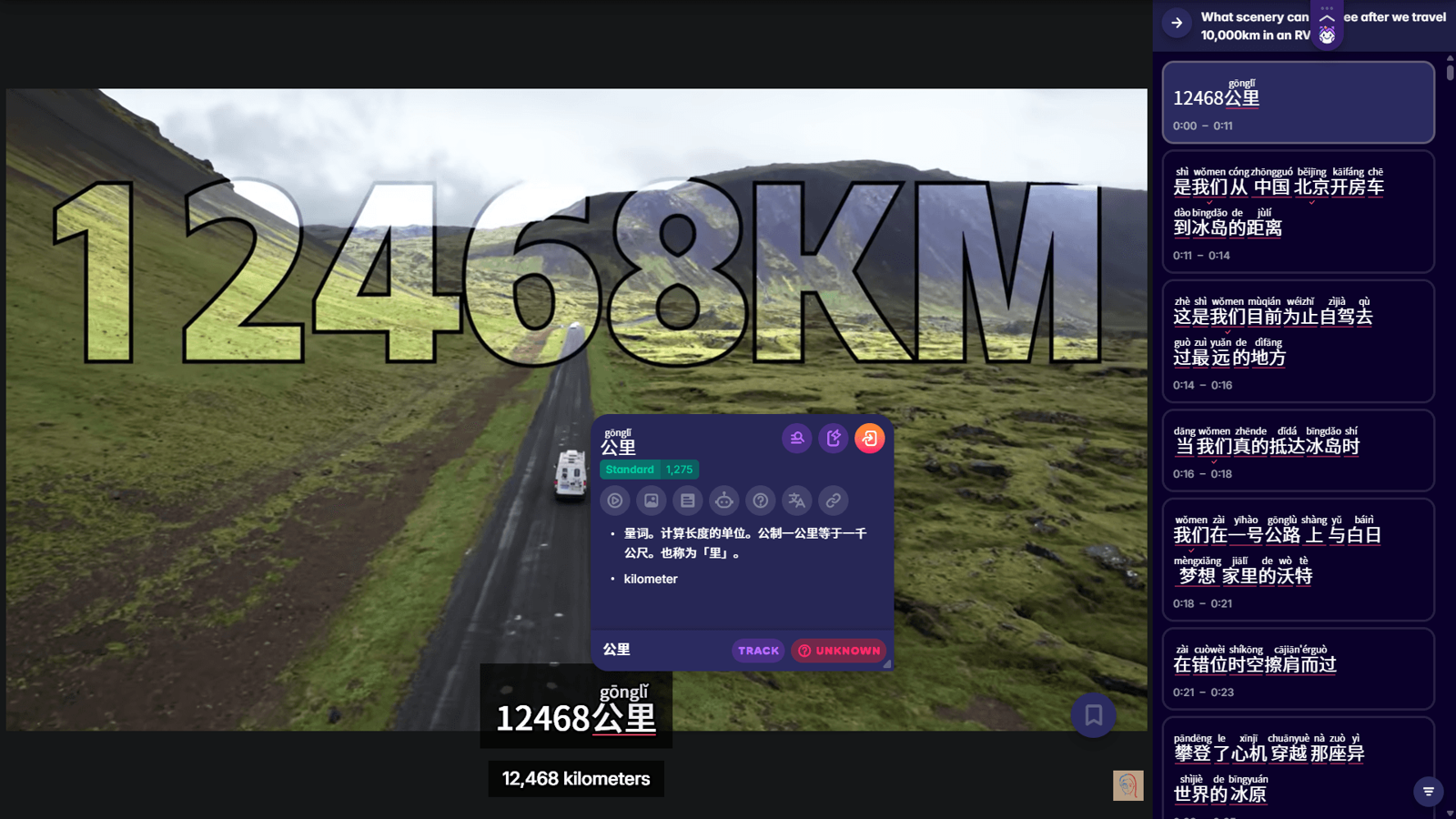
Anyway, if you want to actually use these terms with real content, Migaku's browser extension and app let you look up Chinese words instantly while watching sports commentary or reading articles. Makes immersion learning way more practical. There's a 10-day free trial if you want to check it out.
Start with the sports you actually care about
If you love tennis, focus on tennis vocabulary first. If you enjoy swimming, learn all the swimming phrases. Your genuine interest makes the words stick faster than forcing yourself through sports that bore you. And when you actually enjoy a sport, you will find it less of a chore to watch its matches, videos, and read news articles about it.
If you consume media in Chinese, and you understand at least some of the messages and sentences within that media, you will make progress. Period.
Keep going! !