How Long Does It Take to Learn Cantonese? Timeline for Each Level
Last updated: April 5, 2026

So you want to learn Cantonese? Good choice. It's one of the most distinctive Chinese languages out there, spoken by millions in Hong Kong, Guangdong province, and diaspora communities worldwide. But here's what everyone wants to know upfront: how long is this actually going to take? The answer depends on your goals, your background, and how much time you can realistically put in. Let me break down what you can expect at each level, from absolute beginner to conversational fluency.
How long does it take to learn Cantonese
Here's the thing: the Foreign Service Institute (FSI) classifies Cantonese as a Category IV language for English speakers. That means they estimate around 2,200 hours of study to reach professional working proficiency. But that's just a baseline, and it doesn't tell the whole story.
Your timeline will vary massively based on a few factors.
- Are you learning just to speak, or do you want to read and write Chinese characters too?
- Do you already know Mandarin or another tonal language?
- Are you studying 30 minutes a day or 3 hours?
These variables can shift your timeline from 2 years to 5 years or more.
Most people aren't aiming for FSI's "professional working proficiency" anyway. You might just want to chat with family, watch Hong Kong movies without subtitles, or order food confidently during your next trip. Different goals mean different timelines.
Beginner level: 3 to 6 months
At the beginner stage, you're building your foundation. This means learning basic greetings, numbers, essential vocabulary, and getting your head around those famous Cantonese tones.
With consistent daily practice (around 30 minutes to 1 hour), most English speakers can reach a basic conversational level in 3 to 6 months. You'll be able to introduce yourself, ask simple questions, order food, and handle basic transactions.
The tone challenge
Cantonese is a tonal language with six main tones (some linguists argue for seven or nine, but six is the standard teaching model). This is actually more complex than Mandarin, which has four tones. Each tone changes the meaning of a word completely.
For example, the syllable "si" can mean different things depending on the tone: "teacher," "to try," "time," "market," "history," or "yes." Pretty wild, right?
The good news? Your ear adapts faster than you think. After a few weeks of focused listening practice, you'll start hearing the differences. After a few months, you'll start producing them more accurately. Don't expect perfection at this stage, native speakers are usually forgiving with pronunciation as long as you're in the ballpark.
Learning tools for beginners
At this stage, you need to focus on listening and speaking. Spaced repetition systems like Anki are perfect for drilling vocabulary and tones. Create or download decks that include audio from native speakers, not just text.
Jyutping is the romanization system for Cantonese, and it's incredibly helpful when you're starting out. It shows you how to pronounce words and includes tone markers (numbers 1 through 6).
Intermediate level: 6 months to 2 years
Once you've got the basics down, the intermediate stage is where things get interesting. You're expanding your vocabulary significantly, learning more complex grammar patterns, and starting to have actual conversations beyond scripted dialogues.
At this level, you might understand 1,000 to 3,000 words. You can talk about your daily life, express opinions (even if simply), and follow conversations on familiar topics. You're probably still missing a lot when watching Cantonese movies or TV shows, but you catch enough to follow the general plot.
Hong Kong and Cantonese learning
If you're learning Cantonese, Hong Kong is probably on your radar. The city is the cultural hub for Cantonese media, from TVB dramas to Cantopop to news broadcasts. Consuming media from Hong Kong gives you exposure to natural speech patterns, slang, and cultural context.
One challenge here is that Hong Kong Cantonese includes a lot of English loanwords and code-switching. You'll hear people say things like "send個email比我" (send me an email) or "今日好happy" (I'm very happy today). This can be confusing at first, but it also makes the language more accessible in some ways.
Building conversational skills
At the intermediate level, you need conversation practice with real people. Language exchange apps, tutors, or local Cantonese-speaking communities are essential. You can't get fluent just from textbooks and apps.
This is also when you should start thinking seriously about immersion content. Watch Cantonese YouTube channels, listen to podcasts, follow Hong Kong news sources. The more you expose yourself to natural speech, the faster you'll progress.
Advanced level: 2 to 4 years
Getting to an advanced level means you can handle most everyday situations comfortably, discuss abstract topics, and understand most media content without subtitles. Your vocabulary is probably in the 5,000 to 8,000 word range.
At this stage, you're refining your pronunciation, learning more nuanced vocabulary, and picking up slang and colloquialisms that make you sound more natural. You can joke around in Cantonese, understand wordplay, and catch cultural references.
The reading and writing challenge
Learning to read and write Chinese characters adds significant time to your journey. There are thousands of characters to learn, and while Cantonese and Mandarin share most of them, there are some Cantonese-specific characters used in informal writing.
Spaced repetition is your best friend here too. Apps that teach characters in context, rather than in isolation, help you remember them better and understand how they're actually used.
Fluent level: 4+ years
True fluency, where you can speak Cantonese as naturally as English in virtually any situation, typically takes 4 to 6 years of consistent study for most English speakers. Some people get there faster with intensive immersion (like moving to Hong Kong), while others take longer with casual study.
At this level, you understand regional accents, can switch between formal and casual registers, and rarely need to pause to think about grammar or vocabulary. You might still make occasional mistakes, but you communicate effectively and confidently.
Factors that speed up your language learning progress
Your timeline isn't set in stone. Here are things that can accelerate your learning:
Previous language learning experience. If you've already learned another language to a high level, you understand the process. You know how to study effectively, you're comfortable with ambiguity, and you have realistic expectations.
Immersion environment. Living in Hong Kong, Guangzhou, or another Cantonese-speaking area is the fastest way to improve. You're forced to use the language daily, you hear it constantly, and you pick up natural patterns through osmosis.
Study intensity. Obviously, studying 2 hours a day gets you further than 20 minutes a day. But consistency matters more than occasional marathon sessions. Daily practice, even if brief, builds habits and keeps the language fresh in your mind.
Quality of resources. Using well-designed courses, working with good tutors, and consuming engaging content all make a difference. Boring textbooks that don't reflect real speech will slow you down.
Motivation and goals. If you're learning Cantonese to connect with family, you'll probably stick with it longer than someone who's just casually interested. Clear, personal motivation carries you through the frustrating plateaus.
The best way to improve Cantonese proficiency
There's no single perfect method, but the most effective approach combines several elements.
- You need structured learning (a course or textbook that teaches grammar and core vocabulary systematically), active practice (speaking with tutors or language partners), and immersion (consuming media and content you actually enjoy).
- Spaced repetition systems help you retain vocabulary long-term. Instead of cramming words and forgetting them next week, SRS algorithms show you words right before you're about to forget them, strengthening your memory efficiently.
- Language learning works best when you're engaged with real content. Textbook dialogues about buying train tickets are fine for basics, but you'll make faster progress by watching shows you care about, reading news on topics that interest you, and having conversations about things that matter to you.
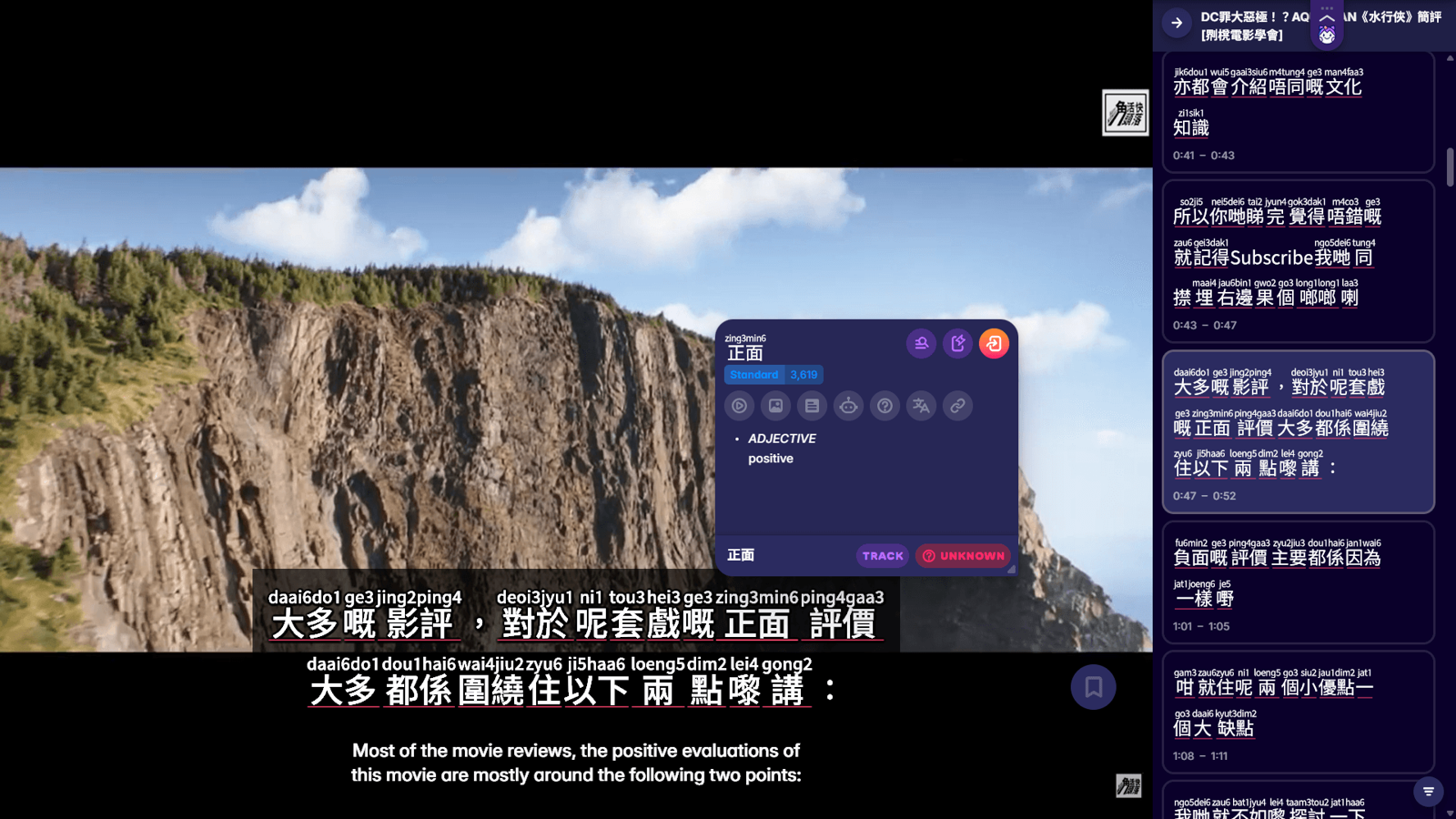
Speaking of consuming media, if you're serious about learning through immersion, Migaku's browser extension and app let you look up Cantonese words instantly while watching YouTube videos or reading articles. You can save words directly to your spaced repetition decks without breaking your flow. There's a 10-day free trial if you want to see how it works with real content.
FAQs
No matter what your study plan is, learning Cantonese takes time
However, every hour you invest opens up new connections, media, and experiences. Whether you're in it for family connections, career opportunities, or just because you love Hong Kong cinema, the journey is worth it.
If you consume media in Cantonese, and you understand at least some of the messages and sentences within that media, you will make progress. Period.
The best time to start was yesterday. The second best time is today.☀️☕