Best Way to Learn Japanese in 2026: What Actually Works
Last updated: April 27, 2026

So you want to learn Japanese? Pretty cool. Whether you're into anime, planning a trip to Tokyo, or just fascinated by the language, you're probably wondering what actually works in 2026. I'm going to walk you through what gets results based on how people are successfully learning Japanese right now. We'll cover everything from the absolute basics like hiragana and katakana to building real conversational skills. No fluff, just what works.
- Starting with the Japanese writing system
- The 80/20 rule for Japanese learning
- Best apps and tools for vocabulary and kanji
- Japanese grammar: Building your foundation
- Textbooks: Learn basic Japanese as a beginner
- Immersion: The best way to learn Japanese
- Using free resources to learn Japanese online
- Speaking practice and tutors
- Pronunciation: Pronounce the Japanese sounds right early
- Creating your Japanese language learning schedule
Starting with the Japanese writing system
You can't really study Japanese without dealing with its writing system. Japanese uses three scripts: hiragana (ひらがな), katakana (カタカナ), and kanji (漢字).
- Hiragana is your first stop. It's a phonetic alphabet with 46 basic characters that represent all the sounds in Japanese. You'll see it everywhere, and honestly, you can learn the whole thing in a weekend if you push yourself. Most beginner resources start here because you need hiragana to read anything.
- Katakana uses the same sounds as hiragana but looks different. Japanese uses it mainly for foreign words, like コーヒー (koohii) for coffee or コンピューター (konpyuutaa) for computer. Learn this right after hiragana. Together, hiragana and katakana are called kana, and they're your foundation.
- Kanji is where things get interesting. These are the Chinese characters that Japanese borrowed centuries ago. There are thousands of them, and yes, you need to learn a bunch. The Japanese government lists about 2,136 "daily use" kanji that educated adults should know. Sounds scary, but here's what nobody tells beginners: you don't need all of them to start reading real content. The most common 500 kanji cover a huge chunk of everyday text.
The 80/20 rule for Japanese learning
You've probably heard of the Pareto principle. In Japanese, it means focusing on the 20% of material that gives you 80% of results.
- For kanji, that means prioritizing the most frequent characters first. Learning kanji like 日 (hi, sun/day), 本 (hon, book/origin), and 人 (hito, person) gives you way more mileage than obscure characters you'll rarely see. Apps like WaniKani structure their curriculum around frequency, which is smart.
- For vocabulary, the same applies. The top 1,000 most common Japanese words let you understand a massive portion of everyday conversation. Focus there before worrying about specialized vocab.
- For grammar, master the core sentence structures and verb conjugations before diving into advanced literary forms. You'll use the basic past tense (食べた, tabeta, ate) constantly, but some obscure classical grammar point? Maybe never.
Best apps and tools for vocabulary and kanji
Let's talk about the apps that actually work in 2026.
- Anki remains the king for spaced repetition. It's free (except on iOS), and you can find nearly 1,000 free decks for Japanese. The algorithm shows you flashcards right before you'd forget them, which is scientifically proven to lock information into long-term memory. You can drill vocabulary, kanji, even full sentences. The learning curve is steep, but it's worth it.
- WaniKani is purpose-built to teach you kanji and vocabulary through mnemonics and spaced repetition. It takes you from zero to about 2,000 kanji over a year or two if you're consistent. The mnemonics are sometimes goofy, but they stick in your brain. There's a subscription cost, but many learners swear by it. They offer a free trial for the first three levels.
- Bunpro handles grammar the same way WaniKani handles kanji. You learn grammar points, then review them in spaced intervals. It explains things clearly and links to multiple textbook explanations if you want deeper dives. Really helpful for drilling conjugations and sentence patterns until they become automatic.
- HelloTalk and iTalki connect you with native speakers. HelloTalk is more like a language exchange social network (free), while iTalki lets you book one-on-one lessons with tutors (paid, but affordable). Both are solid for getting real conversation practice.
Japanese grammar: Building your foundation
Japanese grammar works differently from English. The verb comes at the end of sentences, particles mark grammatical relationships, and there's no future tense (you use context instead).
Start with these core concepts:
- Particles like は (wa), が (ga), を (wo), に (ni), and で (de) are tiny words that tell you what role each word plays in a sentence. They're confusing at first because English doesn't really have an equivalent. You just have to see them in action hundreds of times.
- Verb conjugation matters a lot. Japanese verbs change form to show tense, politeness, negation, and more. The good news? There are only two irregular verbs: する (suru, to do) and 来る (kuru, to come). Everything else follows patterns. Learn the te-form (て形) early because you'll use it constantly.
- Politeness levels are built into the language. You'll start with です/ます (desu/masu) polite forms as a beginner, which is appropriate for most situations. Casual forms come later.
What's the best way to learn Japanese grammar? Honestly, you need a mix. A good textbook gives you structured explanations, but you also need to see grammar in real contexts through immersion. Drilling with an app like Bunpro helps make conjugations automatic.
Textbooks: Learn basic Japanese as a beginner
Here's my take: textbooks are useful for beginners, but don't get stuck in them forever.
Genki is the most popular textbook series for a reason. Genki I and II take you from zero to intermediate (roughly N5 to N4 level). The explanations are clear, the exercises are decent, and it's widely used, so you'll find tons of supplementary resources online. Each chapter introduces new vocabulary, kanji, and grammar points in a logical order.
Other solid options include Minna no Nihongo (more grammar-focused, less English explanation) and Japanese From Zero (very beginner-friendly, maybe too slow for some learners).
But here's the thing about textbooks: they're training wheels. Use them to build your foundation, but transition to real content as soon as possible. Textbook Japanese sounds stilted compared to how people actually talk.
Immersion: The best way to learn Japanese
You want to know what separates people who get fluent from people who stay stuck at beginner level forever? Immersion.
- Passive immersion means having Japanese playing in the background while you do other stuff. Podcasts, music, Netflix shows with Japanese audio. You're training your brain to recognize the sounds and rhythm of the language. Does it work by itself? No. But it helps.
- Active immersion is where the magic happens. This means engaging with Japanese content where you're actively trying to understand. Watch anime without subtitles (or with Japanese subtitles once you know some kanji). Read manga with a dictionary handy. Listen to podcasts for learners and actually focus on what they're saying.
The best immersion content for beginners:
- Anime is genuinely useful, despite what some people say. Yes, the language can be exaggerated, but you're hearing natural pronunciation, picking up common phrases, and staying motivated. Shows like Shirokuma Cafe or Nichijou use relatively simple, everyday Japanese.
- Podcasts designed for learners are perfect. Check out JapanesePod101 or Nihongo con Teppei for Beginners. They speak slowly and clearly, and you can replay sections until you get it.
- Netflix has a decent Japanese catalog now. Turn on Japanese audio and subtitles. You can use browser extensions to look up words in the subtitles, which is incredibly helpful.
- Manga is fantastic once you know hiragana, katakana, and some basic kanji. Yotsuba&! is famous as a learner-friendly manga because the main character is a kid, so the language is simpler.
Using free resources to learn Japanese online
What's the best way to learn Japanese for free? You've got more options than ever in 2026.
- YouTube has complete beginner courses now. Channels like Japanese Ammo with Misa, Cure Dolly (unique grammar explanations), and Kaname Naito offer hundreds of hours of free lessons. The quality is honestly better than some paid courses.
- NHK News Web Easy provides real news articles rewritten in simple Japanese with furigana (hiragana readings above kanji). Perfect for intermediate learners who want to read real content.
- Reddit communities like r/LearnJapanese have tons of free resources, advice, and people sharing what worked for them. Did best way to learn Japanese Reddit discussions help? Actually, yeah. You'll find honest reviews of resources and methods from people actually learning.
Speaking practice and tutors
You can study vocabulary and grammar all day, but if you never speak, you won't become conversational. Speaking practice needs to start early, even when you are not yet good at the language.
- Online lessons with native speakers through platforms like iTalki are incredibly effective. You can find tutors for $10-15 per hour, and they'll correct your mistakes in real-time, answer questions, and give you structured conversation practice. Even one lesson per week makes a huge difference.
- Language exchange partners through HelloTalk or Tandem are free alternatives. You help someone with English, they help you with Japanese. The quality varies, but it's better than nothing.
Some learners hire a tutor just for the first few months to build good pronunciation habits and get comfortable speaking. Others wait until they're intermediate. Both approaches work, but earlier is generally better.
Pronunciation: Pronounce the Japanese sounds right early
Japanese pronunciation is actually pretty straightforward compared to English. There are only five vowel sounds, and they're consistent. The tricky parts:
- Pitch accent exists in Japanese, but most learners ignore it at first. Tokyo dialect uses pitch (high or low) to distinguish words, like 橋 (hashi, bridge) versus 箸 (hashi, chopsticks). Native speakers will usually understand you from context even if your pitch is wrong, but learning it helps you sound more natural.
- Long vowels matter. おばさん (obasan, aunt) and おばあさん (obaasan, grandmother) are different because of that long "a" sound. Listen carefully to native speakers and try to match the length.
- The "r" sound in Japanese is between an English "r" and "l". It's more like a quick tap of your tongue. Practice words like りんご (ringo, apple) until it feels natural.
Watch native content with subtitles and repeat what you hear. Shadowing (speaking along with audio in real-time) is super effective for pronunciation and rhythm.
Creating your Japanese language learning schedule
Here's a realistic study plan that actually works:
Daily (30-60 minutes minimum):
- 15-20 minutes of Anki reviews for vocabulary and kanji
- 15-20 minutes of grammar study (textbook or Bunpro)
- 20-30 minutes of immersion (anime, podcast, reading)
Weekly:
- 1-2 conversation sessions with a tutor or language partner
- Review and learn new kanji (aim for 5-10 new kanji per week as a beginner)
- One longer immersion session (watch a full episode or read a manga chapter)
Monthly goals:
- Complete one textbook chapter
- Learn 100-150 new vocabulary words
- Finish one full manga volume or anime series
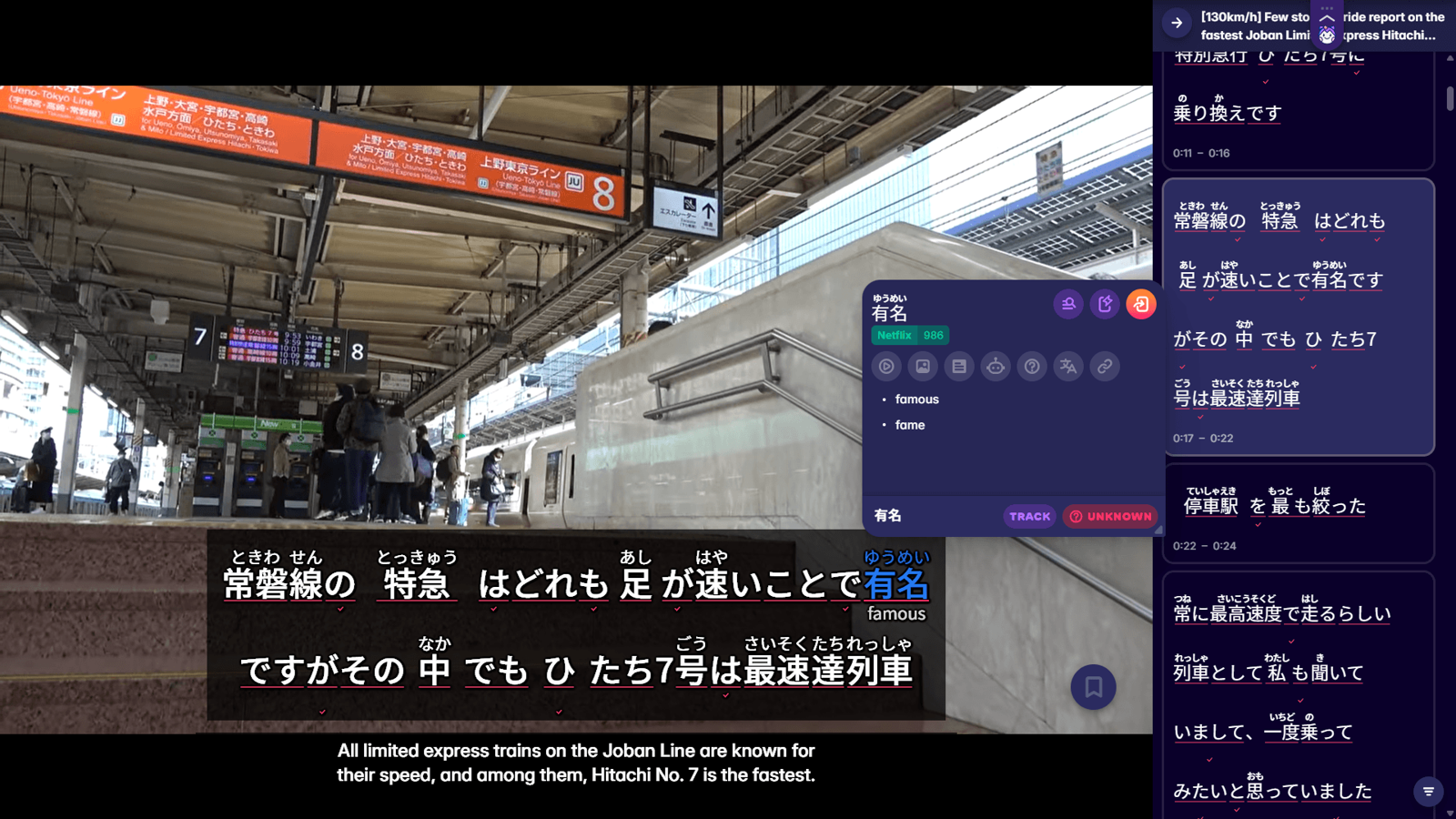
Anyway, if you want to make immersion learning way more practical in your schedule, Migaku's browser extension and app let you look up Japanese words instantly while watching shows or reading articles. You can create flashcards directly from content you're consuming, which beats manually making cards any day. There's a 10-day free trial if you want to check it out.
Motivation crashes are normal when learning a language
You'll have weeks where Japanese feels impossible and you don't want to study. That's fine. The key is having systems that keep you going even when motivation is low. Keep the barrier to immersion low by having Japanese content ready to go. Join online communities where you can share progress and get encouragement. Track your study streak and try not to break it.
Learning Japanese opens up a whole world. You can consume Japanese media in its original form, travel with confidence, make Japanese friends, or even work in Japan. The effort is worth it.
If you consume media in Japanese, and you understand at least some of the messages and sentences within that media, you will make progress. Period.
Plateaus are temporary. Adjust, and keep going!🏃