# Japanese Grammar N1: Complete Guide on 文法 for JLPT N1 Success
> There are 200 Japanese grammar N1 points you need for JLPT N1. Get study tips, grammar lists, and examples for formal expressions, kanji, and vocabulary.
**URL:** https://migaku.com/blog/japanese/japanese-grammar-n1-complete-guide
**Last Updated:** 2026-03-02
**Tags:** resources, discussion, deepdive
---
So you've decided to tackle JLPT N1. That's pretty ambitious, and honestly, the [grammar](https://migaku.com/blog/japanese/japanese-sentence-structure) can feel overwhelming at first. The N1 level tests your ability to [understand Japanese](https://migaku.com/learn-japanese) used in a wide variety of circumstances, including formal writing, academic contexts, and nuanced expressions that native speakers use. This guide breaks down all the grammar points you need to know, how they differ from lower levels, and practical ways to study them without losing your mind.
---
## Overview: What makes N1 grammar different from N2 and N3
The jump from N2 to N1 is genuinely tough. While N3 focuses on everyday conversation and N2 introduces more formal patterns, N1 grammar points show up primarily in written Japanese, news articles, academic papers, and formal speeches. You'll encounter expressions that convey subtle nuances in cause and effect, hypothetical situations, and degrees of certainty that just don't exist at lower levels.
Here's the thing: N1 grammar isn't necessarily harder to understand conceptually. The difficulty comes from **how rarely these patterns appear in casual conversation.** You might watch hours of anime or YouTube videos and never hear some N1 grammar points because they're reserved for specific contexts. That's why the listening test includes business settings where and show up extensively. The situations test whether you can follow [formal](https://migaku.com/blog/japanese/japanese-respectful-language-sonkeigo) workplace discussions, academic lectures, and news reports.
Most N2 grammar focuses on connecting ideas and expressing your thoughts clearly. N1 takes this further by testing whether you can grasp sophisticated written arguments and formal spoken Japanese that educated native speakers use in professional settings.
---
## The N1 grammar list breakdown with examples
The JLPT N1 exam tests around 200 distinct grammar points. Yeah, that's a lot. But before you panic, remember that many of these patterns follow similar structures or build on grammar you already know from N2.
The grammar points fall into several categories.
You've got expressions for indicating sources of information like 〜によると (according to) and (depending on). There are patterns for showing strong emphasis or contrast, hypothetical constructions that express "if only" or "provided that," and formal connectors used in written arguments.
Some of the most common N1 grammar patterns include (cannot help but), (nothing is better than), (with, by means of), and (combined with). These aren't phrases you'd use chatting with friends, but they appear constantly in newspapers and formal writing.
The list also includes expressions for stating reasons and causes at a formal level, like (because, due to) and (triggered by). You'll need to recognize patterns that show the speaker's attitude or judgment, such as (although) and (unique to, special to).
---
## Understanding nuanced expressions and formal patterns in the language proficiency test
N1 grammar gets really specific about expressing subtle differences in meaning.
Take **cause and effect** expressions. While N2 teaches you and , N1 introduces variations like (precisely because) and (for the purpose of). These aren't interchangeable. Each carries a different level of formality and implies different relationships between cause and effect.
**Hypothetical** expressions at the N1 level go way beyond simple "if" statements. You'll encounter (if one could), which suggests doing something that's probably impossible or inadvisable. There's (even if), expressing that doing something won't change the outcome. And warns that if something happens, bad consequences will follow.
The **formal and academic patterns** can trip people up because they sound stiff and old-fashioned. Expressions like (must not) appear on warning signs and in regulations. (even, not even) shows up in emphatic written statements. You need to recognize these even if you'd never use them in conversation.
**Written Japanese** at the N1 level also uses specific connectors that link ideas in essays and articles. Patterns like (on the other hand), (while, on the flip side), and (contrary to) help structure arguments and present contrasting information.
---
## How kanji and vocabulary integrate with JLPT N1 grammar
Here's something people don't talk about enough: you can't separate N1 grammar from kanji and vocabulary. Many grammar patterns use specific kanji that carry meaning beyond just the grammatical function.
When you see (extremely), the kanji means "extreme" or "pole." Understanding this helps the grammar stick.
The N1 exam expects you to know around **2,000 kanji** and **10,000 vocabulary** words. That vocabulary knowledge directly supports your grammar comprehension because many N1 patterns incorporate specific verbs, nouns, or adjectives.
The pattern (in accordance with) uses the verb , which you need to know independently.
Some grammar points are actually set phrases that combine multiple words. (to be compelled to) includes the noun (unavoidable circumstances). If you only memorize the pattern mechanically without understanding the component words, you'll struggle to remember it or use it correctly.
The vocabulary also determines which grammar patterns work together. Certain expressions collocate with specific types of nouns or verbs. Learning these natural combinations matters more than just memorizing isolated grammar rules.
---
## Study tips that work for level N1 preparation
Okay, so how do you actually learn 200 grammar points plus all the kanji and vocabulary? First, ditch the idea of studying grammar in isolation. The most effective approach involves seeing these patterns in real contexts repeatedly.
1. **Reading** is your best friend for N1 grammar. News articles, opinion pieces, and essays use these formal patterns constantly. When you encounter a grammar point in an actual article about economics or social issues, it sticks way better than seeing it in a [textbook](https://migaku.com/blog/japanese/best-japanese-textbooks) example sentence. Try reading [NHK News Web](https://news.web.nhk/newsweb) or opinion columns in Japanese newspapers. You'll see the same N1 grammar patterns showing up over and over.
2. **Create example sentences** that matter to you personally. If you're interested in environmental issues, write sentences about climate change using N1 grammar. If you care about technology, use these patterns to discuss AI developments. Generic textbook sentences about going to the library or eating lunch won't help you remember formal grammar that appears in serious discussions.
3. **Practice question books** definitely help, especially for understanding the exam format. Did you use practice books for lower levels like N3 or N2? If those worked for you, grab some N1 practice materials too. The official JLPT practice workbooks show you exactly how questions get formatted and what kind of tricky answer choices appear.
4. For listening practice, **watch Japanese news programs or documentaries**. The listening test includes formal situations where people use keigo extensively, so you need exposure to business meetings, academic presentations, and formal interviews. Just watching with Japanese subtitles helps you connect the formal spoken patterns with their written forms. Did you try watching without Japanese subtitles? That's the ultimate test, but honestly, using subtitles while studying helps you learn faster.
---
## Online resources and JLPT N1 grammar lists for learning
Plenty of free N1 grammar lists exist online, and some are genuinely useful.
1. Websites like **JTest4You** and **JLPT Sensei** provide comprehensive lists with example sentences and English explanations. These give you a solid overview of what you need to cover.
2. **Bunpro** offers a structured approach to learning JLPT grammar points with spaced repetition. They organize everything by level, so you can focus specifically on N1 patterns. The quiz format helps you practice recognizing grammar in context rather than just memorizing definitions.
3. For downloadable resources, several sites offer **free PDF JLPT N1 grammar lists**. These work well as reference materials when you encounter unfamiliar patterns while reading. Keep a list handy so you can quickly look up what means when you see it in an article.
4. **YouTube channels** like Japanese Ammo with Misa and Cure Dolly explain grammar concepts in detail. While they cover all levels and some advanced grammar, their N1 content breaks down the nuanced differences between similar patterns. This helps when you're confused about when to use versus .
5. The Japanese Language Proficiency Test **official website** publishes sample questions and past exam information. This gives you authentic practice material straight from the source.
### Practice with flashcards
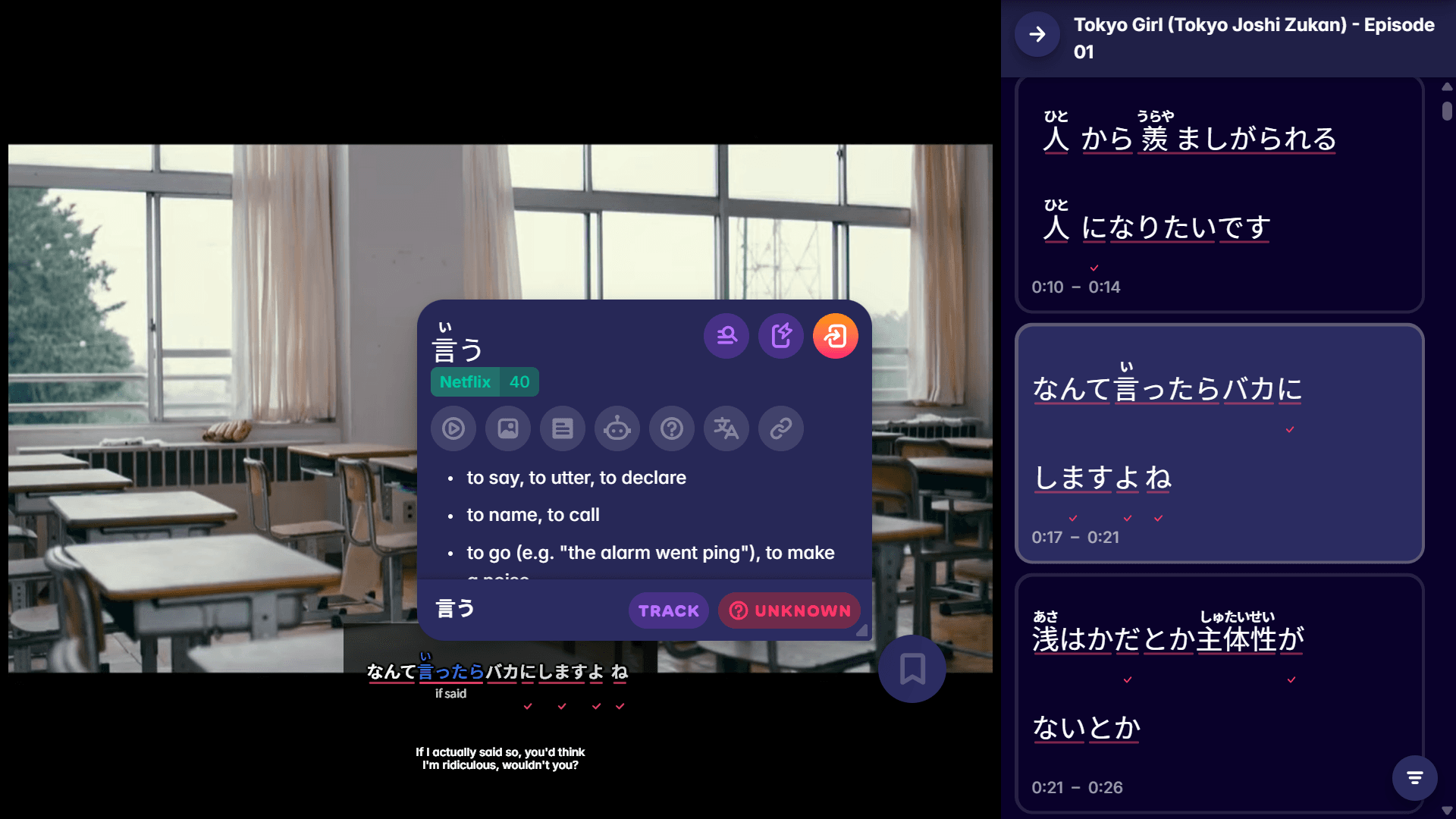
Anyway, if you want to practice and master these N1 patterns with real Japanese content, Migaku's browser extension and app let you look up grammar and vocabulary instantly while reading articles or watching videos. You can also add flashcards while watching videos. Makes studying from native materials way more practical. There's a 10-day free trial if you want to check it out.
 ---
## Making Japanese N1 grammar stick for the long term
Regular review matters more than intense cramming. Revisit grammar points you learned months ago to keep them fresh. The patterns you don't review regularly will fade, especially the ones that rarely appear in the content you consume. That said, consuming content is still the most efficient way to keep most of the grammar points in your memory fresh, especially if you are consuming the content specifically designed for N1 Japanese grammar.
> If you consume media in Japanese, and you understand at least some of the messages and sentences within that media, you will make progress. _Period_.
Media is the bridge. Cross it daily.🌉
---
## Making Japanese N1 grammar stick for the long term
Regular review matters more than intense cramming. Revisit grammar points you learned months ago to keep them fresh. The patterns you don't review regularly will fade, especially the ones that rarely appear in the content you consume. That said, consuming content is still the most efficient way to keep most of the grammar points in your memory fresh, especially if you are consuming the content specifically designed for N1 Japanese grammar.
> If you consume media in Japanese, and you understand at least some of the messages and sentences within that media, you will make progress. _Period_.
Media is the bridge. Cross it daily.🌉