# Japanese Question Words: Using Question Words and Particles in Japanese
> Learn essential Japanese question words like nani, doko, and itsu with particles, examples, and usage rules. Start asking real questions today.
**URL:** https://migaku.com/blog/japanese/japanese-question-words
**Last Updated:** 2025-12-29
**Tags:** fundamentals, vocabulary, phrases, grammar
---
The cool thing about Japanese question words is that they're actually pretty straightforward once you start [learning Japanese](https://migaku.com/learn-japanese). Most of them start with the same sound (that "d" sound), which makes them easier to remember than you'd think. Plus, unlike English where question structure can get weird, Japanese keeps the same sentence order whether you're making a statement or asking a question. You need to understand how the question words work with particles, when to use formal versus casual versions, and why sometimes the particle comes before the question word and sometimes after. That's what we're covering here.
---
## Basic Japanese question words you need to know
Let's start with the core question words. These are your bread and butter for asking basically anything.
1. **Nani/Nan ()** means "what." You'll see this written in kanji as , and yeah, it has two pronunciations. Generally, you use "nan" before certain sounds (like "d" and "n") and "nani" in other contexts. For example, "Kore wa nan desu ka ()" means "What is this?" The "desu ka (ですか)" at the end is what makes it a question in polite speech.
2. **Dare ()** means "who." Pretty straightforward. "Dare desu ka ()" asks "Who is it?"
3. **Doko (どこ)** means "where." This one's super useful. "Toire wa doko desu ka (トイレはどこですか)" is probably one of the first questions you'll actually need: "Where is the bathroom?"
4. **Itsu (いつ)** means "when." No kanji needed for this one, just hiragana. "Itsu desu ka (いつですか)" asks "When is it?"
5. **Naze (なぜ)** and **Nande (なんで)** both mean "why." Naze is more formal, while nande is casual. You'll also hear **Doushite (どうして)**, which sits somewhere in between formality-wise.
6. **Dou (どう)** means "how." You can ask "Dou desu ka (どうですか)" to mean "How is it?" or "How about it?"
See what I mean about that "d" sound? Doko, dare, dou, doushite. The Japanese language really likes patterns.
---
## Understanding particles with question words
Okay, this is where people get confused. Particles in Japanese are those little words that show the grammatical function of what comes before them. With question words, particles work the same way they do in regular sentences, but the placement can look weird if you're coming from English.
1. The particle **wa (は)** marks the topic of the sentence. When you say "Toire wa doko desu ka (トイレはどこですか)," you're literally saying "As for the bathroom, where is it?" The bathroom is your topic, and you're asking where it is.
2. The particle **ga (が)** marks the subject, and this is where things get interesting. "Doko ga ichiban samui desu ka ()" means "Where is the coldest?" Here, doko comes before ga because the question word itself is the subject. You're asking which place is the coldest.
3. The particle **o (を)** marks the object of an action. "Nani o tabemasu ka ()" asks "What will you eat?" The "what" is the object being eaten, so it gets the o particle.
So to answer that question from earlier about why どこ appears before and after particles: it depends on whether the question word is the topic/object or the subject. When the bathroom is the topic and you're asking about its location, you say "toire wa doko." When the location itself is the subject doing something (like being the coldest), you say "doko ga."
---
## “What” in Japanese: Nani vs nan (何)
Let's dig deeper into because it's probably the question word you'll use most.
> The general rule is that **nan** appears before "d," "n," and "t" sounds, while **nani** appears before particles and in other contexts. So you say "nan desu ka" but "nani o" or "nani ga."
- ?
*What is that?* (This is super useful when you see something you don't recognize.)
You'll also see in compound forms.
- Nanika () means "something" (literally "what-か").
- Nannin () asks "how many people?" when you're counting people specifically.
- Nansai () asks "how old?" when talking about age.
The kanji is worth learning early because you'll see it everywhere. It shows up in tons of words beyond just the question word.
---
## “Where” questions with doko (どこ)
Doko is one of those words you'll use constantly. Beyond just "Where is X?" you can use it in all sorts of ways.
- ?
*Where are you going?* (The particle ni here indicates direction or destination.)
- ?
*Where did you come from?* (The particle kara means "from.")
- ?
*Where did you buy it?* (The particle de indicates where an action takes place.)
You can also use **dochira (どちら)** as a more polite version of doko. "Dochira kara irasshaimashita ka (どちらからいらっしゃいましたか)" is a formal way to ask where someone came from. You'll hear this in business situations or when talking to people you need to show respect to.
---
## “When” questions with itsu (いつ)
Itsu is beautifully simple. Just stick it in a sentence where the time would go.
- いつ行きますか means "When are you going?"
- いつからですか asks "From when?" or "Since when?"
- いつまでですか asks "Until when?"
One thing to note: いつ doesn't usually take particles like ni (The time particle) the way specific times do. You say "goji ni (5時に )" for "at 5 o'clock," but just "itsu" without ni for "when."
---
## “Why” questions: Naze (なぜ), nande (なんで), and doushite (どうして)
Japanese gives you three main ways to ask "why," and they're not totally interchangeable.
1. **Naze (なぜ)** is the most formal. You'd use this in writing or very formal speech. "Naze desu ka (なぜですか)" sounds pretty stiff in casual conversation.
2. **Doushite (どうして)** is your middle-ground option. It's polite enough for most situations but doesn't sound stuffy. "Doushite konakatta no ()" asks "Why didn't you come?" in a normal, conversational way.
3. **Nande (なんで)** is casual. Use this with friends and people you're comfortable with. "Nande (なんで)?" by itself is basically "Why?" or "How come?"
All three work grammatically the same way. They just carry different levels of formality.
---
## “Which” variations: Dore (どれ), dono (どの), and docchi (どっち)
When you need to ask "which" in Japanese, you've got options depending on the situation.
1. **Dore (どれ)** means "which one" when choosing from three or more things. "Dore ga ii desu ka (どれがいいですか)" asks "Which one is good?"
2. **Dono (どの)** means "which" as a modifier. It comes before a noun. "Dono hon desu ka ()" asks "Which book is it?"
3. **Docchi (どっち)** or the more polite **dochira (どちら)** means "which" when choosing between two things. "Docchi ga suki ()" asks "Which do you like?" in casual speech.
Dochira also doubles as a polite version of doko (where) and dare (who) in certain contexts. "Dochira-sama desu ka ()" is a formal way to ask "Who are you?" that you'd hear on the phone or at a reception desk.
---
## “How” questions with dou (どう)
Dou is your basic "how" question word. It asks about manner, method, or opinion.
1. "Dou desu ka (どうですか)" is incredibly versatile. It can mean "How is it?" "What do you think?" or "How about it?" depending on context.
2. "Dou shimasu ka (どうしますか)" asks "What will you do?" or "How will you do it?"
3. "Dou yatte (どうやって)" means "how" in the sense of "by what method." "Dou yatte ikimasu ka ()" asks "How do you get there?"
4. You'll also see douiu (どういう) meaning "what kind of." "Douiu imi desu ka ()" asks "What does it mean?" or literally "What kind of meaning is it?"
---
## Counting questions: Ikutsu (いくつ) and counters
Japanese uses different counters for different types of things, and this shows up in questions too.
**Ikutsu (いくつ)** is your general "how many" or "how old" question word. "Ikutsu desu ka (いくつですか)" can ask someone's age (Casually) or how many of something there are.
But Japanese also has specific counter questions. We already mentioned **nannin ()** for people.
You'll also see:
1. **Ikura (いくら)** asks "how much" for price. "Ikura desu ka (いくらですか)" is essential for shopping.
2. **Nankai ()** asks "how many times."
3. **Nansatsu ()** asks "how many books" specifically.
4. **oikutsu (おいくつ)** is the polite form of asking ages. "Oikutsu desu ka (おいくつですか)" is a respectful way to ask someone's age.
---
## Making questions polite: Desu ka (ですか) and beyond
In casual Japanese, you can just use rising intonation to make something a question. "Nani ()?" with a questioning tone means "What?"
But in polite speech, you add desu ka (ですか) or masu ka (ますか) to the end of sentences. This is the standard polite question form you'll use most of the time.
- "Kore wa nan desu ka ()" is polite.
- "Kore wa nani ()?" is casual.
For even more formal situations, you might hear deshou ka (でしょうか), which adds a layer of politeness and sometimes uncertainty. "Dochira deshou ka (どちらでしょうか)" is a very polite "Which might it be?"
The particle ka (か) is what actually marks a question grammatically. In casual speech, especially among younger people, you'll often hear questions without it, relying purely on intonation. But in polite speech, that ka is essential.
---
## Putting it all together
The beautiful thing about Japanese question words is that once you learn them, they work consistently. You don't have to rearrange your whole sentence like in English where "You are going" becomes "Are you going?"
The particle system takes some getting used to, but it's actually more consistent than English once you understand it. The question word goes where the answer would go, and the particles tell you its grammatical role.
Start with the basic question words and desu ka endings. Get comfortable asking simple questions. Then layer in the particle nuances, the polite variations, and the compound forms.
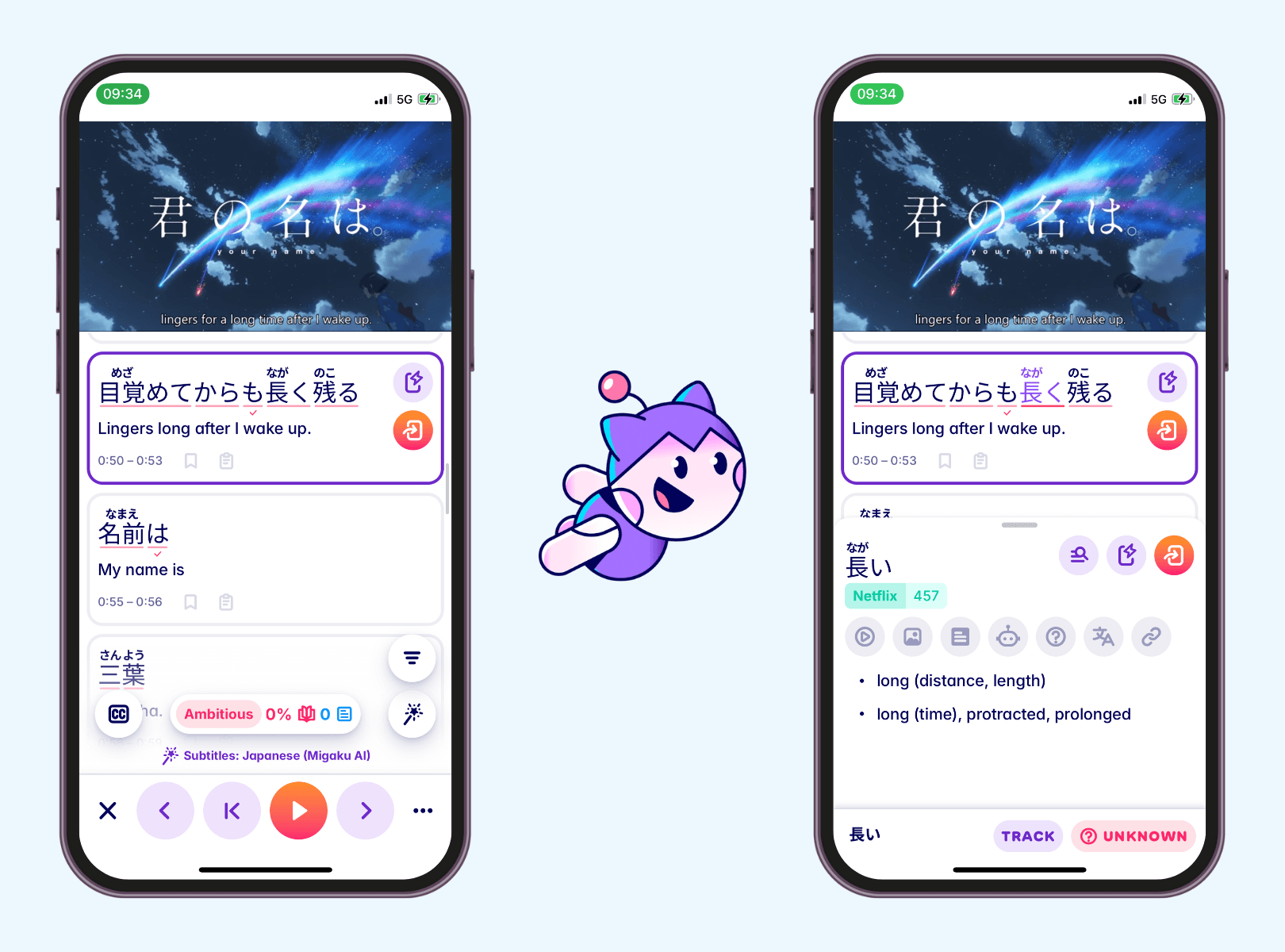
Anyway, if you want to practice these question words with actual Japanese content, Migaku's browser extension and app let you look up words and save sentences while watching Japanese shows or reading articles. Makes it way easier to see how these words work in real contexts. There's a 10-day free trial if you want to check it out.
 ---
## Don't let mistakes daunt your progress in learning Japanese grammar!
You'll mess up particle placement sometimes. Everyone does. But Japanese speakers are generally super patient with learners, and even a slightly awkward question gets your point across. Compared to output, input is more important at the early stage of learning. Choose a drama or anime you like, and use it to get used to how Japanese natives ask questions.
> If you consume media in Japanese, and you understand at least some of the messages and sentences within that media, you will make progress. _Period_.
Anyone who has never made a mistake has never tried anything new.
---
## Don't let mistakes daunt your progress in learning Japanese grammar!
You'll mess up particle placement sometimes. Everyone does. But Japanese speakers are generally super patient with learners, and even a slightly awkward question gets your point across. Compared to output, input is more important at the early stage of learning. Choose a drama or anime you like, and use it to get used to how Japanese natives ask questions.
> If you consume media in Japanese, and you understand at least some of the messages and sentences within that media, you will make progress. _Period_.
Anyone who has never made a mistake has never tried anything new.