# Japanese Sentence Structures: Complete Guide to Japanese Sentences & Particles
> Learn Japanese sentence structure with this complete guide covering SOV order, particles, verbs, and word order flexibility. Practical examples included.
**URL:** https://migaku.com/blog/japanese/japanese-sentence-structure-complete-guide
**Last Updated:** 2026-04-29
**Tags:** fundamentals, grammar
---
When you first start [learning Japanese](https://migaku.com/learn-japanese), the sentence structure feels completely backwards. If you're coming from English, your brain expects the verb to show up in the middle of the sentence, but Japanese keeps you waiting until the very end. Let's break down how Japanese sentence structure works!
----
## The basic pattern of Japanese sentences: SOV word order
The structure of Japanese centers on that verb-final placement. Every basic Japanese sentence ends with a verb or a copula (the "to be" equivalent). This means you're always building up to the action or state of being at the end.
Take this example sentence: 私は寿司を食べます (Watashi wa sushi wo tabemasu) which means "I eat sushi." Break it down word by word:
- 私 (Watashi) means "I"
- は (wa) is a particle marking the topic
- 寿司 (sushi) means "sushi"
- を (wo) is a particle marking the direct object
- 食べます (tabemasu) means "eat"
The verb 食べます sits right at the end of the sentence. This happens in every Japanese sentence, whether it's a simple statement or a complex grammatical construction. You could add ten more details to this sentence, and the verb would still anchor the end.
Compare this to English word order, where the verb appears immediately after the subject. English speakers naturally want to say the action early in the sentence, but Japanese speakers are totally comfortable waiting. This difference affects how you process information when listening or reading Japanese. You need to hold all the pieces in your head until that final verb tells you what's actually happening.
----
## Japanese particles: The traffic controllers of Japanese grammar
[Particles](https://migaku.com/blog/japanese/japanese-particles-cheat-sheet) are these little grammatical markers that attach to words and tell you their function in the sentence. They're absolutely essential to Japanese sentence structure because they mark relationships between words. Without particles, you'd have no idea what's doing what to whom.
The most common particles you'll encounter:
- **は (Wa)** marks the topic of the sentence. The topic is what the sentence is about, which isn't always the same as the grammatical subject. In 私は学生です (Watashi wa gakusei desu), meaning "I am a student," は tells you that "I" is what we're talking about.
- **が (Ga)** marks the grammatical subject. This particle shows what's performing the action or existing in a certain state. The difference between は and が confuses learners for years, honestly. が tends to introduce new information or emphasize the subject specifically.
- **を (Wo)** marks the direct object, the thing receiving the action of the verb. In 本を読みます (Hon wo yomimasu), meaning "I read a book," を attaches to 本 (hon) to show that the book is what's being read.
- **に (Ni)** indicates direction, time, or indirect objects. It's super versatile. 学校に行きます (Gakkou ni ikimasu) means "I go to school," where に marks the destination.
- **の (No)** shows possession or attribution, similar to apostrophe-s in English. 私の本 (Watashi no hon) means "my book."
These particles let Japanese shuffle word order around while keeping the meaning clear. The particle tells you what role each noun plays, so you can move things for emphasis without confusing the listener. That's the flexibility I mentioned earlier.
----
## Verbs: The anchor at the end
Every sentence in Japanese builds toward the verb at the end of the sentence. The verb carries crucial information: the tense, the politeness level, whether something is positive or negative, and sometimes the mood or aspect. [Japanese verbs conjugate](https://migaku.com/blog/japanese/japanese-verb-conjugation) to show all of this.
Japanese verbs fall into three groups: **godan verbs (五段動詞), ichidan verbs (一段動詞), and irregular verbs**. The conjugation patterns differ slightly, but they all end up at the end of your sentence regardless.
A simple present tense verb like 食べます (tabemasu), meaning "eat" or "will eat," can become:
- 食べません (tabemasen) for "don't eat" or "won't eat"
- 食べました (tabemashita) for "ate"
- 食べない (tabenai) for casual "don't eat"
- 食べたい (tabetai) for "want to eat"
The verb ending changes, but its position stays fixed. This is one of the most consistent rules in Japanese grammar.
Because the verb comes last, you can stack modifiers, objects, and additional information before it. 今日レストランで友達と美味しい寿司を食べました (Kyou resutoran de tomodachi to oishii sushi wo tabemashita) means "Today I ate delicious sushi with friends at a restaurant." All those details pile up, and 食べました (tabemashita) lands at the very end to complete the thought.
----
## Subject omission in sentence structures
Japanese speakers drop subjects constantly. If the context makes it obvious who or what you're talking about, you just leave it out. This happens way more than in English, where we usually need to state the subject explicitly.
Ask someone "What did you do yesterday?" and they might answer 映画を見ました (Eiga wo mimashita), which translates literally as "Watched a movie." The subject "I" is completely absent, but everyone understands from context that the speaker is talking about themselves.
This subject omission extends to conversations where you're discussing a third party. Once you've established who you're talking about, you can drop that person from subsequent sentences. The particle structure keeps everything clear even without explicitly naming the subject each time.
----
## Japanese word order flexibility and emphasis
While the verb stays locked at the end, Japanese lets you rearrange other elements for emphasis or style. The particles maintain clarity regardless of where you place the words they're attached to.
Take 私はりんごを食べます (Watashi wa ringo wo tabemasu), meaning "I eat an apple." You could also say:
- りんごを私は食べます (Ringo wo watashi wa tabemasu) to emphasize the apple
- 私は食べます、りんごを (Watashi wa tabemasu, ringo wo) in casual speech
The meaning stays the same because the particles wo and wa show you the grammatical relationships. This flexibility lets speakers highlight different parts of the sentence depending on what they want to emphasize.
In practical conversation, Japanese speakers use this flexibility all the time. They'll front-load important information or save surprising details for just before the verb. The word order can signal emotional emphasis or contrast with previous statements.
That said, the standard SOV order is still the most common and neutral way to structure sentences. You'll hear variations, but beginners should focus on mastering the basic pattern first before getting creative with word order.
----
## The 7 basic sentence patterns
Different linguists define "basic sentence patterns" differently, but here are seven fundamental patterns you'll use constantly in Japanese:
1. XはYです (Noun wa noun desu): "X is Y" for identification and description
2. Xがあります/います (Noun ga arimasu/imasu): "X exists" or "There is X"
3. XはAdjectiveです (Noun wa adjective desu): "X is (adjective)"
4. XはYをVerb (Noun wa noun wo verb): "X does (verb) to Y"
5. XはYにZをVerb (Noun wa noun ni noun wo verb): "X does (verb) Z to/for Y"
6. XはYでVerb (Noun wa noun de verb): "X does (verb) at/by means of Y"
7. XはYにVerb (Noun wa noun ni verb): "X does (verb) to/at Y"
These patterns cover the majority of simple sentences you'll encounter. Each one uses different particles to show the relationships between nouns and verbs. Practice these with different vocabulary, and you'll build a strong foundation for more complex structures.
----
## Building complex sentences
Once you've got basics of Japanese sentence structure down, you can build increasingly complex sentences by chaining clauses and embedding modifying phrases.
Relative clauses in Japanese come before the noun they modify, and they don't require relative pronouns like "who" or "that." You just stick a complete clause in front of a noun. 昨日買った本 (Kinoo katta hon) means "the book I bought yesterday." The entire clause 昨日買った modifies 本.
You can connect sentences with conjunctions like が (ga) for "but," から (kara) for "because," or ので (node) for "since." These typically appear at the end of the first clause, before the second clause begins.
Te-form verbs let you chain actions or states: 朝ごはんを食べて、学校に行きました (Asagohan wo tabete, gakkou ni ikimashita) means "I ate breakfast and went to school." The te-form 食べて connects the two actions sequentially.
As sentences get longer, that verb-final structure means you're sometimes waiting through several clauses before you reach the main verb. This takes practice to process smoothly, but native speakers handle it effortlessly.
----
## Learning common Japanese sentence structure effectively
Understanding basic Japanese sentence structure intellectually is one thing. Actually internalizing it so you can produce and comprehend sentences naturally takes exposure and practice.
1. **Reading and listening to lots of Japanese** helps you absorb the sentence patterns unconsciously. Your brain starts expecting that verb at the end. The particle patterns become familiar. You develop an intuition for what sounds right.
2. **Active practice matters too.** Constructing your own sentences, even simple ones, reinforces the patterns. Try translating thoughts from English to Japanese, paying attention to how you need to restructure the sentence. Notice where you're putting the verb, which particles you're using, whether you need to state the subject.
3. **Analyzing example sentences** helps you see the patterns explicitly. Break down the word order in Japanese you encounter: identify the particles, find the verb, figure out what's modifying what. This conscious analysis speeds up the unconscious acquisition.
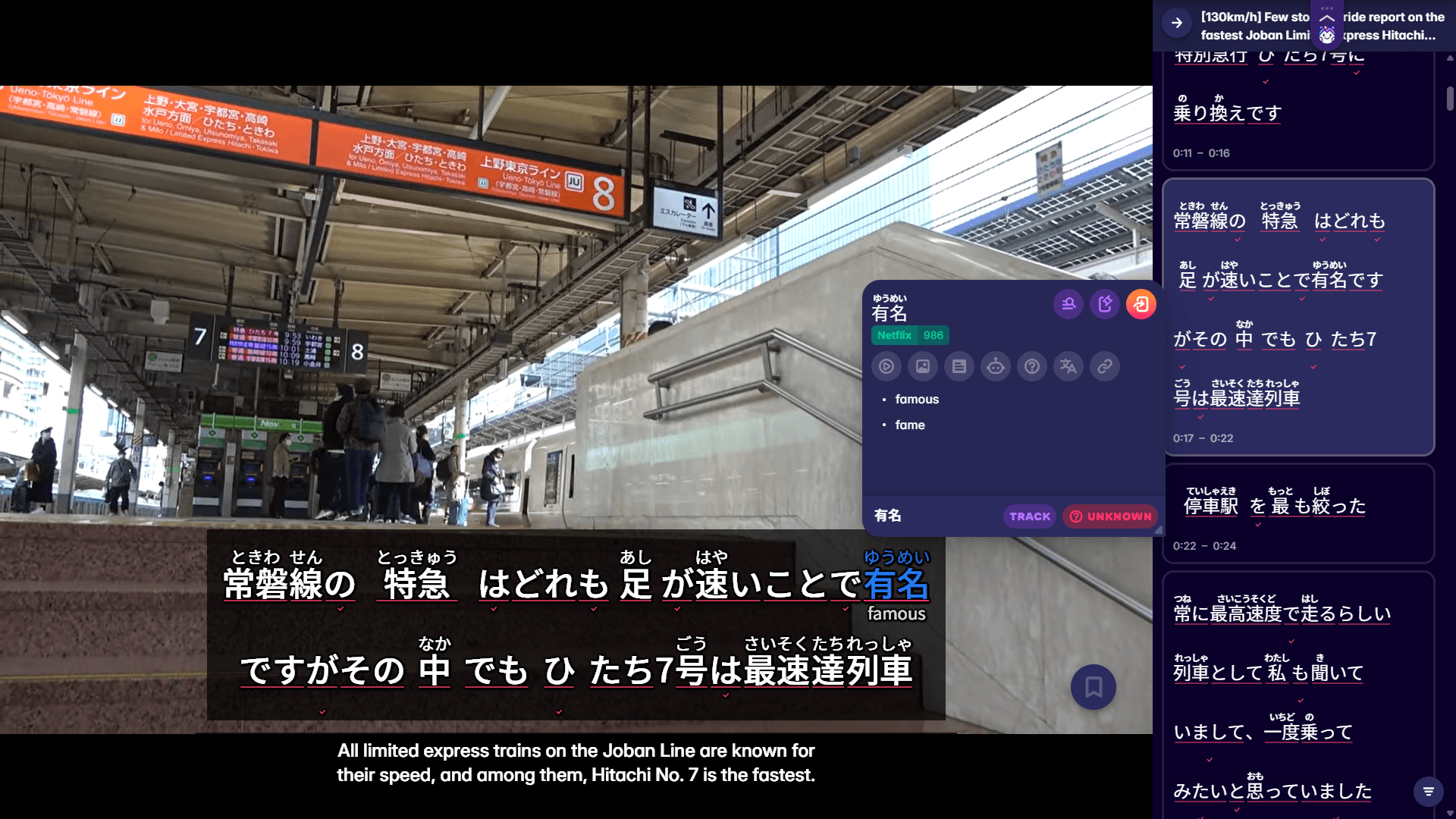
Anyway, if you want to actually practice these sentence structures with real Japanese content, Migaku's browser extension and app let you look up words and analyze grammar instantly while watching shows or reading articles. Makes learning from native content way more practical. There's a 10-day free trial if you want to check it out.
 ----
## Japanese grammar is beginner-friendly
Japanese grammar is pretty consistent. Once you learn a pattern, it applies broadly. There are fewer exceptions and irregularities than in many European languages. The structure of Japanese sentences might feel backwards at first, but it follows clear, logical rules. By consuming Japanese media and observing how native speakers form sentences, you can get used to the sov structure pretty fast.
> If you consume media in Japanese, and you understand at least some of the messages and sentences within that media, you will make progress. _Period_.
Start right. Keep going!
----
## Japanese grammar is beginner-friendly
Japanese grammar is pretty consistent. Once you learn a pattern, it applies broadly. There are fewer exceptions and irregularities than in many European languages. The structure of Japanese sentences might feel backwards at first, but it follows clear, logical rules. By consuming Japanese media and observing how native speakers form sentences, you can get used to the sov structure pretty fast.
> If you consume media in Japanese, and you understand at least some of the messages and sentences within that media, you will make progress. _Period_.
Start right. Keep going!