Japanese Shopping Vocabulary for Stores and Markets: Essential Phrases & Etiquette
Last updated: April 2, 2026

Shopping in Japan can feel like stepping into a whole new world, especially when you're standing at a cashier trying to figure out if they're asking about your payment method or offering you a loyalty card. The good news? You don't need to master the entire Japanese language to navigate stores, markets, and convenience stores like a pro. A solid foundation of Japanese shopping vocabulary will get you through most situations, from asking prices to trying on clothes. Let's break down the essential phrases and words you'll actually use.
- How Japanese shopping vocabulary works in real situations
- Essential Japanese phrases for shopping at any store
- Trying on clothes and navigating fashion stores
- Convenience store vocabulary you'll use daily
- Market and grocery store specific shopping phrases
- Price and payment vocabulary when shopping in Japanese
- The cultural etiquette when you go shopping
- Learn Japanese shopping vocabulary and stay up to date
- Practical tips for learning Japanese shopping vocabulary
How Japanese shopping vocabulary works in real situations
Here's the thing about shopping vocabulary in Japanese. It's pretty structured once you understand the basic patterns. Most interactions follow predictable scripts, which makes learning easier than you'd think.
When you walk into any store in Japan, you'll immediately hear (irasshaimase), which means "welcome." Store staff say this constantly, and they don't expect a response. Just acknowledge it with a nod if you want, or ignore it completely. Both are totally acceptable.
The core structure of shopping conversations relies heavily on a few grammatical particles.
- The particle (wa) marks the topic of your sentence. So when you say (kore wa), you're establishing "this" as what you're talking about. Then you add (ikura desu ka) to ask "how much is this?"
- The word (desu) appears constantly in shopping contexts. It's a copula that roughly translates to "is" or "am," and it adds politeness to your statements. You'll hear it in phrases like (sen en desu, "it's 1000 yen") or (daijoubu desu, "I'm okay/no thank you").
Essential Japanese phrases for shopping at any store
Let me give you the phrases that'll cover about 80% of your shopping needs. I'm talking about the stuff you'll actually say, not textbook examples.
- (kore wo kudasai) means "this one, please." Point at what you want and say this. Done. The word (kudasai) means "please give me," and it's incredibly useful. You can combine it with anything you're requesting.
- (misete kudasai) means "please show me." Use this when you want to see something behind the counter or get a closer look at an item.
- (fukuro wa irimasen) translates to "I don't need a bag." Since Japan started charging for plastic bags, this phrase has become super common. The particle wa appears here to mark "bag" as the topic.
- (kaado de) means "by card." Just say this when the cashier asks about payment. If you want to pay cash, say (genkin de).
Actually, the only way to distinguish the number of items you want is to either guess from the context or ask (How many?). But honestly, pointing and using your fingers works perfectly fine, too. Japanese numbers with counters can get complicated, so don't stress about perfect grammar when you're just buying three apples.
Trying on clothes and navigating fashion stores
Clothing stores have their own specific vocabulary set.
- When you want to try something on, you'll need (shichaku shite mo ii desu ka), which means "may I try this on?"
- The fitting room is called (shichaku-shitsu).
- Staff will often ask (nan-ten desu ka), meaning "how many items?" Just hold up the number of pieces you're taking in.
Size vocabulary is straightforward.
- Small is .
- Medium is .
- Large is .
- You might also hear (hoka no saizu wa arimasu ka), which means "do you have other sizes?"
Colors come up frequently too.
- (kuro) is black.
- (shiro) is white.
- (aka) is red.
- (ao) is blue.
- When asking about different colors, say (hoka no iro wa arimasu ka).
Convenience store vocabulary you'll use daily
The (konbini) is where you'll probably shop most often in Japan. These convenience stores are everywhere, and the vocabulary is pretty consistent across all of them.
When you're checking out, the cashier might ask (atatamemasu ka), meaning "would you like this heated?" This applies to bento boxes and other ready-to-eat items. Just say (hai) for yes or (iie) for no.
They'll also ask about chopsticks: (ohashi wa irimasu ka). Again, hai or iie works fine.
The question (genkin demo ii desu ka) means "is cash okay?" You might ask this if you're unsure whether they accept cash for certain services. The phrase (demo ii desu ka) literally means "is it okay even with..." and you'll hear variations of this constantly.
Konbini staff have a whole script they follow. You've probably heard (I'm terribly sorry), but have you ever wondered about the other phrases that convenience store staff say? They'll often say (thank you very much) multiple times, along with (please come again).
Market and grocery store specific shopping phrases
Fresh food markets and supermarkets have their own vocabulary you'll want to know.
- (yasai) means vegetables.
- (kudamono) is fruit.
- (niku) is meat.
- (sakana) is fish.
When buying produce, you might need (hitotsu, one item), (futatsu, two items), (mittsu, three items). These native Japanese counters work for most small items.
- (shinsen) means fresh, which is helpful when you're looking for quality products.
- (shoumi kigen) is the best-before date.
- (shouhi kigen) is the expiration date.
Many supermarkets have self-checkout now, labeled (serufu reji). The regular checkout with a person is just (reji).
Price and payment vocabulary when shopping in Japanese
Money talk is crucial. The Japanese currency is (en), which we write as yen in English. When asking prices, (ikura desu ka) is your go-to phrase.
- (takai) means expensive, while (yasui) means cheap.
- You'll see (waribiki) for discounts and (seeru) for sales.
Payment methods have expanded a lot in recent years. (credit card), (electronic money), and (QR code) are all common now.
The cashier might say (I'll receive your payment) when taking your money, and (here's your change) when returning change.
The cultural etiquette when you go shopping
Shopping vocabulary in Japan reflects the culture's emphasis on politeness and customer service. The level of formality in stores is consistently high, which is why you'll hear (desu) and (masu) forms constantly.
Staff use (keigo), or honorific language, when speaking to customers. You don't need to match this level of formality as a customer. Using basic polite forms with desu and kudasai is perfectly acceptable.
The phrase (okyaku-sama) means "honored customer," and you'll hear it frequently. This reflects the (the customer is god) philosophy in Japanese retail culture.
Japanese phrases in shopping contexts often include buffer words and softeners. (excuse me/sorry) gets used to politely get attention, ask questions, or apologize for any inconvenience. You'll probably say this word a hundred times a day in Japan.
Learn Japanese shopping vocabulary and stay up to date
Shopping vocabulary has definitely evolved, especially in the past decade.
- The biggest shift came with the introduction of cashless payment systems. Words like (PayPay), (Suica), and (Pasmo) entered everyday shopping conversations.
- Environmental awareness brought new phrases too. (eco bag) became common after plastic bag fees started. (my bag) is another variation you'll hear.
- Online shopping introduced terms like (online shopping), (haisou, delivery), and (souryou muryou, free shipping).
- The COVID-19 pandemic in the early 2020s added (hisesshoku, contactless) and (self-checkout) to common shopping vocabulary. By 2026, these terms are just standard parts of the shopping experience.
Practical tips for learning Japanese shopping vocabulary
The best way to learn this vocabulary? Use it in real situations. Seriously, textbook study only gets you so far. You need actual practice.
- Start with one or two phrases per shopping trip. Master first, then add next time. Build gradually.
- Watch Japanese shopping content online. YouTube has tons of videos showing convenience store hauls, supermarket tours, and shopping vlogs. Pay attention to the natural conversations between customers and staff.
- Make flashcards with the phrases you'll actually use. Don't waste time memorizing words for "medieval marketplace" when you need to know how to ask for a plastic bag.
- Practice the intonation. Japanese is a pitch-accent language, and getting the rhythm right makes you much easier to understand. Listen to native speakers and mimic their patterns.
- Read Japanese shopping websites or app interfaces. Even if you're not buying anything, navigating a Japanese e-commerce site teaches you tons of vocabulary. (add to cart), (to purchase), (reviews). All useful stuff.
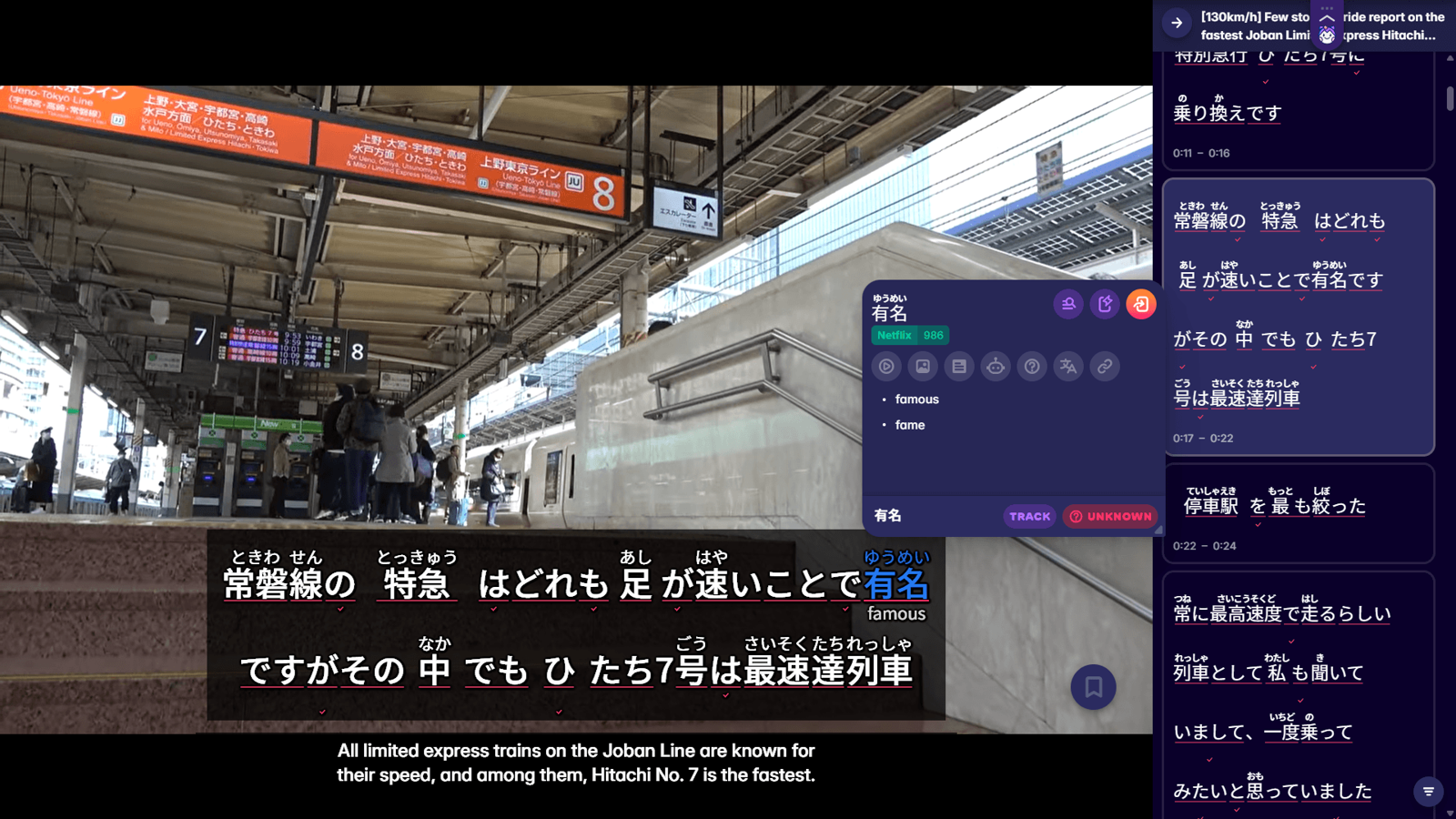
If you're serious about learning Japanese through real content, Migaku's browser extension and app let you look up words instantly while watching shows or reading articles. Makes immersion learning way more practical. There's a 10-day free trial if you want to check it out.
Learning Japanese shopping vocabulary gives you immediate practical benefits
You'll feel way more confident walking into any store in Japan, and you'll actually understand what's happening during transactions instead of just nodding and hoping for the best. But vocabulary alone only takes you so far. The real magic happens when you encounter these words in natural contexts, whether that's shopping in Japan, watching Japanese content, or reading product descriptions online. That's when the words stop being memorized phrases and become part of how you understand and use the Japanese language.
If you consume media in Japanese, and you understand at least some of the messages and sentences within that media, you will make progress. Period.
Shopping is part of everyday life!🏷️