# Japanese Train Station Vocabulary: Guide to Traveling by Train in Japan
> Learn Japanese train station vocabulary to navigate Japan's rail system confidently. Covers tickets, platforms, train types, and practical phrases.
**URL:** https://migaku.com/blog/japanese/japanese-train-station-vocabulary
**Last Updated:** 2026-04-01
**Tags:** vocabulary, phrases
---
If you're planning to [travel](https://migaku.com/blog/japanese/japanese-travel-phrases) around Japan, you'll spend a lot of time in train stations. Japanese trains are incredibly efficient and connect nearly every corner of the country, but navigating the stations can feel overwhelming without [learning the right Japanese vocabulary](https://migaku.com/learn-japanese). This guide covers essential Japanese train station vocabulary you'll actually need, from buying tickets to finding the right platform. Whether you're catching a local train in Tokyo or boarding the shinkansen to Osaka, these words and phrases will make your journey smoother.
----
## Basic train station vocabulary you need to know
Let's start with the fundamental terms you'll encounter at every train station in Japan.
- (eki) means station. You'll see this everywhere. If you need to ask where a specific station is, say "" (eki wa doko desu ka), which means "Where is the station?" For a specific station, add the station name before eki. For example, to ask about Shibuya Station, you'd say "" (Shibuya eki wa doko desu ka).
- (densha) is the general word for train. You'll hear this constantly in announcements and see it on signs throughout stations.
- (kaisatsu) refers to the ticket gates where you tap your IC card or insert your paper ticket to enter and exit the station. These automated gates are everywhere in Japanese stations, and knowing this word helps when station staff give you directions.
- (hoomu) means platform. This comes from the English word "home" but refers to the train platform. A useful phrase to help you remember this vocabulary point is (hassha hoomu wa dochira desu ka), which means "Which is the departure platform?"
- (iriguchi) means entrance, and (deguchi) means exit. Most stations have multiple exits numbered or named after nearby landmarks, so paying attention to the specific exit name saves you from walking in circles.
----
## Understanding different types of trains
Japan has several train types, and they affect your fare and travel time significantly.
- (futsuu) means local train. These trains stop at every single station along the route. They're the slowest option but also the cheapest since they don't require any additional fare beyond your basic ticket.
- (kaisoku) means rapid train. These skip some smaller stations, getting you to your destination faster. In most cases, rapid trains don't cost extra, which makes them a great option for commuter travel.
- (kyuukou) means express train. These stop at even fewer stations than rapid trains. Depending on the railway company, you might need to pay an additional express fare.
- (tokkyuu) means limited express or super express. These are the fastest regular trains and typically require an additional limited express ticket on top of your basic fare.
- (shinkansen) is Japan's famous bullet train system. The shinkansen connects major cities across Japan at speeds reaching up to 320 km/h. That's why Japanese trains are so fast compared to rail systems in many other countries. The shinkansen requires a separate ticket from regular trains, and you'll need both a base fare ticket and a shinkansen supplement ticket.
----
## Buying tickets and understanding fares
Navigating ticket machines can be tricky, but knowing these terms helps tremendously.
- (kippu) means ticket. Paper tickets are still common, though many people use IC cards like Suica or Pasmo instead.
- (kenbaiki) refers to the ticket vending machines you'll find near station entrances. Most machines in major cities have an English language option, but knowing the Japanese term helps when asking for directions.
- (ryoukin) means fare or fee. Above ticket machines, you'll usually see a route map with numbers indicating the fare to each destination.
- (katamichi) means one-way ticket, while (oufuku) means round-trip ticket. Round-trip tickets sometimes offer a small discount on longer routes.
- (shiteiseki) means reserved seat. On shinkansen and limited express trains, you can reserve a specific seat for a small additional fee.
- (jiyuuseki) means unreserved seat or non-reserved seat. Avoid paying extra by choosing an unreserved seat if you're flexible and don't mind potentially standing during busy periods. Useful, is it not?
- (guriin sha) means green car, which is the first-class car on Japanese trains. These offer more spacious seats and a quieter environment but cost significantly more.
----
## Learn Japanese platform and train car vocabulary
Once you're past the ticket gates, you need to navigate to the correct platform and train car.
- (bansen) means track number or platform number. Announcements will say something like "" (san bansen) for platform 3.
- (gousha) refers to car number. Shinkansen platforms have markings on the floor showing where each car will stop. If you have a reserved seat in car 7, you'd look for the (nana gousha) marking.
- (jousha ichi) means boarding position. These markings on the platform show exactly where doors will open, and people line up accordingly. Pretty organized system!
- (hassha) means departure, while (touchaku) means arrival. Digital displays show both the departure time and which train is arriving next.
- (iki) means "bound for" or "going to." You'll see this on train destination signs. For example, (Tokyo iki) means "bound for Tokyo."
----
## Navigation and transfers
Japanese stations can be massive, especially in Tokyo where multiple train lines intersect.
- (norikae) means transfer or connection. When you need to change trains, follow the signs to find your connecting line.
- (rosen) means line or route. Tokyo has dozens of train lines operated by different companies, so knowing which line you need is crucial.
- (jikokuhyou) means timetable. These detailed schedules are posted on platforms and show exactly when each train type arrives.
- (tsugi) means next. Digital displays often show (tsugi no densha), meaning "next train."
- (saishuu densha) means last train. Japanese trains stop running around midnight or 1 AM, so missing the last train means taking an expensive taxi or waiting until morning when trains resume around 5 AM.
----
## Inside the train
Once you board the train, these terms become relevant.
- (yuusenseki) means priority seating. These seats, usually marked in different colors, are reserved for elderly passengers, pregnant women, people with disabilities, and those with small children.
- (amidana) refers to the overhead luggage rack. These are perfect for storing bags and suitcases, keeping the aisles clear.
- (kousha) means getting off or alighting. You'll sometimes see (kousha guchi), meaning the exit door.
- (jousha) means boarding or getting on the train.
- (shanai) means inside the train. Announcements often begin with when they're about to give information relevant to passengers already on board.
----
## Signs and kanji you'll see everywhere
Recognizing common kanji at train stations makes navigation much faster.
- (tomare) means stop. You'll see this on various warning signs.
- (kiken) means danger. This appears on signs near tracks and other hazardous areas.
- (kin'en) means no smoking. Most Japanese stations and all trains are completely non-smoking these days.
- (otoko) means male, and (onna) means female. You'll see these kanji on restroom signs.
- (kuu) or (kuuseki) means vacant or empty seat. Some trains have indicators above seats showing availability.
- (manseki) means full or no vacancy. During busy commuter hours, you'll definitely understand this word!
----
## IC cards and modern ticketing
While not strictly vocabulary, understanding these terms helps with the modern Japanese train experience.
- (IC kaado) refers to rechargeable smart cards like Suica, Pasmo, and ICOCA. These work across most of Japan and make traveling much simpler than buying individual tickets.
- (chaaji) means to charge or add money to your IC card. Machines at every station let you add funds.
- (zandaka) means balance. When your card doesn't have enough money to exit at your destination, the gate will display an error showing your remaining balance.
----
## Common phrases for asking directions
Sometimes you need to ask station staff or fellow passengers for help.
- "" (sumimasen) means [excuse me](https://migaku.com/blog/japanese/excuse-me-in-japanese) or sorry. Use this to politely get someone's attention.
- "" (doko desu ka) means where is it? Combine this with any location word to ask where something is.
- "" (kore wa doko iki desu ka) means "Where is this train going?" Point at a train and ask this when you're unsure.
- "" (nan bansen desu ka) means "Which platform?" This phrase saves you when station layouts get confusing.
- "" (norikae wa doko desu ka) means "Where do I transfer?" Station staff hear this constantly and can quickly point you in the right direction.
----
## Regional train differences
Train vocabulary can vary slightly depending on where you are in Japan.
In the Kansai region around Osaka and Kyoto, you might hear different terms or see regional railway companies like JR West, Hankyu, or Keihan. The basic vocabulary stays the same, but each company has its own train type names and classifications.
The shinkansen network has different lines with distinct names. The (Tokaido Shinkansen) connects Tokyo to Osaka, while the (Tohoku Shinkansen) runs north from Tokyo.
----
## Reading train maps and schedules
Japanese train maps use color coding extensively, making them easier to navigate once you understand the system.
Each train line has a designated color and letter code. For example, the Yamanote Line in Tokyo is green and uses the code JY. Stations are numbered sequentially along each line, so Shibuya Station on the Yamanote Line is JY20.
Timetables show different train types in different colors or with Japanese characters indicating whether it's local, rapid, express, or limited express. Weekend and weekday schedules often differ, especially for commuter lines.
----
## Practical tips for using this vocabulary
You don't need to memorize every single word before your trip to Japan. Focus on the essentials first: station, train, ticket, platform, entrance, and exit. These six words alone will help you tremendously.
When you're at a station, take a moment to look around and identify the signs you recognize. Seeing the kanji in context helps reinforce your memory much better than studying lists alone.
Most major stations in tourist areas have English signage and announcements, but once you venture outside Tokyo, Osaka, or other major cities, English becomes less common. That's where this vocabulary becomes genuinely useful rather than just interesting to know.
Train station staff in Japan are incredibly helpful. Even if your pronunciation isn't perfect, they'll understand what you're trying to ask and help you get where you need to go. Don't be afraid to use these words even if you're not confident yet.
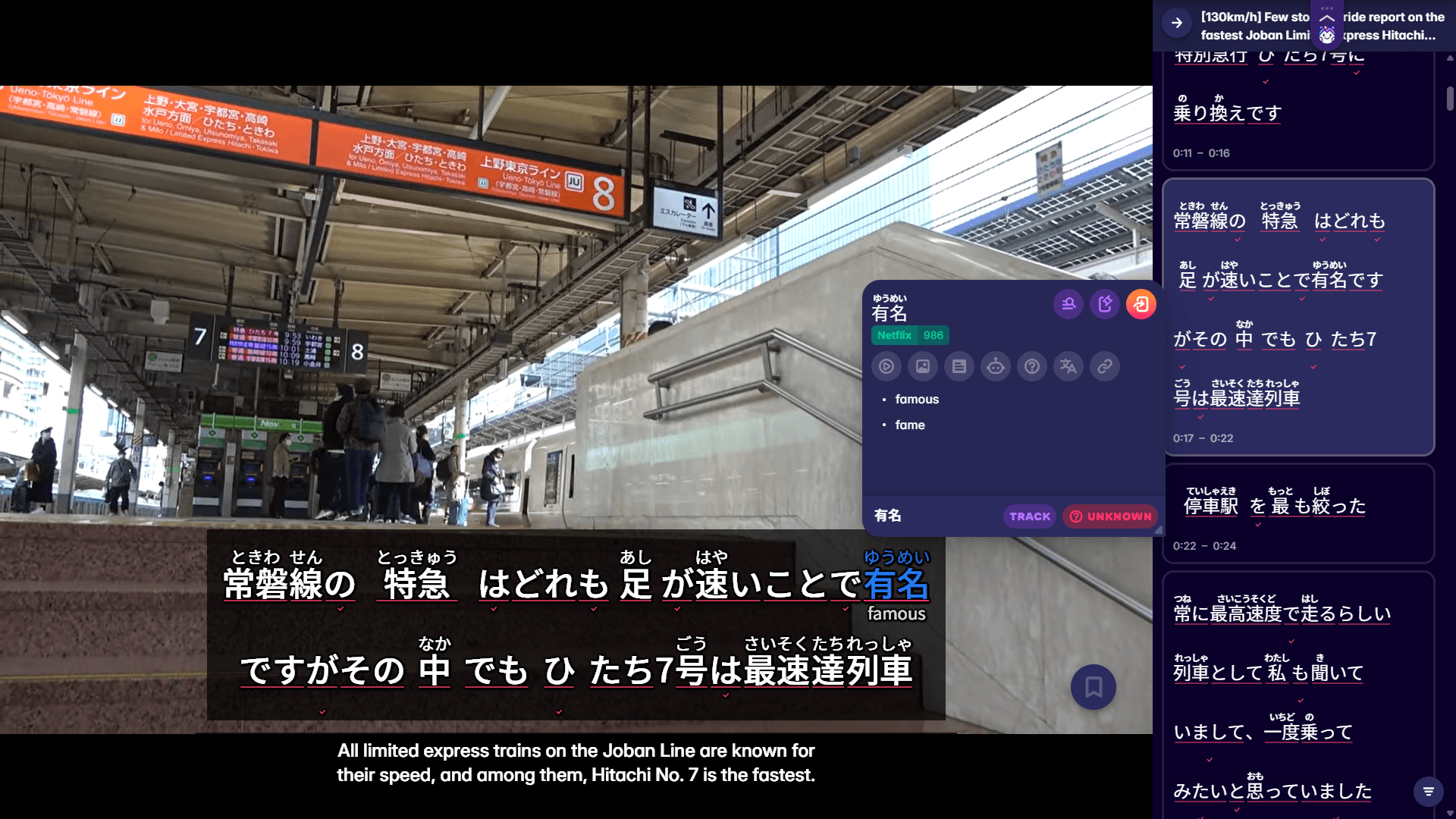
If you want to build your [Japanese vocabulary](https://migaku.com/blog/japanese/how-to-learn-japanese-vocabulary) through real content, Migaku's browser extension and app let you look up words instantly while watching Japanese shows or reading articles about travel in Japan. Makes learning from actual train station scenes and travel vlogs way more practical. There's a 10-day free trial if you want to check it out.
 ----
## Your ticket to confident train travel around Japan
Japanese train station vocabulary might seem overwhelming at first, but you'll use these same words repeatedly throughout your travels in Japan. The best way to really learn this vocabulary? If you haven't got a chance to go to Japan yet, watching train travel vlogs, reading news articles related to trains, and browsing through timetables and maps can greatly help you internalize all the essential train words.
> If you consume media in Japanese, and you understand at least some of the messages and sentences within that media, you will make progress. *Period*.
Practice the new words whenever you can!
----
## Your ticket to confident train travel around Japan
Japanese train station vocabulary might seem overwhelming at first, but you'll use these same words repeatedly throughout your travels in Japan. The best way to really learn this vocabulary? If you haven't got a chance to go to Japan yet, watching train travel vlogs, reading news articles related to trains, and browsing through timetables and maps can greatly help you internalize all the essential train words.
> If you consume media in Japanese, and you understand at least some of the messages and sentences within that media, you will make progress. *Period*.
Practice the new words whenever you can!