Common Korean Phrases and Words You'll Use Daily
Last updated: May 1, 2026

Whether you're planning a trip to Seoul, trying to impress your Korean friend, or just deep into K-drama binge mode, learning Korean high-frequency phrases makes everything way more fun. I'm going to focus on phrases Koreans actually use daily, from polite greetings to casual slang you'll hear in KakaoTalk messages. By the end of this, you'll have practical Korean words and expressions ready to go.
- Basic Korean greetings that matter
- Thank you and basic polite phrases
- Essential Korean phrases for getting around
- Common Korean phrases for food and dining
- Common questions and useful responses
- Learning Korean numbers
- Popular Korean slang and casual expressions
- Getting comfortable with Korean words and phrases
- FAQs
Basic Korean greetings that matter
Let's start with the greeting everyone knows: 안녕하세요 . This is your bread-and-butter Korean phrase. It means "hello" and works in pretty much any situation where you need to be polite. The pronunciation is roughly "ahn-nyoung-hah-seh-yo," and you'll use this constantly.
But here's what most guides don't tell you: Koreans also say 안녕 in casual settings. Drop the "haseyo" part when talking to friends or people younger than you. The formality level in Korean matters a lot, so knowing when to use which version is key.
For goodbye, you've got two options depending on who's leaving. If you're the one leaving, say 안녕히 계세요 , which means "stay well." If the other person is leaving, say 안녕히 가세요 , meaning "go well." Yeah, Korean makes you think about who's doing the leaving.
잘 지내세요 means "How are you?" or literally "Are you doing well?" The typical response is 네, 잘 지내요 , which means "Yes, I'm doing well." Simple enough.
Thank you and basic polite phrases
- 감사합니다 is the formal way to say "thank you." You'll hear this in stores, restaurants, and any professional setting. For casual situations, 고마워요 works better with friends and people you know well.
- When someone thanks you, respond with 천만에요 , which means "you're welcome" or literally "don't mention it." You can also say 괜찮아요 , which means "it's okay" or "no problem."
- 죄송합니다 is your formal apology, meaning "I'm sorry." Use this when you bump into someone, make a mistake, or need to get someone's attention politely. The casual version is 미안해 , which you'd use with friends.
- 실례합니다 means "excuse me" and is super useful when you need to get past someone or interrupt politely. I probably used this phrase a hundred times navigating crowded Seoul subway stations.
Essential Korean phrases for getting around
If you're traveling in Korea, these phrases will save you constantly.
- 어디에요 means "where is it?" Add a location before it: 화장실 어디에요 asks "where is the bathroom?" You'll use that one a lot.
- 얼마예요 means "how much is it?" Perfect for shopping at markets where prices aren't always displayed. Koreans appreciate when foreigners try to speak Korean, even basic phrases like this.
- 여기요 literally means "here" but functions as "excuse me" to get a server's attention at restaurants. Just say it loud enough and raise your hand slightly. Way more effective than trying to make eye contact.
- 주세요 means "please give me" and you'll attach it to whatever you want. 물 주세요 is "water, please." 이거 주세요 means "this one, please" while pointing at menu items. Super practical.
- For directions, 어떻게 가요 means "how do I get there?"
Common Korean phrases for food and dining
Korean food culture is something you shouldn't miss, so you'll want these phrases ready.
- 잘 먹겠습니다 is what you say before eating, kind of like "I will eat well" or "thank you for the food." It shows respect and gratitude.
- After eating, say 잘 먹었습니다 , which means "I ate well." Servers and hosts love hearing this.
- 맛있어요 means "it's delicious." Use this liberally when the food is good.
- 매워요 means "it's spicy," which you'll definitely need to know. Korean food can get seriously spicy.
- 배 고파요 means "I'm hungry," literally "my stomach is empty."
- 배 불러 means "I'm full."
- 계산 해 주세요 means "check, please" or "bill, please." You typically pay at the counter in Korean restaurants rather than at the table, so you might not even need this phrase. But it's good to know anyway.
Common questions and useful responses
- 네 means "yes" and 아니요 means "no." Pretty straightforward. But Koreans also use 응 for casual "yeah" with friends.
- 뭐예요 means "what is it?" You'll use this constantly when you don't understand something.
- 왜 means "why," another essential question word.
- 영어 할 줄 알아요 asks "Do you speak English?" This phrase has saved me multiple times when completely lost.
- 천천히 말 해 주세요 means "please speak slowly." When someone's speaking too fast, this phrase is your friend. Don't be shy about using it.
- 이것 뭐라고 해요 means "what do you call this?" Point at something and ask this when you want to learn new Korean words.
Learning Korean numbers
Korean actually has two number systems, which is kind of annoying but you get used to it. For counting items and telling age, you use native Korean numbers. For dates, money, and addresses, you use Sino-Korean numbers (borrowed from Chinese).
Here are the numbers 1 through 10, which you'll use most often:
Number | Sino-Korean | Native Korean |
|---|---|---|
1 | 일 (il) | 하나 (hana) |
2 | 이 (i) | 둘 (dul) |
3 | 삼 (sam) | 셋 (set) |
4 | 사 (sa) | 넷 (net) |
5 | 오 (o) | 다섯 (daseot) |
6 | 육 (yuk) | 여섯 (yeoseot) |
7 | 칠 (chil) | 일곱 (ilgop) |
8 | 팔 (pal) | 여덟 (yeodeol) |
9 | 구 (gu) | 아홉 (ahop) |
10 | 십 (sip) | 열 (yeol) |
When ordering food or buying things, you'll use these numbers. 이거 삼 개 주세요 means "three of these, please."
Popular Korean slang and casual expressions
If you want to sound natural and connect with younger Koreans, learning some Korean slang helps a lot.
- 대박 is probably the most useful slang term. It means "awesome," "amazing," or "wow." You'll hear this constantly in casual conversation and K-dramas.
- 진짜 means "really" or "seriously." Use it for emphasis: 진짜 맛있어요 means "it's really delicious."
- 헐 is an exclamation of surprise or disbelief, kind of like "what" or "no way."
- 오모 or 오모나 expresses surprise too, often used by women.
- 아싸 is like "yes!" or "alright!" when something good happens. You scored concert tickets? 아싸!
- 인싸 is recent slang meaning someone who's socially popular or "in the know," derived from "insider." The opposite is 아싸 , someone socially awkward or isolated.
Getting comfortable with Korean words and phrases
Look, learning common Korean phrases is just the starting point. The real progress happens when you start using these phrases with actual Korean content like shows, music, and conversations. You'll pick up pronunciation naturally by hearing native speakers.
- Don't stress about perfect pronunciation at first. Koreans appreciate the effort when foreigners try to speak Korean, even if your accent is rough. The key is actually using these phrases instead of just memorizing them.
- Start with the greeting 안녕하세요, the thank you 감사합니다, and the apology 죄송합니다. These three phrases alone will get you surprisingly far in Korea.
- Practice the basic questions like 어디에요 for "where is it," 얼마예요 for "how much," and 뭐예요 for "what is it." You can mix and match these with nouns to ask about anything.
- One thing that really helps is learning Hangul, the Korean alphabet. It only takes a few hours to learn the basics, and suddenly you can read signs, menus, and text messages. Korean words make way more sense when you can see them written in Hangul instead of just romanization.
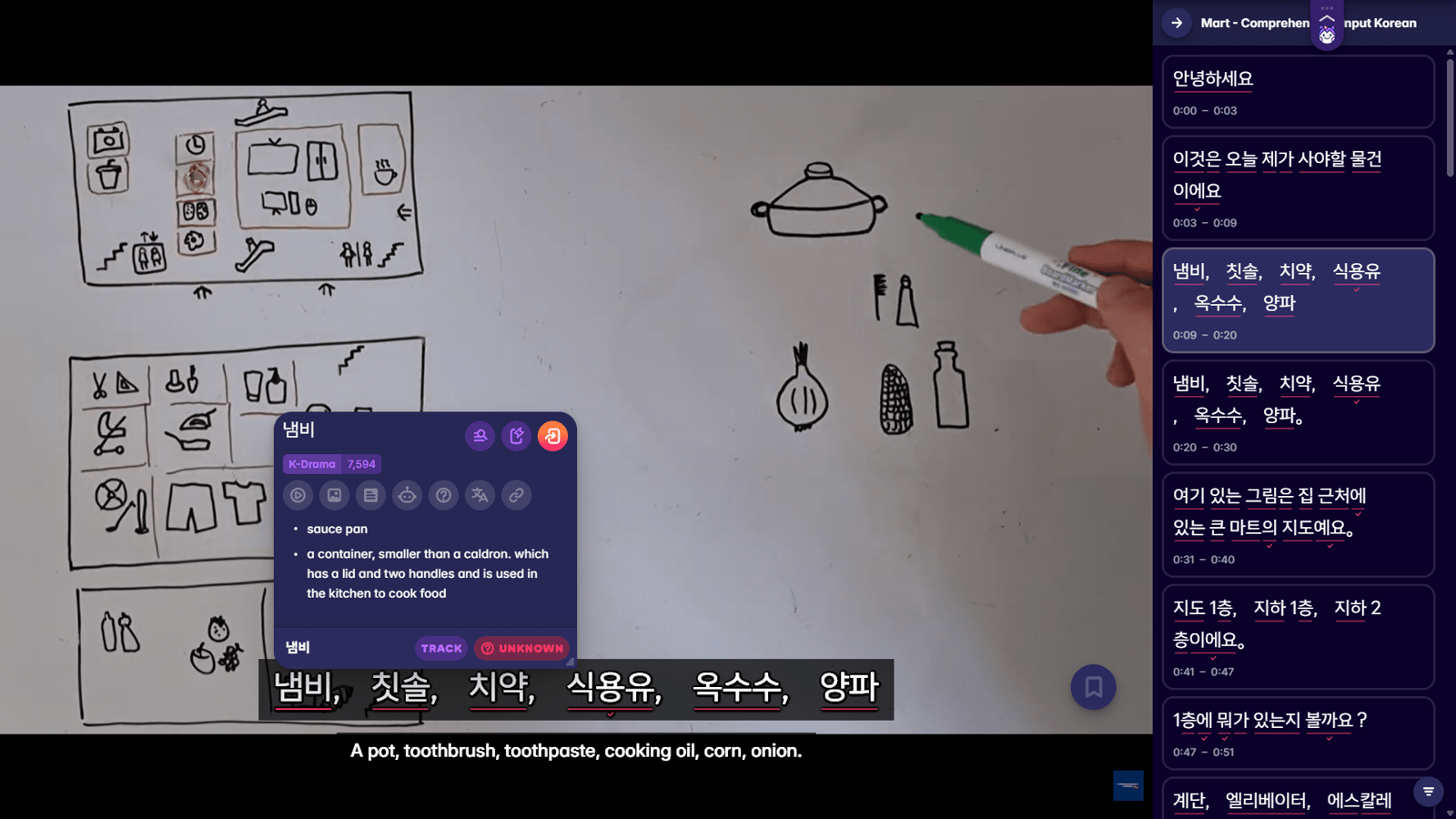
Anyway, if you want to level up from memorizing phrases to actually understanding Korean in real contexts, Migaku's browser extension and app let you look up Korean words instantly while watching K-dramas or reading Korean websites. Makes immersion learning way more practical. There's a 10-day free trial if you want to check it out.
FAQs
Learn basic Korean words and phrases, and put them in use from Day 1
The phrases of greetings, dining, numbers, and more are what you can hear constantly in daily conversations, and what you will use very often once you arrive in South Korea. The difference between someone who studied Korean phrases and someone who can actually speak Korean comes down to practice with real content. You need exposure to natural speech patterns, different voices, and contextual usage.
If you consume media in Korean, and you understand at least some of the messages and sentences within that media, you will make progress. Period.
A practical start beats a perfect plan.☕