How Long to Learn Korean? Real Timelines for English Speakers
Last updated: April 1, 2026

You're thinking about learning Korean, and honestly, the first question everyone asks is "how long is this going to take?" The answer depends on what you mean by "learn." Are we talking about reading Hangul, ordering food in Seoul, watching K-dramas without subtitles, or becoming fluent in Korean? Each level requires different time investments, and I'll break down realistic timelines based on how much effort you're willing to put in.
How long does it take to learn the Korean alphabet
Here's some good news: Hangul is probably the easiest writing system you'll ever learn. King Sejong designed it in the 15th century specifically so regular people could read and write, and it works. Most learners can memorize all 24 basic letters in just a few hours of focused study.
If you sit down with a Hangul chart and practice writing each character, you'll recognize them within a single afternoon. Being able to actually read words fluently takes a bit longer, maybe a week of daily practice. The characters combine into syllable blocks, so you need time to train your brain to see 한 as one unit instead of three separate letters.
The cool part about Hangul is that once you know it, you can sound out any Korean word you see. You might not know what it means, but you can read it. This takes maybe 10-15 hours total if you're being thorough about it.
The FSI timeline: 2,200 hours to become fluent in Korean
The Foreign Service Institute classifies Korean as a Category IV language for English speakers, which means it's one of the harder languages to learn. Their estimate says you need about 2,200 hours of study to reach professional working proficiency.
That number assumes you're in an intensive classroom environment with homework, immersion practice, and consistent daily study. For self-learners, the timeline usually stretches longer because you're figuring things out as you go.
Let's put 2,200 hours in perspective.
- If you study one hour per day, that's about six years.
- Three hours daily gets you there in roughly two years.
- Five hours a day, which is what full-time language students do, means you could become fluent in Korean in about 14-15 months.
These are ballpark figures, though. Some people hit fluency faster, others take longer. The FSI teaches diplomats who need to work in Korean professionally, so their bar for "fluent" is pretty high.
Breaking down timelines by level of fluency in Korean
Beginner level (3-6 months)
At this stage, you're learning basic grammar patterns, essential vocabulary, and getting comfortable with Hangul in real contexts. You can introduce yourself, order at restaurants, ask for directions, and handle simple conversations about daily life.
Expect to study 1-2 hours daily to reach this point in about three months. You'll know maybe 500-1,000 words and recognize common sentence structures. Korean dramas will still sound like rapid-fire gibberish, but you'll catch random words here and there.
This is where most casual learners plateau if they're just doing it for fun. You can survive a vacation to Korea at this level, which is honestly enough for some people.
Intermediate level (1-2 years)
Now you're getting somewhere. You can have actual conversations about various topics, understand the main points in Korean media (with some help), and express opinions beyond just "I like this" or "that's expensive."
To reach intermediate proficiency, you're looking at 600-1,000 hours of study time. If you want to learn Korean seriously, this is where consistent daily practice really matters. Studying Korean for 2 hours every single day will get you here in about a year to 18 months.
Your vocabulary expands to 2,000-3,000 words. You understand how verb conjugations work, can use different speech levels appropriately (formal vs casual), and start picking up on cultural nuances in language.
Advanced level (2-4 years)
This is where you can actually use Korean in professional settings, read novels or news articles without constantly checking a dictionary, and follow TV shows or movies at normal speed. You're not perfectly fluent yet, but you're definitely proficient.
Getting here takes roughly 1,500-2,000 hours of study. You know 5,000+ words, handle complex grammar structures naturally, and can discuss abstract topics like politics, philosophy, or technical subjects in your field.
Most people living in Korea who seriously study the language reach this level after a few years. You still make mistakes, and native speakers can tell you're not Korean, but communication flows smoothly.
Fluency (3-5+ years)
True fluency means you think in Korean, understand subtle jokes and wordplay, use idioms naturally, and can handle any situation that comes up. This takes most English speakers at least 2,200 hours, often more.
If you want to become fluent in Korean, plan for 3-5 years of consistent study and practice. Some people get there faster with full immersion, others take longer. The key is maintaining your study habits over the long haul without burning out.
What affects how long it takes to study Korean
Your language background
Being an English speaker puts you at a disadvantage compared to Japanese or Chinese speakers learning Korean. Japanese shares similar grammar structures with Korean, and Chinese speakers already know many of the Sino-Korean vocabulary words.
If you've learned other languages before, especially Asian languages, you'll pick up Korean faster. Your brain already knows how to handle new grammar systems and memorize vocabulary efficiently.
Study intensity and consistency
Here's the thing: studying Korean for three hours every Sunday won't get you as far as 30 minutes every single day. Language learning rewards consistency over cramming.
Your brain needs regular exposure to move information from short-term to long-term memory. Daily practice, even if it's brief, beats sporadic marathon sessions every time.
Quality of study methods
Spending hours on grammar drills might feel productive, but it won't help you speak Korean or understand real conversations. The methods you use matter just as much as the time you put in.
Immersion-based learning, where you engage with actual Korean content like shows, podcasts, or conversations, tends to be more efficient than traditional textbook study alone. You learn words in context, pick up natural speech patterns, and stay motivated because you're consuming interesting content.
Your personal goals
If you just want to understand K-pop lyrics or follow along with dramas, you don't need full fluency. Conversational ability for travel requires way less time than business-level proficiency.
Be honest about what you actually want. Adjusting your goals to something realistic keeps you motivated and prevents burnout from chasing an unnecessarily high standard.
Immersion opportunities
Living in Korea obviously accelerates your learning. You're forced to use the language daily, you hear it constantly, and you pick up colloquial expressions that textbooks never teach.
But you can create immersion at home too. Watching Korean content, changing your phone's language settings, finding language exchange partners online, and consuming Korean social media all help. It won't match actually living in Korea, but it definitely speeds things up compared to classroom study alone.
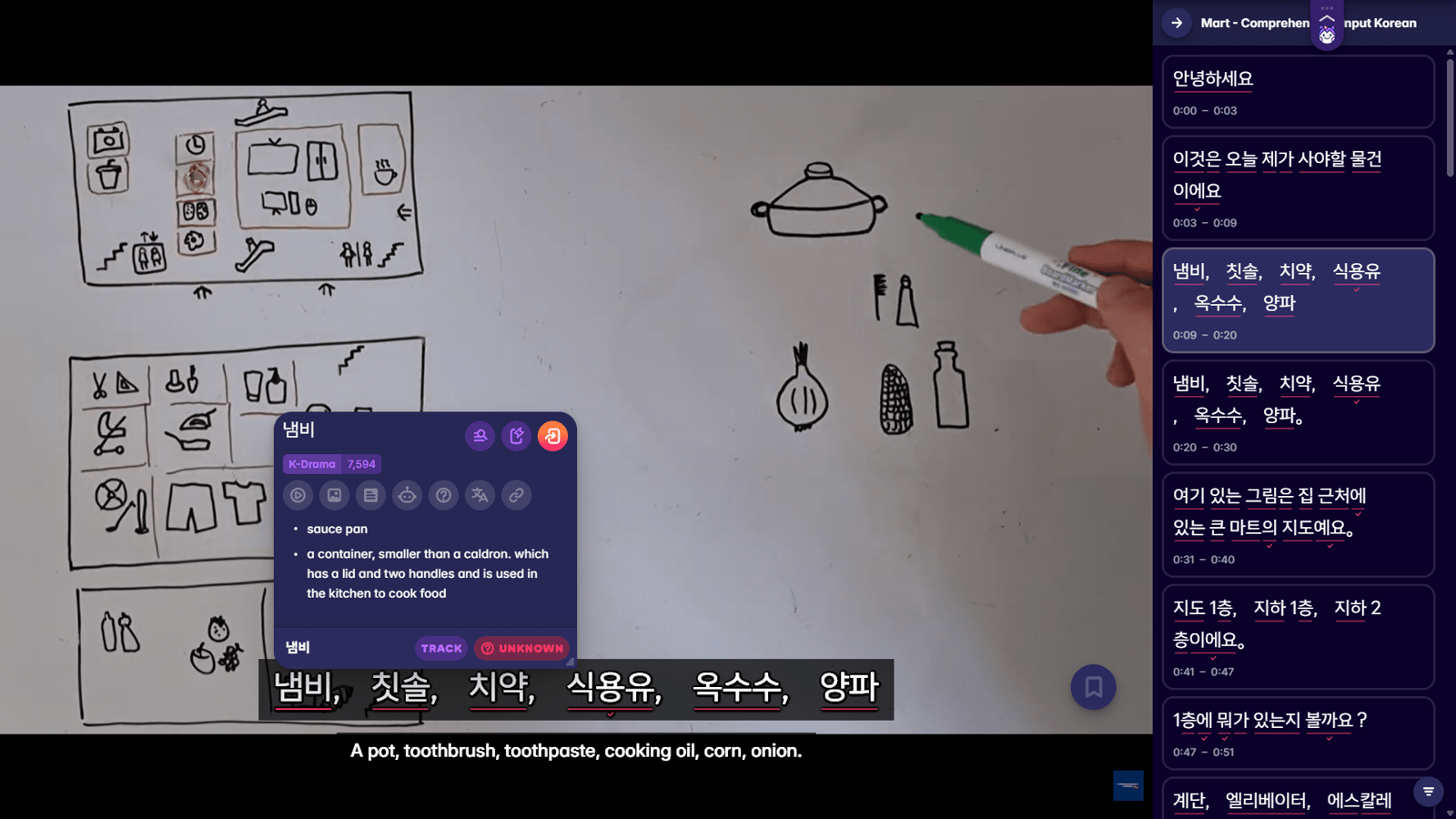
If you're ready to actually start learning through real Korean content, Migaku's browser extension and app let you look up words instantly while watching shows or reading articles. Makes the whole immersion thing way more practical. There's a 10-day free trial if you want to check it out.
FAQs
Lisa from Thailand also learned through immersion as a trainee at YG Entertainment. She arrived knowing basically no Korean and became fluent after 1 year of intensive daily exposure, practice, and usage. These idols had advantages most learners don't have: they were young (teens or early twenties), fully immersed 24/7, highly motivated (their careers depended on it), and had access to teachers and native speakers constantly. Their timelines aren't realistic for typical self-learners, but they show what's possible with full immersion.
There's no magic number that applies to everyone in language learning
The time it takes to learn Korean depends on your goals, your methods, your consistency, and honestly, how much you enjoy the process. And if language learning is new to you, it may take a longer time to explore an effective routine that combines vocabulary, grammar, speaking practice, and immersion learning. But as long as you are exposing yourself to the language, you are making progress.
If you consume media in Korean, and you understand at least some of the messages and sentences within that media, you will make progress. Period.
Progress doesn't need to be fast to be real.