# Korean Adjectives Guide: Essential Korean Adjectives and How to Conjugate Them
> Korean adjectives conjugate like verbs. Here's the guide covering conjugation rules, common adjectives, and practical sentence examples for beginners.
**URL:** https://migaku.com/blog/korean/korean-adjectives-guide
**Last Updated:** 2026-03-20
**Tags:** vocabulary, phrases
---
If you're [learning Korean](https://migaku.com/learn-korean), you've probably noticed something weird about adjectives. They conjugate. They change forms based on tense, [politeness level](https://migaku.com/blog/korean/korean-honorifics), and sentence type, just like verbs do. Coming from English, where adjectives just sit there looking pretty, this feels strange at first. But here's the thing: Korean adjectives are actually a type of verb called **descriptive verbs**, and understanding how they work will make your Korean way more natural.
----
## What makes Korean adjectives different from English adjectives
English adjectives are simple. You stick them before a noun, and you're done. "The big house." "A beautiful day." They never change form, whether you're talking about the past, present, or future.
Korean adjectives work completely differently. Every Korean adjective ends in **다** in its dictionary form, exactly like verbs. 크다 (to be big), 아름답다 (to be beautiful), 좋다 (to be good). Notice how I translated these as "to be (adjective)" rather than just the adjective alone? That's because **they function as complete predicates in Korean sentences**.
When you want to say "The house is big" in Korean, you're literally saying "The house big-does." The adjective 크다 conjugates to 크다 → 커요 in polite present tense. The adjective itself acts as the main verb of the sentence. Pretty cool how that works.
This is why Korean grammar guides call them **descriptive verbs**. They describe qualities or states, but they behave grammatically like action verbs. You conjugate them for tense, you add politeness endings to them, and they can stand alone as the predicate of a sentence.
----
## How Korean adjectives conjugate like verbs
The conjugation rules for Korean adjectives follow the same patterns as regular verbs. You take the stem (remove 다 from the dictionary form) and add various endings depending on what you want to express.
### Present tense polite form
For present tense polite form, you use the **아요/어요** ending. The choice between 아요 and 어요 depends on the final vowel of the stem. If the stem's last vowel is ㅏ or ㅗ, you use 아요. For all other vowels, you use 어요.
Let's look at 작다 (to be small). The stem is 작. The last vowel is ㅏ, so you add 아요. But here's where it gets interesting: 작 + 아요 contracts to 작아요. Korean loves to contract these combinations when the stem ends in a vowel.
For 크다 (to be big), the stem is 크. The vowel is ㅡ, which means you use 어요. 크 + 어요 becomes 커요 after contraction.
### Past tense
Past tense uses the **았어요/었어요** ending. Same vowel harmony rules apply. 작다 becomes 작았어요 (was small), and 크다 becomes 컸어요 (was big).
### Future tense
Future tense adds **을 거예요 or ㄹ 거예요** to the stem. If the stem ends in a consonant, use 을 거예요. If it ends in a vowel, use ㄹ 거예요. So 작다 becomes 작을 거예요 (will be small), and 크다 becomes 클 거예요 (will be big).
The conjugation patterns match action verbs perfectly. Once you learn verb conjugation, you already know how to conjugate adjectives.
----
## Common Korean adjectives every beginner should know
Here's a practical list of adjectives you'll use constantly. I'm grouping them by category to make them easier to remember.
**Size and dimension:**
| Korean | English |
| - | - |
| 크다 | To be big |
| 작다 | To be small |
| 길다 | To be long |
| 짧다 | To be short |
| 높다 | To be high / tall |
| 낮다 | To be low |
**Temperature and sensation:**
| Korean | English |
| - | - |
| 덥다 | To be hot (weather) |
| 춥다 | To be cold (weather) |
| 뜨겁다 | To be hot (objects) |
| 차갑다 | To be cold (objects) |
| 따뜻하다 | To be warm |
| 시원하다 | To be cool / refreshing |
**Emotional states:**
| Korean | English |
| - | - |
| 기쁘다 | To be happy / glad |
| 슬프다 | To be sad |
| 화나다 | To be angry |
| 외롭다 | To be lonely |
| 무섭다 | To be scary / afraid |
**Quality and evaluation:**
| Korean | English |
| - | - |
| 좋다 | To be good |
| 나쁘다 | To be bad |
| 예쁘다 | To be pretty |
| 아름답다 | To be beautiful |
| 맛있다 | To be delicious |
| 맛없다 | To be bad tasting |
| 재미있다 | To be interesting / fun |
| 재미없다 | To be boring |
**Basic descriptors:**
| Korean | English |
| - | - |
| 새롭다 | To be new |
| 오래되다 | To be old (things) |
| 깨끗하다 | To be clean |
| 더럽다 | To be dirty |
| 쉽다 | To be easy |
| 어렵다 | To be difficult |
These adjectives end in 다 in their dictionary form, and you'll conjugate them based on the context. Memorizing these with their conjugated forms will make your Korean sound way more natural.
----
## How to use Korean adjectives in sentences
Korean adjectives can work in two main ways: as **predicates** or as **modifiers before nouns**.
> 💡When a Korean adjective functions as the main **predicate**, it comes at the end of the sentence. The basic sentence structure is: **Subject + Adjective.**
- 날씨가 좋아요.
*The weather is good.*
- 이 책이 재미있어요.
*This book is interesting.*
- 커피가 뜨거워요.
*The coffee is hot.*
Notice how the adjective conjugates and sits at the end? The adjective carries all the grammatical information about tense and politeness level.
> 💡When you want to use a Korean adjective to modify a noun directly (like English adjectives do), you need to **add a modifier ending**. The present tense modifier ending is **ㄴ/은** for adjectives.
If the adjective stem ends in a vowel, add ㄴ. If it ends in a consonant, add 은.
- 작다 (to be small) → 작은 집 (small house)
- 크다 (to be big) → 큰 집 (big house)
- 좋다 (to be good) → 좋은 사람 (good person)
- 예쁘다 (to be pretty) → 예쁜 꽃 (pretty flower)
The position before nouns works similarly to English adjectives in this case, but remember that you had to conjugate the adjective into its modifier form first. You can't just stick the dictionary form in front of a noun.
For past tense modification, you use 었던/았던:
- 작았던 집 (house that was small)
- 좋았던 시간 (time that was good)
This is how you describe nouns with qualities from the past.
----
## Making negative adjectives in Korean
Can you make negative adjectives in Korean? Yep, and there are two main ways to do it.
> 💡The first method uses **안 before the adjective**. This is the simpler, more conversational way.
- 안 좋아요.
*It's not good.*
- 안 커요.
*It's not big.*
- 안 예뻐요.
*It's not pretty.*
Just stick 안 right before the conjugated adjective. Easy.
> 💡The second method uses **the ending 지 않다**. This sounds a bit more formal and emphatic.
- 좋지 않아요.
*It's not good.*
- 크지 않아요.
*It's not big.*
- 예쁘지 않아요.
*It's not pretty.*
You attach 지 않다 to the stem of the adjective, then conjugate 않다 according to tense and politeness. This construction emphasizes the negation more strongly than just using 안.
Some adjectives have their own negative counterparts as separate words. 맛있다 (delicious) has 맛없다 (not delicious). 재미있다 (interesting) has 재미없다 (boring). These work as independent adjectives with their own conjugations.
----
## How to conjugate adjectives based on tense
Let me break down the main tense conjugations with a specific example: 좋다 (to be good).
### Present tense
Present tense uses 아요/어요:
- Polite: 좋아요
- Casual: 좋아
- Formal: 좋습니다
The stem is 좋, and since the vowel is ㅗ, you use 아요. 좋 + 아요 contracts to 좋아요.
### Past tense
[Past tense uses 았어요/었어요](https://migaku.com/blog/korean/korean-past-tense):
- Polite: 좋았어요
- Casual: 좋았어
- Formal: 좋았습니다
Again, the ㅗ vowel means you use the 았 version. This translates to "was good."
### Future tense
[Future tense uses ㄹ 거예요](https://migaku.com/blog/korean/korean-future-tense)/을 거예요:
- 좋을 거예요 (will be good)
Since 좋 ends in a consonant (ㅎ), you add 을 거예요.
There's also the future tense using 겠어요, which expresses assumption or conjecture:
- 좋겠어요.
*It will probably be good. / I hope it's good.*
### Modifying nouns
For modifying nouns, the tense changes the ending:
- Present: 좋은 (good, as in "a good book")
- Past: 좋았던 (that was good)
- Future: 좋을 (that will be good)
Let's try another example with different vowel harmony. 크다 (to be big):
- Present: 커요 (stem 크 + 어요 = 커요)
- Past: 컸어요
- Future: 클 거예요
- Modifier: 큰 (big, before noun)
The conjugation system stays consistent across all Korean adjectives. Once you internalize the vowel harmony rules and contraction patterns, you can conjugate any adjective you encounter.
----
## Special conjugation patterns and irregular adjectives
Some Korean adjectives follow irregular patterns that you need to memorize separately. These irregularities happen with certain final consonants in the stem.
**ㅂ irregular adjectives** drop the ㅂ and add 우 before vowel endings.
- 춥다 (to be cold): 추워요 (not 춥어요)
- 덥다 (to be hot): 더워요
- 아름답다 (to be beautiful): 아름다워요
**ㄷ irregular adjectives** change ㄷ to ㄹ before vowel endings.
- 듣다 (to hear/listen) is a verb, but the pattern applies to some descriptive words too.
- The adjective 걷다 when meaning "to walk" follows this, though it's technically a verb.
**ㅅ irregular adjectives** drop the ㅅ before vowel endings.
- 낫다 (to be better): 나아요
**ㅎ irregular adjectives** drop the ㅎ before certain endings.
- 그렇다 (to be so/like that): 그래요
- 이렇다 (to be like this): 이래요
- 어떻다 (to be how): 어때요
These irregulars trip up beginners constantly. You just have to practice them until the patterns become automatic. The good news is that most common adjectives are regular, so you'll get plenty of practice with the standard patterns before dealing with irregulars.
----
## Practical tips for learning Korean adjectives
1. Start with the most common adjectives and drill their conjugations. The list I gave earlier covers probably 80% of the adjectives you'll use in everyday conversation.
2. Practice conjugating adjectives in all three tenses. Write out conjugation tables for 좋다, 크다, 작다, 예쁘다, and 재미있다. Do it by hand. The physical act of writing helps cement the patterns.
3. Learn adjectives in context, not in isolation. Instead of memorizing "크다 = big," learn the phrase "큰 집이에요" (It's a big house) or "집이 커요" (The house is big). This shows you both the modifier form and the predicate form.
4. Pay attention to vowel harmony from day one. The 아요/어요 distinction based on the stem's final vowel is crucial. If you ignore it early on, you'll form bad habits that are hard to break later.
5. Use Korean adjectives in your speaking practice immediately. Describe everything around you. "이 커피가 뜨거워요." "날씨가 좋아요." "이 책이 재미있어요." The more you produce these sentences, the more natural the conjugations become.
6. Listen for adjectives in Korean content. When you watch Korean shows or listen to Korean music, notice how speakers use adjectives. You'll hear them at the end of sentences constantly, and you'll start to internalize the natural rhythm of descriptive sentences.
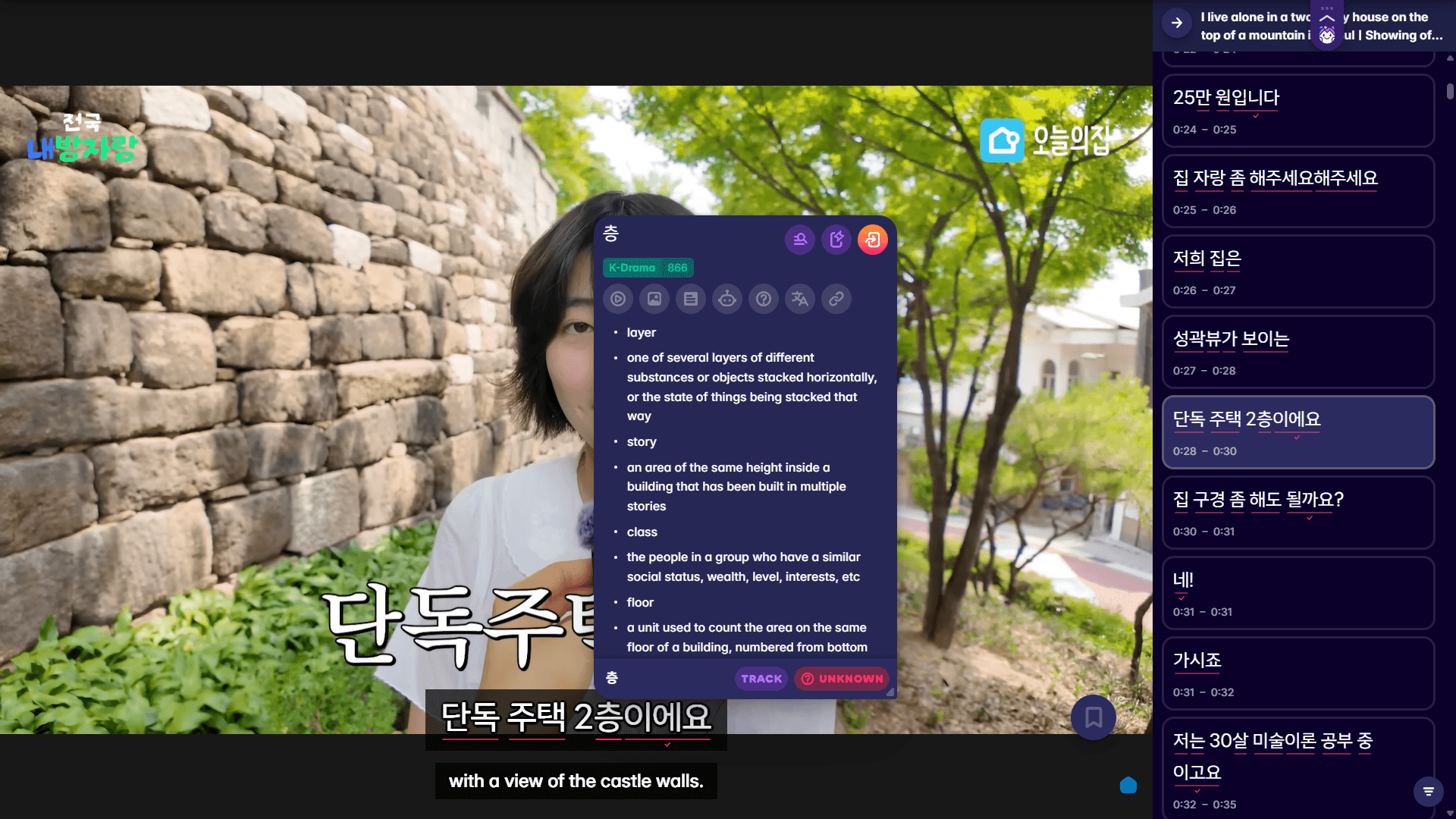
Anyway, if you want to practice using Korean adjectives with real content, Migaku's browser extension and app let you look up words instantly while [watching Korean shows](https://migaku.com/blog/korean/best-korean-shows-for-learning) or reading Korean articles. Makes immersion learning way more practical. There's a 10-day free trial if you want to check it out.
 ----
## Learning descriptive verbs is fundamental to your Korean fluency
You can't avoid them. Every time you describe something, express an opinion, or talk about qualities, you're using descriptive verbs. The conjugation system might feel overwhelming at first, especially coming from English where adjectives just sit there unchanged. But now that you know these basic rules in Korean language, you can actively pay attention to how native speakers conjugate Korean adjectives when consuming media content. With time, you will gradually internalize these rules and be able to put them into practice confidently.
> If you consume media in Korean, and you understand at least some of the messages and sentences within that media, you will make progress. _Period_.
The more you practice, the more automatic it becomes.
----
## Learning descriptive verbs is fundamental to your Korean fluency
You can't avoid them. Every time you describe something, express an opinion, or talk about qualities, you're using descriptive verbs. The conjugation system might feel overwhelming at first, especially coming from English where adjectives just sit there unchanged. But now that you know these basic rules in Korean language, you can actively pay attention to how native speakers conjugate Korean adjectives when consuming media content. With time, you will gradually internalize these rules and be able to put them into practice confidently.
> If you consume media in Korean, and you understand at least some of the messages and sentences within that media, you will make progress. _Period_.
The more you practice, the more automatic it becomes.