# Korean Characters: Complete Guide to Hangul & the Korean Alphabet
> Hangul has just 24 letters and you can master them in hours. Complete guide to the Korean alphabet, vowels, consonants, and syllables.
**URL:** https://migaku.com/blog/korean/korean-characters-hangul-guide
**Last Updated:** 2026-04-27
**Tags:** fundamentals, vocabulary, phrases, grammar
---
Hangul (한글 ) is probably one of the easiest writing systems you'll ever learn. That's an easy beginning for you if you're starting to [learn Korean](https://migaku.com/learn-korean). While Chinese characters can take years to master and even Japanese has three different writing systems to juggle, Korean characters are designed to be learned in a matter of hours or days. King Sejong the Great created Hangul back in 1443 specifically so that common people could learn to read and write. Let me walk you through everything you need to know about Korean characters, from how they work to how you can actually learn them fast.
----
## How the Korean alphabet was made
King Sejong the Great wasn't messing around when he created Hangul. He gathered a group of scholars and designed a writing system based on actual linguistic principles. This was revolutionary for the 15th century.
The consonants in Hangul are designed to visually represent the shape your mouth, tongue, and throat make when producing each sound. For example, the letter ㄱ (giyeok) represents a /g/ or /k/ sound, and if you look at it, it kind of shows the back of your tongue touching your soft palate.
The vowels are based on three elements: heaven (a dot, which became a short line), earth (a horizontal line), and human (a vertical line). These combine to form all the vowel letters in Hangul.
Pretty cool, right? This systematic approach makes Hangul incredibly logical to learn compared to writing systems that evolved organically over thousands of years.
----
## The Korean alphabet: Letters and structure
The Korean alphabet consists of **24 basic letters**: 14 consonants and 10 vowels. But wait, there's more. You can combine these to create double consonants and compound vowels, bringing the total to 40 letters if you count all variations.
Let me break this down for you.
### Consonants
The 14 basic consonants are:
- ㄱ (giyeok) sounds like /g/ or /k/
- ㄴ (nieun) sounds like /n/
- ㄷ (digeut) sounds like /d/ or /t/
- ㄹ (rieul) sounds like /r/ or /l/
- ㅁ (mieum) sounds like /m/
- ㅂ (bieup) sounds like /b/ or /p/
- ㅅ (siot) sounds like /s/
- ㅇ (ieung) is silent at the beginning, /ng/ at the end
- ㅈ (jieut) sounds like /j/
- ㅊ (chieut) sounds like /ch/
- ㅋ (kieuk) sounds like /k/ (aspirated)
- ㅌ (tieut) sounds like /t/ (aspirated)
- ㅍ (pieup) sounds like /p/ (aspirated)
- ㅎ (hieut) sounds like /h/
Then you have double consonants (called tensed consonants), which are pronounced with more tension:
- ㄲ (ssangiyeok) sounds like /kk/
- ㄸ (ssangdigeut) sounds like /tt/
- ㅃ (ssangbieup) sounds like /pp/
- ㅆ (ssangsiot) sounds like /ss/
- ㅉ (ssangjieut) sounds like /jj/
Does the Korean alphabet have F? Nope. Korean doesn't have an F sound in its native phonology. If Koreans need to write foreign words with F sounds, they typically use ㅍ (pieup), which makes a /p/ sound. So "coffee" becomes keopi (커피).
### Vowels
The 10 basic vowels are:
- ㅏ (a) sounds like /ah/
- ㅑ (ya) sounds like /yah/
- ㅓ (eo) sounds like /uh/
- ㅕ (yeo) sounds like /yuh/
- ㅗ (o) sounds like /oh/
- ㅛ (yo) sounds like /yoh/
- ㅜ (u) sounds like /oo/
- ㅠ (yu) sounds like /yoo/
- ㅡ (eu) sounds like /eu/ (no English equivalent)
- ㅣ (i) sounds like /ee/
There are also compound vowels formed by combining basic vowels:
- ㅐ (ae) sounds like /eh/
- ㅒ (yae) sounds like /yeh/
- ㅔ (e) sounds like /eh/
- ㅖ (ye) sounds like /yeh/
- ㅘ (wa) sounds like /wah/
- ㅙ (wae) sounds like /weh/
- ㅚ (oe) sounds like /weh/
- ㅝ (wo) sounds like /wuh/
- ㅞ (we) sounds like /weh/
- ㅟ (wi) sounds like /wee/
- ㅢ (ui) sounds like /ui/
The vowel system might look intimidating at first, but once you understand the basic 10, the compound vowels make total sense.
----
## How Korean syllables work
Here's where Korean gets really interesting. Korean characters don't line up horizontally like English letters. Instead, they form **syllable blocks**. Each block represents one syllable and contains 2-4 letters arranged in a square shape.
Every syllable block needs at least one consonant and one vowel. The arrangement follows specific patterns:
1. **Consonant + Vowel**: Like 나 (na), which combines ㄴ and ㅏ
2. **Consonant + Vowel + Consonant**: Like 한 (han), which combines ㅎ, ㅏ, and ㄴ
3. **Consonant + Compound Vowel**: Like 과 (gwa), which combines ㄱ and ㅘ
4. **Consonant + Vowel + Double Consonant**: Like 닭 (dak), which combines ㄷ, ㅏ, and ㄹㄱ
If a syllable starts with a vowel sound, you use the silent **ㅇ as a placeholder**. For example, the word for "language" in Korean is eon-eo (언어), which starts with a vowel sound but is written with ㅇ at the beginning.
This syllable block system is genius because it makes Korean incredibly compact to write while still being phonetic. You can pronounce any Korean word just by looking at it, once you know the letter sounds.
----
## Learning to read Korean hangul
Most learners can learn to read Hangul in about 2-3 hours of focused study. I'm not exaggerating. The system is that logical.
**Start with the basic consonants and vowels.** Don't worry about the double consonants or compound vowels yet. Just master those 24 basic letters first. Write them out by hand, practice the stroke order, and say each sound out loud.
**Then practice forming syllable blocks.** Take a consonant like ㄱ and combine it with each vowel. You'll get:
- 가 (ga)
- 거 (geo)
- 고 (go)
- 구 (gu)
- 그 (geu)
- 기 (gi)
Do this with every consonant, and you'll quickly internalize how syllable blocks work.
**Once you can read syllable blocks, start reading actual Korean words.** Here's a simple one: 한국 (hanguk), which means "Korea." You can see it's made of two syllable blocks: 한 (han) and 국 (guk).
The pronunciation aspect takes more time than just reading. Korean has sounds that don't exist in English, like the ㅓ vowel or the tense consonants. You'll need to listen to native speakers and practice mimicking the sounds. But being able to decode the letters comes fast.
----
## Korean characters in context
Once you can read Hangul, you'll start noticing Korean everywhere. K-pop lyrics, Korean dramas with subtitles, Korean food packaging, signs in Korean neighborhoods. Being able to read the characters, even if you don't understand the meaning yet, makes you feel way more connected to the language.
You'll also notice that **many Korean words are borrowed from English or other languages**, written phonetically in Hangul. Words like keopi (커피) for "coffee," k'eomp'yuteo (컴퓨터) for "computer," or aiseukeurim (아이스크림) for "ice cream." Being able to read these gives you a surprising amount of comprehension right away.
The Korean language has a rich vocabulary that includes native Korean words, Sino-Korean words (borrowed from Chinese), and modern loanwords from English and other languages. All of them are written in Hangul in modern Korean, making the writing system your gateway to all of this.
----
## Moving beyond basic characters
After you've mastered reading Hangul, the next challenge is **pronunciation rules**. Korean has various sound changes that happen when certain letters appear next to each other in words. For example, when ㄱ appears at the end of a syllable before ㄴ at the beginning of the next syllable, the ㄱ sound changes to ㅇ.
These pronunciation rules (called sound change rules or phonological rules) can be tricky, but they're predictable once you learn the patterns. Native speakers apply these rules automatically without thinking about them.
You'll also encounter more complex vocabulary that uses less common consonant clusters or vowel combinations. Medical terms, technical vocabulary, and formal language often use Sino-Korean words that can be harder to parse at first.
But here's the beautiful thing about Hangul: no matter how complex the vocabulary gets, you can always sound it out. There are no irregular spellings like in English (think "though," "through," "tough," "thought"). What you see is what you get.
----
## Tips to learn the Korean alphabet fast
1. **Practice with real Korean words from day one.** Don't just drill the letters in isolation. As soon as you learn a few consonants and vowels, start reading actual words. Even if you don't know what they mean yet, the practice of decoding syllable blocks is invaluable.
2. **Use mnemonics for tricky letters.** Some letters look similar, like ㅂ and ㅍ, or ㅈ and ㅊ. Create mental associations to keep them straight. For example, ㅍ has an extra line and makes a stronger /p/ sound (aspirated), so you can remember "more lines, more air."
3. **Write by hand, not just type.** Typing on a Korean keyboard is useful, but writing by hand forces you to remember the stroke order and really internalize each letter's shape. Get a notebook and fill pages with Hangul.
4. **Don't rely on romanization.** A lot of [Korean learning resources](https://migaku.com/blog/korean/best-korean-textbooks) include romanization (writing Korean with English letters), and while it can help at first, it becomes a crutch. Romanization can't accurately represent Korean sounds anyway. Wean yourself off it as quickly as possible.
5. **Practice reading out loud.** Even if you're just reading random signs in photos or Korean text you find online, practice saying the sounds out loud. This connects the visual letter with the pronunciation, which helps both reading and speaking.
6. **Learn common syllable blocks as units.** After a while, you'll stop decoding letter by letter and start recognizing common syllable blocks instantly. Syllables like 한, 국, 이, 가 appear constantly in Korean, so they'll become automatic.
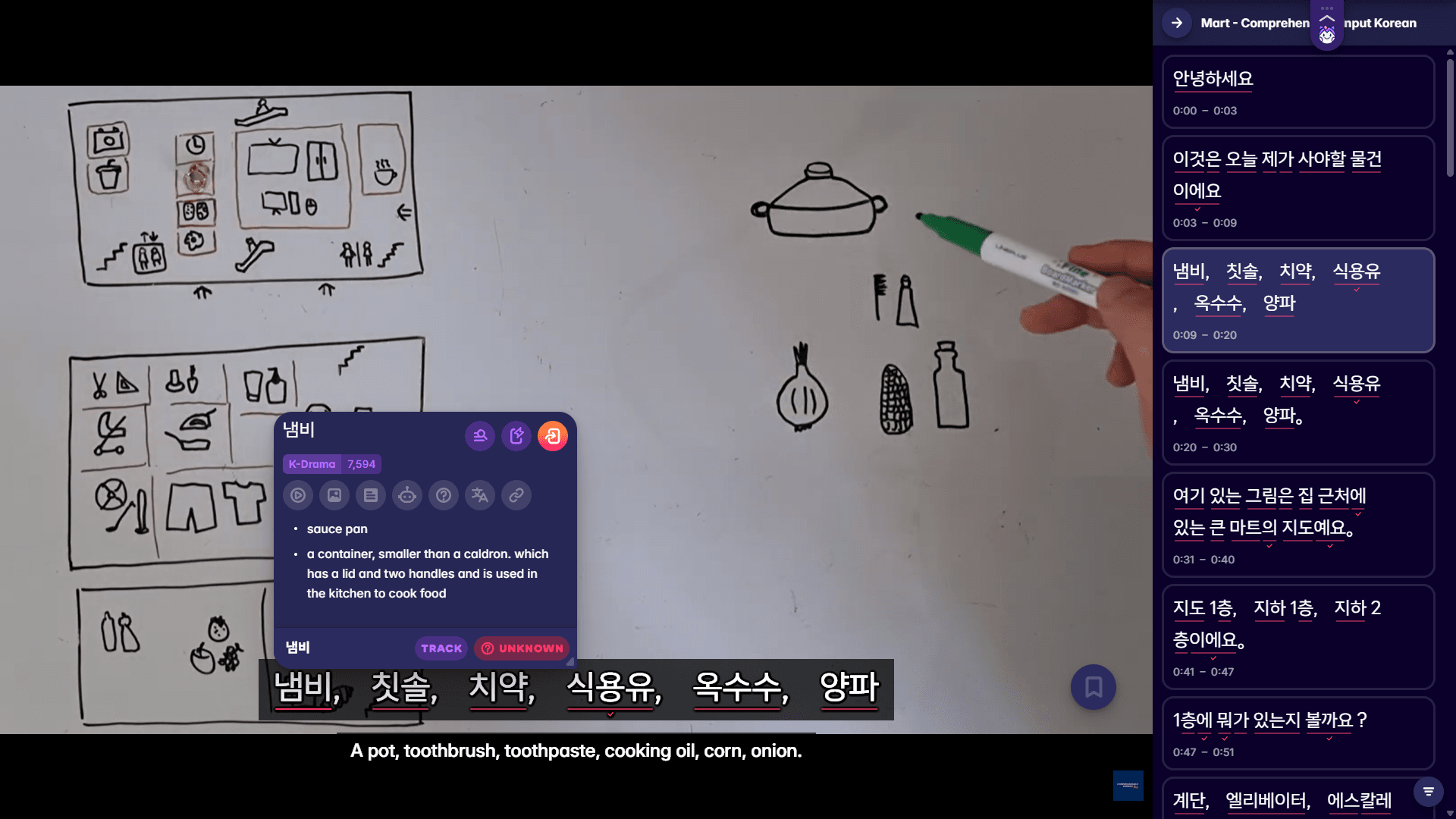
Anyway, if you want to level up your Korean learning with real content, Migaku's browser extension and app let you look up Korean words instantly while watching [Korean shows](https://migaku.com/blog/korean/best-korean-shows-for-learning) or reading Korean websites. You can see the Hangul, the pronunciation, and the meaning all at once, which makes immersion learning way more practical. There's a 10-day free trial if you want to check it out.
 ----
## Start using Korean characters today
The best way to learn is to just start. Grab a Hangul chart, spend an afternoon practicing, and you'll be reading Korean by dinner time. The 24 letters of Hangul are your foundation for everything else in Korean. Master them first, and the rest of your Korean learning journey becomes so much easier. You'll be able to read Korean word lists, look up vocabulary in dictionaries, read subtitles, and actually engage with authentic Korean content.
> If you consume media in Korean, and you understand at least some of the messages and sentences within that media, you will make progress. _Period_.
A solid start leads to a smoother path.💪😃
----
## Start using Korean characters today
The best way to learn is to just start. Grab a Hangul chart, spend an afternoon practicing, and you'll be reading Korean by dinner time. The 24 letters of Hangul are your foundation for everything else in Korean. Master them first, and the rest of your Korean learning journey becomes so much easier. You'll be able to read Korean word lists, look up vocabulary in dictionaries, read subtitles, and actually engage with authentic Korean content.
> If you consume media in Korean, and you understand at least some of the messages and sentences within that media, you will make progress. _Period_.
A solid start leads to a smoother path.💪😃