# Korean Connector Endings: Learn How to Link Clauses in Korean Grammar
> Use Korean connector endings like ~고, ~지만, and ~아서 to link clauses naturally. Practical guide with examples for building complex Korean sentences.
**URL:** https://migaku.com/blog/korean/korean-connector-endings
**Last Updated:** 2026-03-11
**Tags:** vocabulary, phrases, grammar
---
As [a Korean learner](https://migaku.com/learn-korean), you've probably noticed that Korean sentences don't just stack up one after another like English does. Korean has this whole system of connector endings that glue clauses together in ways that feel totally different from how we do things in English. These endings attach directly to verbs and adjectives, letting you build complex thoughts without needing separate conjunction words every time. Pretty cool how it works once you get the hang of it.
---
## What Korean connector endings do
> 💡 Definition 💡
Korean connector endings are [grammatical particles that attach](https://migaku.com/blog/korean/korean-particles) to the end of verb stems or adjective stems to link clauses together. They replace what English does with words like "and," "but," "so," and "because." Instead of using standalone conjunction words between two sentences, Korean smooshes the connector right onto **the end of the first clause's verb or adjective**.
Here's the thing about how Korean connector endings work. When you want to say "I ate lunch and went to school" in Korean, you don't put a separate word for "and" between the two actions. You modify the verb "ate" by adding the connector ending ~고 directly to its stem. The sentence becomes "점심을 먹고 학교에 갔어요" (jeomsimeul meokgo hakgyoe gasseoyo). The connector ~고 attaches to the verb stem 먹 (meok, to eat), creating 먹고 (meokgo, eat and).
This system exists because [Korean grammar fundamentally structures sentences](https://migaku.com/blog/korean/korean-sentence-structure) differently from English. Korean is an **SOV** (subject-object-verb) language, meaning the verb always comes at the end of a clause. The connector endings evolved as a natural way to chain these verb-final clauses together while maintaining grammatical flow.
---
## The basic Korean connector endings you need to know
### ~고 (and)
**The connector ~고 links two actions or states in sequence.** You attach it to the verb stem of the first action, then follow with the second clause.
Take the verb 가다 (gada, to go). Remove 다 to get the stem 가 (ga), then add ~고 to make 가고 (gago, go and).
Example:
- 커피를 마시고 책을 읽었어요.
*I drank coffee and read a book.*
The ~고 connector works for both verbs and adjectives. When describing multiple qualities, you can chain them together: 그 사람은 키가 크고 친절해요 (That person is tall and kind).
One quirky thing about ~고 is that it doesn't always mean the actions happen in strict sequence. Sometimes it just lists related facts. The sentence "한국어를 공부하고 일본어도 배워요" could mean "I study Korean and also learn Japanese" without implying one happens before the other.
### ~지만 (but, however)
When you want to **express opposition or contrast** between two clauses, ~지만 does the job. This connector attaches to verb stems just like ~고, but it introduces a contrasting idea.
Example:
- 비가 오지만 밖에 나갈 거예요.
*It's raining, but I'm going outside.*
The verb 오다 (oda, to come/fall) becomes 오지만 (ojiman, comes but). You can use this connector with any verb or adjective stem to show contrast.
Korean learners often confuse ~지만 with another connector, ~는데, because both can translate to "but" in English. The difference is that ~지만 creates a stronger, more direct opposition. If you say "한국어는 어렵지만 재미있어요" (Korean is difficult but fun), you're setting up a clear contrast. The ~는데 connector, which we'll get to, feels softer and more explanatory.
### ~는데 (but, and, explanatory context)
Here's where Korean grammar gets interesting. The connector ~는데 doesn't have a single clean English translation. **It provides background information, sets up context, or introduces a mild contrast.**
For verbs, you attach ~는데 to the stem. For adjectives and past tense, the form changes slightly. Present tense verbs take ~는데, adjectives take ~ㄴ데/은데, and past tense takes ~았는데/었는데.
Example with a verb:
- 어제 친구를 만났는데 기분이 안 좋아 보였어요.
*I met my friend yesterday, and they looked upset.*
- 날씨가 좋은데 산책할까요?
*The weather is nice, so shall we take a walk?*
The ~는데 connector shows up constantly in spoken Korean. People use it to soften statements, provide explanations, or transition between thoughts. When someone says "저는 학생인데요..." (I'm a student, and...), they're setting up context for whatever comes next.
### ~거나 (or)
**To express alternatives or choices**, Korean uses ~거나. This connector means "or" when presenting options.
Example:
- 주말에 영화를 보거나 책을 읽어요.
*On weekends, I watch movies or read books.*
You can repeat ~거나 for multiple options: 커피를 마시거나 차를 마시거나 물을 마셔요 (I drink coffee, tea, or water).
The related connector ~나 works similarly but attaches differently depending on whether the verb stem ends in a vowel or consonant. For [basic Korean learners](https://migaku.com/blog/korean/learn-basic-korean-grammar), ~거나 works in most situations and sounds natural.
### ~아서/어서 (so, because)
When you need to **express cause and reason**, the connectors ~아서 and ~어서 handle that job. Which one you use depends on the vowel in the verb stem.
If the verb stem has the vowel ㅏ or ㅗ, use ~아서. For other vowels, use ~어서.
Example with ~아서:
- 배가 고파서 밥을 먹었어요.
*I was hungry, so I ate.*
The adjective 고프다 (gopeuda, to be hungry) has the stem 고프, which contains ㅗ. Drop the 프 and combine: 고파서.
Example with ~어서:
- 날씨가 추워서 집에 있었어요.
*It was cold, so I stayed home.*
The adjective 춥다 (chupda, to be cold) has the stem 춥, which contains ㅜ. It becomes 추워서.
These connectors show causation. The first clause explains why the second clause happened. You can't use ~아서/어서 with commands or suggestions in the second clause, though. Don't say "배가 고파서 먹으세요" for "You're hungry, so please eat." That sounds wrong to Korean speakers. Use ~니까 instead for those situations.
---
## Conjugating connector endings with different verb types
Regular verbs follow predictable patterns with connector endings. Take 먹다 (meokda, to eat): stem is 먹, add ~고 to get 먹고, add ~지만 to get 먹지만, add ~어서 to get 먹어서.
Irregular verbs need special attention.
- ㄹ irregular verbs like 만들다 (mandeulda, to make) drop the ㄹ before certain endings. For ~ㄴ데, 만들다 becomes 만드는데, not 만들는데.
- ㅂ irregular verbs like 춥다 (chupda, to be cold) change ㅂ to 우 or 오 before vowel endings. 춥다 becomes 추워서 with ~어서, not 춥어서.
- ㄷ irregular verbs like 듣다 (deutda, to hear/listen) change ㄷ to ㄹ before vowel endings. With ~고, it stays 듣고, but with ~어서, it becomes 들어서.
Noun connectors work differently. To connect two nouns with "and," you use particles like 하고, 와/과, or (이)랑. 사과하고 바나나 (apples and bananas), 커피와 차 (coffee and tea). These are noun particles, not verb connector endings.
---
## Standalone conjunctions versus connector endings
There are standalone Korean conjunction words like 그리고 (geurigo, and), 그래서 (geuraeseo, so), and 그렇지만 (geureojiman, but). These work more like English conjunctions, appearing between two complete sentences in Korean language.
- **그리고 connects two sentences**: 저는 학생이에요. 그리고 아르바이트도 해요. (I'm a student. And I also work part-time.)
- **그래서 shows result**: 어제 많이 걸었어요. 그래서 다리가 아파요. (I walked a lot yesterday. So my legs hurt.)
- **그렇지만 expresses contrast**: 한국어를 공부해요. 그렇지만 아직 어려워요. (I study Korean. But it's still difficult.)
The difference between these standalone conjunctions and connector endings comes down to sentence structure and formality.
1. Connector endings create smoother, more natural-sounding Korean by joining clauses into single sentences.
2. Standalone conjunctions separate ideas into distinct sentences, which can sound choppier or more emphatic.
In spoken Korean, people mix both styles. You might hear "밥을 먹고 영화를 봤어요" (I ate and watched a movie) just as often as "밥을 먹었어요. 그리고 영화를 봤어요" (I ate. And I watched a movie). The connector ending version flows better, while the conjunction version emphasizes each action separately.
---
## Building complex sentences with multiple connectors
Once you get comfortable with basic connector endings, you can chain multiple clauses together to express complex ideas. Korean speakers do this constantly.
Example: 어제 친구를 만났는데 같이 영화를 보고 밥을 먹었지만 시간이 부족해서 카페에는 못 갔어요.
Breaking it down:
- 어제 친구를 만났는데 (Yesterday I met a friend, and) — sets context with ~는데
- 같이 영화를 보고 (together watched a movie and) — continues with ~고
- 밥을 먹었지만 (ate food but) — adds contrast with ~지만
- 시간이 부족해서 (time was insufficient, so) — shows cause with ~어서
- 카페에는 못 갔어요 (couldn't go to a cafe) — final result
This single sentence in Korean would probably be three or four sentences in English. The connector endings let you build these elaborate structures while maintaining clarity.
You can mix connector endings and standalone conjunctions in Korean too. 한국어를 공부하고 있어요. 그렇지만 아직 어려워요. 그래서 매일 연습해요. (I'm studying Korean. But it's still difficult. So I practice every day.) The ~고 connects the continuous action "am studying," while 그렇지만 and 그래서 separate the distinct thoughts.
---
## Common mistakes learners make with connector endings
1. One frequent error is using ~아서/어서 with commands or suggestions. You can't say "피곤해서 쉬세요" for "You're tired, so please rest." Korean grammar doesn't allow ~아서/어서 in the first clause when the second clause is imperative or suggestive. Use ~니까 instead: "피곤하니까 쉬세요."
2. Another mistake is overusing 그리고 when connector endings would sound more natural. English speakers often translate "and" directly to 그리고 for every instance. Korean flows better with ~고 connecting related actions: 아침을 먹고 학교에 갔어요 sounds way more natural than 아침을 먹었어요. 그리고 학교에 갔어요.
3. Learners also confuse ~는데 with ~지만, using them interchangeably. While both can translate to "but," ~는데 provides context or background, while ~지만 creates direct opposition. Saying "비가 오는데 우산이 없어요" (It's raining, and I don't have an umbrella) describes a problematic situation. Saying "비가 오지만 우산이 없어요" (It's raining, but I don't have an umbrella) sounds like you're emphasizing the contrast more strongly, almost defiantly.
---
## How to learn Korean connector endings
1. Start with the most common connectors: ~고, ~지만, ~는데, and ~아서/어서. These four cover probably 80% of the connector usage you'll encounter in everyday Korean.
2. Practice conjugating regular verbs with each connector until it becomes automatic. Write out conjugation charts for verbs like 하다 (hada, to do), 가다 (gada, to go), and 먹다 (meokda, to eat) with all the basic connectors.
3. Listen to how native speakers use these in context. [Korean dramas](https://migaku.com/blog/korean/learn-korean-with-kdramas), variety shows, and podcasts give you tons of examples. Pay attention to when speakers choose connector endings versus standalone conjunctions.
4. Try translating your own English thoughts into Korean, focusing on connector usage. When you think "I'm tired, so I'm going to rest," practice saying "피곤해서 쉴 거예요" instead of "피곤해요. 그래서 쉴 거예요."
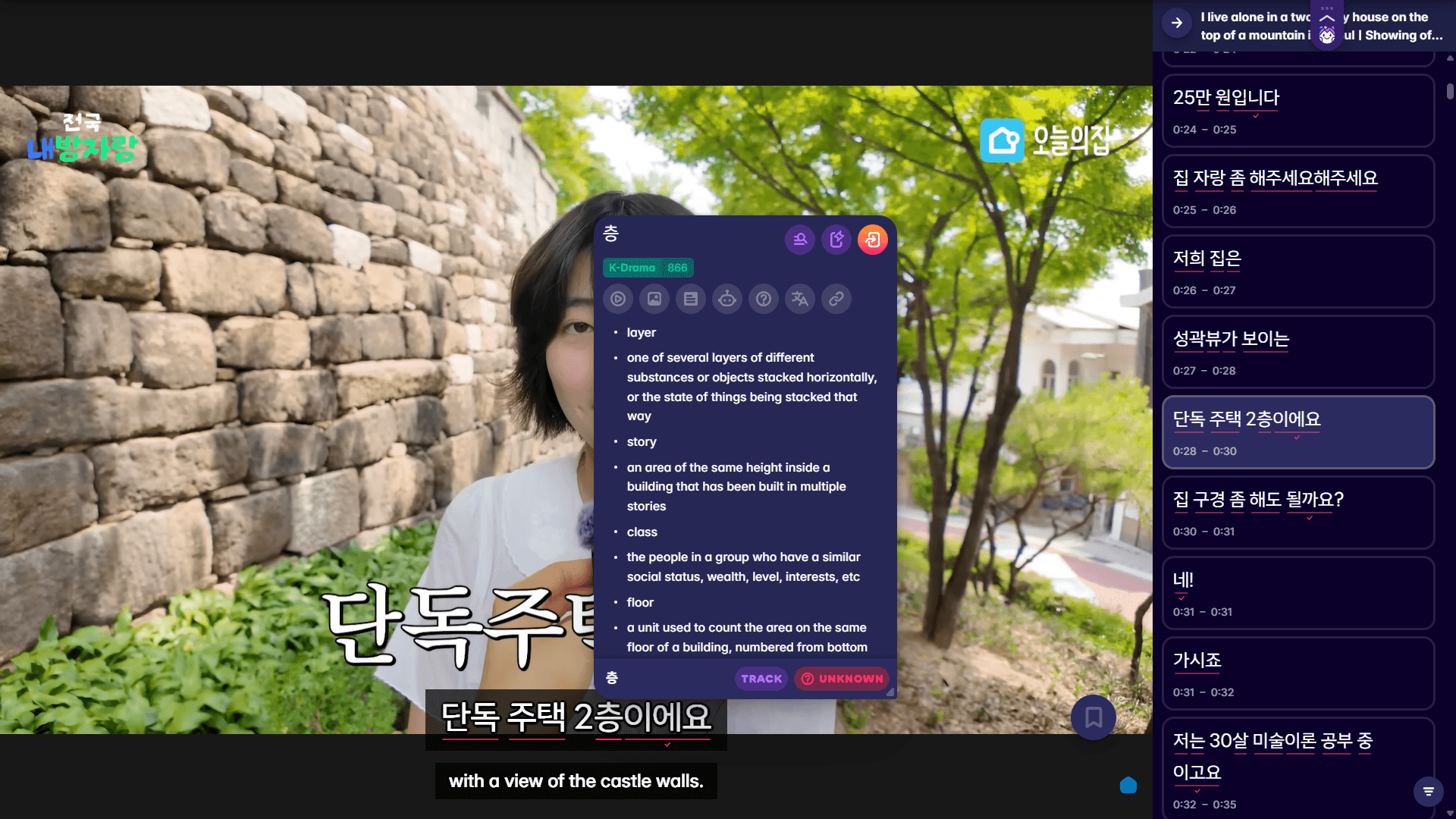
Anyway, if you're serious about learning Korean through real content, Migaku's browser extension and app let you look up Korean words and grammar instantly while watching shows or reading articles. Makes learning connector endings in context way easier than just memorizing conjugation tables. There's a 10-day free trial if you want to check it out.
 ---
## Learning Korean conjunctions and connectors with immersion
Don't stress about perfection early on. Korean speakers will understand you even if you use 그리고 everywhere instead of ~고. As you get more exposure and consume more Korean media content, the natural patterns will click. The way that immersion practice can teach you is that you are getting yourself used to how the Korean ending words conjugate to accommodate the connectors when you are enjoying your leisure time.
> If you consume media in Korean, and you understand at least some of the messages and sentences within that media, you will make progress. _Period_.
One step at a time is enough.☕☀️
---
## Learning Korean conjunctions and connectors with immersion
Don't stress about perfection early on. Korean speakers will understand you even if you use 그리고 everywhere instead of ~고. As you get more exposure and consume more Korean media content, the natural patterns will click. The way that immersion practice can teach you is that you are getting yourself used to how the Korean ending words conjugate to accommodate the connectors when you are enjoying your leisure time.
> If you consume media in Korean, and you understand at least some of the messages and sentences within that media, you will make progress. _Period_.
One step at a time is enough.☕☀️