Korean Negation: How to Form and Use Negation in Korean Grammar
Last updated: March 24, 2026

Learning how to say "no" or express negation in Korean is one of those grammar points that seems simple at first but has a few layers to it. You'll find that Korean uses different negative structures depending on what you're trying to say, whether you're being polite or casual, and whether you're expressing unwillingness or inability. Let's break down exactly how Korean negation works so you can start using it confidently as a Korean learner.
- What is negation in Korean
- The two main types of Korean negation
- Using 안 to negate verbs and adjectives in Korean grammar
- The long negative form with 지 않다
- Expressing inability with 못
- The long form of inability with 지 못하다
- Negating the copula with 아니다
- Negative imperatives with 말다
- Negative pronouns
- Common mistakes learners make
- Practice strategies for mastering negative sentences in Korean
What is negation in Korean
Negation in Korean refers to the grammatical structures you use to make a sentence negative. Just like in English where we add "not" or use words like "don't" and "can't," Korean has its own set of patterns for turning positive statements into negative ones.
The Korean language actually gives you multiple ways to negate a verb or adjective, and which one you choose depends on the context and level of formality.
The most common methods involve adding the word 안 before a verb, using the ending 지 않다 , or placing 못 before a verb to express inability.
The two main types of Korean negation
Korean negation splits into two major categories: negation of action or state, and negation of ability. Understanding this distinction helps you choose the right negative form for what you're trying to express.
- When you want to say you won't do something or that something isn't true, you'll use 안 or 지 않다. These structures indicate unwillingness, disagreement, or a negative state. For example, if you don't want to eat something or if the weather isn't cold, you'd use these forms.
- On the other hand, when you can't do something due to inability or circumstances beyond your control, you'll use 못 or 지 못하다. This distinction matters in Korean because saying you won't do something versus you can't do something carries different implications for your listener.
Using 안 to negate verbs and adjectives in Korean grammar
The simplest way to create a negative sentence in Korean is by placing 안 directly before the verb or adjective you want to negate. This is the short negative form, and it's super common in everyday conversation.
💡The structure looks like this: Subject + 안 + Verb/Adjective
- Let's say you want to say "I don't eat meat." The verb "to eat" is 먹다. You'd say: 저는 고기를 안 먹어요. The 안 sits right before the verb stem, making it negative.
- For adjectives, the pattern works the same way. "It's not cold" would be 안 추워요, where 안 negates the adjective 춥다 (to be cold). Pretty straightforward, right?
This form works great for casual and polite speech. You can use it in most daily conversations without sounding too formal or too casual. The particle placement stays the same as in positive sentences, which means you don't have to rearrange your whole sentence structure.
One quick note: 안 can't be used with every single verb. Certain verbs, especially 있다 (to exist/have) and 모르다 (to not know), have their own special negative forms. For 있다, the negative is 없다. You wouldn't say 안 있다 in standard Korean.
The long negative form with 지 않다
The second major way to form negative sentences uses the ending 지 않다 attached to the verb stem. This is called the long negative form, and it sounds slightly more formal or emphatic than using 안.
💡The structure here is: Subject + Verb stem + 지 않다
Using the same example about eating meat, you'd say: 저는 고기를 먹지 않아요. Notice how 지 않다 attaches to the verb stem 먹, creating 먹지 않아요 in the polite present tense.
This form gives you more flexibility when you want to add emphasis or speak more formally. In written Korean or formal situations, you'll see 지 않다 used quite frequently. It also works well when you want to stress the negation itself.
Both 안 and 지 않다 can often be used interchangeably, but there are subtle differences. The 지 않다 form tends to sound more deliberate or considered, while 안 feels more spontaneous and conversational. Native speakers naturally switch between them based on what feels right in the moment.
Expressing inability with 못
When you want to express that you can't do something due to inability or external circumstances, 못 is your go-to word. This is different from choosing not to do something, which is what 안 expresses.
💡The structure mirrors the 안 pattern: Subject + 못 + Verb
If you want to say "I can't eat spicy food" (because your stomach can't handle it, not because you refuse to), you'd say: 저는 매운 음식을 못 먹어요. The 못 before 먹어요 indicates a physical or circumstantial inability.
This distinction between 안 and 못 is really important in Korean. If someone offers you food and you say 안 먹어요, it might sound like you're refusing their hospitality. But if you say 못 먹어요, you're explaining that you have a reason you can't eat it, which comes across as more polite.
Common situations where you'd use 못 include physical limitations (can't see well, can't hear), skill limitations (can't speak Korean well yet), or external circumstances (can't go because of work).
The long form of inability with 지 못하다
Just like 지 않다 is the long form of 안, there's also 지 못하다 as the long form of 못. This works exactly the same way as 지 않다 but expresses inability instead of unwillingness.
💡The structure is: Subject + Verb stem + 지 못하다
So "I can't eat spicy food" could also be: 저는 매운 음식을 먹지 못해요. This sounds slightly more formal than using 못 directly before the verb.
You'll hear 지 못하다 in more formal contexts, news broadcasts, or written Korean. It's perfectly correct to use in conversation too, but 못 + verb tends to be more common in everyday speech.
Negating the copula with 아니다
The verb "to be" in Korean works differently when negated. Instead of using 안 or 못, Korean uses the negative copula 아니다 (to not be).
When you want to say something like "I'm not a student," you use: 저는 학생이 아니에요. The structure is Noun + 이/가 아니다, where you choose 이 after consonants and 가 after vowels.
In more formal situations, you'd use 아닙니다 instead of 아니에요. For example: 저는 학생이 아닙니다. Both mean the same thing, but the formality level changes.
This structure is super common because you use it anytime you want to say what something or someone is not. "This is not my book" would be 이것은 제 책이 아니에요. The particle 은/는 marks the topic, and 아니다 provides the negation.
Negative imperatives with 말다
When you want to tell someone not to do something, Korean uses the verb 말다 . This is specifically for commands or requests, which means it only appears in imperative forms.
💡The polite way to say "Please don't do X" uses the pattern: Verb stem + 지 마세요
For example, "Please don't worry" is 걱정하지 마세요. The verb 걱정하다 (to worry) combines with 지 마세요 to create a polite negative command.
In casual speech with friends or people younger than you, you'd drop the 세요 and just say 지 마 . So "Don't go!" to a friend would be 가지 마, from the verb 가다 (to go).
You'll hear this structure all the time in daily Korean. Parents use it with kids, friends use it with each other, and it appears in signs and warnings. "Don't smoke" signs say 담배 피우지 마세요.
Negative pronouns
Korean also has a set of negative pronouns that work with negation to mean "nobody," "nowhere," "nothing," and similar concepts. These words combine with negative verb forms to create complete meanings.
- The word 아무도 means "nobody" or "anyone" and must be used with a negative verb. For example, 아무도 안 왔어요 means "Nobody came." You can't use 아무도 with a positive verb in standard Korean.
- Similarly, 아무것도 means "nothing" or "anything" and also requires negation. 아무것도 안 먹었어요 means "I didn't eat anything" or "I ate nothing."
- For places, 어디에도 means "nowhere" or "anywhere" when used with negation. 어디에도 안 갔어요 translates to "I didn't go anywhere."
These negative pronouns add emphasis to your negative sentences. Instead of just saying 안 먹었어요 (I didn't eat), saying 아무것도 안 먹었어요 stresses that you ate absolutely nothing.
Common mistakes learners make
- One mistake I see a lot is using 안 when 못 would be more appropriate. Remember, 안 expresses choice or will, while 못 expresses inability. If you physically can't do something, 못 is the right choice.
- Another common error is trying to use 안 with 있다. The negative of 있다 is 없다, which is its own word. You'd say 시간이 없어요 (I don't have time), not 시간이 안 있어요.
- Some learners also forget that negative pronouns like 아무도 require a negative verb form. You can't say 아무도 왔어요 to mean "nobody came." You must add the negation: 아무도 안 왔어요.
- Word order can trip people up too. With the short negative form using 안 or 못, these words go directly before the verb, not at the beginning of the sentence like "not" sometimes appears in English.
Practice strategies for mastering negative sentences in Korean
The best way to get comfortable with Korean negation is to practice converting positive sentences to negative ones.
- Take simple sentences you already know and try making them negative using both 안 and 지 않다 forms.
- Listen for negation patterns when you're watching Korean shows or videos. You'll start noticing how often native speakers use 안 versus 지 않다, and when they choose 못 over 안. This exposure helps you develop intuition for natural usage.
- Try creating example sentences for different contexts. Make a sentence about something you won't do, something you can't do, something that isn't true, and a command not to do something. This covers all the main negative structures.
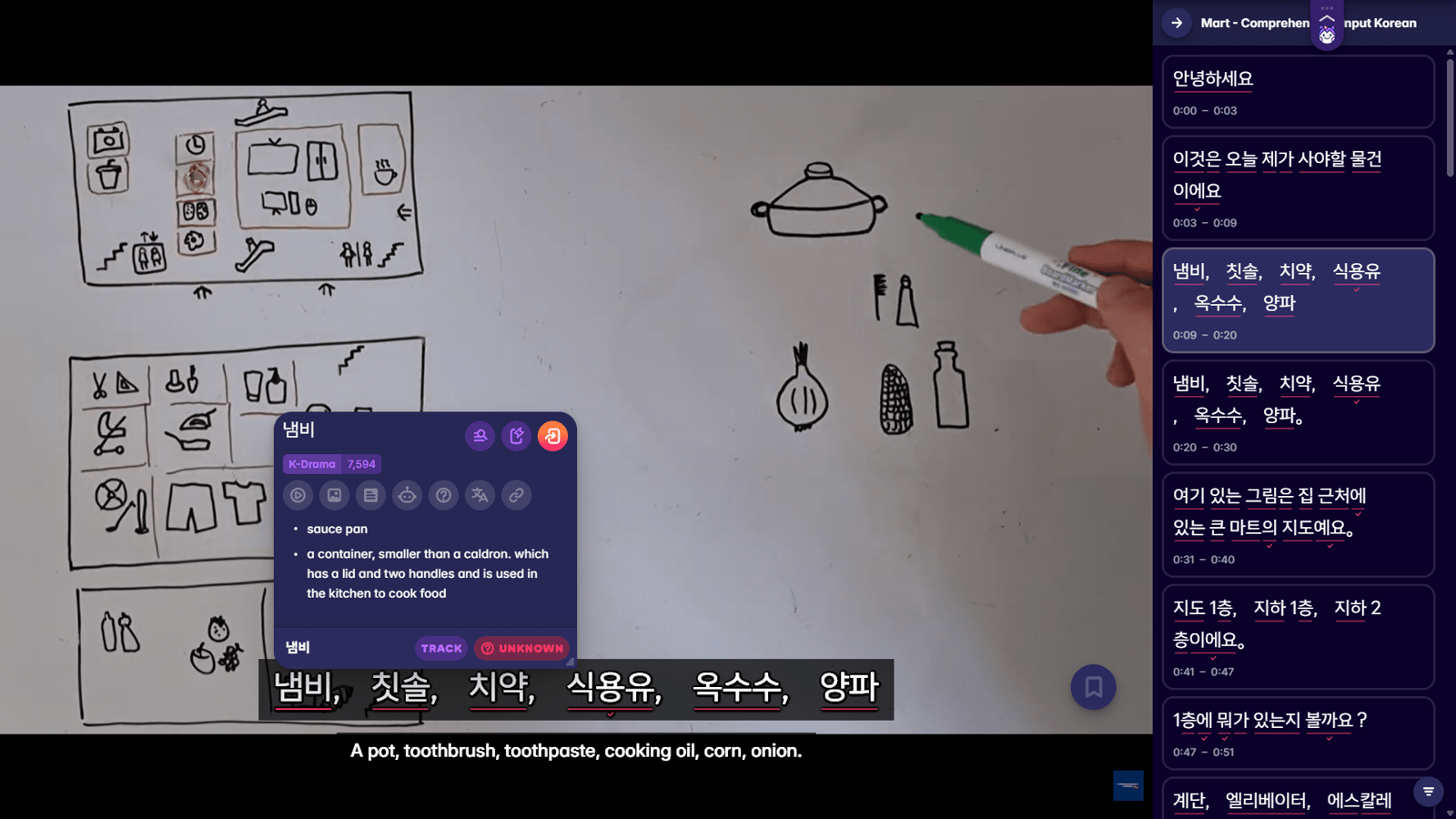
If you're learning Korean through immersion with videos, articles, or other native content, Migaku's browser extension and app make it way easier to look up words and grammar patterns instantly while you're consuming content. You can see how negation works in real contexts instead of just studying grammar rules. There's a 10-day free trial if you want to give it a shot.
Why Korean negation is important for learners
Understanding negation is fundamental because you use it constantly in real conversations. You need to refuse offers politely, explain what you can't do, describe what isn't true, and express preferences. All of these require solid command of negative structures. Once you get these patterns down, you can pretty much understand the common negations in Korean dramas, movies, and any written text. With some more input, you can negate anything you want to say in Korean.
If you consume media in Korean, and you understand at least some of the messages and sentences within that media, you will make progress. Period.
Start simple, and build up from there!