# Korean Shopping Vocabulary: Useful Korean Phrases for Markets & Stores
> Practical Korean shopping vocabulary for stores, markets, payments, and clothing sizes. Navigate real shopping situations in Korea with confidence.
**URL:** https://migaku.com/blog/korean/korean-shopping-vocabulary
**Last Updated:** 2026-03-22
**Tags:** vocabulary, phrases
---
Shopping in Korea can be a wild experience if you don't know the basic vocabulary. Whether you're haggling at a traditional market in Seoul or trying to find your size at a clothing shop in Busan, having the right Korean phrases makes everything smoother. This guide covers all the essential shopping vocabulary you need as you [learn Korean](https://migaku.com/learn-korean), from asking prices to navigating payment at the cashier.
----
## Types of stores and markets in Korean
Before you can shop anywhere, you need to know where you're actually going. Korea has tons of different shopping spots, and they all have specific names.
| Korean | Romanization | English |
| - | - | - |
| 가게 | gage | Regular store (general term) |
| 상점 | sangjeom | Shop (more specific) |
| 백화점 | baekhwajeom | Department store (massive, fancy, higher quality) |
| 편의점 | pyeonuijeom | Convenience store (on every corner in Korea) |
| 시장 | sijang | Market (general term) |
| 전통 시장 | jeongtong sijang | Traditional market (great for fresh food, street snacks, bargaining) |
| 옷가게 / 의류점 | otgage / uiryujeom | Clothing store |
| 서점 | seojeom | Bookstore |
| 식료품점 / 마트 | singnyopumjeom / mateu | Grocery store / Supermarket |
----
## Essential shopping words and phrases
Let's get into the practical stuff you'll use when shopping in Korea.
Here are the core words you need:
- 얼마예요? (eolmayeyo?) means "How much is it?" You'll use this constantly.
- 이거 (igeo) means "this one"
- 저거 (jeogeo) means "that one" (farther away)
- 있어요? (isseoyo?) means "Do you have it?"
- 주세요 (juseyo) means "please give me."
When you walk into a shop, you'll probably hear 어서 오세요 (eoseo oseyo), which means "welcome." You don't really need to respond, but a smile works.
So if you want to buy something, you can point and say 이거 주세요 (igeo juseyo), which is "Give me this one, please."
To ask if they have something specific, use the pattern: (item) 있어요? For example, 물 있어요? (mul isseoyo?) means "Do you have water?"
When you're just browsing and don't want help, you can say 그냥 보는 거예요 (geunyang boneun geoyeyo), which means "I'm just looking."
----
## Clothing sizes and trying things on
Shopping for clothes in Korea requires knowing size vocabulary because [Korean sizes](https://migaku.com/blog/korean/korean-clothing-vocabulary) run smaller than Western sizes, and you'll definitely need to ask questions.
The word for size is 사이즈 (saijeu) or 크기 (keugi). To ask "Do you have a bigger size?" say 더 큰 사이즈 있어요? (deo keun saijeu isseoyo?). For a smaller size, use 더 작은 사이즈 있어요? (deo jageun saijeu isseoyo?).
Korean sizes often use these terms:
- 소 (so) means small
- 중 (jung) means medium
- 대 (dae) means large
You might also see free size, which is called 프리 사이즈 (peuri saijeu). This usually means one size fits most, but honestly, it often means one size fits smaller people.
To ask if you can try something on, say 입어 봐도 돼요? (ibeo bwado dwaeyo?). The fitting room is 탈의실 (taruisil) or sometimes just called 피팅룸 (pitinglum).
[Colors matter too](https://migaku.com/blog/korean/korean-colors) when shopping:
- 빨강 (ppalgang) is red
- 파랑 (parang) is blue
- 검정 (geomjeong) is black
- 하양 (hayang) is white
- 노랑 (norang) is yellow
To ask if they have something in a different color, say 다른 색 있어요? (dareun saek isseoyo?).
----
## Korean vocabulary for payment and cashier
When you're ready to pay, you need specific Korean words to handle the transaction smoothly.
The cashier is 계산대 (gyesandae) or the person is 계산원 (gyesanwon). To say you want to pay, you can say 계산할게요 (gyesanhalgeyo) or just 계산이요 (gyesaniyo).
The word for price is 가격 (gagyeok), and total is 총액 (chongaek). When the cashier tells you the total, they'll usually say the number followed by 원이에요 (wonieyo), since 원 (won) is the Korean currency.
Here's how to handle different payment methods:
- 현금 (hyeongeum) means cash
- 카드 (kadeu) means card
- 신용카드 (sinyongkadeu) is credit card
- 체크카드 (chekeukadeu) is debit card
To ask if they accept cards, say 카드 돼요? (kadeu dwaeyo?). Most places in Korea take cards, even for small purchases.
When you purchase something, you might need a bag. The word for bag is 봉투 (bongtu) or 가방 (gabang) for a reusable shopping bag. These days, many stores charge for plastic bags, so they'll ask 봉투 필요하세요? (bongtu piryohaseyo?), which means "Do you need a bag?"
Receipt is 영수증 (yeongsujeung). If you need one, say 영수증 주세요 (yeongsujeung juseyo).
----
## Bargaining and making requests at markets
Traditional markets in Korea are where you can negotiate prices, unlike fixed-price stores. Learning how to bargain politely makes shopping way more fun.
To ask for a discount, you can say 깎아 주세요 (kkakka juseyo), which literally means "please reduce it." A more polite version is 좀 깎아 주실 수 있어요? (jom kkakka jusil su isseoyo?), meaning "Could you reduce it a bit?"
When something seems too expensive, you might say 너무 비싸요 (neomu bissayo), which means "It's too expensive." Sometimes vendors will lower the price just from hearing this.
Here are useful phrases for market shopping:
- 신선해요? (sinseonhaeyo?) means "Is it fresh?"
- 맛있어요? (masisseoyo?) means "Is it delicious?"
- 언제 왔어요? (eonje wasseoyo?) means "When did it arrive?" (asking about produce freshness)
----
## Korean words for grocery shopping specific terms
Grocery shopping has its own set of Korean vocabulary that differs from general shopping.
Different sections of a grocery store:
| Korean | Romanization | English |
| - | - | - |
| 야채 코너 | yachae koneo | Vegetable section |
| 과일 코너 | gwail koneo | Fruit section |
| 정육점 | jeongyukjeom | Butcher section |
| 수산물 | susanmul | Seafood |
| 유제품 | yujepum | Dairy products |
Common grocery items you'll need to know:
| Korean | Romanization | English |
| - | - | - |
| 쌀 | ssal | Rice |
| 빵 | ppang | Bread |
| 우유 | uyu | Milk |
| 계란 | gyeran | Eggs |
| 고기 | gogi | Meat |
| 생선 | saengseon | Fish |
| 물 | mul | Water |
When shopping for produce, you might need to know:
| Korean | Romanization | English |
| - | - | - |
| 유기농 | yuginong | Organic |
| 국산 | guksan | Domestic / Locally produced |
| 수입 | suip | Imported |
At the deli counter or butcher, you'll need to specify amounts. Korean uses grams (그램 , geuraem) and kilograms (킬로그램 , killogeuraem or just 킬로 , killo).
To ask for a specific amount, say the number plus the unit plus 주세요 (juseyo). For example, 500그램 주세요 (obaek geuraem juseyo) means "Give me 500 grams, please."
----
## How to learn essential Korean shopping phrases
Learning Korean shopping vocabulary isn't about memorizing every possible word.
1. Focus on the high-frequency terms you'll use: asking prices, requesting sizes, and handling payment.
2. Practice these until they're automatic. Then add specific vocabulary for the types of shopping you do most, or you will most likely be doing when arriving in South Korea.
3. The real test is using these Korean words in actual shops and markets in Korea. You'll mess up sometimes, but shopkeepers are usually patient with learners. Each shopping trip gives you more confidence with the language.
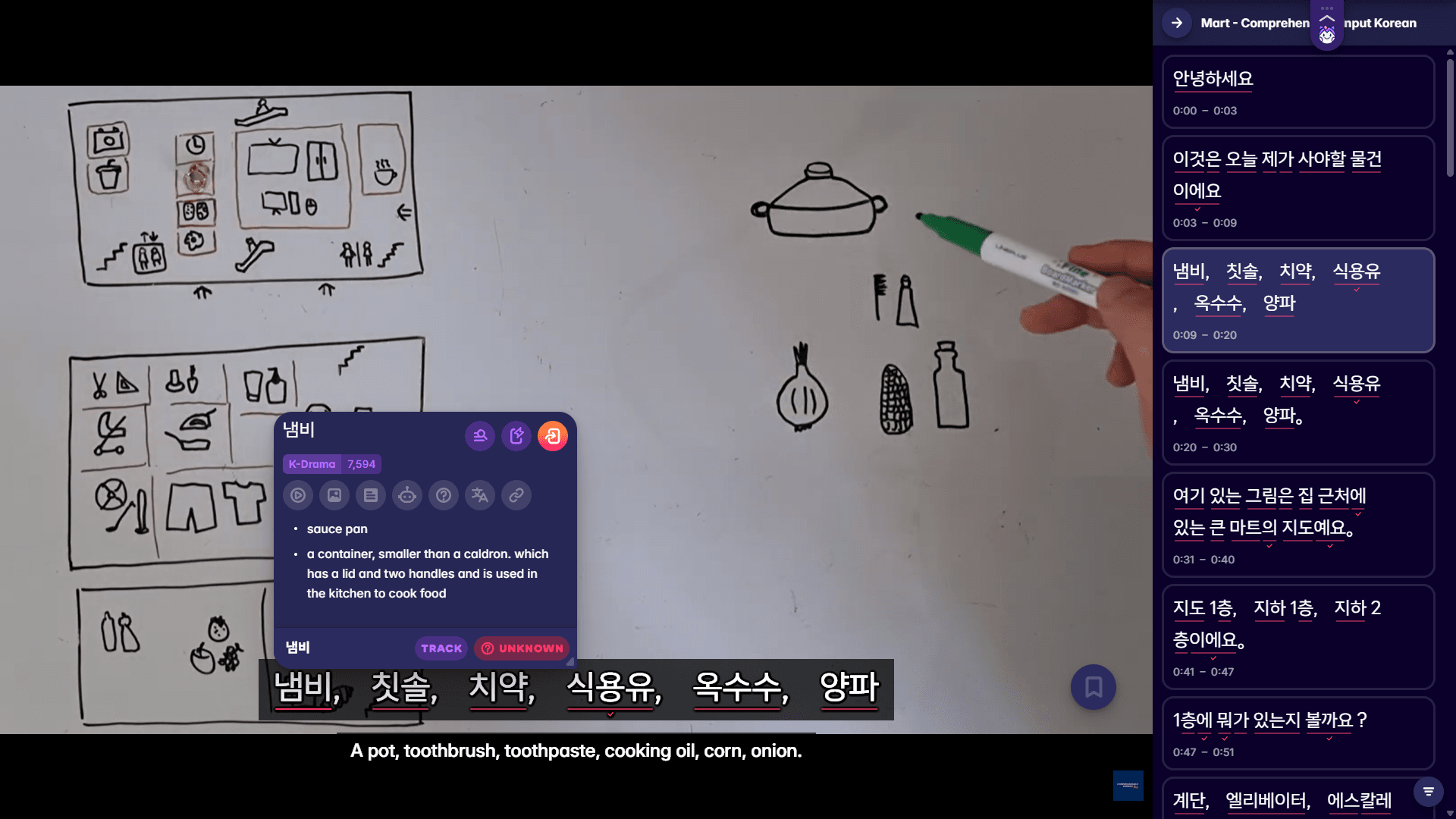
Anyway, if you're serious about learning Korean through immersion, Migaku's browser extension and app let you look up Korean words instantly while watching videos or reading Korean websites. Makes learning vocabulary from real shopping content way more practical. There's a 10-day free trial if you want to check it out.
 ----
## You don't need fluency to explore shops in Korea
Just knowing this core shopping vocabulary makes you functional in stores and markets right away. If you want to learn Korean beyond just shopping phrases, immersion with real content works best. [Watching Korean shows](https://migaku.com/blog/korean/best-korean-shows-for-learning), reading product descriptions online, or following Korean shopping vlogs gives you natural exposure to how people actually use this vocabulary.
> If you consume media in Korean, and you understand at least some of the messages and sentences within that media, you will make progress. _Period_.
Learn from what you enjoy the most!👜📿
----
## You don't need fluency to explore shops in Korea
Just knowing this core shopping vocabulary makes you functional in stores and markets right away. If you want to learn Korean beyond just shopping phrases, immersion with real content works best. [Watching Korean shows](https://migaku.com/blog/korean/best-korean-shows-for-learning), reading product descriptions online, or following Korean shopping vlogs gives you natural exposure to how people actually use this vocabulary.
> If you consume media in Korean, and you understand at least some of the messages and sentences within that media, you will make progress. _Period_.
Learn from what you enjoy the most!👜📿