Korean Time Expressions: Ultimate Guide to Practical Time Phrases in Korean
Last updated: April 8, 2026
If you're learning Korean, you'll need to know how to talk about time pretty much from day one. Whether you're making plans with friends, checking when the bus arrives, or just talking about your daily schedule, time expressions pop up constantly in everyday conversation. The good news? Korean time expressions follow clear patterns once you understand the basic building blocks. Let's break down everything you need to know about telling time in Korean, from the basic hours and minutes to useful phrases you'll actually use.
- Understanding the two number systems in Korean
- Hours with 시 (si)
- Minutes with 분 (bun)
- Korean time expressions for AM/PM: 오전 (ojeon) and 오후 (ohu)
- Half hour: 반 (ban)
- Korean words for relative time: ago (전 jeon), every (마다 mada)
- General time expressions: today, tomorrow, and more
- Practical lesson tips for mastering time phrases in Korean
Understanding the two number systems in Korean
Here's the thing about Korean numbers: you need to know two different systems. Korean uses both native Korean numbers and Sino-Korean numbers (borrowed from Chinese), and for telling time, you'll use both depending on what you're counting.
For hours, you use native Korean numbers from 1 to 12. These are:
- 하나 (hana)
- 둘 (dul)
- 셋 (set)
- 넷 (net)
- 다섯 (daseot)
- 여섯 (yeoseot)
- 일곱 (ilgop)
- 여덟 (yeodeol)
- 아홉 (ahop)
- 열 (yeol)
- 열하나 (yeolhana)
- 열둘 (yeoldul).
For minutes, you use Sino-Korean numbers:
- 일 (il)
- 이 (i)
- 삼 (sam)
- 사 (sa)
- 오 (o)
- 육 (yuk)
- 칠 (chil)
- 팔 (pal)
- 구 (gu)
- 십 (sip)
These continue combining just like in Chinese:
- 십일 (11)
- 이십 (20)
- 삼십 (30)
- 오십구 (59)
Why two systems? That's just how Korean evolved over centuries of contact with China while maintaining its own linguistic identity. You'll get used to switching between them with practice.
Hours with 시 (si)
The Korean word for hour or o'clock is 시 (si). When you tell someone the hour, you combine a native Korean number with 시. But here's a small catch: some of the native numbers change slightly when used with 시.
- One o'clock is 한 시 (han si), not 하나 시.
- Two o'clock is 두 시 (du si), not 둘 시.
- Three o'clock is 세 시 (se si), not 셋 시.
- Four o'clock is 네 시 (ne si), not 넷 시.
- From five onwards, the numbers stay the same: 다섯 시, 여섯 시, 일곱 시, 여덟 시, 아홉 시, 열 시, 열한 시, 열두 시.
So if someone asks you "지금 몇 시예요?" (jigeum myeot si yeyo? - What time is it now?), you'd answer with the hour plus 시. The word 지금 (jigeum) means "now" and you'll hear it constantly when people ask about the current time.
Most Koreans use the 12-hour clock in casual conversation, though you'll see 24-hour format in official schedules like train timetables or business hours. When speaking, stick to 1-12 with AM/PM markers.
Minutes with 분 (bun)
After stating the hour, you add minutes using 분 (bun) with Sino-Korean numbers. This part is actually easier because the numbers don't change.
- Three fifteen would be 세 시 십오 분 (se si sibo bun).
- Eight forty-five is 여덟 시 사십오 분 (yeodeol si sasibo bun).
Notice how you're mixing native Korean for the hour and Sino-Korean for the minutes in the same phrase.
When the minute is a round number like 10, 20, 30, etc., Koreans often drop the 분 in casual speech, but it's safer to include it when you're learning. So 십 분 (sip bun) is ten minutes, 이십 분 (isip bun) is twenty minutes, and 오십 분 (osip bun) is fifty minutes.
Korean time expressions for AM/PM: 오전 (ojeon) and 오후 (ohu)
To distinguish morning from afternoon and evening, Korean uses 오전 (ojeon) for AM and 오후 (ohu) for PM. These go at the beginning of the time expression, before the hour.
- 오전 아홉 시 (ojeon ahop si) means 9 AM.
- 오후 세 시 (ohu se si) means 3 PM.
If you're meeting someone for lunch at 12:30 PM, you'd say 오후 열두 시 삼십 분 (ohu yeoldu si samsip bun).
In everyday conversation, context often makes AM/PM clear, so Koreans sometimes skip these markers. If you're talking about breakfast, people know you mean morning. But when making plans or being precise, definitely include 오전 or 오후.
You might also hear 낮 (nat) for daytime/afternoon and 밤 (bam) for nighttime in casual speech, though these are less formal than 오전 and 오후.
Half hour: 반 (ban)
Instead of saying thirty minutes every time, Korean has a handy shortcut: 반 (ban), which means "half." This works exactly like saying "half past" in English.
- Three thirty becomes 세 시 반 (se si ban).
- Seven thirty is 일곱 시 반 (ilgop si ban).
Much simpler than saying 삼십 분 every time, right?
You can't use 반 for other fractions though. There's no "quarter past" equivalent in Korean. For 3:15, you have to say the full 세 시 십오 분. For 3:45, it's 세 시 사십오 분 (though some people might say "four o'clock minus fifteen minutes" using different grammar).
Korean words for relative time: ago (전 jeon), every (마다 mada)
Learning Korean time expressions goes beyond just clock times. You need relative time phrases for everyday situations.
- 전 (jeon) means "ago" or "before" and comes after a time duration. 십 분 전 (sip bun jeon) means "ten minutes ago." 한 시간 전 (han sigan jeon) means "one hour ago." Notice that for durations, you use 시간 (sigan) for "hour" instead of 시.
- 마다 (mada) means "every" and also comes after the time unit.
- 매일 (maeil) means "every day," but you can also say 하루마다 (harumada).
- 한 시간마다 (han siganmada) means "every hour." This is super useful for talking about routines or schedules.
- If you want to say "in" as in "in ten minutes," you use 후 (hu): 십 분 후 (sip bun hu). So 전 is for past, 후 is for future.
General time expressions: today, tomorrow, and more
Beyond telling clock time, you need these everyday time words that come up in almost every conversation.
Korean | English |
|---|---|
오늘 | Today |
내일 | Tomorrow |
어제 | Yesterday |
아침 | Morning |
점심 | Midday / Lunch time |
저녁 | Evening / Dinner time |
밤 | Night |
Days of the week all end in 요일 (yoil):
Korean | English |
|---|---|
월요일 | Monday |
화요일 | Tuesday |
수요일 | Wednesday |
목요일 | Thursday |
금요일 | Friday |
토요일 | Saturday |
일요일 | Sunday |
For weeks and months:
Korean | English |
|---|---|
이번 주 | This week |
다음 주 | Next week |
지난주 | Last week |
이번 달 | This month |
다음 달 | Next month |
지난달 | Last month |
Practical lesson tips for mastering time phrases in Korean
Here's how to actually get good at using these expressions beyond just reading about them.
- Start by practicing telling the current time out loud whenever you check your phone. See 2:45? Say 오후 두 시 사십오 분. This builds automatic recall.
- Set your phone or computer to display Korean. Many devices let you change the clock language. Seeing 오전 9:30 every morning reinforces the pattern.
- Make a daily schedule in Korean. Write out your routine: 오전 7시에 일어나요, 오전 8시에 아침을 먹어요, 오전 9시에 일해요. This connects time expressions to real activities.
- Watch Korean variety shows or dramas and pay attention when characters mention times or make plans. You'll hear these expressions in natural contexts, which helps them stick way better than textbook examples.
- Practice with a language partner or tutor. Have them ask you random times and you respond, then switch. The back-and-forth makes it feel less like studying and more like actual communication.
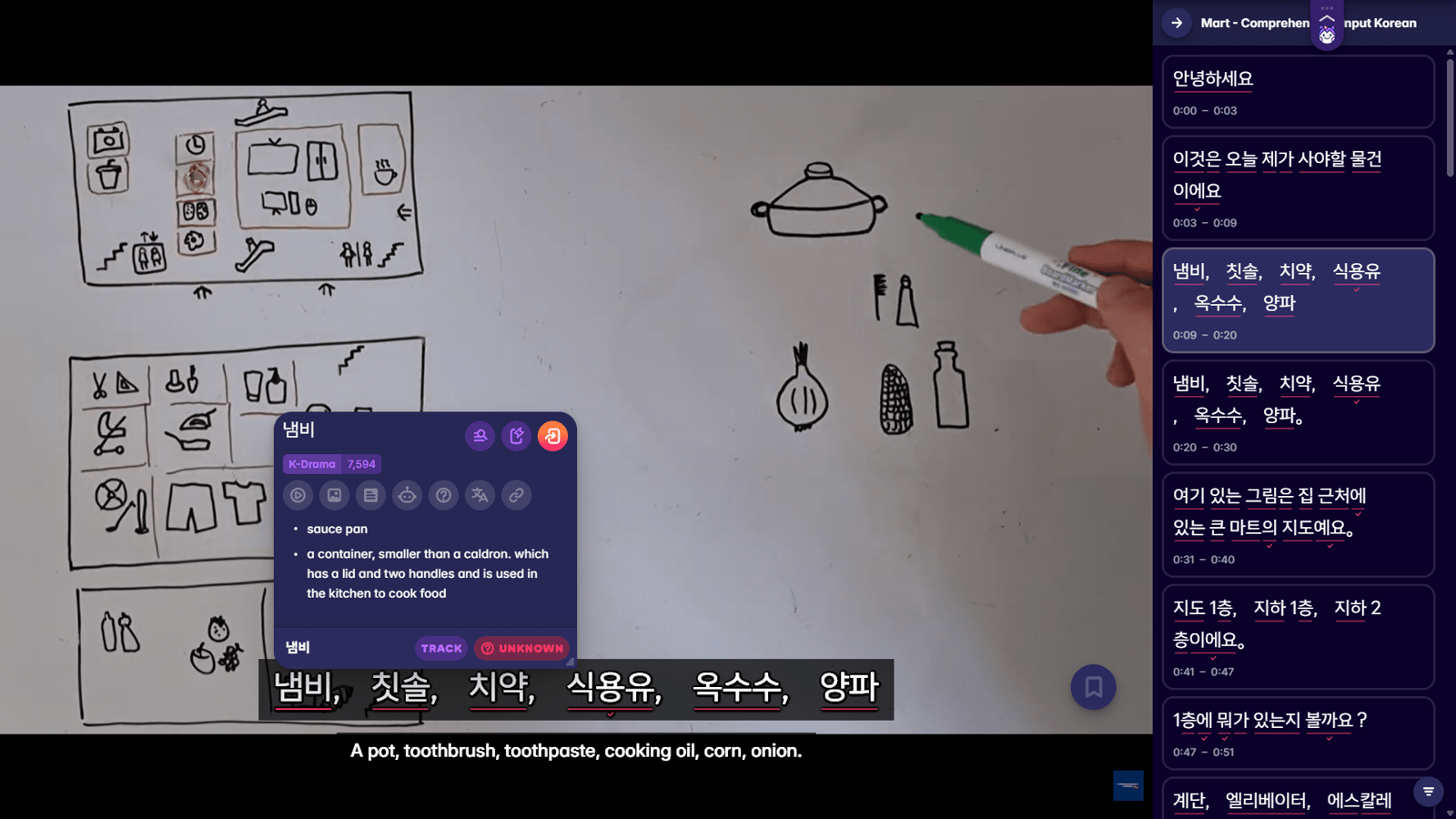
If you want to practice these time expressions with real Korean content, Migaku's browser extension and app let you look up words and save phrases instantly while watching shows or reading articles. Makes immersion learning way more practical. There's a 10-day free trial if you want to check it out.
Your next steps for learning time in Korean
Korea uses time expressions constantly in daily life, just like any other language. The more you expose yourself to Korean media and conversation, the more automatic these patterns become. You'll stop translating in your head and just know that 오후 세 시 반 means 3:30 PM without thinking about it.
If you consume media in Korean, and you understand at least some of the messages and sentences within that media, you will make progress. Period.
Learn the time, and schedule your life!