# Learn Korean With K-Dramas: How to Watch K-Dramas to Learn Korean
> Stop watching passively. Learn Korean with K-dramas using subtitle strategies, shadowing techniques, and drama selection by level.
**URL:** https://migaku.com/blog/korean/learn-korean-with-kdramas
**Last Updated:** 2026-03-07
**Tags:** resources, culture, discussion
---
You've probably heard people say they [learned Korean](https://migaku.com/learn-korean) from watching K-dramas, and honestly? It's totally possible. But here's the thing: just binge-watching "Crash Landing on You" with English subtitles won't magically make you fluent. You need a real strategy. This guide will show you exactly how to use K-dramas to [learn Korean](https://migaku.com/blog/korean/best-apps-to-learn-korean), not just passively watch them.
---
## Can you learn Korean from watching K-dramas
Yes, but with some important caveats.
✅K-dramas work because they give you hours of native Korean speech in context. You hear how people actually talk in Seoul, [how politeness levels shift](https://migaku.com/blog/korean/korean-honorifics) between characters, and how emotions change the way words sound. That's stuff [textbooks](https://migaku.com/blog/korean/best-korean-textbooks) can't really teach you.
❌The problem is that passive watching doesn't cut it. If you just watch with English subtitles and zone out, you're basically watching TV in English. Your brain takes the easy route and ignores the Korean audio entirely. I've seen people watch hundreds of episodes and barely pick up more than "annyeonghaseyo" because they never engaged actively with the language.
The real question isn't whether you can learn Korean with K-dramas. It's whether you're willing to watch them like a student, not just a fan. That means rewinding scenes, taking notes, switching subtitle settings, and sometimes pausing to look up a Korean word that keeps popping up.
---
## Picking the right drama for your level
### Beginner dramas: Slice of life and romance
If you're just starting out, you want to learn Korean through dramas with everyday conversations. Skip the historical dramas (we'll get to those later) and the legal thrillers packed with specialized vocabulary.
- **"Hometown Cha-Cha-Cha"** is perfect for beginners. It's set in a small seaside town, and characters spend most of their time chatting about daily life, food, and relationships. The vocabulary is practical stuff you'll actually use.
- Same goes for **"What's Wrong with Secretary Kim?"** which focuses on office life and romance without getting too technical.
Romance dramas generally use simpler sentence structures and repeat common phrases. You'll hear "saranghae" (I love you) often, which is great for reinforcement. The emotional delivery also helps you connect words to feelings, making them stick better in your memory.
### Intermediate dramas: Itaewon Class, Reply 1988, and Hospital Playlist
Once you've got basics down, Korean dramas with mixed genres give you more variety.
- **"Itaewon Class"** combines business vocabulary with street slang and different politeness registers. You'll hear characters switch between formal speech with investors and casual talk with friends.
- **"Reply 1988"** is amazing for intermediate learners because it shows family dynamics across generations. Grandparents speak differently than teenagers, and you get exposed to how the Korean language adapts based on age and relationship. Plus, the nostalgia factor makes it emotionally engaging, which helps retention.
- Medical dramas like **"Hospital Playlist"** introduce specialized terms, but they balance them with plenty of everyday conversation between doctors. You don't need to memorize medical jargon, but hearing it in context helps you understand how Korean handles technical vocabulary.
### Advanced: Mr. Sunshine and Extraordinary Attorney Woo
Want to learn Korean at a higher level? Historical K-dramas use formal, classical speech patterns you won't hear in modern Seoul.
- **"Mr. Sunshine"** has beautiful period-appropriate dialogue, but it's tough. The [grammar](https://migaku.com/blog/korean/learn-basic-korean-grammar) structures are more complex, and characters use honorifics in ways that seem overly formal by today's standards.
- Legal and political dramas throw specialized vocabulary at you constantly. **"Extraordinary Attorney Woo"** mixes courtroom Korean with the main character's unique speech patterns. It's challenging but rewarding if you're aiming for professional-level comprehension.
---
## The subtitle strategy when watching Korean dramas
Here's where most people mess up. They watch with English subtitles because Korean subtitles feel overwhelming. I get it, but you're shooting yourself in the foot.
1. **Start with Korean subtitles from episode one, even as a beginner.** Your brain will hurt for the first few episodes. You won't understand most of what you're reading. That's fine. You're training your eyes to recognize [Hangul](https://migaku.com/blog/korean/learn-korean-hangul) quickly and connecting written Korean to spoken sounds.
2. **If Korean-only subtitles feel impossible, use dual subtitles** (Korean and English together) for a few episodes, then drop the English. There are [browser extensions](https://migaku.com/) that can display both, but wean yourself off the English translation as fast as possible.
3. **For absolute beginners, watching the same episode twice works well.** First time with English subtitles to understand the plot. Second time with Korean subtitles to focus on the language. Yeah, it takes longer, but you'll learn Korean instead of just enjoying a show.
---
## Active learning techniques while watching kdramas
### Shadowing dialogue
Shadowing means repeating what characters say immediately after they say it. Pick a scene, maybe 2-3 minutes long, and replay it while speaking along. Try to match the pronunciation, rhythm, and emotion.
This technique is ridiculously effective for accent and intonation. Korean has a musical quality, with pitch changes that affect meaning. Shadowing helps you internalize these patterns without consciously thinking about them. Do this for 10-15 minutes per drama session, and your pronunciation will improve faster than any textbook drill.
### The pause and predict method
Pause right before a character responds in a conversation. Try to predict what they'll say in Korean. You'll be wrong most of the time at first, but that's the point. When you hear the response, your brain pays extra attention because it's comparing your guess to reality.
This forces active engagement. You can't zone out when you're constantly trying to predict dialogue. It also reveals gaps in your grammar, words and phrases that you can target in your study sessions.
### Vocabulary extraction
Keep a running note on your phone of interesting words or phrases. Don't try to write down everything, just stuff that appears multiple times or seems useful. After the episode, look up 5-10 of these words properly, create example sentences, and add them to your flashcard system.
Focus on chunks, not just individual words. If you hear "gwaenchana" (It's okay) used in three different contexts during an episode, note all three situations. Korean words shift meaning based on context and tone, so collecting these variations can help you learn the nuance.
---
## Understanding Korean politeness levels through drama
K-dramas are perfect for learning how politeness registers work because you see the same characters switch between formal and informal speech depending on who they're talking to.
Watch how a character speaks to their boss versus their best friend. The verb endings completely change. "Hamnida" endings in formal situations, "hae" or "haeyyo" with friends and family. This is something you want to learn through immersion because the rules are complex and situational.
Romance dramas show this shift beautifully. Couples often start with formal speech and gradually drop to [banmal (informal speech)](https://migaku.com/blog/korean/korean-informal-speech) as they get closer. That transition marks relationship development, and you'll start to feel when it's appropriate to use each level.
---
## Use dramas to study Korean slang and colloquial expressions
Textbooks teach you proper Korean. Dramas teach you how people actually talk. There's a huge gap between the two.
You'll hear tons of slang in modern K-dramas, especially in shows about younger characters. "Daebak" (awesome), "chincha" (really), "aish" (expression of frustration). These words appear constantly in real conversations in Seoul but rarely in formal learning materials.
The key is context. When you hear slang in a drama, you see the situation, the speaker's age, their relationship to the listener, and the emotional tone. That's how you learn when it's appropriate to use these expressions. Using slang wrong is worse than not using it at all, so this contextual learning matters.
---
## Building a structured learning schedule with K-dramas
Don't just watch whenever you feel like it. Build K-dramas into a consistent routine alongside other study methods.
> 💡 Try This Out 💡
A solid schedule might look like this: 30 minutes of grammar study, 30 minutes of vocabulary review, then one episode of a drama with Korean subtitles.
The drama becomes your reward and your immersion practice. You're applying what you studied earlier while staying entertained.
Three episodes per week with active learning techniques beats seven episodes of passive watching. Quality over quantity. If you're shadowing, pausing to predict, and taking notes, one episode might take 90 minutes instead of 60. That's fine. You're trying to learn Korean, not just finish a series.
---
## Comparing K-dramas to other Korean content
K-dramas aren't the only option. Variety shows, YouTube channels, and K-pop all offer different benefits.
1. Variety shows have more spontaneous, natural speech. Less scripted dialogue means more filler words, interruptions, and real conversation patterns. But they're also harder to follow because there's no clear narrative structure to help you guess meaning from context.
2. K-pop teaches you almost nothing about grammar or conversation, but it's great for pronunciation practice and memorizing vocabulary through repetition. Song lyrics stick in your head whether you want them to or not.
3. Korean YouTube channels give you niche vocabulary based on the topic. Cooking channels teach food vocabulary, gaming channels teach internet slang.
---
## Common mistakes to avoid
1. Watching only one genre limits your vocabulary. If you only watch romance dramas, you'll be great at talking about feelings but lost in a business conversation. Mix it up.
2. Learning Korean through k-dramas only, without grammar study leaves gaps. You'll pick up patterns through immersion, but some grammar points need explicit explanation. Use dramas for practice and reinforcement, not as your only learning source.
3. Getting obsessed with understanding every single word kills your momentum. You don't need 100% comprehension to benefit from immersion. If you understand 60-70% of a drama, you're in the sweet spot where you're challenged but not overwhelmed.
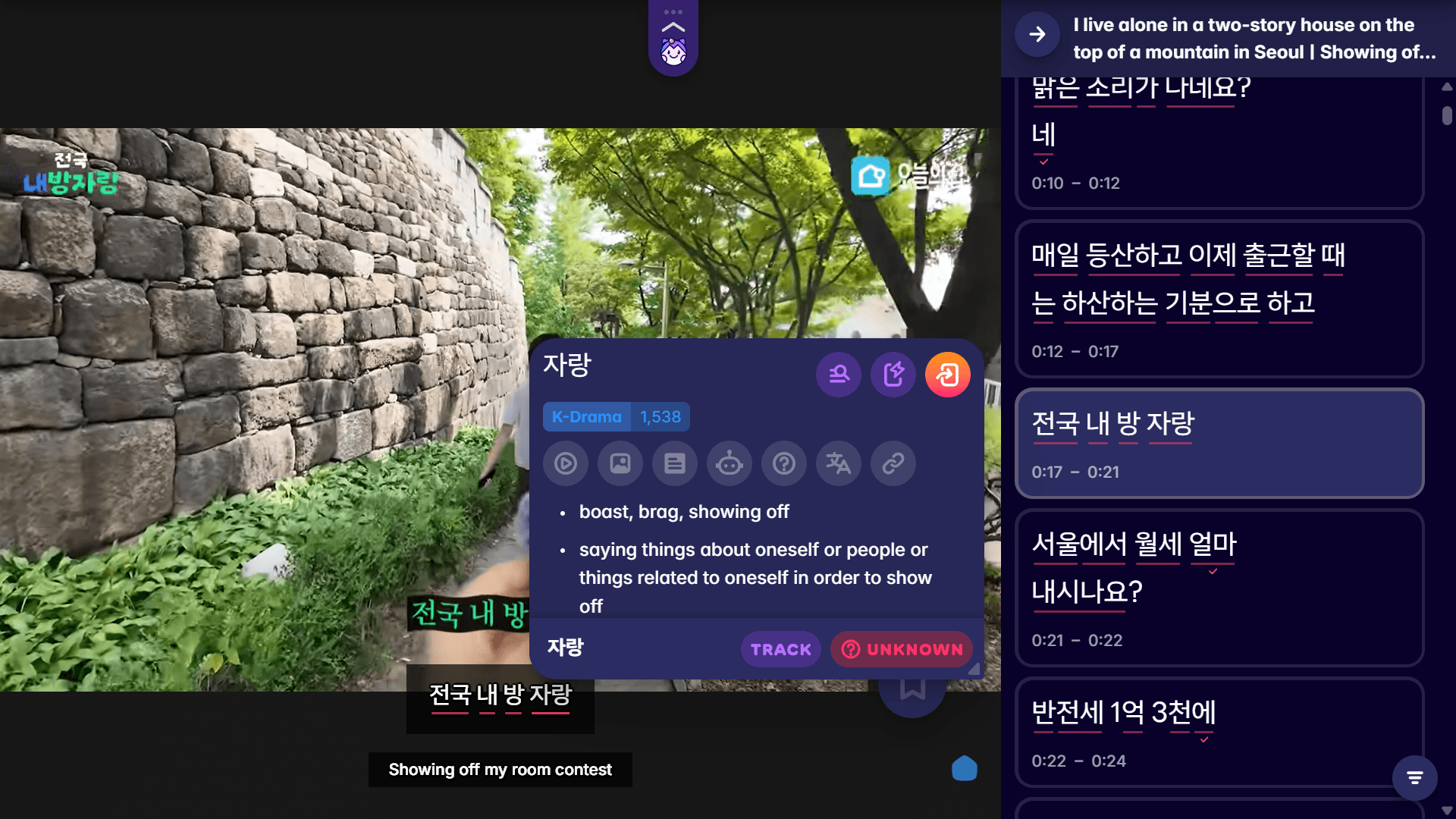
Anyway, if you want to use these strategies with real content, Migaku's browser extension and app let you look up Korean words instantly while watching shows. Makes the whole vocabulary extraction process way smoother. There's a 10-day free trial if you want to check it out 🫡
 ---
## Treat drama-watching as a serious way to learn Korean
The people who successfully learn Korean with K-dramas treat it like a serious study method, not just entertainment. They take notes, review vocabulary, and gradually increase difficulty. But they also genuinely enjoy the process. If you hate the dramas you're watching, pick different ones.
> If you consume media in Korean, and you understand at least some of the messages and sentences within that media, you will make progress. _Period_.
Enjoy it, master it!🥰
---
## Treat drama-watching as a serious way to learn Korean
The people who successfully learn Korean with K-dramas treat it like a serious study method, not just entertainment. They take notes, review vocabulary, and gradually increase difficulty. But they also genuinely enjoy the process. If you hate the dramas you're watching, pick different ones.
> If you consume media in Korean, and you understand at least some of the messages and sentences within that media, you will make progress. _Period_.
Enjoy it, master it!🥰