# Best Italian Podcasts for Language Learning in 2026
> Discover the best Italian podcasts for every level. From Coffee Break Italian to advanced content, find shows that actually improve your listening skills.
**URL:** https://migaku.com/blog/language-fun/best-italian-podcasts-for-language-learners
**Last Updated:** 2026-03-25
**Tags:** resources, discussion, deepdive
---
Finding good Italian podcasts can feel overwhelming when you're just trying to [improve your Italian](https://migaku.com/learn-italian) listening skills. I've spent way too much time scrolling through Spotify trying to figure out which shows actually help learners versus which ones just sound nice but leave you confused. The good news? There are some genuinely excellent podcasts out there that meet you at your level, whether you're struggling with basic greetings or ready to dive into cultural discussions. Here's what actually works.
----
## Why podcasts work for learning Italian
Podcasts give you something textbooks can't: real Italian pronunciation, natural speech patterns, and the ability to learn while doing literally anything else. You can listen while commuting, cooking, or pretending to work out at the gym.
The thing about podcasts is they train your ear to recognize sounds and patterns without the pressure of having to respond immediately. You can pause, rewind, and replay the same section until it clicks. Plus, most language learning podcasts are designed specifically for non-native speakers, so the hosts speak clearly and explain tricky concepts as they go.
Consistent listening practice also helps you internalize grammar patterns and vocabulary way faster than just reading alone. Your brain starts recognizing common phrases and sentence structures automatically, which makes speaking feel more natural when you actually try it.
----
## Best podcasts for beginner learners
### [Coffee Break Italian](https://coffeebreaklanguages.com/coffeebreakitalian/)
Coffee Break Italian is probably the most recommended podcast for beginners, and honestly, it deserves the hype. The format is simple: each episode runs about 15-20 minutes, and hosts Mark and Francesca guide you through Italian lessons that build on each other progressively.
What makes this podcast special is how it balances English explanations with Italian practice. Mark asks questions as a learner, while Francesca (a native speaker) provides answers and cultural context. The early episodes start with absolute basics like greetings and numbers, then gradually introduce more complex grammar.
The free version gives you plenty of content to work with, but they also offer premium materials with transcripts and bonus lessons. You can find it on Spotify and most podcast apps.
### [News in Slow Italian](https://www.newsinslowitalian.com/)
This one does exactly what the name suggests. News in Slow Italian takes current events and delivers them at a pace that beginner and intermediate learners can actually follow. Each episode covers real news stories, so you're learning vocabulary that's relevant to modern life.
The hosts speak clearly and use simpler sentence structures compared to regular Italian news broadcasts. Episodes typically run 10-15 minutes, making them perfect for daily practice. They also provide transcripts with their premium subscription, which helps you match what you're hearing with the written words.
### [Learn Italian Pod](https://www.learnitalianpod.com/learnitalianpod-podcast-series/)
Learn Italian Pod focuses on practical conversations you'd actually use. The episodes cover situations like ordering at restaurants, asking for directions, or making small talk with neighbors. Each lesson includes Italian dialogue followed by English explanations.
The host breaks down grammar points without making them feel like a boring textbook chapter. Episodes are short, usually under 5 minutes, so you can easily fit them into your day. The progression is gentle enough that you won't feel lost if you're just starting out.
----
## Intermediate podcasts for conversational practice
### [Podcast Italiano](https://www.podcastitaliano.com/en/podcast/overview)
Davide, the host of Podcast Italiano, creates content specifically for intermediate learners who want to bridge the gap between beginner lessons and native-level content. He speaks at a natural pace but articulates clearly, making it easier to follow along than random YouTube videos.
What I really like about this podcast is the variety. Some episodes feature interviews with other Italians discussing everyday topics, while others dive into cultural aspects like regional dialects or historical events. Davide also provides free transcripts for many episodes on his website, which is incredibly helpful for checking your comprehension.
The difficulty level varies by episode, so you can choose content that matches where you are right now. Some episodes include more English explanations, while others are entirely in Italian with slower, clearer speech.
### [Italiano Automatico](https://www.italianoautomatico.com/)
Alberto's podcast focuses on helping learners think in Italian rather than constantly translating from English. He covers topics ranging from personal development to Italian culture, all delivered in clear Italian that intermediate learners can follow.
The episodes run longer than beginner podcasts, usually 20-30 minutes, which gives you sustained listening practice. Alberto speaks with genuine enthusiasm about the topics he covers, making the content engaging rather than feeling like a dry language lesson.
He also has a YouTube channel and offers additional resources on his website, including transcripts for some episodes. The approach here is all about [comprehensible input](https://migaku.com/blog/language-fun/comprehensible-input-method-language-learning), getting you used to hearing Italian in context until it starts feeling natural.
### [5 Minute Italian](https://www.youtube.com/playlist?list=PLSUz2ZXbn4iAZI36dda2pCf-W8lcIB7oe)
Despite the name, episodes actually vary in length, but they're all designed for quick, focused learning sessions. Matteo and Katie (an Italian and English speaker respectively) cover specific grammar points, vocabulary themes, or cultural topics in bite-sized chunks.
The format makes it easy to stay consistent. Even on busy days, you can squeeze in an episode and actually learn something useful. They explain concepts clearly and provide plenty of examples, so you're not just memorizing rules but understanding how to actually use them.
----
## Advanced Italian learning podcasts for cultural immersion
### [Ci vuole una scienza](https://www.youtube.com/playlist?list=PLbOpF10uoJyc0_I2voZfrh6Ypr7s70b7B)
This science podcast covers everything from physics to biology in accessible Italian. It's perfect for advanced learners who want to expand their vocabulary beyond everyday conversations into more specialized topics.
The hosts explain complex concepts clearly, making it educational on multiple levels. You're learning Italian while also picking up interesting facts about how the world works. The language is sophisticated but not unnecessarily complicated.
----
## Finding Italian podcasts on Spotify and other platforms
**Spotify** has become one of the easiest places to discover Italian podcasts. Just search for "learn Italian" or "Italian language" and you'll find dozens of options. The platform's algorithm also suggests similar podcasts based on what you're already listening to, which helps you discover new shows.
**Apple Podcasts** and **Google Podcasts** also have solid collections of Italian learning content. Most of the podcasts I've mentioned are available across all major platforms, so you can use whatever app you prefer.
Some podcast creators also host their content on their own websites with additional resources like transcripts, exercises, and community forums. Checking the podcast's official site often gives you access to materials that enhance your learning beyond just listening.
----
## How to use podcasts to learn Italian
Just [passively listening while zoning out](https://migaku.com/blog/language-fun/active-vs-passive-listening-language-learning) won't do much for your Italian. You need to engage with the content actively.
1. Start by listening to an episode all the way through to get the general idea, then go back and listen again while reading the transcript if available.
2. When you encounter new words or phrases, write them down. Create flashcards or add them to a [spaced repetition app](https://migaku.com/blog/language-fun/anki-settings-for-language-learning) so you actually remember them later. Repetition matters more than variety when you're building vocabulary.
3. Try shadowing, which means repeating what the speaker says immediately after they say it. This technique improves your pronunciation and helps you internalize natural speech patterns. It feels weird at first, but it works.
4. Mix different podcast levels into your routine. Even if you're intermediate, going back to beginner content helps reinforce basics and builds confidence. Similarly, challenging yourself with slightly harder material pushes your skills forward.
----
## Combining podcasts with other learning methods
Podcasts work best as part of a [broader learning strategy](https://migaku.com/blog/language-fun/best-language-learning-methods).
- Pair your listening practice with reading Italian articles, watching [Italian shows on Netflix](https://migaku.com/blog/language-fun/best-italian-shows-language-learners) (try *Suburra* or *Baby* for modern content), and actually speaking with native speakers through language exchange apps.
- [Duolingo and similar apps](https://migaku.com/blog/language-fun/best-italian-learning-apps) can complement podcast learning by giving you structured grammar practice and vocabulary drills. The gamification keeps you consistent, while podcasts provide the authentic language exposure that apps sometimes lack.
- Consider working with a tutor for conversation practice. Apps like italki connect you with native Italian speakers who can correct your mistakes and help you apply what you're learning from podcasts in real conversations.
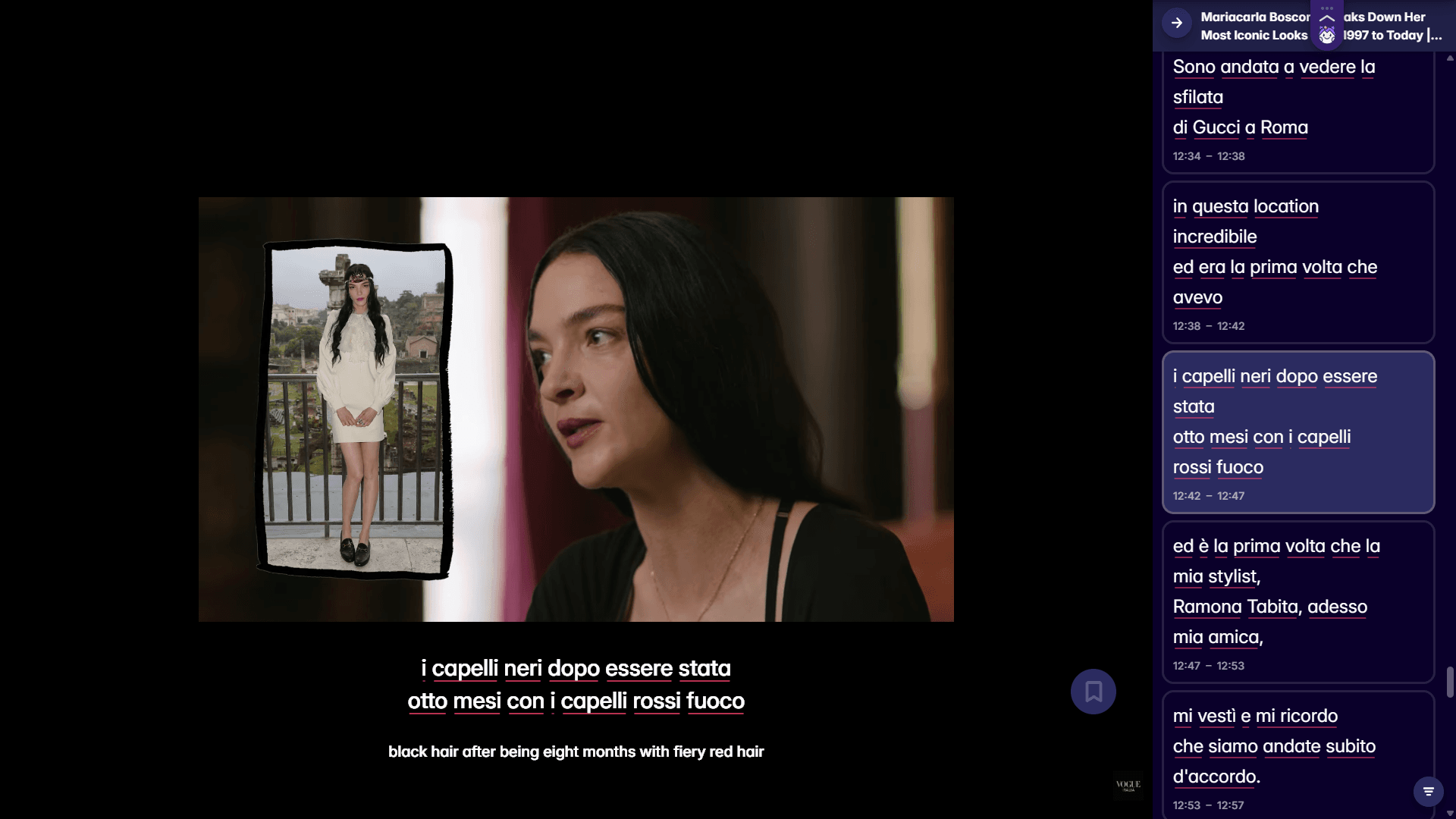
Anyway, if you want to level up your Italian learning beyond podcasts, Migaku's browser extension and app let you look up Italian words instantly while watching shows or reading articles online. Makes immersion way more practical than constantly switching to a dictionary. There's a 10-day free trial if you want to check it out.
 ----
## FAQs
Most language learning podcasts don't have subtitles in the traditional sense since they're audio-only. However, many offer transcripts that serve a similar purpose. Coffee Break Italian, Podcast Italiano, and News in Slow Italian all provide written transcripts for at least some of their episodes.
Let's be real: no, you can't become fluent in Italian in 30 days just by listening to podcasts. Anyone claiming otherwise is selling something. Language learning takes consistent effort over months and years, not weeks. That said, you can make noticeable progress in 30 days if you're dedicated. Daily podcast listening combined with other study methods can get you comfortable with basic phrases, improve your pronunciation, and train your ear to recognize common words.
----
## Most Italian learners listen to several podcasts!
Don't be afraid to try several podcasts before settling on your favorites, or maybe, never settling on a favorite. You may find a perfect podcast that matches your level and interest, but what is most likely is that you find multiple podcasts targeting different aspects or fields of your Italian study. That works fine too.
> If you consume media in Italian, and you understand at least some of the messages and sentences within that media, you will make progress. _Period_.
Learning styles vary. The best podcasts are the ones you'll listen to consistently!
----
## FAQs
Most language learning podcasts don't have subtitles in the traditional sense since they're audio-only. However, many offer transcripts that serve a similar purpose. Coffee Break Italian, Podcast Italiano, and News in Slow Italian all provide written transcripts for at least some of their episodes.
Let's be real: no, you can't become fluent in Italian in 30 days just by listening to podcasts. Anyone claiming otherwise is selling something. Language learning takes consistent effort over months and years, not weeks. That said, you can make noticeable progress in 30 days if you're dedicated. Daily podcast listening combined with other study methods can get you comfortable with basic phrases, improve your pronunciation, and train your ear to recognize common words.
----
## Most Italian learners listen to several podcasts!
Don't be afraid to try several podcasts before settling on your favorites, or maybe, never settling on a favorite. You may find a perfect podcast that matches your level and interest, but what is most likely is that you find multiple podcasts targeting different aspects or fields of your Italian study. That works fine too.
> If you consume media in Italian, and you understand at least some of the messages and sentences within that media, you will make progress. _Period_.
Learning styles vary. The best podcasts are the ones you'll listen to consistently!