# Best YouTube Channels for Language Learning at Every Level
> Find the best language learning YouTube channels for beginners to advanced learners. Covers grammar, pronunciation, conversations, and immersion content.
**URL:** https://migaku.com/blog/language-fun/best-language-learning-youtube-channels
**Last Updated:** 2026-04-06
**Tags:** resources, discussion, deepdive
---
YouTube has become one of the best places to [learn languages](https://migaku.com/) for free. You've got channels for every level, from absolute beginners to advanced learners who want to perfect their pronunciation or dive into real-life conversations. The variety is honestly incredible. Some channels focus on grammar and vocabulary lessons, others feature street interviews with native speakers, and a few blend humor with cultural insights to keep things interesting. This guide breaks down the best [language learning](https://migaku.com/blog/language-fun/3-things-to-learn-a-language) YouTube channels by category, so you can find exactly what works for your current level and goals.
----
## Best YouTube channel picks for absolute beginners
When you're just starting out with a new language, you need channels that explain things clearly without assuming you know anything. These channels break down the basics in ways that actually stick.
### [Easy Languages for real street conversations](https://www.youtube.com/@easylanguages)
Easy Languages is probably one of the most useful channels for beginners who want to hear how people actually talk. The format is simple: they go out on the streets in different countries and interview locals about everyday topics. You get to see real people speaking naturally, with subtitles in both the target language and English. Pretty cool for building comprehension from day one.
The channel covers tons of languages. Easy German, Easy Spanish, Easy French, Easy Russian, and way more. Each language has its own sub-channel, so you can focus on exactly what you're learning. The street interviews give you a feel for natural pronunciation and common phrases that textbooks usually skip.
### [Learn French with Alexa](https://www.youtube.com/user/learnfrenchwithalexa)
Alexa Polidoro runs one of the most beginner-friendly channels for French learners. She teaches with a lot of energy and breaks down grammar concepts into digestible chunks. Her lessons cover everything from basic greetings to verb conjugations, and she repeats key phrases enough times that they actually sink in.
What makes her channel stand out is how she structures her playlists. You can follow a complete beginner course from lesson one all the way through, which gives you a clear path instead of jumping around randomly. She also focuses heavily on pronunciation, which is crucial for French with all those nasal sounds and silent letters.
### [SpanishDict for structured Spanish lessons](https://www.youtube.com/@SpanishDict)
SpanishDict offers short, focused videos that tackle specific grammar points or vocabulary themes. Each video is usually under 10 minutes, which makes it easy to fit into your day. They cover everything from how to roll your Rs to the difference between ser and estar.
----
## Intermediate language learning YouTube channels
Once you've got the basics down, you need channels that challenge you without completely overwhelming you. These picks help you transition from textbook phrases to actual fluency.
### [Easy Languages](https://www.youtube.com/@easylanguages) (yes, again)
Here's the thing: Easy Languages works for intermediate learners too. As you get better, you can turn off the English subtitles and just use the target language ones. The conversations get more complex as you move through their video library, covering topics like politics, culture, and personal stories.
The real benefit at this level is using their content for [listening practice](https://migaku.com/blog/language-fun/active-vs-passive-listening-language-learning). You can pause, rewind, and really analyze how native speakers construct sentences on the fly. It's basically free [immersion](https://migaku.com/blog/language-fun/comprehensible-input-method-language-learning) content with the safety net of subtitles when you need them.
### [Language Jones](https://www.youtube.com/@languagejones) for polyglot insights
Language Jones is run by a linguist who speaks multiple languages and breaks down the science behind language learning. His videos aren't traditional lessons. Instead, he talks about pronunciation techniques, learning strategies, and how different languages compare structurally.
For intermediate learners, his pronunciation videos are gold. He uses phonetic breakdowns and shows you exactly how to position your mouth and tongue for sounds that don't exist in English. This level of detail helps you sound more natural instead of just being understood.
### Comprehensible Input channels
Channels like [Dreaming Spanish](https://www.youtube.com/DreamingSpanish) or [Comprehensible Thai](https://www.youtube.com/@ComprehensibleThai) focus on teaching through context rather than explicit grammar explanations. They speak slowly and clearly, using visuals and gestures to help you understand without translation.
This approach works really well for intermediate learners because it trains your brain to think in the target language. You're building comprehension skills naturally, the same way you learned your first language as a kid. The content gradually increases in difficulty as you work through their video libraries.
----
## Advanced language-learning resources for near-native fluency
At the advanced level, you need content that exposes you to native-speed conversations, cultural nuances, and specialized vocabulary. These channels treat you like an adult learner who can handle complexity.
### News in Slow channels
[News in Slow English](https://www.youtube.com/playlist?list=PLu-FPgsivGiZl6Ndh6Q_MXfXrzwt4EWk2), [News in Slow Spanish](https://www.youtube.com/playlist?list=PL-TKS5gRoOvSbJr7q1e3812-qRs6dDods), and similar channels deliver current events at a reduced speed with clear pronunciation. Each episode comes with a transcript, which is perfect for advanced learners who want to analyze sentence structure and pick up new vocabulary.
The topics range from international politics to science and culture, so you're learning the kind of vocabulary you'd actually use in professional or academic settings. Once the slower version feels easy, you can find the same news stories at normal speed on regular news channels.
### [InnerFrench](https://www.youtube.com/innerFrench) for French learners
InnerFrench is designed for intermediate to advanced French learners. The host, Hugo, speaks at a natural pace about interesting topics like psychology, history, and culture. The podcast-style format means you can listen while doing other things, but the YouTube channel adds visual context.
What makes this channel valuable is that Hugo explains complex ideas entirely in French, using simpler French words to define harder ones. This builds your ability to stay in the language instead of constantly translating back to English.
### [Easy German podcast](https://www.youtube.com/@EasyGerman)
The Easy German team also produces a podcast where they discuss various topics in German at a natural speaking pace. It's less structured than their street interview videos, which means you get to hear how educated native speakers actually converse when they're just chatting.
The chemistry between the hosts makes it entertaining, and they occasionally explain cultural references or idioms that might confuse learners. It's like having German friends who don't mind that you're still learning.
----
## Grammar and vocabulary focused YouTubers
Some learners prefer systematic approaches to grammar and vocabulary building. These channels deliver structured lessons that you can work through methodically.
### [Learn German with Anja](https://www.youtube.com/@LearnGermanwithAnja)
Anja teaches German with clear explanations of grammar rules that usually confuse learners. She covers everything from case systems to modal verbs, with plenty of examples. Her teaching style is patient and thorough, which works well if you like understanding the why behind the rules.
She also creates vocabulary videos organized by theme: food, travel, business German. This makes it easy to build your word bank in specific areas you care about.
### [French with Vincent](https://www.youtube.com/@frenchwithvincent2485)
Vincent runs a channel that dives deep into French grammar and vocabulary. His videos are longer and more detailed than typical YouTube lessons, sometimes running 20-30 minutes. He doesn't shy away from complex topics like the subjunctive mood or relative pronouns.
For learners who want to really master French grammar, his systematic approach pays off. He builds on previous lessons, so working through his playlists in order gives you a solid foundation.
### [SpanishPod101](https://www.youtube.com/@spanishpod101)
SpanishPod101 uploads tons of content covering grammar, vocabulary, and cultural lessons. The channel has videos for every level, clearly labeled so you can find appropriate content. They use a mix of teaching styles: some videos feature a tutor explaining concepts, others use animated lessons.
The sheer volume of content means you could probably learn Spanish entirely from this channel if you worked through everything systematically. They also cover both European Spanish and Latin American variations.
----
## Pronunciation specialists worth following
Pronunciation can make or break your ability to communicate, even if your grammar is perfect. These YouTube channels for languages focus specifically on helping you sound more natural.
### [Rachel's English](https://www.youtube.com/@rachelsenglish)
Rachel's English is technically focused on English pronunciation for non-native speakers, but the techniques she teaches apply to language learners in general. She breaks down mouth positions, stress patterns, and intonation in incredible detail.
Even if you're learning a different language, understanding how pronunciation works technically can help you apply similar analysis to your target language. Plus, if you're reading this in English as a second language, her channel will help you sound more natural.
### [Pronunciation with Emma](https://www.youtube.com/@Pronunciationwithemma)
Emma teaches British English pronunciation with a focus on received pronunciation and common British accents. She explains the differences between [British and American pronunciation](https://migaku.com/blog/language-fun/american-vs-british-english), which is useful for learners who want to choose a specific accent to model.
Her videos include exercises you can practice along with, which beats just passively watching. The repetition helps train your mouth muscles to make unfamiliar sounds.
----
## Channels that answer the big questions
Some channels focus on the meta aspects of language learning: strategies, motivation, and comparing different learning methods.
### Polyglot channels and Reddit favorites
If you've spent time on language learning Reddit, you've probably seen recommendations for channels like [Ikenna](https://www.youtube.com/@IkennaLanguages), [Steve Kaufmann](https://www.youtube.com/@Thelinguist), or [Xiaomanyc](https://www.youtube.com/@xiaomanyc). These polyglots share their experiences learning multiple languages and what worked for them.
Steve Kaufmann, who speaks over 20 languages, emphasizes massive input through reading and listening. His channel LingQ documents his learning process with new languages, showing you what intermediate and advanced learning actually looks like. He's pretty critical of traditional classroom methods and advocates for self-directed learning through interesting content.
Ikenna focuses on learning languages quickly using immersion techniques and shares his progress publicly. His videos are more entertainment-focused but still packed with useful insights about staying motivated and finding content you actually enjoy.
----
## Finding channels for specific languages
While English learning channels dominate YouTube, you can find quality content for pretty much any language if you know where to look.
For **Spanish**, check out:
- [Butterfly Spanish](https://www.youtube.com/@ButterflySpanish)
- [Why Not Spanish](https://www.youtube.com/@WhyNotSpanish)
- [Easy Spanish](https://www.youtube.com/@EasySpanish)
The best YouTube channel for learning Spanish depends on your level, but Butterfly Spanish works well for beginners because Ana explains grammar clearly and keeps lessons short.
For **French** learners beyond the beginner stage, check out channels like:
- [French Mornings with Elisa](https://www.youtube.com/@FrenchmorningswithElisa)
- [Français Authentique](https://www.youtube.com/@francaisauthentique)
There are **Russian** channels like:
- [Russian With Max](https://www.youtube.com/@RussianWithMax)
- [Be Fluent in Russian](https://www.youtube.com/@BeFluentinRussian)
Max's channel is particularly good because he speaks slowly and clearly while discussing interesting topics entirely in Russian. Be Fluent in Russian provides structured lessons with clear explanations.
For **Asian languages:**
- [Comprehensible Japanese](https://www.youtube.com/@cijapanese)
- [Learn Korean with GO!](https://www.youtube.com/@GoBillyKorean)
These languages require more time investment because of different writing systems, but the channels provide clear paths forward.
----
## Practical tips for using YouTube channels effectively
Just watching videos won't make you fluent. You need to engage actively with the content.
1. Start by finding 2-3 channels at your level and commit to them instead of channel-hopping constantly. Create playlists of videos you want to work through, and actually work through them in order rather than randomly clicking suggested videos.
2. Use the subtitle feature strategically. Start with both target language and English subtitles if you need them, then gradually remove the English ones. Eventually, try watching without any subtitles to test your comprehension.
3. Take notes while watching, especially for vocabulary and phrases that seem useful. Better yet, [create flashcards from sentences](https://migaku.com/blog/language-fun/anki-settings-for-language-learning) you hear in videos. This turns passive watching into active learning.
4. Repeat videos. Seriously. Watch the same video multiple times over several days. The first time you'll catch maybe 60% of it. The second time, 80%. By the third viewing, you'll notice details you completely missed before.
5. Try shadowing: pause the video after each sentence and repeat exactly what you heard, mimicking the pronunciation and intonation. This feels awkward at first but dramatically improves your speaking ability.
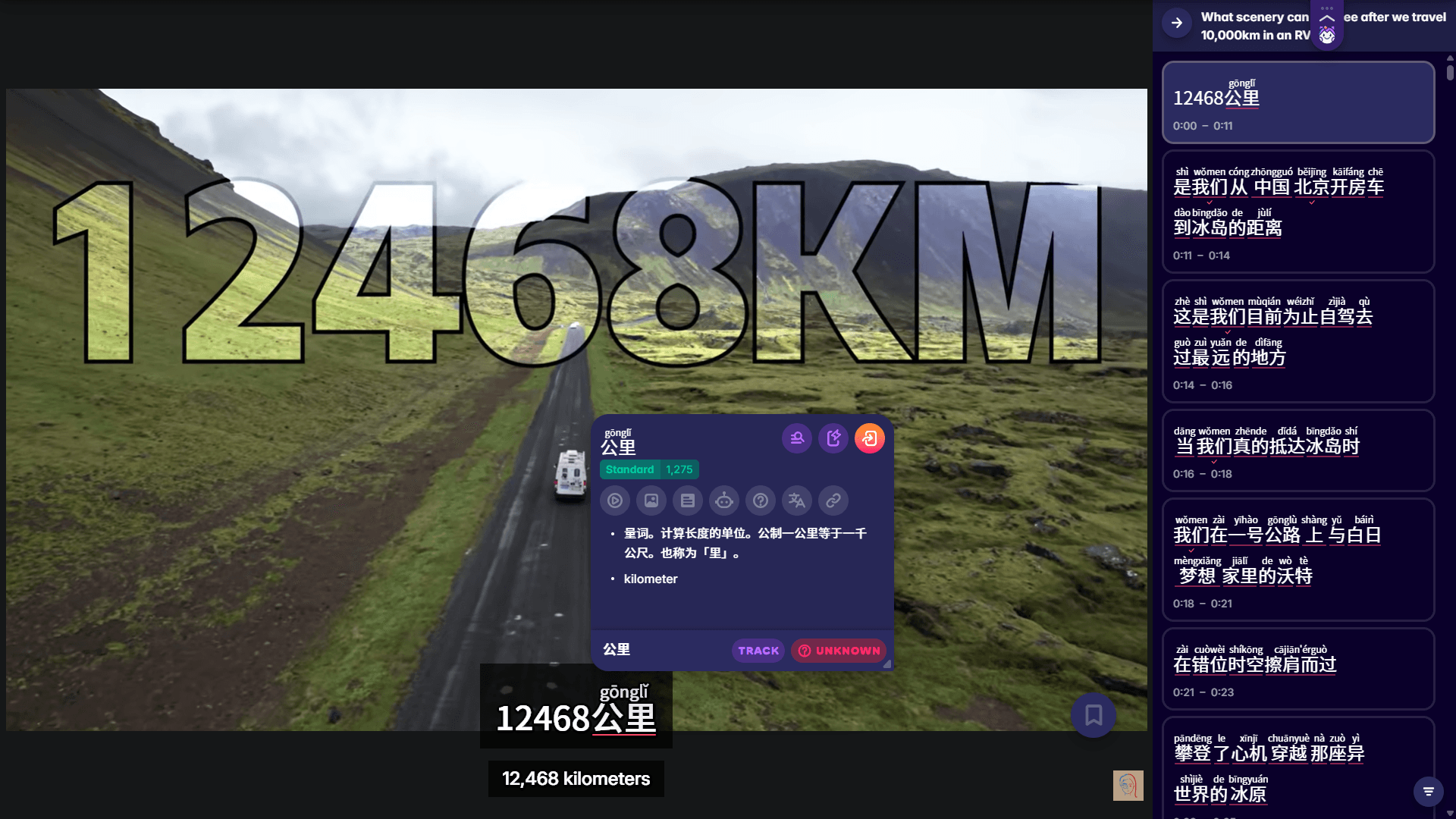
If you want to level up your immersion learning, Migaku's browser extension and app let you look up words instantly while watching YouTube videos or reading articles in your target language. Makes the whole process way more practical. There's a 10-day free trial if you want to check it out.
 ----
## FAQs
People ask this a lot. Babbel is fine as a structured course, especially for beginners who want guided lessons. But here's the reality: no app or course alone will make you fluent. You need to combine structured learning with real content consumption and practice. YouTube channels give you the real content part for free. You can use Babbel or any other app for structured grammar, then supplement with YouTube for listening practice, pronunciation modeling, and cultural context. The best approach uses multiple resources.
----
## No matter which language you want to learn, you can start your journey here!
YouTube gives you access to thousands of hours of free language learning content across every major language. The channels listed here represent some of the best options for different learning styles and levels, but the real magic happens when you actually use them consistently. Watch actively, take notes, create flashcards, and practice what you learn. Combine YouTube with real conversations, reading, and other input sources for balanced progress.
> If you consume media in your target language, and you understand at least some of the messages and sentences within that media, you will make progress. *Period*.
Some of the best learning opportunities are free.
----
## FAQs
People ask this a lot. Babbel is fine as a structured course, especially for beginners who want guided lessons. But here's the reality: no app or course alone will make you fluent. You need to combine structured learning with real content consumption and practice. YouTube channels give you the real content part for free. You can use Babbel or any other app for structured grammar, then supplement with YouTube for listening practice, pronunciation modeling, and cultural context. The best approach uses multiple resources.
----
## No matter which language you want to learn, you can start your journey here!
YouTube gives you access to thousands of hours of free language learning content across every major language. The channels listed here represent some of the best options for different learning styles and levels, but the real magic happens when you actually use them consistently. Watch actively, take notes, create flashcards, and practice what you learn. Combine YouTube with real conversations, reading, and other input sources for balanced progress.
> If you consume media in your target language, and you understand at least some of the messages and sentences within that media, you will make progress. *Period*.
Some of the best learning opportunities are free.