# Best Vietnamese TV Series for Language Learners in 2026
> Find the best Vietnamese shows for every level, from beginner sitcoms to advanced dramas. Learn where to watch and which phrases you'll pick up.
**URL:** https://migaku.com/blog/language-fun/best-vietnamese-shows-language-learners
**Last Updated:** 2026-04-07
**Tags:** resources, discussion, deepdive
---
If you're [learning Vietnamese](https://migaku.com/learn-vietnamese), watching TV shows beats staring at [textbooks](https://migaku.com/blog/language-fun/best-vietnamese-textbooks) any day. The problem is finding shows that actually work for language learners. You need clear dialogue, natural conversations, and content that doesn't move so fast you're lost after five minutes. I've spent way too much time tracking down Vietnamese shows that hit that sweet spot between entertaining and educational, so here's what actually works for different skill levels.
----
## Why Vietnamese TV shows work better than traditional study
Here's the thing about learning Vietnamese from shows: you're getting real language in context. When someone says "Cảm ơn" in a drama, you see exactly when and how to use it. You catch the tone (super important in Vietnamese), the body language, the social context. Compare that to a textbook example and there's no context.
1. Vietnamese has six [tones](https://migaku.com/blog/language-fun/vietnamese-tones-overview) in the Northern dialect and five in the Southern dialect. Reading about tones is one thing. Hearing them used naturally in conversation over and over? That's how they actually stick.
2. Plus, you're learning vocabulary that people actually use, not just formal textbook phrases that make you sound like a robot.
3. The other benefit is cultural immersion. You pick up on Vietnamese humor, family dynamics, social etiquette, and daily life stuff that never makes it into language courses. When you eventually visit Vietnam or talk with native speakers, you'll have context for everything.
----
## Best Vietnamese shows for beginners
### Gia đình là số 1 (Family Comes First)
This sitcom is basically the Vietnamese language learner's best friend. The dialogue is clear, repetitive, and focused on everyday family situations. You'll hear the same phrases over and over, which is exactly what beginners need.
The show follows a multi-generational family living under one roof. Episodes cover typical daily scenarios like cooking meals, going to work, dealing with neighbors, and family arguments. The vocabulary stays practical and grounded in real life.
Key phrases you'll pick up: "Ăn cơm chưa?" (Have you eaten?), "Đi đâu đấy?" (Where are you going?), "Về nhà đi" (Go home). These are phrases Vietnamese people use constantly.
The Northern Vietnamese dialect dominates here, so if you're learning Northern Vietnamese, this is perfect. You can watch it on YouTube with Vietnamese subtitles, which helps connect spoken words to written text.
### Cổ tích Việt Nam (Vietnamese Fairy Tales)
Animated fairy tales might sound childish, but they're gold for beginners. The narration is slow and clear. The vocabulary is simple. The stories are short enough that you won't get overwhelmed.
You'll hear stories like "Tấm Cám" (the Vietnamese Cinderella) or "Sọ Dừa" (The Coconut Skull). The cultural value is huge because these stories are part of Vietnamese childhood.
The language is formal and clear, which actually helps beginners. You're not dealing with slang or fast-paced dialogue. The repetitive storytelling structure means you'll hear similar sentence patterns across episodes.
Available on YouTube for free. Search "Cổ tích Việt Nam" and you'll find full episodes with Vietnamese subtitles.
### Những cô gái trong thành phố (City Girls)
This drama series follows young women navigating life, work, and relationships in modern Ho Chi Minh City. The Southern Vietnamese dialect is prominent here, which is useful if you're focusing on Southern pronunciation.
The pace is slower than typical dramas. Characters speak clearly, and much of the dialogue centers on everyday topics like work stress, dating, friendship problems, and family expectations. The vocabulary stays accessible for upper beginners.
You'll learn tons of useful phrases for social situations: "Hôm nay bạn thế nào?" (How are you today?), "Tôi bận lắm" (I'm very busy), "Gặp lại sau nhé" (See you later).
Watch it on [VTV Go](https://vtvgo.vn/), the streaming platform for Vietnamese national television. Some episodes are also available on YouTube.
----
## Vietnamese TV series for intermediate learners
### Hoa hồng trên ngực trái (The Rose on the Left Chest)
This family drama became massively popular in Vietnam around 2023-2024. The story deals with marriage, betrayal, and family relationships. The dialogue gets more complex than beginner shows, but it's still clear enough for intermediate learners.
The emotional scenes actually help language learning because the context makes meanings obvious. When someone's crying and says "Anh phản bội em" (You betrayed me), you don't need a dictionary to figure it out.
The show uses Northern Vietnamese dialect primarily. You'll encounter more sophisticated vocabulary related to emotions, relationships, and social issues. Great for learners who want to move beyond basic conversations.
Available on VTV Go and Netflix in some regions. The Netflix version includes English subtitles, which can help when you're stuck, but try using Vietnamese subtitles first.
### Về nhà đi con (Come Home, Darling)
Another family drama that dominated Vietnamese TV. This one explores modern family dynamics, divorce, remarriage, and generational conflicts. The dialogue feels natural and contemporary.
What makes this good for intermediate learners is the variety of speaking styles. You've got older characters using more formal Vietnamese, younger characters with casual speech, and professional scenes with business vocabulary. You're getting exposure to different registers of the language.
The series has 80+ episodes, so there's plenty of content to work through. The repetitive nature of TV series helps because you get familiar with each character's speaking patterns and commonly used phrases.
Watch on VTV Go or YouTube. Full episodes are available with Vietnamese subtitles.
### Mẹ ghế (The Step Mother)
This drama tackles the complicated dynamics of blended families. The story follows a woman who marries a widower with children, dealing with the challenges of becoming a stepmother.
The vocabulary expands into more nuanced emotional territory. You'll learn how Vietnamese people express complex feelings, handle conflicts, and navigate difficult social situations. The dialogue includes more idioms and culturally specific expressions than beginner content.
Southern Vietnamese dialect is used here. If you're learning Southern Vietnamese or planning to live in Ho Chi Minh City, this gives you authentic exposure to how people actually speak.
----
## Advanced Vietnamese shows for serious learners
### Người phán xử (The Arbitrator)
This crime drama series was hugely popular in Vietnam. The plot involves organized crime, business corruption, and moral dilemmas. The language gets sophisticated with legal terms, business vocabulary, and complex narrative structures.
Characters speak quickly and use slang, idioms, and regional expressions. You'll hear Northern Vietnamese dialect with some variations. This show challenges advanced learners because the dialogue doesn't slow down for anyone.
The cultural insights are deep. You learn about Vietnamese business culture, social hierarchies, and how people navigate power dynamics. The show sparked tons of discussion in Vietnam about morality and justice.
Watch on VTV Go or find it on YouTube. At this level, you should be able to follow most dialogue without subtitles, using context to figure out unfamiliar words.
### Sống chung với mẹ chồng (Living with Mother-in-Law)
The title says it all. This drama explores the classic Vietnamese family situation of living with your husband's mother. The dialogue is fast, natural, and full of the kind of everyday Vietnamese you won't find in textbooks.
What makes this challenging is the rapid-fire conversations during family arguments and the use of informal speech patterns. Characters interrupt each other, use sentence fragments, and employ tons of cultural references.
You'll learn how Vietnamese people actually argue, negotiate, express frustration, and make peace. The vocabulary includes family relationship terms, household management language, and emotional expressions.
Available on YouTube and Vietnamese streaming platforms.
----
## Where to watch Vietnamese shows
1. **YouTube** is honestly your best friend for Vietnamese content. Tons of full episodes are uploaded with Vietnamese subtitles. Search for show names in Vietnamese and you'll find official channels and fan uploads.
2. **VTV Go** is the official streaming app for Vietnamese national television. It's free and has a huge library of Vietnamese dramas, news, and variety shows. The interface is in Vietnamese, which is actually good practice. You can download it on iOS or Android.
3. **Netflix** has started adding more Vietnamese content in recent years. The selection is limited compared to Korean or Japanese shows, but what's there usually has good subtitle options. You can switch between Vietnamese and English subtitles as needed.
Some Vietnamese shows are available on **[Viki](https://www.viki.com/)** or other Asian drama platforms. The benefit here is community subtitles and discussion forums where learners share insights.
----
## How to learn Vietnamese from TV shows
Just watching passively won't cut it. You need active engagement. Here's what actually works:
1. **Watch with Vietnamese subtitles, not English.** You want to connect the sounds to the Vietnamese words, not translate everything. When you don't understand something, pause and look it up.
2. **Rewatch scenes or episodes.** The first time through, you're catching maybe 30-40% of the dialogue. The second time, you'll catch way more because you know the context. Repetition is how language sticks.
3. **Keep a notebook or digital list of new phrases.** When you hear something useful, write it down with the context. "Ăn cơm chưa?" doesn't just mean "Have you eaten?" It's a greeting, a way to show care, a conversation starter.
4. **Shadow the dialogue.** Play a scene and repeat what characters say, matching their tone and rhythm. This helps with pronunciation and gets the phrases into your muscle memory.
5. **Focus on one show at a time.** Binge a series instead of jumping around. You'll get familiar with the actors' voices, the recurring vocabulary, and the speech patterns. This builds comprehension faster than sampling lots of different content.
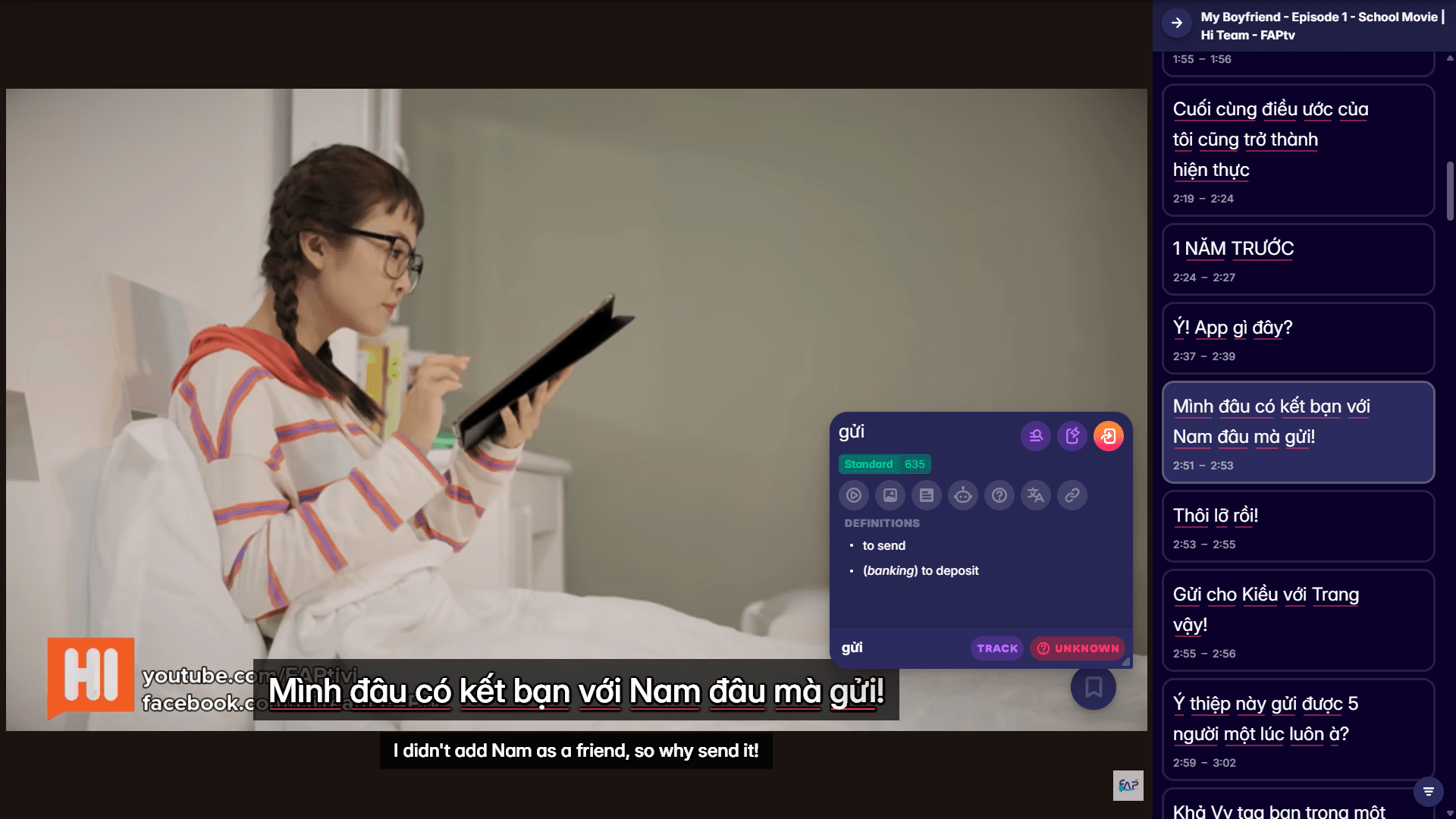
By the way, if you want to actually capture and learn from these shows efficiently, Migaku's browser extension and app let you save words and phrases directly from Vietnamese content you're watching. Makes the whole process way more practical than pausing and writing things down manually. There's a 10-day free trial if you want to check it out.
 ----
## Binge-watching your way to fluency
Vietnamese TV shows give you everything you need: natural dialogue, cultural context, repetition, and entertainment that actually keeps you coming back. Start with beginner-friendly sitcoms and fairy tales, move up to family dramas, and eventually tackle crime series and complex narratives.
> If you consume media in Vietnamese, and you understand at least some of the messages and sentences within that media, you will make progress. *Period*.
Enjoyment is one of the fastest paths to learning.🫡
----
## Binge-watching your way to fluency
Vietnamese TV shows give you everything you need: natural dialogue, cultural context, repetition, and entertainment that actually keeps you coming back. Start with beginner-friendly sitcoms and fairy tales, move up to family dramas, and eventually tackle crime series and complex narratives.
> If you consume media in Vietnamese, and you understand at least some of the messages and sentences within that media, you will make progress. *Period*.
Enjoyment is one of the fastest paths to learning.🫡