Duolingo Portuguese Review: What Duolingo Offers in 2026
Last updated: March 19, 2026

So you're thinking about using Duolingo to learn Portuguese? Good choice on the language, Portuguese is super useful and honestly pretty beautiful to listen to. But here's what you need to know about Duolingo's Portuguese course before you commit to that green owl. I've spent a lot of time with this app, and I'm going to give you the real deal on what works, what doesn't, and whether you should use it. Spoiler: it's complicated.
- What the Duolingo Portuguese course covers
- How Duolingo teaches you to learn Portuguese
- The good parts about learning Portuguese with Duolingo
- Where Duolingo falls short for Portuguese: Grammar and others
- Brazilian Portuguese vs European Portuguese
- Other alternatives: Memrise, Babbel, Pimsleur, iTalki
- The multi-app strategy
What the Duolingo Portuguese course covers
Let's start with the basics. Duolingo offers Brazilian Portuguese, which is what most learners want anyway, since Brazil has like 200 million speakers compared to Portugal's 10 million.
The current structure uses Duolingo's path system. You work through units that gradually increase in difficulty, starting from absolute beginner stuff like "Olá" and "Obrigado" all the way up to more complex grammar concepts. Each unit contains multiple lessons, and you need to complete them to unlock the next section.
Here's the thing though. The entire Portuguese course on Duolingo will take you maybe 1 year if you're doing it consistently every day. That's not very long. You're looking at around 70 units total, which sounds like a lot until you realize each unit takes maybe 30-60 minutes to complete.
The course covers basic verb conjugations (present, past, future), common vocabulary categories (food, family, travel, work), and fundamental grammar structures. You'll learn how to introduce yourself, order at restaurants, ask for directions, and handle simple conversations.
How Duolingo teaches you to learn Portuguese
Duolingo uses a mix of exercise types to teach Portuguese. You get translation exercises (Portuguese to English and back), fill-in-the-blank sentences, matching pairs, and listening comprehension where you type what you hear.
The gamification is honestly pretty effective for building a habit. You get XP points, maintain streaks, compete in leaderboards, and unlock achievements. Sounds silly, but it actually works for keeping you coming back. I've seen people maintain 500+ day streaks just because they don't want to break the chain.
The app introduces new vocabulary gradually, usually 5-10 new words per lesson. You'll see the same words repeated across different exercises, which helps with retention. The spaced repetition isn't as sophisticated as dedicated SRS apps, but it's there.
One feature that helps is the Stories section. These are short narratives in Portuguese with comprehension questions. They're way more engaging than isolated sentences and give you context for how words are actually used. The stories start super simple but get progressively harder as you advance.
The good parts about learning Portuguese with Duolingo
Let me be clear about what Duolingo does well for Portuguese learners.
- First, it's free. Yeah, there's Duolingo Plus (now called Super Duolingo), but you can complete the entire Portuguese course without paying anything. That's huge for beginners who aren't sure if they want to commit yet.
- Second, the habit-building aspect is genuinely valuable. Language learning requires consistency, and Duolingo's streak system and daily reminders actually get people to practice every day. Even 10 minutes daily beats studying for 2 hours once a week.
- Third, it introduces you to Portuguese pronunciation from day one. You hear native speakers (Brazilian accent) saying words and sentences, which helps you develop an ear for the language early. The listening exercises force you to distinguish between similar sounds.
- Fourth, it's low-pressure for beginners. If you've never learned a language before or you're intimidated by Portuguese, Duolingo makes it feel manageable. The bite-sized lessons don't overwhelm you.
- The grammar explanations have improved too. They're still pretty basic, but at least now you get some context for why verb conjugations work the way they do or when to use certain pronouns.
Where Duolingo falls short for Portuguese: Grammar and others
Alright, now the problems.
- The biggest issue is that the course is too short. You'll finish it feeling like you've just scratched the surface, because you have. Duolingo will get you to maybe A2 level, possibly B1 if you really pay attention and do supplementary work. That's nowhere near fluent.
- Speaking practice is severely limited. You can record yourself saying phrases, but there's no real conversation practice. You're not learning to think on your feet, construct original sentences under pressure, or handle the back-and-forth of dialogue. This is a massive gap.
- The vocabulary plateau hits hard. After completing the course, most learners report knowing around 1,500-2,000 words. That's enough for basic communication, but not enough to watch Brazilian shows without subtitles or read news articles comfortably. You need more like 5,000-8,000 words for that.
- Grammar coverage is superficial. You'll learn that verbs conjugate and get some practice with common patterns, but you won't deeply understand the subjunctive mood, the personal infinitive (which Portuguese has and Spanish doesn't), or the nuances of por vs. para. These gaps will catch up with you.
- The sentences can be weirdly random. You'll be translating stuff like "The elephant drinks beer" when you probably want to learn "Where is the bathroom?" The app has gotten better about this, but you still get some bizarre examples that aren't practically useful.
Brazilian Portuguese vs European Portuguese
Duolingo teaches Brazilian Portuguese exclusively. If you want to learn the European variant, you're out of luck here.
For most learners, this is fine. Brazilian Portuguese has way more speakers globally, and Brazilian media (music, TV shows, YouTube content) is more accessible. The pronunciation is generally considered easier for English speakers, too.
But the differences are real. European Portuguese has different pronunciation (They drop a lot of vowel sounds), different vocabulary choices, and slightly different grammar preferences. If you're planning to move to Portugal or work with Portuguese companies, Duolingo won't prepare you perfectly.
Brazilian Portuguese itself has regional variations, but Duolingo uses a fairly neutral accent that most Brazilians will understand easily.
Other alternatives: Memrise, Babbel, Pimsleur, iTalki
So what other learning apps are out there for learning Portuguese?
- Memrise has a Portuguese course that focuses more heavily on vocabulary building with video clips of native speakers. The spaced repetition is better than Duolingo's, and you get more exposure to real-world Portuguese. But the gamification isn't as strong, so some people find it harder to stick with.
- Babbel's Portuguese course is more structured and grammar-focused. The lessons feel more like traditional language classes, which some people prefer. It's subscription-based though, so you're paying from day one.
- Pimsleur Portuguese is entirely audio-based and focuses on speaking from the start. You're constructing sentences out loud from lesson one. It's great for pronunciation and conversational flow but doesn't teach reading or writing. Also expensive.
- iTalki connects you with Portuguese tutors for one-on-one lessons. This is hands-down the best way to actually learn to speak, but it requires more money and scheduling commitment than apps.
- PortuguesePod101 offers podcast-style lessons with cultural context and detailed grammar explanations. It's more comprehensive than Duolingo but less gamified, so you need more self-discipline.
The multi-app strategy
Here's what I recommend for 2026.
- Start with Duolingo for your first 2-3 months. Build the habit, learn basic vocabulary and grammar, and get comfortable with Portuguese sounds. Do 20-30 minutes daily.
- Simultaneously, add Memrise or a similar app for more vocabulary exposure. Duolingo's vocabulary is limited, so supplement it early.
- After month 2, start adding comprehensible input. Watch Brazilian YouTube channels with Portuguese subtitles, even if you barely understand. Your brain needs exposure to natural speech patterns.
- By month 3-4, add speaking practice. Get on iTalki or a similar platform and start doing weekly conversation sessions with a tutor. This is where you'll learn to use the language.
Keep using Duolingo as your daily maintenance routine, but don't rely on it exclusively. Think of it as your vocabulary and grammar review tool while you do the real learning through immersion and conversation.
The learners who succeed with Portuguese use multiple resources. The ones who plateau are usually the ones who think one app will get them fluent.
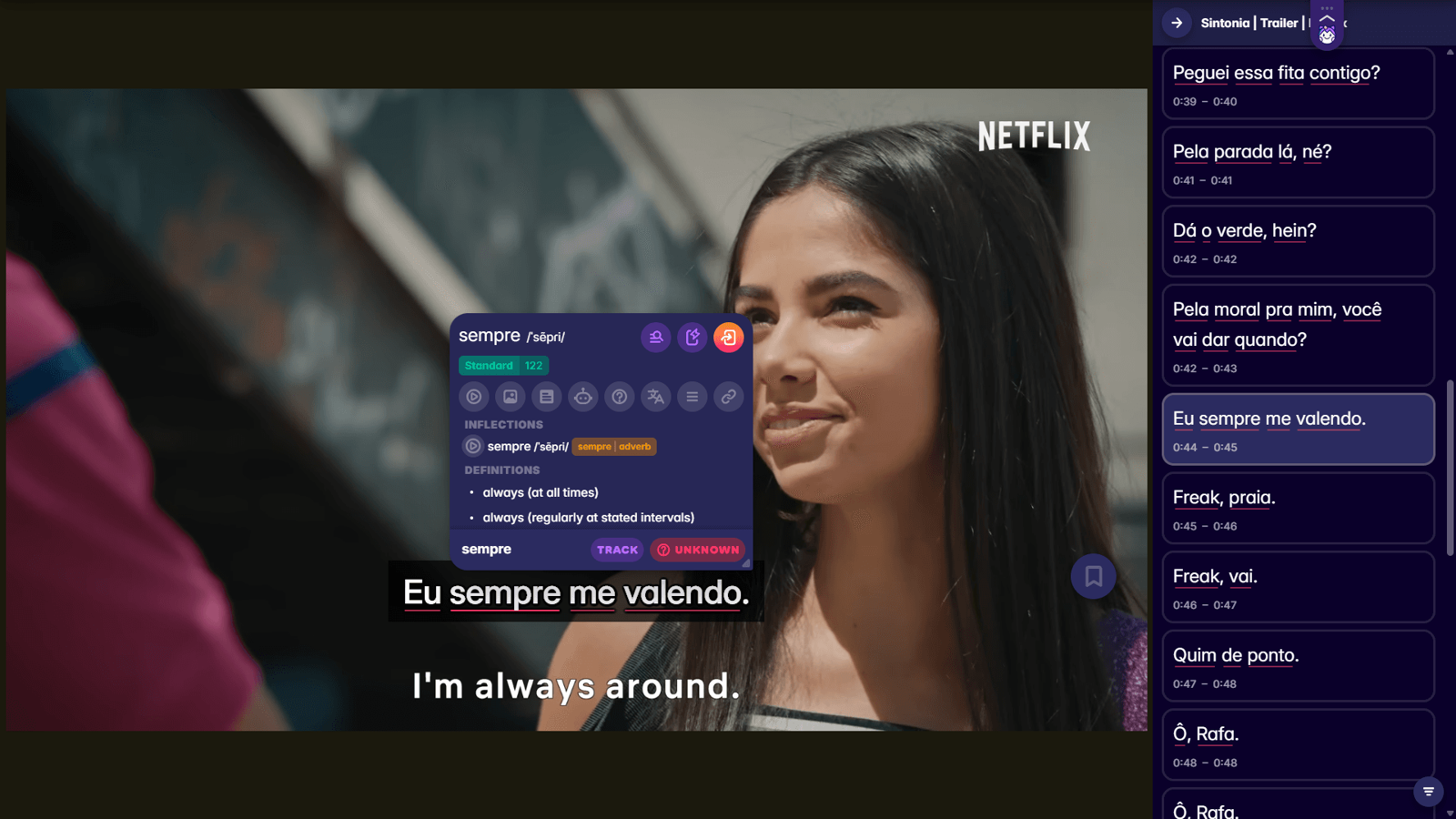
Anyway, if you want to level up your Portuguese learning, Migaku's browser extension and app let you look up Portuguese words instantly while watching Brazilian shows or reading articles. Makes the whole immersion thing way more practical. There's a 10-day free trial if you want to check it out.
Look, Duolingo is good for language learning beginners
If you're a complete beginner who wants to dip your toes into Portuguese without spending money or making a huge commitment, just use Duolingo. If you want to become conversational or fluent in Portuguese, you'll need other resources like textbooks, tutors, immersion practices with dramas, movies, novels, and other media content.
If you consume media in Portuguese, and you understand at least some of the messages and sentences within that media, you will make progress. Period.
The green owl can only take you so far.🦉🏁