# Duolingo Vietnamese Review: Should You Use Duolingo for Learning Vietnamese Language?
> Honest Duolingo Vietnamese review covering what works, major pronunciation gaps, and whether this free app can actually teach you Vietnamese in 2026.
**URL:** https://migaku.com/blog/language-fun/duolingo-vietnamese-review
**Last Updated:** 2026-03-15
**Tags:** resources, discussion, deepdive
---
So you're thinking about [learning Vietnamese](https://migaku.com/learn-vietnamese) and wondering if Duolingo can actually get you there? I've spent a good amount of time testing out the Vietnamese course on Duolingo, and I'm going to give you the honest breakdown. Spoiler: It's a decent starting point if you're a complete beginner, but it has some pretty significant gaps that you'll need to fill if you want to speak Vietnamese with confidence. Let's dig into what works, what doesn't, and whether you should download this app or look elsewhere.
----
## Can I learn Vietnamese on Duolingo
The short answer is yes, you can learn some Vietnamese on Duolingo. But here's the thing: you'll learn enough to recognize basic vocabulary and sentence patterns, but you won't master the language using Duolingo alone.
Duolingo's Vietnamese course teaches you around 1,296 to 3,278 words across its lessons. That's actually not bad for a free app. You'll get exposure to common phrases, basic [grammar](https://migaku.com/blog/language-fun/vietnamese-grammar-guide) structures, and everyday vocabulary that you'd use in Vietnam. The course follows Duolingo's typical gamified approach with short lessons, experience points, and streaks to keep you coming back.
The problem is that Vietnamese is a tonal language with six different tones, and Duolingo doesn't do a great job teaching you how to actually pronounce these tones correctly. You can complete the entire course and still sound completely off to a native speaker. That's a pretty big limitation when pronunciation is so critical in Vietnamese.
----
## What the Duolingo Vietnamese course offers
Duolingo's Vietnamese course follows the same structure as their other language offerings.
1. **You work through a skill tree with different units** covering topics like [greetings](https://migaku.com/blog/language-fun/vietnamese-greetings), family, food, travel, and more complex grammar as you progress.
2. **Each lesson mixes multiple exercise types.** You'll translate sentences from English to Vietnamese and vice versa, match words with pictures, listen to audio clips and type what you hear, and speak phrases into your microphone. The variety keeps things from getting too boring.
3. **The course focuses on Northern Vietnamese**, which is the dialect spoken in Hanoi and the surrounding regions. This matters because Vietnamese has pretty distinct regional accents and vocabulary differences. If you're planning to spend time in Ho Chi Minh City or southern Vietnam, you'll notice some differences in how people speak compared to what Duolingo teaches.
4. **One thing I appreciate is that the app uses real audio from speakers rather than robotic text-to-speech.** The audio quality is decent, though the speakers sometimes talk pretty fast for beginners to catch every syllable.
----
## Strengths for beginner learners
If you're just starting out with Vietnamese language and have zero background in the language, Duolingo gives you a gentle introduction.
- **The gamification** actually works here because Vietnamese can feel overwhelming at first with its tones and unfamiliar sounds.
- **The app introduces vocabulary gradually.** You're not drowning in 100 new words per lesson. Instead, you might learn 5-10 new words and then practice them repeatedly in different sentence contexts. This [spaced repetition helps with retention](https://migaku.com/blog/language-fun/spaced-repetition-vs-cramming).
- **Duolingo also does a decent job with basic grammar patterns.** You'll learn how to form simple sentences, ask questions, use classifiers (which are super important in Vietnamese), and understand word order. The explanations are pretty minimal, but you pick up patterns through exposure.
- **Another strength is accessibility.** You can literally start learning the language right now without paying anything. Just download the app and go. For people who aren't sure if they want to commit to learning Vietnamese yet, this low barrier to entry is perfect.
- **The streak feature genuinely motivates some people to practice daily.** Even if it's just 5-10 minutes, that consistency adds up over time.
----
## Where Duolingo language course falls short with Vietnamese
Here's where I need to be brutally honest. Duolingo has some serious limitations for Vietnamese learners.
- **The biggest issue is pronunciation and tones.** Vietnamese has six tones: flat, sharp, grave, question, stumbling, and heavy. These tones completely change word meanings. The word "ma" can mean ghost, mother, rice seedling, tomb, horse, or but/and depending on which tone you use. Pretty important to get right!
- **There's also basically zero cultural context.** You'll learn the words and sentences, but you won't understand when to use formal versus informal language, which matters a lot in Vietnamese. The culture around respect, age hierarchies, and social relationships directly impacts how you speak, and Duolingo just ignores all of that.
- **Grammar explanations are minimal to nonexistent.** You're supposed to figure out patterns through repetition, which works for some things but leaves you confused about others. Why do you use this classifier with people but that one with animals? Duolingo won't tell you.
- **The course also doesn't go very deep.** Once you finish the entire tree, you'll be somewhere around an A2 or maybe B1 level at best. You can handle basic conversations about everyday topics, but you're nowhere near fluent.
----
## How Duolingo compares to other Vietnamese learning apps
Duolingo isn't your only option for learning Vietnamese through an app. Let's look at how it stacks up against alternatives.
- **Lingodeer** gets mentioned a lot as a better option for Vietnamese. It provides more detailed grammar explanations and focuses more on the structure of the language. The lessons are less gamified but more educational. If you want to actually understand why sentences work the way they do, Lingodeer does a better job.
- **Talkpal** uses AI conversation practice, which gives you more speaking opportunities than Duolingo. You can have actual back-and-forth exchanges rather than just repeating preset phrases. This helps with building conversation skills faster.
- **Drops** focuses purely on vocabulary with visual associations. It's beautifully designed and great for building your word base quickly, but it doesn't teach grammar or sentence construction at all.
- **Pimsleur** takes an audio-first approach with lots of speaking practice. It's better for pronunciation than Duolingo, but it's also way more expensive and can feel repetitive.
Honestly, Duolingo sits in a sweet spot of being free, accessible, and covering multiple skill areas, even if it doesn't excel at any single one. For absolute beginners who want to dip their toes in, it's hard to beat the price point.
----
## What to use alongside Duolingo for better results
Here's my recommended approach if you want to use Duolingo as part of your Vietnamese learning strategy.
1. Get a tutor for pronunciation feedback. You can find affordable Vietnamese tutors on platforms like iTalki or Preply. Even one 30-minute session per week where someone corrects your tones will make a massive difference. This addresses Duolingo's biggest weakness.
2. Use Anki or another spaced repetition app for vocabulary. Duolingo has built-in repetition, but dedicated SRS apps are more efficient. You can find pre-made Vietnamese decks or create your own from words you encounter.
3. Watch Vietnamese content with subtitles. YouTube has tons of Vietnamese channels covering everything from cooking to vlogs to news. Start with content that has both Vietnamese and English subtitles so you can follow along.
4. Join online Vietnamese learning communities. The Vietnamese learning subreddit and various Facebook groups have people at all levels and native Vietnamese speakers sharing resources, answering questions, and offering language exchanges.
5. Consider a proper textbook for grammar. "[Elementary Vietnamese](https://migaku.com/blog/language-fun/best-vietnamese-textbooks)" by Binh Ngo is solid and will fill in all the grammar gaps that Duolingo leaves. You don't need to work through it cover to cover, but having it as a reference helps.
----
## The verdict on Duolingo for Vietnamese
Duolingo works as a free introduction to Vietnamese that builds basic vocabulary and familiarizes you with sentence patterns. It's good for establishing a daily study habit and getting your feet wet with the language.
But it's not sufficient on its own. The lack of proper pronunciation training, minimal cultural context, and limited depth mean you'll hit a wall pretty quickly if Duolingo is your only resource.
> 💡 My Recommendation 💡
Use Duolingo for 10-15 minutes daily as your baseline practice, but spend equal or more time on other activities. Listen to native speakers, practice with tutors, consume Vietnamese media, and actually try to use the language.
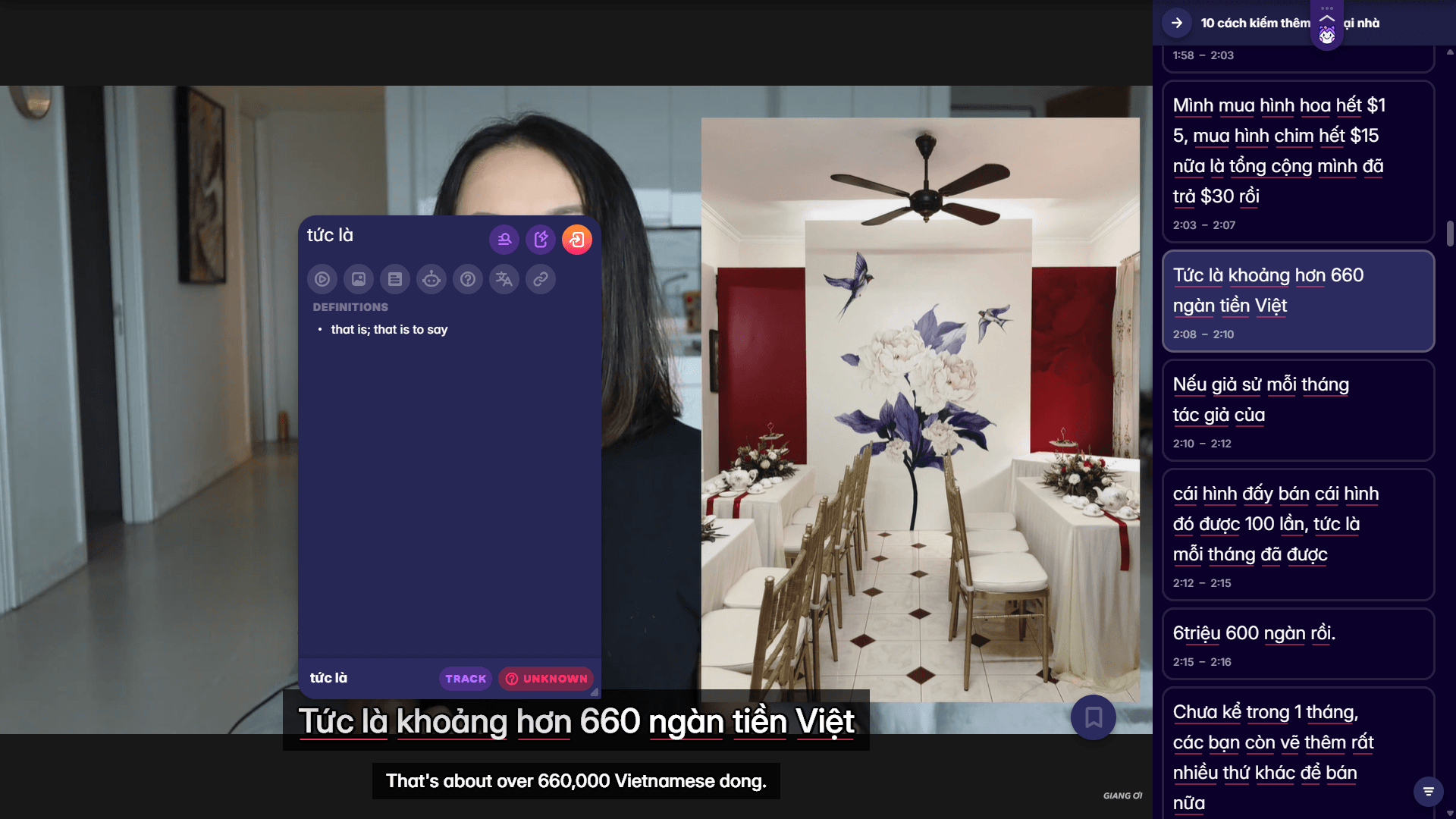
If you want to accelerate your Vietnamese learning with real content, Migaku's browser extension and app let you look up words instantly while watching Vietnamese YouTube videos or reading Vietnamese websites. Makes immersion way more practical when you're still building your vocabulary. There's a 10-day free trial if you want to check it out.
 ----
## FAQs
If you're a complete beginner with zero Vietnamese knowledge, starting with Duolingo isn't a bad idea. It'll familiarize you with basic vocabulary, common phrases, and the general feel of the language without overwhelming you. Use it for your first month or two to build a foundation. Get comfortable with how Vietnamese sentences are structured, learn your first 500 words, and develop a daily study habit through the streak system.
----
## Use Duolingo for learning the basic words, and nothing more
Think of Duolingo as your structured curriculum that keeps you progressing systematically, while other resources provide the authentic language input you need to actually develop practical skills. You can watch YouTube videos of native speakers, listen to Vietnamese music or podcasts, and try to find language exchange partners online. This exposure to real Vietnamese will help your ear adjust to natural speech patterns and proper tones.
> If you consume media in Vietnamese, and you understand at least some of the messages and sentences within that media, you will make progress. _Period_.
A resourceful learner finds a way!💡📖
----
## FAQs
If you're a complete beginner with zero Vietnamese knowledge, starting with Duolingo isn't a bad idea. It'll familiarize you with basic vocabulary, common phrases, and the general feel of the language without overwhelming you. Use it for your first month or two to build a foundation. Get comfortable with how Vietnamese sentences are structured, learn your first 500 words, and develop a daily study habit through the streak system.
----
## Use Duolingo for learning the basic words, and nothing more
Think of Duolingo as your structured curriculum that keeps you progressing systematically, while other resources provide the authentic language input you need to actually develop practical skills. You can watch YouTube videos of native speakers, listen to Vietnamese music or podcasts, and try to find language exchange partners online. This exposure to real Vietnamese will help your ear adjust to natural speech patterns and proper tones.
> If you consume media in Vietnamese, and you understand at least some of the messages and sentences within that media, you will make progress. _Period_.
A resourceful learner finds a way!💡📖