# French Clothing Vocabulary: Complete Guide to Talk About Clothes in French (Audio Included)
> Let's get ready for some shopping! Learn essential French clothing vocabulary from shirts to shoes. Guide with pronunciation tips and shopping phrases.
**URL:** https://migaku.com/blog/language-fun/french-clothing-vocabulary
**Last Updated:** 2026-02-22
**Tags:** vocabulary, phrases
---
So you need to talk about what you're wearing when [learning French](https://migaku.com/learn-french). Makes sense. Clothing [vocabulary](https://migaku.com/blog/language-fun/french-body-parts-vocabulary-guide) is one of those super practical topics that comes up constantly, whether you're shopping in Paris, describing what someone looks like, or just talking about your day. The good news is that French clothing vocabulary follows some pretty consistent patterns once you get the hang of gender agreements. Let me walk you through everything you need to know about clothes in French, from basic shirts to fancy accessories.
---
## Why French clothing vocabulary matters for learners
Here's the thing about learning clothes vocabulary in any language. You use these words all the time. Think about how often you discuss what you're wearing, what you want to buy, or what someone else has on. It's way more frequent than, say, talking about geological formations or medieval architecture.
French clothing vocab also gives you a solid foundation for understanding gender in French. Every piece of clothing has a gender (un or une), and you'll start noticing patterns. Most words ending in "e" are feminine, but there are exceptions that'll keep you on your toes. Plus, when you're shopping in a French-speaking country, knowing these terms makes the whole experience less stressful and way more fun.
---
## Basic French clothing terms you'll use constantly
Let's start with the essentials. The general word for clothes in French is "les vêtements" (masculine plural). You'll see this word everywhere, from store signs to laundry instructions.
For everyday tops, you've got:
| French | English |
| - | - |
| une chemise | a dress shirt or button-up |
| un t-shirt | a t-shirt |
| un pull | a sweater or pullover |
| un sweat | a sweatshirt |
| un gilet | a cardigan or vest |
The word "chemise" is feminine, which trips up some learners at first since it can refer to both men's and women's shirts. Context usually makes it clear.
---
## Bottoms and pants in French
Moving down to bottoms, here's what you need:
| French | English |
| - | - |
| un pantalon | pants or trousers |
| un jean | jeans (singular in French) |
| une jupe | a skirt |
| un short | shorts |
| un bermuda | longer shorts (like Bermuda shorts) |
Notice that "pantalon" is singular in French even though we say "pants" in English. You'd say "un pantalon" for one pair of pants. The word "jean" works the same way. This is one of those little quirks that feels weird at first but you get used to it.
Skirts have their own vocabulary for different styles. You might hear "une mini-jupe" for a miniskirt or "une jupe longue" for a long skirt. Pretty straightforward once you know the base word.
---
## Outerwear and jackets
French has a bunch of specific words for different types of jackets and coats:
| French | English |
| - | - |
| un manteau | a coat, usually longer and warmer |
| une veste | a jacket, more casual or suit jacket |
| un blouson | a bomber jacket or casual jacket |
| un anorak | a parka or windbreaker |
| une doudoune | a puffy jacket or down jacket |
That last one, "doudoune," is pretty recent slang that's become mainstream. You'll hear it all the time in France, especially during winter. It's way more common than the formal term "une veste matelassée."
For rain gear, you've got "un imperméable" (a raincoat) or the more casual "un k-way" (a lightweight rain jacket, from the brand name).
---
## Dresses, suits, and formal wear
When you need to dress up:
| French | English |
| - | - |
| une robe | a dress |
| un costume | a men's suit |
| un tailleur | a women's suit |
| une cravate | a tie |
| un nœud papillon | a bow tie |
The word "robe" is super versatile. It can mean anything from a casual sundress to a formal evening gown. You'd add adjectives to specify: "une robe de soirée" for an evening dress or "une robe d'été" for a summer dress.
"Costume" being a men's suit throws off English speakers sometimes since we use "costume" for Halloween outfits. In French, that would be "un déguisement."
---
## Shoes and footwear
Shoe vocabulary in French is pretty extensive:
| French | English |
| - | - |
| une chaussure | a shoe (general term) |
| des baskets | sneakers or trainers |
| des chaussures de sport | sports shoes |
| une botte | a boot |
| une bottine | an ankle boot |
| un talon | a heel or high-heeled shoe |
| une sandale | a sandal |
| une tong | a flip-flop |
The word "chaussure" is feminine and usually used in plural when you're talking about a pair: "des chaussures." But you might say "une chaussure" if you're literally talking about one single shoe.
How Do You Say Boots in French? It's "une botte" for a regular boot, and "une bottine" specifically for ankle boots. Winter boots would be "des bottes d'hiver" and rain boots are "des bottes de pluie."
For shoe sizes, you'd ask "Quelle est votre pointure?" which means "What's your size / shoe size?" French sizing runs different from US or UK sizing, so always try things on when shopping.
---
## French underwear and sleepwear
These are the words you need for undergarments and pajamas:
| French | English |
| - | - |
| un sous-vêtement | underwear (general term) |
| un slip | briefs or panties |
| un caleçon | boxers |
| un soutien-gorge | a bra |
| des chaussettes | socks |
| des collants | tights or pantyhose |
| un pyjama | pajamas |
| une chemise de nuit | a nightgown |
"Collants" is one of those words that comes up more than you'd think, especially in fashion contexts. It covers everything from sheer tights to opaque leggings-style tights.
Socks are always plural in French: "des chaussettes." You wouldn't really say "une chaussette" unless you literally lost one sock.
---
## Accessories that complete the outfit
French has specific terms for all the extras:
| French | English |
| - | - |
| une ceinture | a belt |
| une écharpe | a scarf |
| un foulard | a lighter scarf or silk scarf |
| des gants | gloves |
| un chapeau | a hat |
| une casquette | a cap or baseball hat |
| un bonnet | a beanie or knit hat |
| un sac | a bag |
| un sac à main | a handbag or purse |
The distinction between "écharpe" and "foulard" is about weight and style. An "écharpe" is usually thicker and for warmth, while a "foulard" is more decorative and lightweight.
For jewelry, you'd use "un bijou" (singular) or "des bijoux" (plural). Specific pieces include "un collier" (necklace), "une bague" (ring), and "des boucles d'oreilles" (earrings).
---
## Verbs for wearing and dressing
You can't talk about clothes without knowing [how to say you're wearing](https://migaku.com/blog/language-fun/comprehensible-input-method-language-learning) them.
The main verb is "porter" (to wear):
- Je porte un jean.
*I'm wearing jeans.*
- Elle porte une robe rouge.
*She's wearing a red dress.*
For getting dressed, you use the reflexive verb "s'habiller":
- Je m'habille.
*I'm getting dressed.*
- Il s'habille bien.
*He dresses well.*
To put on clothes, use "mettre":
- Je mets mon manteau.
*I'm putting on my coat.*
- Mets tes chaussures.
*Put on your shoes.*
And to take off clothes, use "enlever" or "retirer":
- J'enlève ma veste.
*I'm taking off my jacket.*
The verb "essayer" means to try on:
- Je peux essayer cette robe ?
*Can I try on this dress?*
---
## Adjectives for describing clothes
When you want to describe how clothes fit or look:
| French | English |
| - | - |
| moulant | tight-fitting, form-fitting |
| ample | loose, roomy |
| serré | tight, too tight |
| large | wide, loose |
| court | short |
| long | long |
| étroit | narrow, tight |
For style and appearance:
| French | English |
| - | - |
| élégant | elegant |
| décontracté | casual |
| chic | stylish |
| à la mode | fashionable, trendy |
| démodé | out of style |
| rayé | striped |
| à pois | polka-dotted |
| à carreaux | checkered, plaid |
Colors work as adjectives too, and they need to agree with the gender of the clothing item. So "un pull noir" (a black sweater) but "une robe noire" (a black dress).
---
## Shopping phrases and expressions
When you're actually shopping for clothes in France, these phrases will save you:
- Je cherche un pantalon.
*I'm looking for pants.*
- Vous avez ça en plus grand ?
*Do you have this in a larger size?*
- C'est trop petit.
*It's too small.*
- Où sont les cabines d'essayage ?
*Where are the fitting rooms?*
- Ça coûte combien ?
*How much does it cost?*
- Je prends celui-ci.
*I'll take this one.*
The expression "faire du shopping" means to go shopping. You might also hear "faire les magasins" or "faire les boutiques" for the same thing.
For sizes, French uses different systems. Clothing sizes run higher than US sizes (a US size 8 is roughly a French 38-40). Shoe sizes use European sizing.
---
## Common mistakes learners make
A few things that trip people up with French clothing vocabulary:
1. First, remembering that "pantalon" and "jean" are singular. English speakers want to pluralize them since we say "pants" and "jeans."
2. Second, "baskets" looks like it should mean "baskets" but it actually means sneakers. The word for an actual basket is "un panier."
3. Third, [pronunciation](https://migaku.com/blog/language-fun/french-alphabet-pronunciation-guide) can be tricky. Words like "chemise" and "chaussure" have that soft "ch" sound (like "sh" in English). Practice these early because you'll use them constantly.
4. Also, watch out for false friends. "Un costume" is a suit, not a costume. "Des baskets" are sneakers, not baskets. "Un slip" is underwear, not a slip dress (that would be "une combinaison").
---
## Regional variations and slang of clothes in French
Standard French clothing vocabulary works across France, Belgium, Switzerland, and other French-speaking regions, but you'll hear some variations. In Quebec, for example, they might say "un chandail" instead of "un pull" for a sweater. "Des espadrilles" means sneakers in Quebec, while in France it refers to canvas slip-on shoes.
Slang terms pop up in casual conversation. "Des pompes" is slang for shoes. "Un froc" or "un falzar" are old-slang terms for pants that you still hear sometimes. "Des fringues" means clothes in general (kind of like saying "threads" in English).
Young people might use "des running" for running shoes or sneakers, borrowed from English. Fashion-forward folks might drop English terms like "un top" or "un crop top" since French doesn't have direct equivalents for every trendy item.
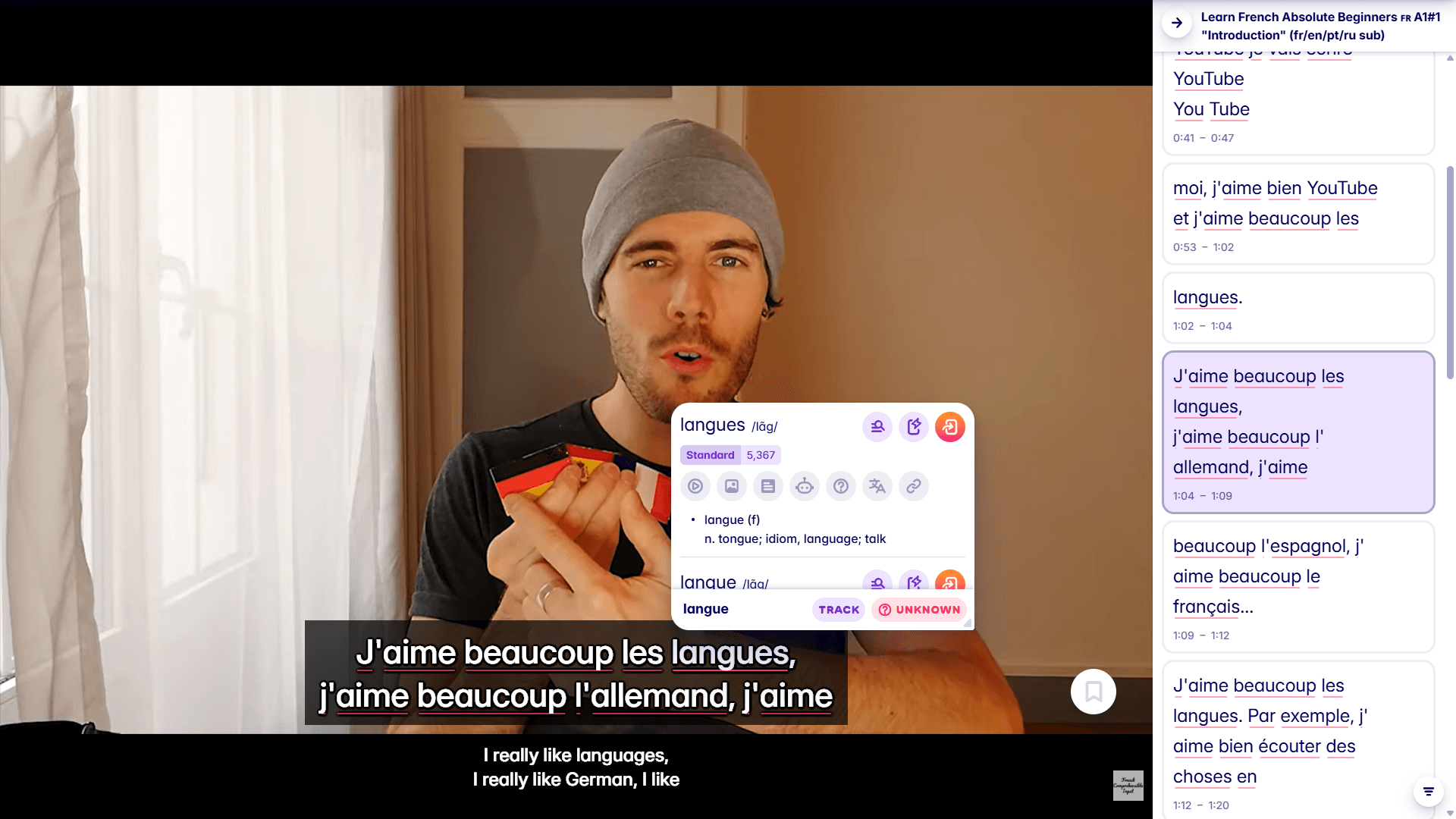
The best way to pick up these natural expressions is via media content. If you want to actually use this vocabulary while consuming real French content, Migaku's browser extension lets you look up words instantly while watching shows or reading articles. Makes learning from context way more practical. There's a 10-day free trial if you want to check it out.
 ---
## Are you looking for French clothing vocab lists in PDF format?
Tons of [language learning sites](https://migaku.com/blog/language-fun/bilingual-brain-benefits) offer downloadable vocabulary lists. Most of them are pretty similar, covering the same basic terms. The real value comes from combining the lists with relevant media consumption. That's how memory works - it only stores information that is useful in context.
> If you consume media in French, and you understand at least some of the messages and sentences within that media, you will make progress. _Period_.
Know yourself, and know how to learn!📓
---
## Are you looking for French clothing vocab lists in PDF format?
Tons of [language learning sites](https://migaku.com/blog/language-fun/bilingual-brain-benefits) offer downloadable vocabulary lists. Most of them are pretty similar, covering the same basic terms. The real value comes from combining the lists with relevant media consumption. That's how memory works - it only stores information that is useful in context.
> If you consume media in French, and you understand at least some of the messages and sentences within that media, you will make progress. _Period_.
Know yourself, and know how to learn!📓