# French Conditional Tense: Formation and Usage Guide on Syntax and Verb Conjugation
> I would check this post if I were you! Learn how to decode and recode this conditional tense in French. Clear rules, examples, and common usage patterns.
**URL:** https://migaku.com/blog/language-fun/french-conditional-tense-guide
**Last Updated:** 2026-02-22
**Tags:** fundamentals, phrases, grammar
---
The French conditional tense (le conditionnel) gets a reputation among [French learners](https://migaku.com/learn-french) for being tricky. You use it all the time in real conversations, whether you're making polite requests, talking about hypothetical situations, or expressing what you'd do under certain circumstances. The formation follows a simple rule that combines elements from [two other tenses you probably already know](https://migaku.com/blog/language-fun/french-future-tense-guide). Let's break down exactly how to form the conditional and when to use it in actual French communication.
---
## What is the French conditional tense
> The conditional in French expresses actions that **would happen** under certain conditions.
Think of it as **the "would" tense in English**. When you say "I would go" or "she would eat," you're using the conditional. In French, this becomes "j'irais" or "elle mangerait."
Here's the thing: the conditional sits somewhere between certainty and pure imagination. You're talking about events that could happen if circumstances were different, or you're softening statements to sound more polite. It's super common in everyday French, way more than English speakers might expect.
The present conditional (conditionnel présent) is what most people mean when they talk about the conditional tense. There's also a past conditional (conditionnel passé), which we'll cover later, but the present form is what you'll use 90% of the time.
---
## When to use the conditional
The conditional shows up in several specific contexts in French [grammar](https://migaku.com/blog/language-fun/french-grammar-guide). Understanding these usage patterns helps you sound more natural.
### Polite requests and softened statements
This is probably the most common everyday use. Using the conditional makes you sound way more polite than the present tense. Compare "Je veux un café" (I want a coffee) with "Je voudrais un café" (I would like a coffee). The second one sounds much less demanding.
You'll hear "je voudrais" constantly in cafés, shops, and restaurants. "Pourriez-vous m'aider?" (Could you help me?) sounds infinitely more polite than "Pouvez-vous m'aider?" (Can you help me?).
### Hypothetical situations and desires
When you're talking about what you'd do in imaginary scenarios, you use the conditional. "J'achèterais une maison à Paris si j'avais l'argent" (I would buy a house in Paris if I had the money). You're not buying the house, you're just imagining what would happen under different circumstances.
This hypothetical usage ties directly into conditional sentences with "si" clauses, which we'll get to in a second.
### Reported speech and indirect statements
When reporting what someone said, you often shift tenses. If someone said "Je viendrai demain" (I will come tomorrow), you'd report it as "Il a dit qu'il viendrait demain" (He said he would come tomorrow). The future tense in direct speech becomes conditional in reported speech.
### Giving advice or suggestions
The conditional of "devoir" (should/ought to) is super useful for advice. "Tu devrais étudier davantage" (You should study more). "Nous devrions partir maintenant" (We should leave now). It's softer than a direct command.
### Use the French conditional tense in other contexts
The conditional shows up in some additional contexts beyond the main uses we've covered. You'll see it in expressions of uncertainty or unconfirmed information, especially in journalism. "Le président serait malade" (The president would be sick) suggests the information isn't confirmed.
It appears in exclamations of surprise or indignation. "Moi, je ferais ça? Jamais!" (Me, I would do that? Never!). The conditional adds a sense of disbelief.
Some set phrases and idioms use the conditional form. "On dirait que..." (It would seem that.../It looks like...) is super common in spoken French.
The conditional also works in hypothetical questions. "Que ferais-tu à ma place?" (What would you do in my place?) invites someone to imagine themselves in your situation.
---
## How to form the conditional tense
The formation rule for the conditional is actually pretty elegant. **You take the future tense stem and add the imperfect tense endings.** Yep, it's a mashup of two tenses you've probably already studied.
> For regular verbs, the stem is just the infinitive form. Then you tack on these endings: -ais, -ais, -ait, -ions, -iez, -aient.
Notice anything? These are exactly the same endings you use for the imparfait.
Let's look at "parler" (To speak) as an example:
- je parlerais (I would speak)
- tu parlerais (You would speak)
- il/elle/on parlerait (He/She/One would speak)
- nous parlerions (We would speak)
- vous parleriez (You would speak)
- ils/elles parleraient (They would speak)
The [pronunciation](https://migaku.com/blog/language-fun/french-alphabet-pronunciation-guide) is key here. Those endings mostly sound the same: "parlerais," "parlerais," and "parlerait" all sound like "par-luh-reh." Only "parlerions" and "parleriez" sound different because of the "i" sound before the ending.
### Regular verb conjugation patterns
> Regular verbs follow the same pattern whether they're -er, -ir, or -re verbs. You keep the infinitive as your stem (though -re verbs drop the final "e"), then add those imperfect endings.
For "finir" (To finish):
- je finirais
- tu finirais
- il/elle/on finirait
- nous finirions
- vous finiriez
- ils/elles finiraient
For "vendre" (To sell), you drop that final "e" from the infinitive:
- je vendrais
- tu vendrais
- il/elle/on vendrait
- nous vendrions
- vous vendriez
- ils/elles vendraient
Pretty straightforward, right? The verb stem stays consistent across all persons, and you just swap the ending based on who's doing the action.
---
## Irregular verbs in the conditional
Okay, so here's where it gets slightly more complicated. Some verbs have irregular stems in the conditional. The good news? These are the exact same irregular stems used in the future tense. If you've learned the future tense already, you're basically done.
The most common irregular verbs you need to know:
| Verb | English | Conditional Stem | Example |
| - | - | - | - |
| avoir | To have | aur- | j'aurais, tu aurais, il aurait, nous aurions, vous auriez, ils auraient |
| être | To be | ser- | je serais, tu serais, il serait, nous serions, vous seriez, ils seraient |
| aller | To go | ir- | j'irais, tu irais, il irait, nous irions, vous iriez, ils iraient |
| faire | To do / To make | fer- | je ferais, tu ferais, il ferait, nous ferions, vous feriez, ils feraient |
| pouvoir | To be able to | pourr- | je pourrais, tu pourrais, il pourrait, nous pourrions, vous pourriez, ils pourraient |
| vouloir | To want | voudr- | je voudrais, tu voudrais, il voudrait, nous voudrions, vous voudriez, ils voudraient |
| venir | To come | viendr- | je viendrais, tu viendrais, il viendrait, nous viendrions, vous viendriez, ils viendraient |
| voir | To see | verr- | je verrais, tu verrais, il verrait, nous verrions, vous verriez, ils verraient |
| savoir | To know | saur- | je saurais, tu saurais, il saurait, nous saurions, vous sauriez, ils sauraient |
| devoir | To have to | devr- | je devrais, tu devrais, il devrait, nous devrions, vous devriez, ils devraient |
The pattern holds: irregular stem plus those same imperfect tense endings. Once you memorize the stems, conjugation becomes automatic.
---
## Si clauses and conditional sentences
Si clauses (if clauses) create conditional sentences that express cause and effect relationships. French has specific tense pairings for these structures, and getting them right is crucial.
### Present + future (first conditional)
This expresses a **likely** or **possible** future outcome based on a present condition.
> Si + present tense, future tense
"Si j'ai le temps, je viendrai" (If I have time, I will come). This is a real possibility you're discussing.
### Imperfect + conditional (second conditional)
This expresses a **hypothetical** situation in the **present** or **future**.
> Si + imperfect tense, conditional tense
"Si j'avais le temps, je viendrais" (If I had time, I would come). You're imagining a scenario that's contrary to current reality.
This is the structure English speakers most associate with the conditional. The imperfect tense in the si clause might feel weird at first (since you're talking about a present hypothetical), but that's just how French works.
### Pluperfect + past conditional (third conditional)
This expresses a **hypothetical** situation in the **past**.
> Si + pluperfect, past conditional
"Si j'avais eu le temps, je serais venu" (If I had had time, I would have come). You're imagining how the past could have been different.
One critical rule: never use the conditional directly after "si" in these structures. You'll hear French learners make this mistake constantly, saying something like "si je serais" instead of "si j'étais." The conditional goes in the main clause, not the si clause.
---
## The past conditional in French (conditionnel passé)
> The past conditional expresses what would have happened under different past circumstances. You form it using the conditional of the **auxiliary verb** (avoir or être) plus the past participle.
For verbs using "avoir":
- J'aurais parlé.
*I would have spoken.*
- Tu aurais fini.
*You would have finished.*
- Il aurait vendu.
*He would have sold.*
For verbs using "être" (mostly movement and reflexive verbs):
- Je serais allé(e).
*I would have gone.*
- Elle serait venue.
*She would have come.*
- Nous nous serions levé(e)s.
*We would have gotten up.*
The same agreement rules apply as with other compound tenses. With être verbs, the past participle agrees with the subject in gender and number.
The past conditional appears in third conditional sentences, reported speech about past events, and expressions of regret or missed opportunities. "J'aurais dû étudier" (I should have studied) is something every student has thought at some point.
---
## Distinguishing the conditional from other tenses
The conditional sits in an interesting space between several other tenses. Understanding the distinctions helps you choose the right form.
- The future tense expresses what will happen. The conditional expresses what would happen under certain conditions. "Je partirai demain" (I will leave tomorrow) is a definite plan. "Je partirais demain si possible" (I would leave tomorrow if possible) is conditional on circumstances.
- The imperfect tense describes past actions that were ongoing or habitual. The conditional describes hypothetical actions. "Quand j'étais jeune, je jouais au football" (When I was young, I played/used to play football) versus "Si j'étais riche, je jouerais au golf" (If I were rich, I would play golf).
Both the conditional and imperfect use the same endings, which creates confusion. The key difference is the stem: the conditional uses the future stem (usually the infinitive), while the imperfect uses a different stem based on the nous form of the present tense.
---
## Common mistakes and how to avoid them
1. Mixing up the conditional and future tense is super common because they sound similar. "Je mangerai" (I will eat) versus "Je mangerais" (I would eat). The pronunciation difference is subtle, especially in fast speech. Context usually makes it clear, but pay attention to those endings.
2. Another frequent error is using the conditional after "si" in conditional sentences. Remember: si + imperfect, then conditional in the main clause. Never "si je serais."
3. Some learners confuse the conditional with the imperfect tense because they share endings. The imperfect describes ongoing or habitual past actions, while the conditional expresses what would happen. "Je parlais" (I was speaking/I used to speak) versus "Je parlerais" (I would speak). Completely different meanings despite similar sounds.
4. Watch out for irregular verb stems. It's tempting to just use the infinitive for everything, but "je voirais" doesn't exist. It's "je verrais." Memorizing those irregular stems saves you from sounding like a beginner.
Getting comfortable with the conditional takes exposure and practice. Start noticing it when you read French texts or watch French content. Pay attention to when native speakers choose the conditional over the present or future tense.
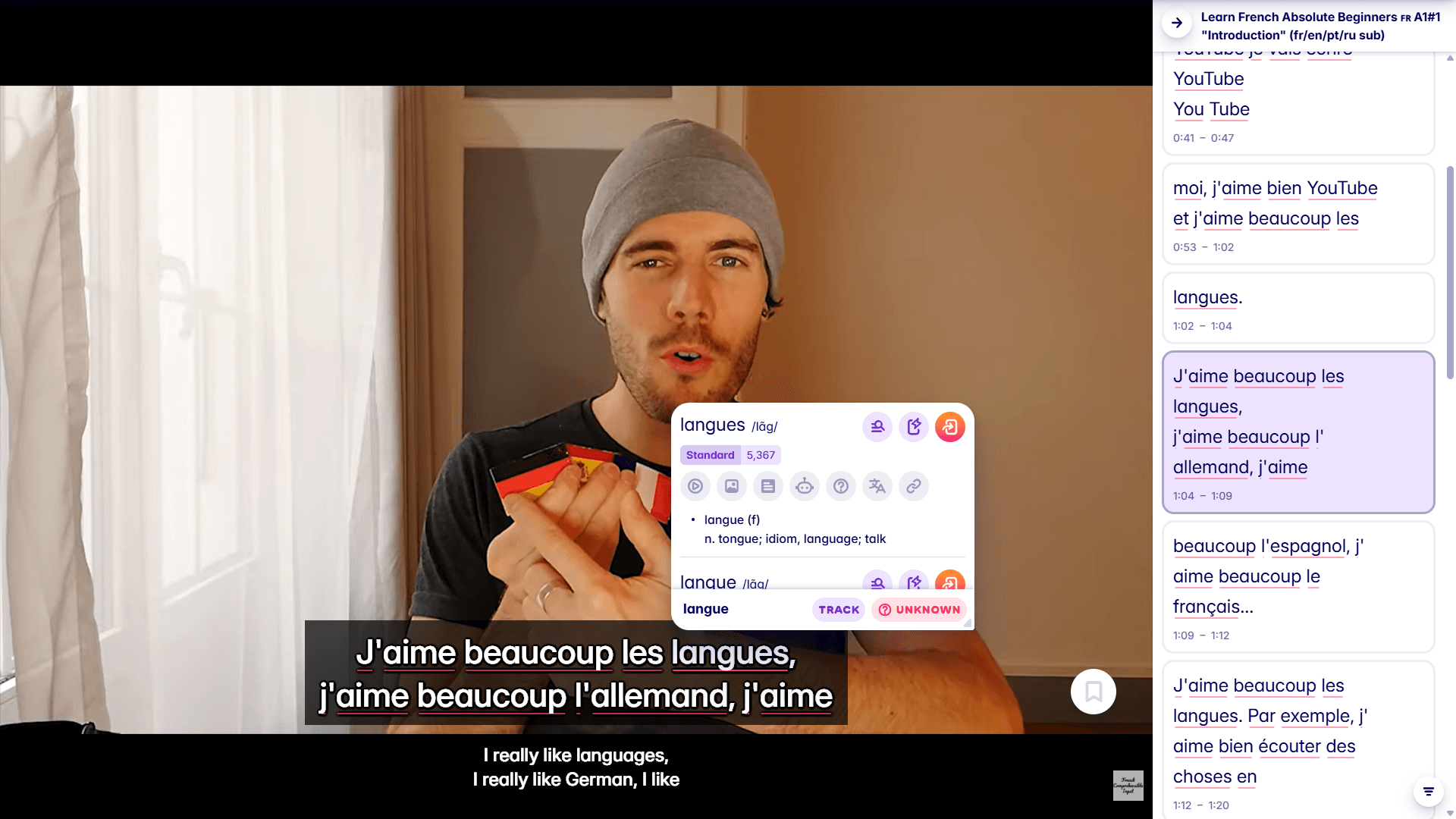
If you're working on improving your French through immersion, Migaku's browser extension and app let you look up conjugations and save example sentences while you're watching shows or reading articles. Makes learning verb forms way more natural than just drilling conjugation tables. There's a 10-day free trial if you want to check it out.
 ---
## FAQs
A classic example that covers multiple uses: "Je voudrais un croissant, s'il vous plaît" (I would like a croissant, please). This uses "voudrais," the conditional form of vouloir, to make a polite request. You'll use this exact phrase dozens of times if you ever visit France. Another common example: "Si j'étais toi, je prendrais le train" (If I were you, I would take the train). This shows the hypothetical usage with a si clause, combining the imperfect in the condition and the conditional in the result.
Honestly? The present conditional is one of the easier French verb tenses to master. The formation rule is consistent, and once you know the irregular stems from the future tense, you're basically there. The endings are identical to the imperfect, which you've probably already learned. The tricky part isn't forming the tense itself. It's knowing when to use it appropriately and getting those si clause structures right. That comes with practice and exposure to real French.
This question usually refers to the different types of conditional sentences in French grammar, though the exact categorization varies depending on who you ask.
---
## FAQs
A classic example that covers multiple uses: "Je voudrais un croissant, s'il vous plaît" (I would like a croissant, please). This uses "voudrais," the conditional form of vouloir, to make a polite request. You'll use this exact phrase dozens of times if you ever visit France. Another common example: "Si j'étais toi, je prendrais le train" (If I were you, I would take the train). This shows the hypothetical usage with a si clause, combining the imperfect in the condition and the conditional in the result.
Honestly? The present conditional is one of the easier French verb tenses to master. The formation rule is consistent, and once you know the irregular stems from the future tense, you're basically there. The endings are identical to the imperfect, which you've probably already learned. The tricky part isn't forming the tense itself. It's knowing when to use it appropriately and getting those si clause structures right. That comes with practice and exposure to real French.
This question usually refers to the different types of conditional sentences in French grammar, though the exact categorization varies depending on who you ask.
The main forms are: the present conditional (conditionnel présent), which we've covered extensively. The past conditional (conditionnel passé), which expresses what would have happened. Some grammarians also distinguish the conditional perfect progressive and other compound forms, but these are less common in everyday speech.
In terms of conditional sentence structures, you have the three main types: present + future (real possibility), imperfect + present conditional (present/future hypothetical), and pluperfect + past conditional (past hypothetical).
---
## Conditional is used more commonly than you might think...
"Si j'avais plus de temps, j'apprendrais le japonais" (If I had more time, I would learn Japanese). "Je voudrais voyager en France l'année prochaine" (I would like to travel to France next year). These examples sound pretty daily, right? They are the conditional sentences you might actually say in conversations, and you will definitely frequently encounter them in French media content.
> If you consume media in French, and you understand at least some of the messages and sentences within that media, you will make progress. _Period_.
One more grammar learned is one more sentence understood!