French Directional Words: Master French Directions and Navigate Like a Local in 2026
Last updated: March 13, 2026

Getting lost in Paris sounds romantic until you're actually wandering around trying to find your hotel at midnight. Learning French directional words makes the difference between confidently navigating French-speaking cities and awkwardly pointing at your phone screen. This guide covers everything you need to ask for directions, understand responses, and actually get where you're going without pulling out Google Maps every five seconds.
Essential French directional vocabulary
Here's the thing about learning french directions: you need maybe 20 words to handle 90% of situations. Start with these basics before worrying about anything fancy.
The most important directional words are gauche (left), droite (right), and tout droit (straight ahead). You'll hear these constantly when someone gives you directions. Practice saying them out loud because mixing up left and right in a foreign language happens way more than you'd think.
Verbs to give directions in French
Next up are the action verbs that tell you what to do: tourner (to turn), continuer (to continue), traverser (to cross), and passer (to pass). These combine with the basic directions to form complete instructions like "tournez à gauche" (turn left) or "traversez la rue" (cross the street).
For vertical movement, you need monter (to go up) and descendre (to go down). Super useful for metro stations and hilly streets. The verb aller (to go) appears everywhere too, usually in phrases like "allez tout droit" (go straight).
Prepositions of place
Prepositions of place connect everything together. Learn devant (in front of), derrière (behind), à côté de (next to), en face de (across from), and près de (near). These help you understand landmarks in directions like "c'est derrière l'église" (It's behind the church).
Cardinal directions
Cardinal directions matter less for street navigation but still come up: nord (north), sud (south), est (east), ouest (west). You'll see these on maps and hear them in longer explanations.
How to ask for directions in French
Politeness counts for a lot in French culture, so always start with "excusez-moi" (Excuse me) or "pardon" before launching into your question. Skipping this makes you sound rude, even if you're stressed about being lost.
- The simplest way to ask for directions is "Où est..." (Where is...) followed by whatever you're looking for. "Où est la gare?" (Where is the train station?) works perfectly fine. Add "s'il vous plaît" at the end to be extra polite.
- For a more formal approach, use "Pouvez-vous me dire où se trouve..." (Can you tell me where... is located?). This sounds more sophisticated: "Pouvez-vous me dire où se trouve le musée du Louvre?"
- If you need someone to show you on a map, ask "Pouvez-vous me montrer sur la carte?" (Can you show me on the map?). This phrase saves you from trying to memorize complex verbal directions.
- When you're completely turned around, try "Je suis perdu" (I'm lost) if you're male or "Je suis perdue" if you're female. People generally respond well to this honest admission and give clearer directions.
- Another useful phrase is "Comment puis-je aller à..." (How can I get to...). This invites more detailed instructions about transportation options, not just walking directions.
- Sometimes you need to ask about distance: "C'est loin d'ici?" (Is it far from here?) or "C'est à combien de minutes?" (How many minutes away is it?). This helps you decide whether to walk or grab a taxi.
French directions vocabulary for understanding the response
When someone answers your question, you'll hear certain patterns repeatedly. Listen for "prenez" or "prends" (take), as in "prenez la première rue à gauche" (take the first street on the left). The numbers première (first), deuxième (second), and troisième (third) show up constantly.
If someone says "c'est juste là" (It's right there) or "c'est tout près" (It's very close), you're basically at your destination. "Juste" means right or just, so "juste devant vous" means right in front of you.
Watch out for "au bout de" (at the end of), which appears in directions like "au bout de la rue" (at the end of the street). Similarly, "jusqu'à" (until/up to) tells you how far to continue: "continuez jusqu'à la place" (continue until the square).
French vocabulary for distance and landmarks
Distance descriptions use "à" plus a time or measurement: "à cinq minutes" (five minutes away), "à cent mètres" (a hundred meters), "à deux rues" (two streets away). This gives you a sense of how far you need to walk.
People often use landmarks instead of street names because they're easier to remember. You'll hear "après le café" (after the café), "jusqu'à la pharmacie" (until the pharmacy), or "au coin de la boulangerie" (at the corner of the bakery).
The phrase "vous allez voir" (You will see) signals what to look for: "vous allez voir une grande église sur votre droite" (You will see a large church on your right). This confirms you're going the right way.
Common French phrases for giving directions yourself
Maybe you're the one helping someone else navigate. Giving directions in French builds confidence and practice with vocabulary you've learned.
- Start your response with "Alors" (So/Well) to give yourself a second to think. Then use the imperative form of verbs: "tournez" (turn), "allez" (go), "prenez" (take), "traversez" (cross). These command forms sound natural and clear.
- Structure your directions step by step: "D'abord, allez tout droit" (First, go straight), "Ensuite, tournez à droite" (Then, turn right), "Après, vous verrez..." (After that, you'll see...). This sequential approach prevents confusion.
- Point while you talk. Combine "là-bas" (over there) with pointing: "C'est là-bas, après le feu rouge" (It's over there, after the traffic light). Physical gestures help even when your French isn't perfect.
- Use "vous voyez" (you see) to check understanding: "Vous voyez le restaurant? Tournez juste avant" (You see the restaurant? Turn just before it). This engages the listener and confirms they're following along.
- For nearby locations, "c'est ici" (It's here) or "c'est là" (It's there) with pointing works great. Add "juste" for emphasis: "C'est juste ici" (It's right here).
- If something is far, be honest: "C'est assez loin" (It's quite far) or "C'est trop loin à pied" (It's too far to walk). Then suggest "Prenez le métro" (Take the metro) or "Prenez un taxi" (Take a taxi).
Master the vocabulary for directions in French through consistent practice
- Learning French directional words works best through spaced repetition and real-world usage. Review your vocabulary daily for the first week, then every few days after that.
- Create flashcards with French on one side and English on the other. Include both individual words and complete phrases. Apps make this easier, but physical cards work fine too.
- Watch French content with subtitles and pay attention when characters ask for or give directions. Movies set in Paris often include navigation scenes. TV shows provide repeated exposure to common phrases.
- Find a language exchange partner and practice giving each other directions to imaginary places. This feels silly, but it builds actual speaking confidence.
- Label a map of a French city with directions vocabulary. Trace routes and describe them out loud in French. "Je commence ici, je vais tout droit, puis je tourne à gauche..."
- Use French when you're navigating anywhere, even in your home city. Mentally translate the directions your GPS gives you. This constant practice embeds the French directions vocabulary deeper.
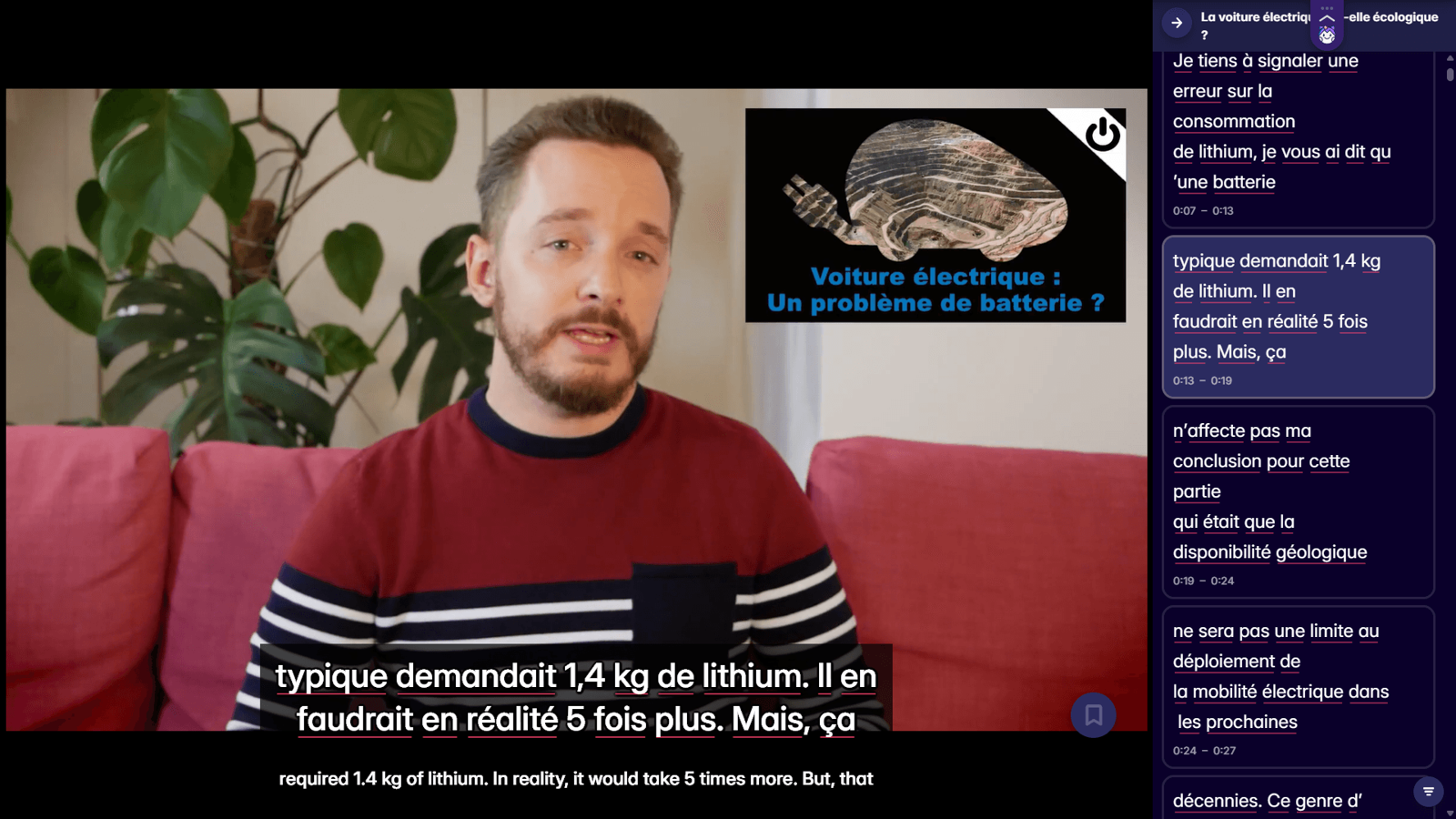
Anyway, if you want to actually practice these French directional words with real content, Migaku's browser extension and app let you look up vocabulary instantly while watching French shows or reading French articles. Makes immersion learning way more practical. There's a 10-day free trial if you want to check it out.
FAQs
Understanding directions in basic French strengthens other areas
This interconnected nature of language learning means mastering directions in French strengthens others. Directional vocabulary isn't isolated knowledge; it's a building block for broader fluency. If you're serious about learning French words and phrases beyond just tourist phrases, immersion with real content makes a huge difference. Reading French articles, watching French shows, and listening to French podcasts expose you to natural language use that textbooks can't replicate.
If you consume media in French, and you understand at least some of the messages and sentences within that media, you will make progress. Period.
No knowledge is wasted.