Gerund in French: How to Use En + Present Participle
Last updated: March 27, 2026

Learning French grammar can feel like navigating a maze sometimes, but the French gerund is actually one of the more straightforward concepts once you get the hang of it. The gerund in French (called "le gérondif") combines the word "en" with the present participle to show actions happening at the same time, explain how something happens, or give a reason for something. If you've been confused about when to use it or how to form it properly, this guide will walk you through everything you need to know with plenty of examples.
- What is a gerund in French
- How to form the gerund in French
- Using French gerund: Simultaneous actions
- Use the gerund to express manner in French grammar
- Use the French gerund to show cause or reason
- Adding emphasis with "tout en"
- Gerund in past tense
- Gerund vs. present participle: What's the difference
- Common mistakes to avoid
- Practical tips for mastering the gerund
What is a gerund in French
The French gerund is a grammatical structure that combines "en" with the present participle form of a verb. In English, we use "-ing" forms all the time (walking, talking, eating), but French handles these differently. The gérondif specifically shows that two actions are happening simultaneously or explains the manner in which something occurs.
Here's the thing: when you see "en" followed by a verb ending in "-ant", that's your gerund. For example, "en marchant" (while walking) or "en mangeant" (while eating). The structure is pretty consistent, which makes it easier to learn than some other aspects of French grammar.
How to form the gerund in French
💡Forming the gerund requires two steps: creating the present participle and then adding "en" in front of it.
Let me break this down for you.
Creating the present participle
To form the present participle, you start with the nous form of the verb in the present tense. Drop the "-ons" ending and add "-ant" instead. This works for the vast majority of French verbs.
Take the verb "parler" (to speak):
- Nous parlons (we speak)
- Drop the "-ons": parl-
- Add "-ant": parlant
Now you've got your present participle. Add "en" in front, and you have "en parlant" (while speaking, by speaking).
Here are more examples:
The verb "manger" (to eat):
- Nous mangeons
- mangeons → mange- + ant = mangeant
- Gerund: en mangeant
The verb "finir" (to finish):
- Nous finissons
- finissons → finiss- + ant = finissant
- Gerund: en finissant
The verb "attendre" (to wait):
- Nous attendons
- attendons → attend- + ant = attendant
- Gerund: en attendant
This pattern works across regular verbs in all three conjugation groups. Pretty straightforward, right?
Irregular forms you need to know
Like most French grammar rules, there are exceptions. Only three verbs have irregular present participles, and you'll use them constantly, so memorize these:
- être (to be): étant → en étant (while being)
- avoir (to have): ayant → en ayant (while having)
- savoir (to know): sachant → en sachant (while knowing)
These don't follow the nous form rule, so you just have to learn them separately. The good news? That's it. Just three irregular forms for the gerund.
Using French gerund: Simultaneous actions
The most common use of the French gerund is showing that two actions happen at the same time. When you do one thing while doing another, the gerund expresses this relationship perfectly.
- Je chante en conduisant.
I sing while driving.
Both actions occur simultaneously. You're driving, and at the same time, you're singing. The gerund "en conduisant" shows this overlap.
More examples of simultaneous actions:
- Elle écoute de la musique en étudiant.
She listens to music while studying. - Il a trouvé ses clés en rangeant sa chambre.
He found his keys while cleaning his room. - Nous parlons français en cuisinant.
We speak French while cooking.
The subject of both verbs must be the same person or thing. You can't say something like "I read while you cook" using a gerund structure in French. The gerund always refers back to the main subject of the sentence.
Use the gerund to express manner in French grammar
Another major use of the gerund is explaining how something happens. Instead of showing two separate actions occurring together, this usage describes the method or manner of doing the main action.
- J'ai appris le français en regardant des films.
I learned French by watching movies.
The gerund "en regardant" explains the method you used to learn French. It answers the question "how?"
Check out these examples:
- Elle a réussi l'examen en travaillant dur.
She passed the exam by working hard. - Tu peux améliorer ton accent en écoutant des podcasts.
You can improve your accent by listening to podcasts. - Il gagne sa vie en donnant des cours de piano.
He earns his living by giving piano lessons.
This is super useful when you want to explain your process or method for achieving something. Language learners use this construction all the time to talk about their study methods.
Use the French gerund to show cause or reason
The gerund can also indicate why something happened. It expresses cause and effect relationships in a concise way.
- En oubliant son parapluie, il s'est fait tremper.
By forgetting his umbrella, he got soaked.
The gerund shows the cause (forgetting the umbrella) that led to the effect (getting soaked).
More examples showing cause:
- En arrivant en retard, j'ai raté le début du film.
By arriving late, I missed the beginning of the movie. - En mangeant trop vite, elle a eu mal au ventre.
By eating too fast, she got a stomachache. - En pratiquant chaque jour, vous ferez des progrès rapides.
By practicing every day, you'll make rapid progress.
The gerund here establishes a logical connection between actions. One thing leads to or causes another.
Adding emphasis with "tout en"
When you want to emphasize contrast or surprise between two simultaneous actions, you can add "tout" before "en".
💡The structure becomes "tout en" plus the present participle.
- Il peut lire tout en écoutant de la musique.
He can read while listening to music.
The "tout" adds emphasis, suggesting that doing both things at once might be surprising or noteworthy. It often implies that one action doesn't prevent the other, even though you might expect it to.
- Elle souriait tout en pleurant.
She was smiling while crying.
This shows contrast between two actions that seem contradictory. The "tout en" construction highlights this unusual combination.
Additional examples:
- Je peux travailler tout en gardant mes enfants.
I can work while watching my children. - Il étudie le japonais tout en ayant un emploi à plein temps.
He studies Japanese while having a full-time job. - Tout en sachant la vérité, elle n'a rien dit.
While knowing the truth, she said nothing.
You don't need "tout" for every gerund. Use it when you want that extra emphasis or when the simultaneous actions seem particularly notable or contrasting.
Gerund in past tense
French also has a past gerund, though it's less common in everyday speech.
💡You form it using "en" plus "ayant" or "étant" (the present participles of avoir and être) followed by a past participle.
- En ayant fini ses devoirs, il est sorti jouer.
Having finished his homework, he went out to play.
This shows that one action was completed before another began. The finishing of homework happened first, then he went out.
- En étant arrivée en avance, elle a pu choisir la meilleure place.
Having arrived early, she was able to choose the best seat.
The past gerund with être uses the past participle and follows agreement rules (notice "arrivée" agrees with the feminine subject "elle").
You'll encounter this construction more in written French than in casual conversation. Most French speakers prefer other structures in everyday speech, but understanding the past gerund helps when reading literature or formal texts.
Gerund vs. present participle: What's the difference
The French present participle and the gerund look similar since the gerund uses the present participle, but they function differently. The present participle without "en" can act as an adjective or modify a noun.
- Une histoire fascinante
A fascinating story
Here, "fascinante" is a present participle functioning as an adjective describing the story.
- Les étudiants parlant français peuvent s'inscrire.
Students speaking French can register.
The present participle "parlant" modifies "étudiants" to specify which students.
The gerund, however, always includes "en" and relates to the verb, showing simultaneous actions, manner, or cause. It doesn't modify nouns like the present participle can.
Understanding this distinction helps you use both forms correctly. When you see "-ant" with "en", that's your gerund. When you see "-ant" alone, it's functioning as a present participle with different grammatical roles.
Common mistakes to avoid
- One frequent error learners make is trying to use the gerund like English uses "-ing" forms. French and English handle these structures differently, so direct translation doesn't always work. In English, we say "I like reading." In French, you'd say "J'aime lire" (I like to read), using the infinitive form of the verb, not a gerund. The French gerund specifically requires that "en" and relates to simultaneous actions, manner, or cause.
- Another mistake is forgetting that the gerund's subject must match the main verb's subject. You can't switch subjects mid-sentence when using a gerund.
Practical tips for mastering the gerund
The best way to internalize the gerund is through exposure and practice.
- When you're reading French texts or watching French content, pay attention to when native speakers use "en" plus a verb ending in "-ant". Notice the context and what relationship the gerund expresses.
- Try creating your own example sentences about your daily routine: "Je révise mon vocabulaire en prenant mon café le matin." (I review my vocabulary while having my coffee in the morning.)
- Practice forming the present participle from different verbs. Pick a verb, conjugate it in the nous form of the present tense, drop the "-ons", add "-ant", and stick "en" in front. Do this enough times, and the pattern becomes automatic.
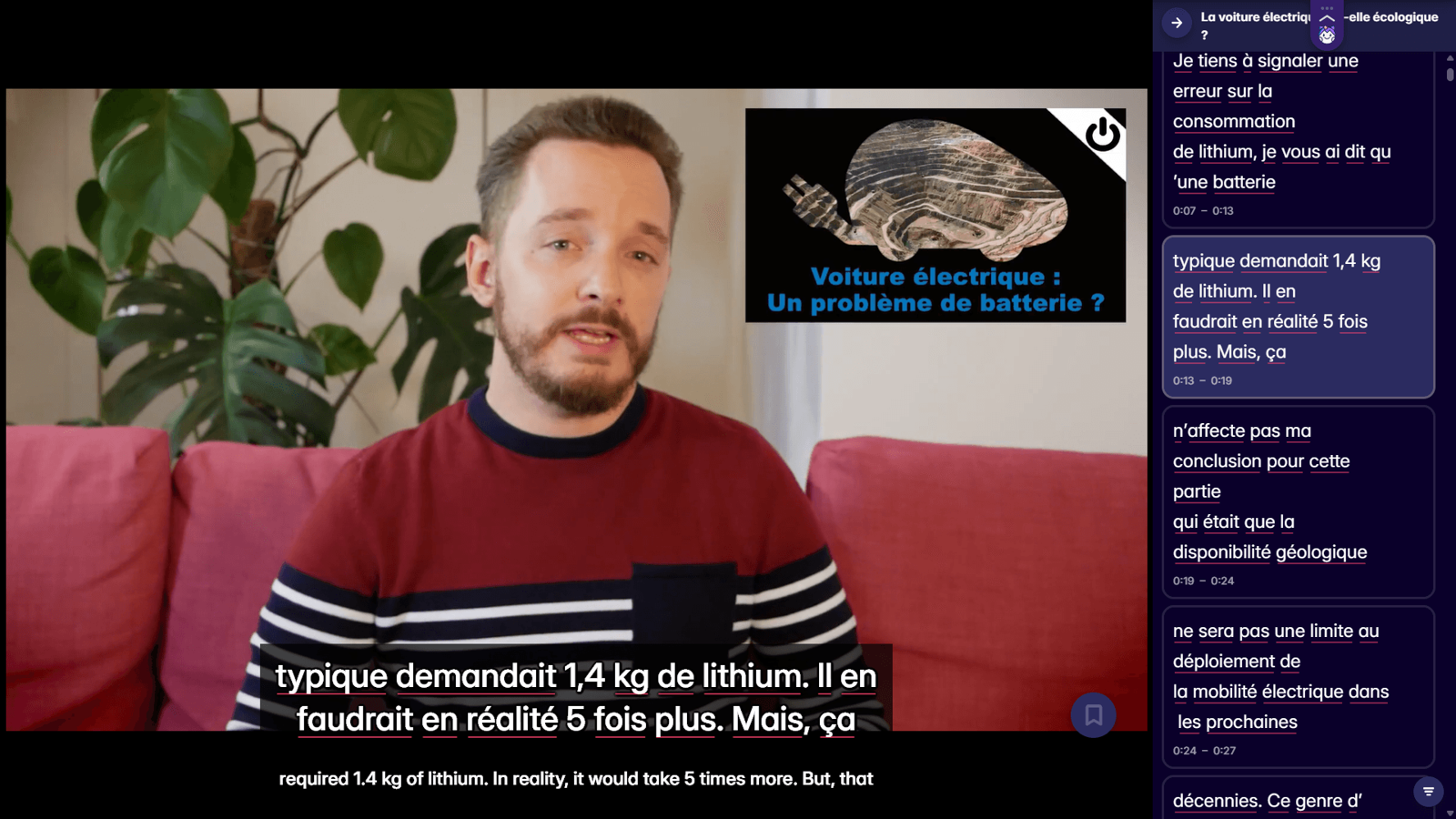
Anyway, if you want to see the gerund in action while learning from real French content, Migaku's browser extension and app let you look up words and grammar patterns instantly while watching shows or reading articles. Makes immersion learning way more practical. There's a 10-day free trial if you want to check it out.
Knowing how to use the gerund in French adds sophistication to your speaking and writing
Instead of using multiple short, choppy sentences, you can connect ideas smoothly and show relationships between actions elegantly. When you want to explain your method for doing something or show cause and effect, the gerund provides an efficient structure that advanced speakers use constantly. On the other hand, knowing gerunds also helps you understand complicated sentences in French. Now you can improve your French reading and listening comprehension because when you encounter these structures in French media, you know how to interpret them.
If you consume media in French, and you understand at least some of the messages and sentences within that media, you will make progress. Period.
Grammar is overwhelming at first, but time makes it manageable!