French Job Interview Phrases: Vocabulary, Questions, and Tips for Your Job Interview in France
Last updated: March 30, 2026

You've landed an interview at a French company, and now you're scrambling to prepare. Learning French job interview phrases isn't just about memorizing a few words. You need to sound professional, confident, and natural in French while discussing your career. The good news? French interviews follow predictable patterns, and once you know the essential phrases, you can adapt them to almost any situation. This guide covers the exact phrases you'll need, from walking through the door to following up after the interview.
- Why French job interview phrases matter more than you think
- Opening greetings and making a strong first impression
- Introducing yourself professionally in French
- Describing your professional experience and achievements
- Expressing your strengths and skills effectively
- Addressing weaknesses without sabotaging yourself
- Explaining your motivation and company fit
- Discussing salary and benefits professionally
- Asking questions about the role and company
- Closing the interview with confidence
- Common interview mistakes to avoid in France
Why French job interview phrases matter more than you think
Here's the thing: showing up to a job interview in France without proper preparation is like bringing a knife to a gunfight. French professional culture values formality and linguistic precision way more than English-speaking countries. Using the wrong level of formality or stumbling over basic vocabulary sends a message that you're not serious about the role.
The phrases you use demonstrate your French language proficiency and cultural awareness. Employers in France want to know you can navigate professional relationships, write emails, and communicate with clients. Your interview is the first test of these skills.
Opening greetings and making a strong first impression
First impressions count everywhere, but in France, the opening moments of your interview set the tone for everything that follows. Always use formal greetings unless explicitly told otherwise.
When you first meet your interviewer, use:
- Bonjour Madame / Bonjour Monsieur.
Good morning/afternoon, Ma'am/Sir. - Bonjour Madame Dupont, enchantée de faire votre connaissance.
Good morning Mrs. Dupont, pleased to meet you.
The handshake matters. Make it firm but not aggressive. In some French companies, you might encounter "la bise" (cheek kisses) among colleagues, but never initiate this in an interview setting. Wait for the interviewer to extend their hand first.
After the initial greeting, acknowledge the opportunity:
- Je vous remercie de m'avoir invité(e) à cet entretien.
Thank you for inviting me to this interview. - C'est un plaisir d'être ici aujourd'hui.
It's a pleasure to be here today.
These French phrases establish respect and professionalism right away. Don't skip them or rush through them. Speak clearly and make eye contact.
Introducing yourself professionally in French
The classic "Parlez-moi de vous" (Tell me about yourself) opens most French interviews. Your response should be structured, concise, and relevant to the post you're applying for.
Start with your current situation:
- Actuellement, je travaille chez (company name) en tant que (job title).
Currently, I work at (company name) as (job title). - Je suis diplômé(e) de (university/school) en (field of study).
I graduated from (university/school) in (field of study).
Connect your background to the role:
- J'ai (number) ans d'expérience dans le domaine de (field).
I have (number) years of experience in the field of (field). - Au cours de ma carrière, j'ai développé des compétences en (skills).
Throughout my career, I've developed skills in (skills).
Keep this introduction to about two minutes. French interviewers appreciate structure and brevity. They'll ask follow-up questions if they want more details.
Describing your professional experience and achievements
When discussing your work history, French employers want specifics. Vague statements don't cut it. Use concrete examples and quantifiable results whenever possible.
To describe responsibilities:
- J'étais responsable de (task/project).
I was responsible for (task/project). - Mes principales missions incluaient (tasks).
My main responsibilities included (tasks). - Je gérais une équipe de (number) personnes.
I managed a team of (number) people.
For achievements, use action-oriented French phrases:
- J'ai réussi à augmenter les ventes de (percentage).
I succeeded in increasing sales by (percentage). - J'ai mis en place un nouveau système qui a permis de réduire les coûts de (amount).
I implemented a new system that reduced costs by (amount). - J'ai dirigé un projet qui a abouti à (result).
I led a project that resulted in (result).
The verb "travailler" (to work) appears frequently in these discussions. Use it with different prepositions to show various work relationships:
- Je travaille avec (colleagues/departments).
I work with (colleagues/departments). - Je travaille sur (projects).
I work on (projects). - Je travaille pour (company/client).
I work for (company/client).
Expressing your strengths and skills effectively
The question "Quelles sont vos qualités professionnelles?" (What are your professional qualities?) requires thoughtful preparation. French workplace culture values certain traits, and knowing the right vocabulary helps you present yourself effectively.
Common strength-related French phrases include:
- Je suis rigoureux / rigoureuse.
I'm thorough / meticulous. - J'ai un bon sens de l'organisation.
I have good organizational skills. - Je suis autonome dans mon travail.
I'm autonomous in my work. - J'ai l'esprit d'équipe.
I'm a team player. - Je suis capable de travailler sous pression.
I'm capable of working under pressure. - J'ai de bonnes capacités d'adaptation.
I have good adaptability skills.
Don't just list qualities. Back them up with brief examples:
Je suis très organisé(e). Par exemple, dans mon poste actuel, je gère plusieurs projets simultanément en utilisant des outils de planification.
I'm very organized. For example, in my current position, I manage several projects simultaneously using planning tools.
Soft skills vocabulary is crucial here. Learn these French words:
French | English |
|---|---|
La communication | Communication |
Le leadership | Leadership |
La résolution de problèmes | Problem-solving |
La créativité | Creativity |
La flexibilité | Flexibility |
Addressing weaknesses without sabotaging yourself
"Quels sont vos points faibles?" (What are your weak points?) is a tricky question in any language. In French professional settings, honesty matters, but you need to frame weaknesses constructively.
Effective French phrases for discussing weaknesses:
- J'ai tendance à être perfectionniste, ce qui peut parfois me ralentir.
I tend to be perfectionist, which can sometimes slow me down. - Je travaille actuellement sur (skill) pour améliorer mes compétences.
I'm currently working on (skill) to improve my competencies. - Dans le passé, j'avais des difficultés avec (task), mais j'ai suivi une formation pour progresser.
In the past, I had difficulties with (task), but I took training to improve.
The key is showing self-awareness and growth. French employers respect candidates who acknowledge areas for improvement while demonstrating initiative to address them.
Avoid these common mistakes:
- Don't say "Je n'ai pas de défauts" (I have no flaws). It sounds arrogant.
- Don't mention weaknesses directly related to core job requirements.
- Don't use humor to deflect. French interviews maintain a formal tone.
Explaining your motivation and company fit
"Pourquoi voulez-vous travailler pour notre entreprise?" (Why do you want to work for our company?) tests your research and genuine interest. Generic answers fail here. You need specific knowledge about the company.
Demonstrate research with these French phrases:
- J'admire votre engagement envers (company value/initiative).
I admire your commitment to (company value/initiative). - Votre entreprise est reconnue pour (achievement/reputation).
Your company is recognized for (achievement/reputation). - Je suis particulièrement intéressé(e) par votre projet de (specific project).
I'm particularly interested in your (specific project) project.
Connect your goals to the role:
- Ce poste correspond parfaitement à mes objectifs de carrière.
This position corresponds perfectly to my career objectives. - Je souhaite développer mes compétences en (area), et ce rôle offre cette opportunité.
I want to develop my skills in (area), and this role offers that opportunity. - Vos valeurs d'entreprise sont alignées avec les miennes.
Your company values are aligned with mine. - Je souhaite travailler pour une entreprise innovante comme la vôtre.
I want to work for an innovative company like yours. (The phrase "travailler pour" (to work for) signals commitment)
Discussing salary and benefits professionally
Money talk in France follows specific etiquette. Wait for the interviewer to bring up compensation first. When they do, these French phrases help you navigate the conversation: "Quelles sont vos prétentions salariales?" (What are your salary expectations?)
Your response:
- D'après mes recherches, le salaire pour ce type de poste se situe entre (range).
According to my research, the salary for this type of position is between (range). - Je suis ouvert(e) à la négociation selon l'ensemble du package.
I'm open to negotiation depending on the complete package. - Pourriez-vous me donner une fourchette pour ce poste?
Could you give me a range for this position?
Benefits vocabulary in French:
French | English |
|---|---|
Les avantages sociaux | Benefits |
Les congés payés | Paid leave |
La mutuelle | Health insurance |
Les tickets restaurant | Meal vouchers |
Le télétravail | Remote work |
La formation continue | Continuing education |
In France, many benefits are standard by law, but some companies offer additional perks. Asking about "les avantages" shows you understand French workplace culture.
Asking questions about the role and company
French interviewers expect you to ask questions. Staying silent when they say "Avez-vous des questions?" (Do you have any questions?) suggests disinterest. Prepare at least three thoughtful questions.
About the role:
- Quelles sont les principales responsabilités de ce poste?
What are the main responsibilities of this position? - Comment se déroule une journée type?
How does a typical day unfold? - Quels sont les objectifs à atteindre dans les premiers mois?
What are the objectives to achieve in the first months?
About the team:
- Avec quelle équipe vais-je travailler?
Which team will I work with? - Comment décririez-vous la culture d'entreprise?
How would you describe the company culture?
About growth:
- Quelles sont les possibilités d'évolution?
What are the advancement possibilities? - Proposez-vous des formations professionnelles?
Do you offer professional training?
These questions demonstrate engagement and help you evaluate if the company fits your needs. The phrase "ask questions" translates to "poser des questions" in French. Use it: "Je voudrais poser quelques questions" (I would like to ask a few questions).
Closing the interview with confidence
The interview ending matters just as much as the beginning. Leave a strong final impression with these French phrases:
- Je vous remercie pour cet entretien.
Thank you for this interview. - J'ai vraiment apprécié notre conversation.
I really appreciated our conversation. - Ce poste m'intéresse beaucoup.
This position interests me greatly.
Ask about next steps:
- Quelles sont les prochaines étapes du processus de recrutement?
What are the next steps in the recruitment process? - Quand puis-je espérer avoir une réponse?
When can I expect to have a response?
Offer to provide additional information:
- N'hésitez pas à me contacter si vous avez besoin d'informations supplémentaires.
Don't hesitate to contact me if you need additional information.
End with a firm handshake and:
- Au revoir Madame/Monsieur, bonne journée.
Goodbye Ma'am/Sir, have a good day.
Common interview mistakes to avoid in France
Understanding what not to do is just as important as knowing the right French phrases. French workplace culture has specific expectations that differ from those of other countries.
- Don't use "tu" (informal you) unless explicitly invited. Always stick with "vous" (formal you) throughout the interview process. This applies even if the interviewer seems casual.
- Avoid interrupting. French professional conversations follow turn-taking patterns. Wait for the interviewer to finish completely before responding.
- Don't bring up personal topics. French professional culture maintains clear boundaries between work and personal life. Mentioning family, religion, or politics is inappropriate unless the interviewer initiates these topics.
- Skip the excessive enthusiasm. While you should show genuine interest, over-the-top excitement reads as unprofessional in France. Maintain a balanced, composed demeanor.
- Never badmouth previous employers. Use neutral language when discussing why you left previous positions.
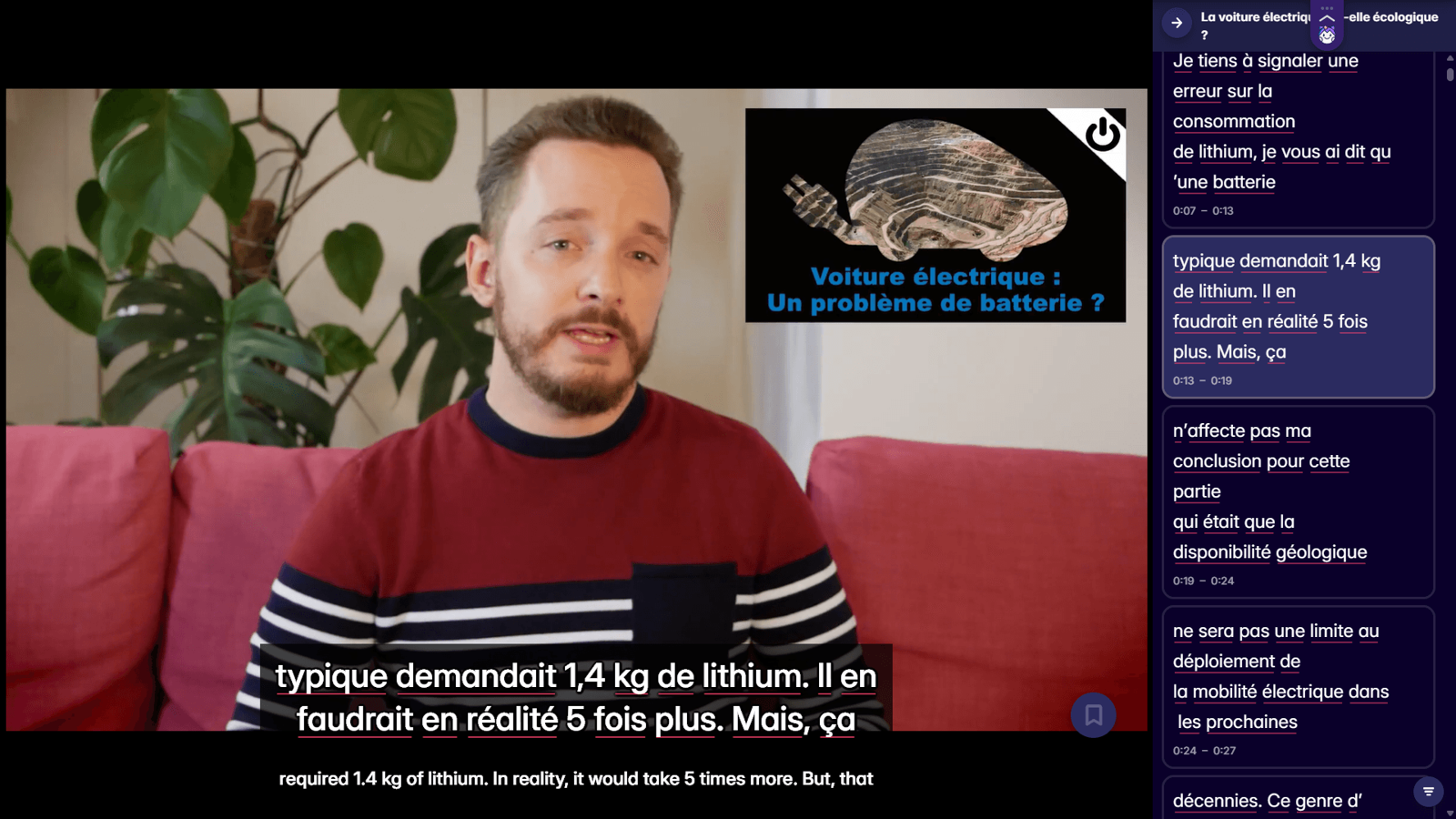
Want to level up your French even faster? Migaku's browser extension and app let you look up French words and phrases instantly while watching French shows, reading news articles, or browsing company websites in French. You can save interview-related phrases directly to your flashcards as you encounter them in real contexts. There's a 10-day free trial if you want to check it out.
Walking into any professional setting in France confidently
You've got the greetings, the self-introduction, the strength and weakness responses, and the intelligent questions to ask. The key now is practice. Run through these phrases out loud, record yourself, and get comfortable with the pronunciation and flow. Watch French career vlogs, videos about career advice, and listen to podcasts about the French working environment. All these preparations teach you the necessary vocabulary and cultural awareness.
If you consume media in French, and you understand at least some of the messages and sentences within that media, you will make progress. Period.
Stay calm, be yourself, and do great!