French Passive Voice: How to Form and Use Passive Voice in French
Last updated: March 29, 2026

You've probably noticed that French loves to flip things around when learning the language. While English speakers might say "The chef prepared the meal," French speakers can just as easily say "Le repas a été préparé par le chef." That's the passive voice at work, and honestly, it's not as scary as it looks once you break down the pattern. Let's walk through exactly how to form and use the passive voice in French, from basic construction to when you'd want to use it.
- What is the passive voice in French
- How to form the passive voice with être and past participle
- Past participle agreement rules in French grammar
- Using French passive voice in different tenses
- Making passive sentences negative
- Use the French passive voice with modal verbs
- When to use the passive voice
- Alternatives to passive voice: Reflexive constructions
- Using "on" as a passive alternative
- Getting comfortable with la voix passive
What is the passive voice in French
The passive voice shifts the focus of your sentence from who's doing the action to what's receiving the action. In active voice, the subject performs the verb. In passive voice, the subject receives the action.
Here's a quick comparison:
- Active: Marie lit le livre. (Marie reads the book.)
- Passive: Le livre est lu par Marie. (The book is read by Marie.)
See what happened? The book became the star of the sentence instead of Marie. The thing being acted upon moves to the front, and the person doing the action gets pushed to the end with "par" (by).
French grammar calls this "la voix passive," and you'll see it used when writers want to emphasize what happened rather than who did it. Pretty common in news articles, formal writing, and situations where the doer doesn't really matter.
How to form the passive voice with être and past participle
💡The basic formula for passive voice is actually super straightforward: Subject + être (conjugated) + past participle + par + agent
The verb "être" does the heavy lifting here. You conjugate être in whatever tense you need, then add the past participle of your main verb. The past participle must agree in gender and number with the subject. That's the part that trips people up at first.
Let's look at a simple example:
- Active: Le professeur corrige les examens. (The teacher corrects the exams.)
- Passive: Les examens sont corrigés par le professeur. (The exams are corrected by the teacher.)
Notice "corrigés" has an "s" at the end because "examens" is masculine plural. If we were talking about "les copies" (feminine plural), it would be "corrigées."
The preposition "par" introduces who's doing the action. Sometimes you'll see "de" instead of "par," especially with verbs of emotion or description like "aimer" (to love) or "connaître" (to know):
- Elle est aimée de tous.
She is loved by everyone.
But "par" is your default choice about 90% of the time.
Past participle agreement rules in French grammar
This is where French gets picky. The past participle in passive constructions acts like an adjective, so it needs to match the subject in gender and number.
- Masculine singular: Le gâteau est mangé. (The cake is eaten.)
- Feminine singular: La pomme est mangée. (The apple is eaten.)
- Masculine plural: Les gâteaux sont mangés. (The cakes are eaten.)
- Feminine plural: Les pommes sont mangées. (The apples are eaten.)
You add "e" for feminine, "s" for plural, and "es" for feminine plural. Some past participles already end in "e" in their masculine form, so you only add the "s" for plural:
- Le message est envoyé. (masculine)
- La lettre est envoyée. (feminine)
- Les messages sont envoyés. (masculine plural)
- Les lettres sont envoyées. (feminine plural)
Getting this agreement right is crucial. Native speakers definitely notice when you mess it up, and it's one of those grammar points that separates intermediate learners from advanced ones.
Using French passive voice in different tenses
The beauty of this construction is that you can use it in any tense. You just conjugate "être" in the tense you need and keep the past participle doing its agreement thing.
Present tense:
- La maison est vendue.
The house is sold.
Imperfect:
- La maison était vendue.
The house was being sold.
Passé composé:
- La maison a été vendue.
The house was sold / has been sold.
Future:
- La maison sera vendue.
The house will be sold.
Conditional:
- La maison serait vendue.
The house would be sold.
Plus-que-parfait:
- La maison avait été vendue.
The house had been sold.
Notice how compound tenses (like passé composé) stack up. You get "a été vendue" because "été" is the past participle of "être," and then "vendue" is the past participle of "vendre." It looks chunky, but it follows the same pattern.
Here's a longer example in passé composé:
- Active: Les élèves ont fini le projet.
- Passive: Le projet a été fini par les élèves.
The verb "finir" becomes "fini" (past participle), and "être" gets conjugated in passé composé as "a été."
Making passive sentences negative
💡Negation in passive voice works exactly like it does in active voice. You wrap "ne...pas" around the conjugated verb "être."
Present negative:
- Le livre n'est pas lu.
The book is not read.
Passé composé negative:
- Le livre n'a pas été lu.
The book was not read / has not been read.
Future negative:
- Le livre ne sera pas lu.
The book will not be read.
The "ne" goes before "être" and "pas" goes after. In compound tenses, both parts of the negation surround the auxiliary "avoir" or "être," not the past participle.
You can also drop the agent (the "par" phrase) if it's not important:
- Les fenêtres ne sont pas nettoyées.
The windows are not cleaned.
Nobody cares who's supposed to clean them. The point is they're dirty.
Use the French passive voice with modal verbs
You can combine passive voice with modal verbs like "devoir" (must), "pouvoir" (can), and "vouloir" (want).
💡The pattern is: modal verb + être + past participle
- Le travail doit être fini.
The work must be finished. - La porte peut être ouverte.
The door can be opened. - Les règles doivent être respectées.
The rules must be respected.
The modal verb gets conjugated, "être" stays in infinitive form, and the past participle still agrees with the subject.
- Present: Le document peut être signé.
- Past: Le document a pu être signé.
- Future: Le document pourra être signé.
This construction is super useful for talking about obligations, possibilities, and requirements without specifying who's responsible.
When to use the passive voice
French speakers don't use passive voice as much as English speakers do. When you do see it, there's usually a specific reason.
You'd use the passive voice when:
- The action receiver matters more than the doer: Le président a été élu hier. (The president was elected yesterday.)
- The doer is unknown or obvious: Ma voiture a été volée. (My car was stolen.)
- You want to sound formal or objective: Les résultats seront publiés demain. (The results will be published tomorrow.)
- You're writing scientific or academic content: L'expérience a été répétée trois fois. (The experiment was repeated three times.)
In everyday conversation, French speakers often prefer active constructions or alternatives. Passive voice can sound stiff or overly formal if you overuse it.
Alternatives to passive voice: Reflexive constructions
Here's the thing about French. Native speakers often dodge the passive voice entirely by using reflexive constructions with "se."
- Instead of: Le français est parlé au Canada.
- You'll hear: Le français se parle au Canada. (French is spoken in Canada.)
- Instead of: Ces livres sont vendus partout.
- You'll hear: Ces livres se vendent partout. (These books are sold everywhere.)
This reflexive passive works especially well with inanimate subjects and general statements. It sounds more natural and less formal than the true passive voice.
💡The construction follows this pattern: Subject + se + verb (active conjugation)
- Le vin se boit frais.
Wine is drunk chilled. - Cette règle s'applique à tous.
This rule applies to everyone.
You can't use this with every verb, and it doesn't work when you want to mention the agent (the person doing the action). But for general statements about how things are done, it's your best friend.
Using "on" as a passive alternative
Another super common way to avoid passive voice is using the pronoun "on" with an active verb.
- Instead of: Les portes sont fermées à 18h.
- You'll hear: On ferme les portes à 18h. (The doors are closed at 6pm / We close the doors at 6pm.)
- Instead of: Le français est enseigné dans cette école.
- You'll hear: On enseigne le français dans cette école. (French is taught in this school.)
The impersonal "on" basically means "people in general" or "someone unspecified." It keeps your sentence active while still avoiding the need to specify who's doing the action.
This construction is way more common in spoken French than the passive voice. If you're aiming for natural, conversational French, lean on "on" constructions.
- On parle français ici.
French is spoken here. - On a volé ma voiture.
My car was stolen. - On m'a dit que...
I was told that...
Getting comfortable with la voix passive
The passive voice in French follows a clear pattern once you understand the building blocks. Conjugate être in the tense you need, add the past participle with proper agreement, and optionally include the agent with "par."
But here's the real advice: pay attention to how often (or rarely) passive voice is used. Read French news articles and formal texts to see passive voice in action. Listen to conversations to hear how people use reflexive constructions and "on" instead.
The grammar is important to know, but recognizing when to use passive voice versus when to choose an alternative makes you sound way more natural. French people use the active voice in most situations, so don't force passive voice just because you can.
If you want to observe how passive voice is formed in real French content, Migaku's browser extension and app let you look up any word or phrase instantly while you're watching videos or reading articles. Makes it way easier to learn grammar in context instead of just memorizing rules. There's a 10-day free trial if you want to check it out.
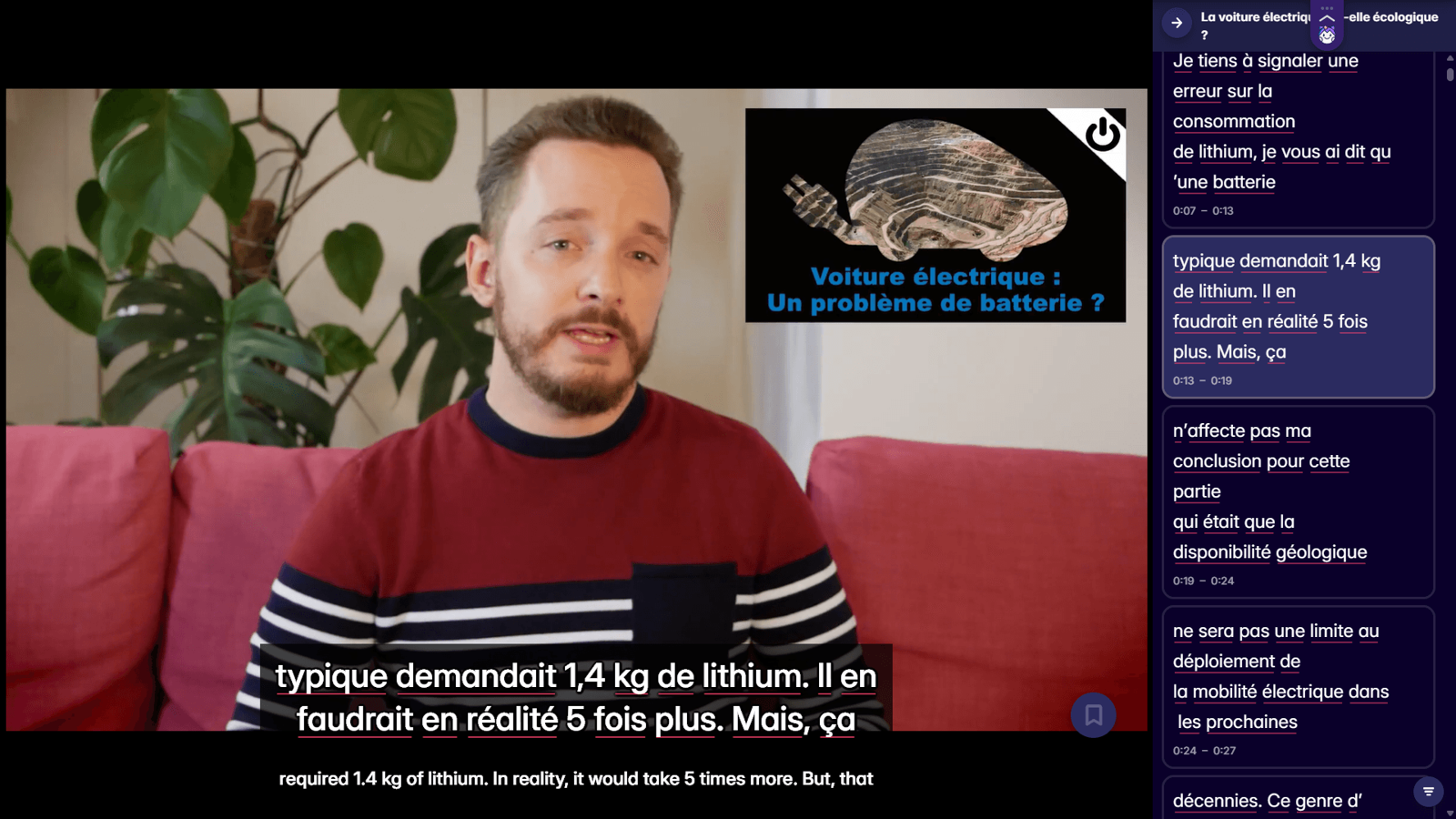
Master passive sentences in French through real content
Learning passive voice from grammar tables is one thing. Seeing it used in actual French media is where it clicks. When you're watching shows or reading articles, and you spot "a été" or "sont faits," you start recognizing the patterns automatically.
If you consume media in French, and you understand at least some of the messages and sentences within that media, you will make progress. Period.
Connect your words into meaningful sentences with all the nuances.