French Regional Cuisine Explained: A Region by Region Eating Guide
Last updated: May 19, 2026
French regional cuisine is best understood as a patchwork of officially protected products and centuries-old local habits, not a single national menu. This guide walks through France region by region, telling you what to order, what the protected label on the package actually means, and what to avoid mistaking for the real thing.
Last updated: May 19, 2026
- How French Regional Cuisine Is Organized
- Northern France: Hauts-de-France and Normandy
- Brittany
- The Loire Valley and Centre-Val de Loire
- Champagne, Alsace, and the Northeast
- Bourgogne-Franche-Comté
- Auvergne-Rhône-Alpes
- Provence, the Côte d'Azur, and Corsica
- Nouvelle-Aquitaine and the Southwest
- Occitanie
- Paris and Île-de-France
- How to Eat Regionally Without Getting Fooled
How French Regional Cuisine Is Organized
Before the regions, the labels. Almost every famous French food or wine you have heard of (Roquefort, Champagne, Comté, Bresse chicken) is regulated by a geographic protection scheme administered by INAO, the national institute for origin and quality. The labels you will see on menus and shop windows:
- AOP / PDO (Appellation d'Origine Protégée / Protected Designation of Origin): the strictest. Production, processing, and ageing must all happen in the defined zone.
- IGP / PGI (Protected Geographical Indication): at least one production stage must occur in the zone.
- Label Rouge: a quality mark, not a geographic one, often used for poultry and pork.
- AB: organic certification.
INAO oversees 1,204 protected products, including 366 PDO/AOC wines, 105 PDO agrifoods, and 443 Label Rouge products (INAO figures, as of 2022). France counts 46 PDO cheeses as of 2025, and the AOP dairy sector alone was worth €2.71 billion in 2024 according to INAO statistics published in September 2025. UNESCO inscribed "the gastronomic meal of the French" on its Representative List of the Intangible Cultural Heritage of Humanity on November 16, 2010, which is the formal recognition of the multi-course, wine-paired French meal as a cultural practice.
With that framework in place, here is what to actually eat, region by region.
Northern France: Hauts-de-France and Normandy
The north is butter, cream, apples, and the sea. Expect heavier sauces than in the south and a strong beer tradition in the far north.
Hauts-de-France (Lille, Calais, Amiens):
- Carbonade flamande: beef stewed in dark beer with a slice of gingerbread to thicken the sauce.
- Welsh: melted cheese, beer, and mustard over toast with ham, served in a ramekin.
- Maroilles: a pungent washed-rind PDO cheese; the base of the flamiche tart.
- Genièvre: juniper spirit, often served as a digestif.
Normandy (Rouen, Caen, Camembert):
- Camembert de Normandie PDO, Pont-l'Évêque PDO, Livarot PDO, and Neufchâtel PDO are all from this region.
- Tripes à la mode de Caen, sole normande, teurgoule (slow-baked cinnamon rice pudding).
- Cider and Calvados (apple brandy) instead of wine. Pommeau de Normandie is a fortified apéritif of cider must and Calvados.
Note that "Camembert" alone is not the protected name. Only Camembert de Normandie carries the PDO. Generic camembert can be made anywhere.
Brittany
Brittany is Atlantic, Celtic, and butter-soaked. The cuisine is built around the sea, buckwheat, and salted dairy.
- Galettes de sarrasin: savory buckwheat crêpes, traditionally filled with ham, egg, and Emmental (the complète).
- Sweet crêpes de froment with salted butter caramel.
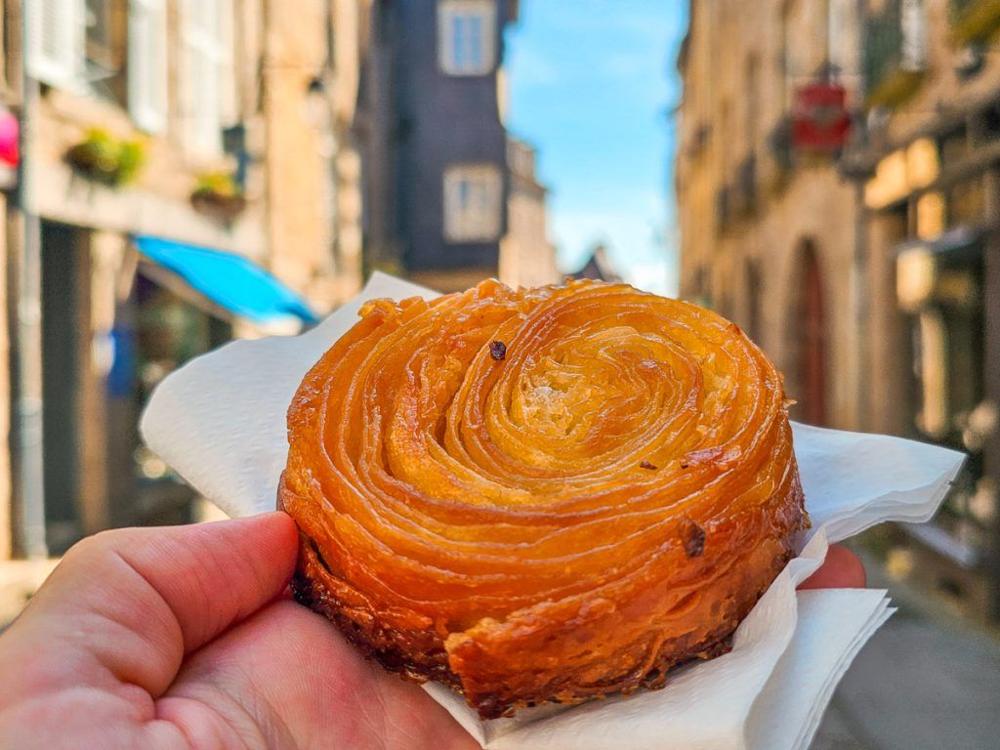
- Kouign-amann: a laminated butter-and-sugar cake from Douarnenez.
- Far breton: a dense flan-like cake with prunes.
- Shellfish: oysters from Cancale and Belon, coquilles Saint-Jacques (scallops) from the Bay of Saint-Brieuc.
- Cidre de Bretagne IGP, served in a bolée (ceramic cup).
Brittany has no PDO cheese tradition to speak of, which is unusual in France. Drink cider here, not wine.
The Loire Valley and Centre-Val de Loire
The Loire is the cradle of French goat cheese and a long ribbon of light, food-friendly wines. Centre-Val de Loire ties with Occitanie for 5 PDO cheeses each.
- Goat cheeses: Crottin de Chavignol PDO, Sainte-Maure de Touraine PDO (with its straw running through the middle), Selles-sur-Cher PDO, Valençay PDO (a truncated pyramid).
- Rillettes de Tours and rillons: shredded and chunked pork preparations.
- Tarte Tatin from Lamotte-Beuvron: upside-down caramelized apple tart.
- Wines: Sancerre and Pouilly-Fumé (Sauvignon Blanc), Vouvray and Montlouis (Chenin Blanc), Chinon and Bourgueil (Cabernet Franc).
A Sancerre with a slice of Crottin de Chavignol is the textbook pairing, and the two are made within sight of each other.
Champagne, Alsace, and the Northeast
Grand Est covers a wide range, but two traditions dominate.
Champagne (Reims, Épernay): the AOC was created in 1935 and the appellation covers around 34,300 hectares, with the Comité Champagne representing over 16,000 winegrowers and 350 houses (as of January 2026). The Echelle des Crus recognizes 17 Grand Cru villages and 44 Premier Cru villages in the Marne. Total Champagne shipments in 2024 reached 271.4 million bottles, down 9.2% from 2023, and fell again to 266 million bottles in 2025. The Champagne Hillsides, Houses and Cellars were inscribed on the UNESCO World Heritage List on July 4, 2015. Local food matches the wine: jambon de Reims, biscuits roses de Reims, and chaource PDO cheese.
Alsace (Strasbourg, Colmar): the most German-influenced French cuisine.
- Choucroute garnie: fermented cabbage with sausages, smoked pork, and potatoes.
- Baeckeoffe: a slow-cooked meat-and-potato casserole.
- Tarte flambée / flammekueche: thin dough with crème fraîche, onions, and lardons.
- Munster PDO cheese, usually eaten with cumin seeds.
- Wines: Riesling, Gewürztraminer, Pinot Gris, Pinot Noir, and Crémant d'Alsace.
Bourgogne-Franche-Comté
Burgundy and the Jura are mountain dairy and serious wine country. Bourgogne-Franche-Comté has 8 PDO cheeses.
- Comté PDO: France's highest-production PDO cheese, AOC granted in 1958. Only milk from Montbéliarde or French Simmental cows is permitted, with no more than 1.3 cows per hectare and silage prohibited. Wheels must weigh between 30 and 55 kilos and mature a minimum of 120 days (European Commission specification, as of 2025).
- Époisses PDO, Mont d'Or PDO (seasonal, baked in its spruce box), Morbier PDO with its black ash line.
- Bœuf bourguignon, coq au vin, œufs en meurette (poached eggs in red wine sauce), jambon persillé.
- Escargots de Bourgogne.
- Wines: Chablis, Côte de Nuits, Côte de Beaune, Mâconnais, plus Crémant de Bourgogne. In the Jura, look for vin jaune and vin de paille.
If you only learn one Burgundy distinction, it is that village wines (e.g., Gevrey-Chambertin) are a tier below Premier Cru, which is a tier below Grand Cru.
Auvergne-Rhône-Alpes
This is the heaviest PDO-cheese region in France, with 14 PDOs as of 2025. It also covers Lyon, the city most often called the food capital of the country.
- Lyonnais bouchons serve quenelles de brochet, salade lyonnaise (frisée, lardons, poached egg), andouillette, tablier de sapeur, and praline rose tarts.
- Alpine cheeses: Beaufort PDO, Reblochon PDO, Abondance PDO, Tomme de Savoie PGI.
- Mountain dishes: fondue savoyarde, raclette, tartiflette (made with Reblochon), diots (Savoyard sausages).
- Auvergne cheeses: Cantal PDO, Saint-Nectaire PDO, Bleu d'Auvergne PDO, Fourme d'Ambert PDO, Salers PDO.
- Volaille de Bresse PDO, the only poultry AOP in France along with Dinde de Bresse. The AO was recognized in 1957 and requires a minimum of 10 m² of grass meadow per bird. A temporary modification of the Volaille de Bresse specifications was published in the Journal Officiel on January 9, 2026.
- Wines: northern Rhône (Côte-Rôtie, Hermitage, Condrieu) and the southern Rhône further down.
Provence, the Côte d'Azur, and Corsica
The Mediterranean south is olive oil, tomatoes, herbs, and fish. Cream and butter mostly disappear here.
- Bouillabaisse (Marseille fish stew with rouille), bourride, pissaladière (Niçoise onion tart with anchovies), socca (chickpea pancake, Nice), daube provençale, ratatouille.
- Salade niçoise: tomato, hard-boiled egg, olives, anchovies or tuna, never potatoes or cooked vegetables if you are being strict about it.
- Aïoli and tapenade as standard table condiments.
- Banon PDO: a goat cheese wrapped in chestnut leaves.
- Wines: Bandol (Mourvèdre-based reds), Cassis whites, Châteauneuf-du-Pape, and the rosés of Côtes de Provence.
Corsica has its own protected products: Brocciu PDO (a fresh whey cheese), charcuterie corse PDO (lonzu, coppa, prisuttu), chestnut flour PDO, and Corsican honey PDO. Order fiadone (brocciu and lemon cake) for dessert.
Nouvelle-Aquitaine and the Southwest
The southwest is duck, goose, and red wine country.
- Confit de canard, magret de canard, foie gras (PGI for Sud-Ouest), cassoulet (the Toulouse, Carcassonne, and Castelnaudary versions all argue with each other).
- Garbure: a hearty cabbage, bean, and duck soup from the Béarn.
- Piment d'Espelette PDO from the Basque Country, jambon de Bayonne PGI, gâteau basque.
- Cheeses: Ossau-Iraty PDO (sheep, Basque-Béarn), Pérail was officially recognized as a Protected Geographical Indication by publication on May 26, 2025.
- Oysters from Arcachon.
- Bordeaux wines: Bordeaux's area under vine fell from 103,000 hectares to 95,000 hectares in 2024. The AOC Bordeaux area decreased about 10% to just under 46,000 hectares in 2024, and state aid for vine grubbing fell from €6,000 per hectare in 2024 to €4,000 per hectare starting 2025. The 2024 harvest totaled 332 million litres, the smallest crop since 1991, and was 80.5% red wine. Crémant de Bordeaux has grown sharply, from 555 hectares producing 4.5 million bottles in 2021 to 1,722 hectares producing the equivalent of 15.5 million bottles in 2024.
Occitanie
Occitanie ties Centre-Val de Loire with 5 PDO cheeses and runs from the Pyrenees to the Rhône delta.
- Cassoulet (Toulouse and Castelnaudary versions), aligot (mashed potatoes whipped with fresh tomme), truffade, fricandeau.
- Roquefort PDO: France's first cheese AOC, granted on July 26, 1925. The appellation celebrated its 100th anniversary on June 7–8, 2025 with the third edition of "Roquefort en fête." There are 7 Roquefort producers today, and Roquefort ranks third among French PDOs by tonnage marketed.
- Other cheeses: Pélardon PDO, Bleu des Causses PDO, Laguiole PDO, Rocamadour PDO.
- Huîtres de Bouzigues from the Étang de Thau.
- Wines: Languedoc, Roussillon, Corbières, Minervois, Picpoul de Pinet, plus the fortified Banyuls and Maury.
Paris and Île-de-France
Paris is less a regional cuisine than a stage where every region performs. That said, a few things are genuinely Parisian or Île-de-France:
- Brie de Meaux PDO and Brie de Melun PDO.
- Jambon de Paris, Paris-Brest (choux pastry with praline cream), baba au rhum.
- The classic bistro repertoire: steak frites, blanquette de veau, gratin dauphinois (technically from Auvergne-Rhône-Alpes but ubiquitous), îles flottantes.
If you want to read a menu without panic, a short list of French restaurant phrases for dining will get you through most situations.
How to Eat Regionally Without Getting Fooled
A few practical habits will protect you from tourist-trap versions:
- Look for the PDO/PGI logo on cheese, butter, meat, and wine. 65% of French people know the PDO label and 80% trust it (INAO consumer data, as of 2025). If a cheese is called Camembert with no "de Normandie," it can come from anywhere.
- Read the menu for the region you are in. Ordering bouillabaisse in Lille or carbonade flamande in Marseille is a sign you will be served a frozen version.
- Markets first, supermarkets second. Covered municipal markets (halles) usually have one or two producers selling PDO products directly.
- Wine by region, not by grape. In Burgundy you order "a Mâcon-Villages," not "a Chardonnay."
- Lunch is often the better deal. The formule or menu du jour at lunch is typically half the dinner price for the same kitchen.
If you are visiting on a short stay, the France Schengen visa tourist guide covers the entry rules you will need before you can sit down to any of this. If you are moving with children, the French school vocabulary and culture guide is a useful companion for the cantine, which is itself a small daily lesson in regional eating.
A Short FAQ
Is French cuisine really that different from region to region? Yes. The cooking fats alone change: butter and cream in the north and center, duck and goose fat in the southwest, olive oil in the south. Wine regions overlap with food regions for good reason.
What is the single most protected French food category? Cheese and wine. France has 46 PDO cheeses (as of 2025) and 366 PDO/AOC wines (INAO, as of 2022). The AOP dairy sector alone produced 238,854 tonnes in 2024.
Is Champagne always from Champagne? Yes, by law within the EU. Sparkling wine made elsewhere in France is called Crémant (de Bourgogne, de Loire, d'Alsace, de Bordeaux, etc.) or mousseux.
What should I order if I want to taste "real" France in one meal? A regional cheese plate with three PDO cheeses, a glass of the local wine, and one slow-cooked regional main (cassoulet, bœuf bourguignon, choucroute, blanquette). That is the structure UNESCO recognized in 2010.
Learning to read a French menu and chat with the people behind the counter changes what you eat in France more than any guidebook will. Migaku is built to help you learn French from the kinds of native videos, shows, and articles you would actually watch anyway.