French School Vocabulary: Useful French Vocabulary for the Classroom
Last updated: April 1, 2026

If you're learning French and want to talk about your day, chances are you'll need to mention school, classes, or studying at some point. Whether you're a student planning to study abroad in France, helping your kid with French homework, or just trying to understand what your French friend means when they complain about "le bac," getting comfortable with French school vocabulary makes conversations way more natural. Plus, school-related words pop up constantly in French media, from coming-of-age films to news articles about education reforms.
Essential classroom vocabulary in French
Let's start with the physical space where learning happens. The classroom itself is "la salle de classe" or simply "la classe." When you walk into a French classroom, you'll find pretty much the same stuff as anywhere else, just with different names.
French | English |
|---|---|
le bureau | The desk (usually the teacher's) |
la chaise | Chair |
la table | Table (often what students sit at) |
le tableau noir | Blackboard |
le tableau blanc | Whiteboard |
le tableau interactif | Interactive whiteboard |
le stylo | Pen |
le crayon | Pencil |
la gomme | Eraser |
le cahier | Notebook |
le livre | Book |
le sac à dos | Backpack |
le cartable | School bag (the more traditional kind) |
la trousse | Pencil case |
la règle | Ruler |
les ciseaux | Scissors |
la colle | Glue |
le taille-crayon | Pencil sharpener |
la feuille de papier | Sheet of paper |
la calculatrice | Calculator |
School personnel and who does what
French | English |
|---|---|
le professeur / l'enseignant | Teacher |
le maître / la maîtresse | Teacher (primary school, becoming less common) |
les élèves | Students (primary/secondary school) |
les étudiants | Students (university level) |
le directeur / la directrice | Principal (primary school) |
le proviseur | Principal (high school) |
le surveillant / le pion | Person who supervises students during breaks and study halls (pion is informal) |
le conseiller d'orientation / le CPE | School counselor |
le secrétaire | Secretary |
le bibliothécaire | Librarian |
Different levels of French education
The French school system works a bit differently from the American or British systems, so it's worth understanding the vocabulary here.
- Preschool is "la maternelle," which kids attend from ages 3 to 6.
- Then comes "l'école primaire" (primary school) from ages 6 to 11.
- Secondary education splits into two parts.
- First is "le collège," which covers ages 11 to 15 (roughly grades 6-9). The years are counted backwards: "la sixième" (6th, first year of collège), "la cinquième" (5th), "la quatrième" (4th), and "la troisième" (3rd, final year of collège).
- After collège comes "le lycée" (high school) for ages 15 to 18. Again, the years count down: "la seconde" (10th grade), "la première" (11th grade), and "la terminale" (12th grade, final year). At the end of terminale, students take "le baccalauréat" or "le bac," which is the big exam that determines university admission.
- University is "l'université" or "la fac" (short for faculté). Students work toward "une licence" (bachelor's degree, 3 years), "un master" (master's degree, 2 more years), or "un doctorat" (PhD).
School subjects you need to know
When talking about what you're studying, you'll need subject vocabulary.
French | English |
|---|---|
les mathématiques / les maths | Math |
la biologie | Biology |
la chimie | Chemistry |
la physique | Physics |
le français | French |
l'anglais | English |
l'espagnol | Spanish |
l'allemand | German |
l'histoire | History |
la géographie | Geography |
l'histoire-géo | History and geography combined |
l'éducation physique et sportive / l'EPS | Physical education |
la musique | Music |
les arts plastiques | Art |
la technologie | Technology |
l'informatique | Computer science |
la philosophie | Philosophy (major subject in final year of lycée) |
le droit | Law |
la médecine | Medicine |
l'économie | Economics |
la littérature | Literature |
les sciences politiques | Political science |
Verbs and phrases for school activities
You can't talk about school without action words.
French | English |
|---|---|
étudier | To study |
apprendre | To learn |
vont à l'école | Go to school |
assistent aux cours | Attend classes |
font leurs devoirs | Do their homework |
prennent des notes | Take notes |
posent des questions | Ask questions |
passent un examen / un contrôle | Take an exam / a quiz |
réussir | Pass / Succeed |
échouer | Fail |
lire | To read |
écrire | To write |
compter | To count |
calculer | To calculate |
dessiner | To draw |
réciter | To recite |
réviser | To review / revise for an exam |
Talking about grades and academic performance
The French grading system uses a 20-point scale, which confuses a lot of English speakers at first.
- A score of "10 sur 20" (10 out of 20) is passing.
- "12 sur 20" is pretty good.
- Anything above "16 sur 20" is excellent.
- Getting "20 sur 20" is extremely rare and means perfect work.
You might hear "avoir une bonne note" (to get a good grade) or "avoir une mauvaise note" (to get a bad grade). "Le bulletin scolaire" or "le bulletin de notes" is the report card.
At university, grades might be expressed as:
French | English |
|---|---|
une mention | Distinction |
mention très bien | Highest honors |
mention bien | High honors |
mention assez bien | Honors |
Students can "redoubler" (repeat a year) if they fail, though this is less common now than it used to be. They might also "sauter une classe" (skip a grade) if they're advanced.
How to practice French school vocabulary
Memorizing lists is boring and honestly, not that effective. The vocabulary becomes way more useful when you connect it to real situations.
- If you're a student, label your own school supplies in French. Put "le stylo" on your pen, "le cahier" on your notebook. Sounds silly, but it works.
- Create scenarios in your head using the vocabulary. Imagine giving a tour of your classroom in French or explaining your schedule to a French exchange student. The more you actively use these words in context, even just mentally, the better they stick.
- Grammar-wise, remember that school subjects are usually masculine except for a few like "la géographie," "la chimie," "la physique," and "la technologie." Most school objects follow standard French grammar rules, so if you know your basics, you're good.
- Another useful trick is to group related words together. Learn "le stylo," "le crayon," and "la gomme" as a set since they all relate to writing. Or learn all the subject names in one go. Your brain likes patterns and connections, so give it some.
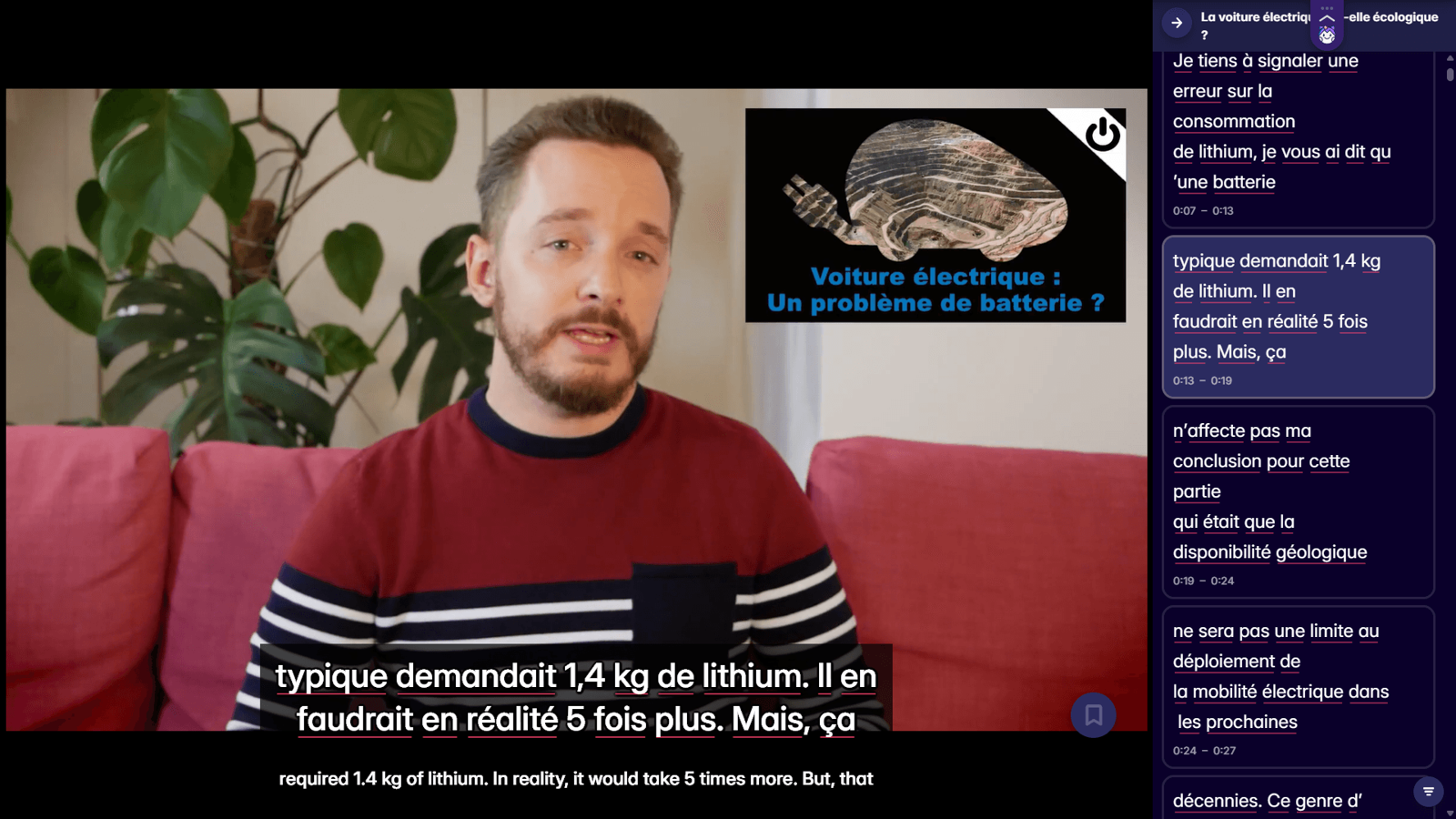
If you want to actually use these words with real French content, Migaku's browser extension and app let you look up vocabulary instantly while watching shows or reading articles. Makes immersion learning way more practical, especially when you're trying to catch school-related terms in context. There's a 10-day free trial if you want to check it out.
French vocabulary for school is just one piece of the puzzle
Once you've got these basics down, you'll probably want to expand into other areas of daily life. The good news is that the learning strategies that work for school vocabulary work for everything else, too. Immersion remains the most effective method. When you're reading French articles, watching French videos, or listening to French podcasts, you're encountering vocabulary in natural contexts.
If you consume media in French, and you understand at least some of the messages and sentences within that media, you will make progress. Period.
One more word learned, one step closer to having real conversations!