# French Transport Vocabulary: Essential Travel Words & Phrases
> Practical phrases for navigating French public transportation and travel. Learn words for different modes of transport, including trains, buses, and cars.
**URL:** https://migaku.com/blog/language-fun/french-transport-vocabulary
**Last Updated:** 2026-03-21
**Tags:** vocabulary, phrases
---
If you're planning to travel in France or just want to [expand your French skills](https://migaku.com/learn-french), knowing how to talk about getting from point A to point B is pretty essential. Whether you're catching a train to Lyon, asking for directions to the nearest metro station, or renting a car to explore the countryside, you'll need the right words. This guide covers all the French transport vocabulary you need, from basic vehicle names to practical phrases for navigating public transportation systems.
----
## Basic French transportation vocabulary
Let's start with the fundamental words for different types of transport. In French, the general word for transport is **"le transport" ** (pretty straightforward, right?). When you're talking about traveling, you'll use **"voyager" ** as the verb.
Here are the essential vehicle types you'll encounter:
- The word for car in French is **"la voiture". ** You'll see this everywhere in France. If someone asks "Tu as une voiture?" they're asking if you have a car. Another word you might hear is **"l'auto", ** which is a shortened, more casual version.
- For trains, use **"le train". ** France has an excellent rail system, and trains are one of the most popular ways to travel between cities. The high-speed trains are called **"le TGV" ** (Train à Grande Vitesse).
- A bus is **"le bus" ** or **"l'autobus". ** Both work fine, though "le bus" is more common in everyday conversation.
- For boats, you'll say **"le bateau". ** This covers everything from small boats to larger vessels. If you're taking a ferry, that's **"le ferry" ** (Yes, they use the English word).
- A bike is **"le vélo", ** short for **"la bicyclette" **. With bike-sharing systems popping up in French cities over the past decade, you'll hear "vélo" constantly.
- The plane is **"l'avion". ** When you're flying somewhere, you'd say "prendre l'avion" (to take the plane).
----
## Words for public transportation systems in French cities
Public transport in French cities is incredibly developed, and knowing the vocabulary makes navigating these systems way easier.
- The metro system in Paris and other major French cities uses **"le métro" **. When asking for directions, you might say "Comment aller à la station de métro?" (How do I get to the metro station?). A common question travelers ask is "Is this ticket valid for the metro?" which translates to "Ce billet est-il valable pour le métro?"
- The tram is **"le tramway" ** or just **"le tram". ** Many French cities have expanded their tram networks in recent years as a cleaner alternative to buses.
- A taxi is **"le taxi". ** Pretty easy to remember. With ride-sharing apps becoming popular, you'll also hear people use "Uber" directly, though some French speakers might say "une voiture avec chauffeur" (a car with driver).
- When you're at a station, that's **"la gare" ** for train stations or **"la station" ** for metro and bus stops. The word **"l'arrêt" ** means a stop, as in "l'arrêt de bus" (bus stop).
----
## Buying tickets and navigating stations
Here's where things get practical. When you're trying to use French transport, you need specific phrases.
| French | English |
| - | - |
| le billet | Ticket |
| le ticket | Ticket |
| le guichet | Ticket office |
| le quai | Platform |
| l'entrée | Entrance |
| la sortie | Exit |
| le composteur | Validation machine |
- To ask where to buy tickets, say **"Où puis-je acheter un billet?" ** (Where can I buy a ticket?).
- You might also need **"Combien coûte un billet pour..." ** (How much does a ticket to... cost?).
----
## Asking for directions and travel information
Getting around requires asking questions. Here are the essential phrases you'll use.
- **"Comment aller à la station..., s'il vous plaît?" ** means "How do I get to the... station, please?". This is super useful when you're lost.
- **"Où est l'arrêt de bus le plus proche?" ** asks where the nearest bus stop is.
- **"À quelle heure part le prochain train?" ** means "What time does the next train leave?".
- **"Ce train va à...?" ** asks if this train goes to a specific destination.
----
## French vocabulary for car travel and driving
If you're renting a car or driving in France, you'll need specific vocabulary for that situation.
| French | English |
| - | - |
| la route | Road |
| la rue | Street |
| l'autoroute | Highway |
| le péage | Toll |
| se garer | To park |
| le parking / le stationnement | Parking lot |
| parking gratuit | Free parking |
| parking payant | Paid parking |
| le permis de conduire | Driver's license |
| louer une voiture | To rent a car |
| l'essence | Gas |
| la station-service | Gas station |
| le gazole / le diesel | Diesel |
| la circulation / le trafic | Traffic |
| un embouteillage | Traffic jam |
----
## Air travel vocabulary in French
Flying requires its own set of terms.
| French | English |
| - | - |
| l'aéroport | Airport (Charles de Gaulle in Paris is often called "CDG" or "Roissy") |
| le vol | Flight |
| le vol direct | Direct flight |
| le vol avec escale | Flight with a stopover |
| l'enregistrement | Check-in |
| Enregistrement en ligne | Online check-in |
| l'embarquement | Boarding |
| la carte d'embarquement | Boarding pass |
| les bagages | Baggage |
| le bagage à main | Hand luggage |
| le bagage en soute | Checked baggage |
| la porte / la porte d'embarquement | Gate |
----
## Water transport and boat vocabulary
France has extensive coastlines and rivers, so boat vocabulary comes up more than you'd think.
| French | English |
| - | - |
| le port | Port / Harbor |
| le port de plaisance | Marina (for smaller boats) |
| le ferry | Ferry |
| naviguer | To sail |
| faire de la voile | To sail (as a hobby) |
| une croisière | Cruise |
| le quai | Dock / Wharf (same word as train platform) |
----
## Two-wheeled transport vocabulary
France has a strong cycling culture, especially in cities.
| French | English |
| - | - |
| le vélo / la bicyclette | Bicycle |
| la moto / la motocyclette | Motorcycle |
| le scooter | Motor scooter |
| la trottinette | Kick scooter |
| la trottinette électrique | Electric scooter |
| les pistes cyclables / les voies cyclables | Bike lanes |
| faire du vélo / rouler à vélo | To ride a bike |
----
## Grammar notes for transport vocabulary
Quick grammar point: most vehicle names in French are masculine (le train, le bus, le vélo, le bateau), but "la voiture" is feminine. "La bicyclette" and "la moto" are also feminine.
When you're saying you're taking a form of transport, use **"prendre" ** plus the article: "prendre le train", "prendre le bus", "prendre l'avion". For bikes and cars, you can also say "aller en voiture" (to go by car) or "aller à vélo" (to go by bike).
----
## Tips for learning French transport vocabulary
The best way to learn these terms is through context.
1. [Watch French travel vlogs](https://migaku.com/blog/language-fun/best-french-shows-language-learners) on YouTube where people navigate train stations or airports. You'll hear the vocabulary used naturally.
2. Create mental associations. "Voiture" sounds a bit like "voyage" (journey), which makes sense since cars take you places. "Gare" (station) sounds harsh, like the industrial feel of a train station.
3. Group vocabulary by situation rather than [just memorizing lists](https://migaku.com/blog/language-fun/best-language-learning-methods). Learn all the metro-related words together, then all the car-related words, then all the airport words.
4. Practice with real materials. Download a Paris metro map in French and practice giving yourself directions using French terms. Look up French train schedules on the SNCF website and read them in French.
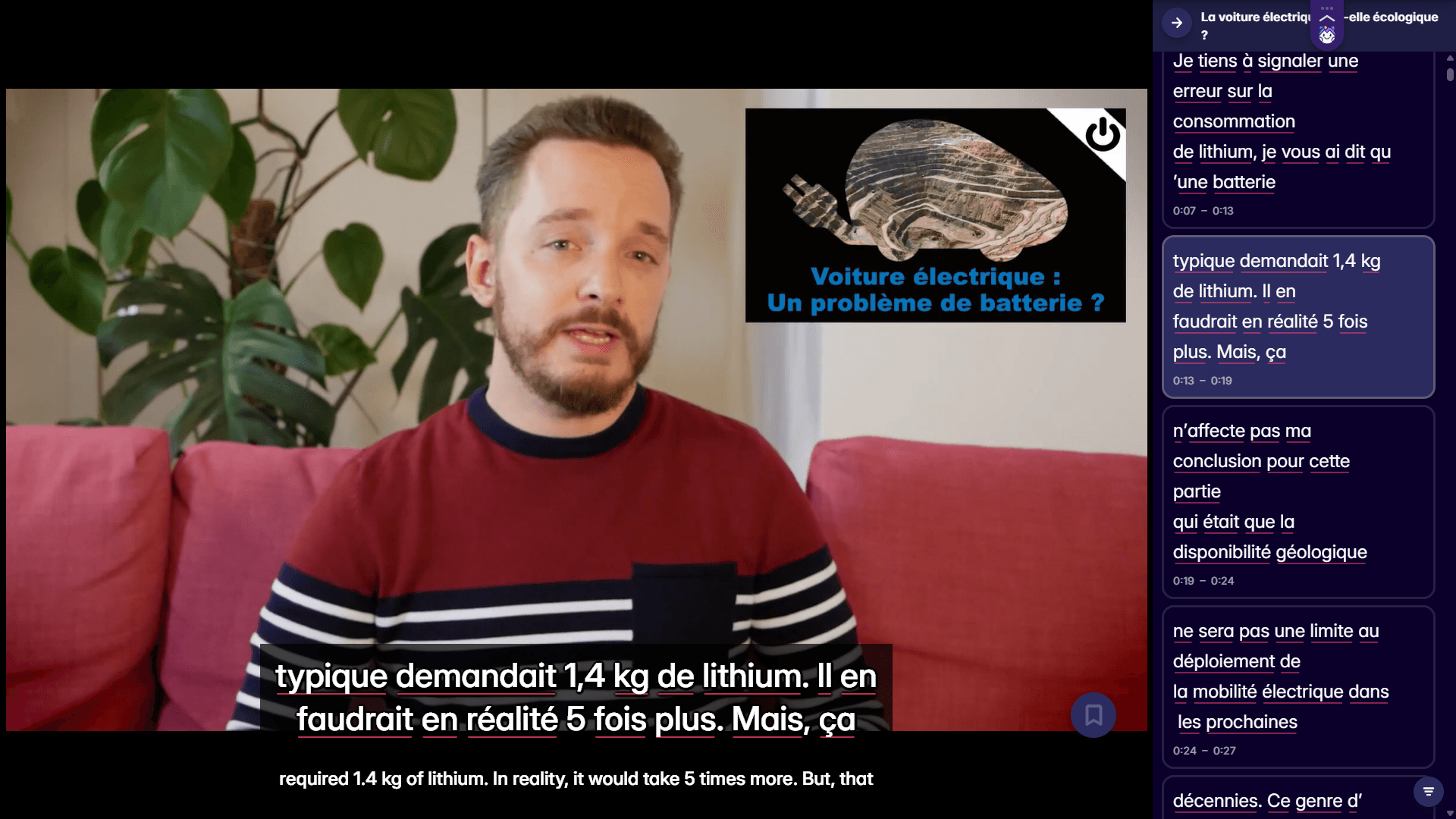
Anyway, if you're serious about building your French vocabulary beyond just memorizing lists, Migaku's browser extension and app let you look up French words instantly while watching French shows or reading French articles. You can save words with context, which makes them way easier to remember. There's a 10-day free trial if you want to check it out.
 ----
## Learn basic transportation words before your trip!
Transportation is such an important part of any travel that many people get nervous when they cannot get a smooth transportation experience. Sometimes, you may need to catch a train or a bus on time, making it all the more stressful to navigate public transportation. While you still have time before the trip, learning essential transportation terms, reading through local maps, and watching vlogs about your destinations will definitely help you build confidence in both the language and the trip!
> If you consume media in French, and you understand at least some of the messages and sentences within that media, you will make progress. _Period_.
The more you prepare, the smoother you go.✈️
----
## Learn basic transportation words before your trip!
Transportation is such an important part of any travel that many people get nervous when they cannot get a smooth transportation experience. Sometimes, you may need to catch a train or a bus on time, making it all the more stressful to navigate public transportation. While you still have time before the trip, learning essential transportation terms, reading through local maps, and watching vlogs about your destinations will definitely help you build confidence in both the language and the trip!
> If you consume media in French, and you understand at least some of the messages and sentences within that media, you will make progress. _Period_.
The more you prepare, the smoother you go.✈️