# French vs Italian: Should You Learn French or Italian in 2026?
> Comparing French vs Italian for language learners: pronunciation, grammar, career utility, and which is easier. Honest breakdown to help you choose.
**URL:** https://migaku.com/blog/language-fun/french-vs-italian
**Last Updated:** 2026-03-07
**Tags:** discussion, deepdive, comparison
---
So you're thinking about learning a [Romance language](https://migaku.com/) and you've narrowed it down to French or Italian. Smart choices, honestly. But here's the thing: they're similar enough to make choosing difficult, yet different enough that your experience learning them will vary quite a bit. I've spent years helping language learners figure out which path makes sense for their goals, and I'm going to break down everything you need to know about the French vs. Italian debate.
---
## Why compare French vs Italian in the first place
French and Italian share about **89% lexical similarity**. That's a huge overlap, which makes sense since they both evolved from Latin. But that remaining 11% difference, plus how each language sounds and functions, creates distinct learning experiences.
Most English speakers end up choosing between these two languages because they're both accessible, culturally rich, and practical. French gives you access to 29 countries where it's an official language, while Italian connects you deeply to one of the world's most influential cultures in art, food, and design.
The real question isn't which language is "better" (they're both awesome), but which one fits your specific goals and learning style.
---
## Pronunciation: Italian language is easier to learn
Here's where Italian and French really diverge, and honestly, this is usually the deciding factor for most learners.
### Italian pronunciation is straightforward
Italian pronunciation follows consistent rules. You see a word, you know how to pronounce it.
1. The vowels are pure and clear: A, E, I, O, U sound the same every single time.
2. There are no silent letters hiding at the end of words waiting to trip you up.
When you see "ciao," you say "CHOW." When you see "grazie," you say "GRAH-tsee-eh." The double consonants get held a bit longer, and that's pretty much the main quirk you need to master.
For English speakers, Italian pronunciation feels achievable from day one. You can read a menu, attempt to order, and Italians will usually understand what you're trying to say even if your accent isn't perfect.
### French pronunciation requires serious practice
French pronunciation is a whole different beast.
1. You've got nasal vowels that don't exist in English (try saying "un bon vin blanc" five times fast).
2. You've got the uvular R sound that comes from the back of your throat.
3. And then there's the silent letters everywhere.
The word "beaux" (beautiful, masculine plural) has five letters but only two sounds: "bo." The final X? Silent. The word "ils parlent" (they speak) looks like it should have two syllables at the end, but you only pronounce "eel PARL" because the "ent" is completely silent.
French also has this thing called **liaison**, where normally silent letters suddenly get pronounced when the next word starts with a vowel. So "les enfants" isn't "lay on-fon," it's "lay-zon-fon" with that S jumping over to link the words.
Does this make French harder? For pronunciation specifically, yeah. You'll need to train your ear and mouth to do things they've never done before. But millions of people learn French successfully, so it's definitely doable with practice.
---
## Italian vs French grammar and verb conjugations
Let's talk about the structural stuff that makes up these languages.
### Verb conjugations in both Romance languages
French and Italian both conjugate verbs extensively. In English, we say "I speak, you speak, he speaks" and call it a day. In French and Italian, every subject pronoun gets its own verb ending.
- **Italian conjugations follow pretty regular patterns once you learn the three main groups** (verbs ending in -are, -ere, and -ire). Sure, there are irregular verbs (looking at you, "essere" and "avere"), but the system feels logical.
- **French conjugations have more irregularities** that you just have to memorize. The verb "aller" (to go) is famously irregular: "je vais, tu vas, il va, nous allons, vous allez, ils vont." None of those forms look remotely similar to the infinitive.
Both languages use compound tenses with auxiliary verbs, which adds another layer. But honestly, once you understand how compound tenses work in one Romance language, the concept transfers pretty easily to others.
### Gender and agreement rules
Both French and Italian assign gender to nouns (masculine or feminine), and adjectives have to agree with the nouns they modify.
- **In Italian, most masculine nouns end in -o and feminine nouns end in -a**, which gives you a helpful hint. "Il ragazzo" (the boy) uses the masculine article, while "la ragazza" (the girl) uses the feminine article. Pretty straightforward.
- **French gender feels more arbitrary.** "Le livre" (the book) is masculine, "la table" (the table) is feminine, and there's no obvious pattern to help you remember. You just have to learn the gender along with each noun.
---
## Vocabulary: Friends and false friends
Since French and Italian share 89% lexical similarity, you'll recognize tons of words once you start learning either language.
### Cognates make learning Italian and French easier
If you know "family" in English, you can guess "famiglia" in Italian and "famille" in French. "University" becomes "università" and "université." These cognates give you a massive head start.
For English speakers, French has an advantage here because English borrowed thousands of French words after the Norman Conquest in 1066. Words like "restaurant," "ballet," "entrepreneur," and "rendezvous" are straight-up French.
Italian has fewer direct cognates with English, but the ones you do encounter tend to be in specialized areas like music (allegro, piano, opera) and food (pasta, pizza, espresso).
### False friends in language learning
False friends are words that look similar but mean different things. These can trip you up in both languages.
- [In Italian, "camera" means "room,"](https://migaku.com/blog/language-fun/italian-false-friends) not a device for taking photos (that's "macchina fotografica").
- [In French, "actuellement" means "currently,"](https://migaku.com/blog/language-fun/french-false-friends-faux-amis) not "actually" (that's "en fait").
The good news? Once you learn the common false friends, you'll stop making these mistakes pretty quickly.
---
## Cultural and business utility: Which one is more useful to learn
Let's get practical about where these languages matter in 2026.
### French is the language to learn for global reach
French is spoken by about 321 million people worldwide across five continents. It's an official language of the United Nations, the European Union, NATO, and the International Olympic Committee.
For career purposes, French opens doors in international organizations, diplomacy, fashion, culinary arts, and any business dealing with Francophone Africa (the fastest-growing French-speaking region).
French is also huge in Canada (particularly Quebec), making it a useful language if you're in North America and want a second language for professional advancement.
### Italian for cultural depth
Italian is spoken by about 85 million people, mostly concentrated in Italy, Switzerland, San Marino, and Vatican City, plus diaspora communities worldwide.
For career purposes, Italian is valuable in luxury goods, fashion, automotive design, classical music, art history, and culinary fields. If you're working in these industries, Italian connects you directly to the source.
Italian also gives you access to some of the world's greatest literature, opera, and Renaissance art in their original language. If cultural enrichment is your main goal, Italian delivers big time.
### Travel considerations
Both languages enhance European travel, but in different ways.
- Italian helps you navigate Italy (obviously), and gives you a foundation for understanding other Romance languages like Spanish and Portuguese. Italians generally appreciate when tourists make an effort to speak Italian, even if it's just basic phrases.
- French helps you in France, Belgium, Switzerland, Monaco, and large parts of Africa and the Caribbean. French speakers can be pickier about pronunciation, but once you reach a decent level, you'll find the language opens up incredible travel experiences.
---
## How are French and Italian different in daily use
Beyond the technical aspects, these languages feel different when you use them.
### Formality and register
Both languages have formal and informal registers, but they handle them differently.
- Italian uses "tu" for informal situations and "Lei" for formal ones. The switch is pretty clear-cut based on social context.
- French uses "tu" and "vous," but "vous" also serves as the plural "you," which can create confusion. Plus, French has more complex politeness formulas built into everyday speech.
### Regional variations and accents
- Italian has strong regional dialects that can be almost mutually unintelligible. Standard Italian (based on the Tuscan dialect) is what you'll learn as a student, but traveling through Italy, you'll hear vastly different accents and vocabulary from Sicily to Milan.
- French also has regional variations (Quebec French, Belgian French, Swiss French, African French), but Standard Parisian French dominates in education and media worldwide.
---
## Is it easier to learn French or Italian
This is the million-dollar question, and the answer depends on what you mean by "easier."
### For pronunciation, Italian is easier than French
If you want to sound decent quickly, Italian is the easier choice. The phonetic consistency means you can read Italian aloud within your first few weeks of study and be understood.
French pronunciation takes months of dedicated practice to sound even remotely natural. Those nasal vowels and the uvular R require training your mouth muscles in new ways.
### For grammar, it's roughly equal
Both languages have complex grammar systems compared to English. Italian might have slightly more regular verb conjugations, but French has simpler plural forms (just add an S, even though you don't pronounce it).
The learning curve for grammar is similar enough that this shouldn't be your deciding factor.
### As foreign languages for English speakers overall
Most learners find Italian slightly easier than French, mainly because of the pronunciation advantage. When you can pronounce words correctly from the start, you feel more confident speaking, which accelerates your learning.
But "easier" doesn't mean "better for you." If your goal is to work in international diplomacy or fashion in Paris, French is the obvious choice regardless of difficulty.
---
## Learning resources and practical tips
Here's what you need to know about studying these languages in 2026.
### Resources for French
[French has more learning resources](https://migaku.com/blog/language-fun/best-french-learning-apps) available than almost any other language except English and Spanish. You'll find countless apps, [textbooks](https://migaku.com/blog/language-fun/best-french-textbooks), podcasts, YouTube channels, and online courses.
Popular resources include Duolingo, Babbel, Coffee Break French podcast, and InnerFrench for intermediate learners. There's also a massive amount of French media: films, TV shows, music, and books at every level.
### Resources for Italian
[Italian has fewer resources](https://migaku.com/blog/language-fun/best-italian-learning-apps) than French, but still plenty to work with. Duolingo, Babbel, and ItalianPod101 are solid starting points.
For media immersion, [Italian films and TV shows](https://migaku.com/blog/language-fun/best-italian-shows-language-learners) are available on major streaming platforms, though you'll find less variety than French content. Italian music and opera offer great listening practice once you're past the beginner stage.
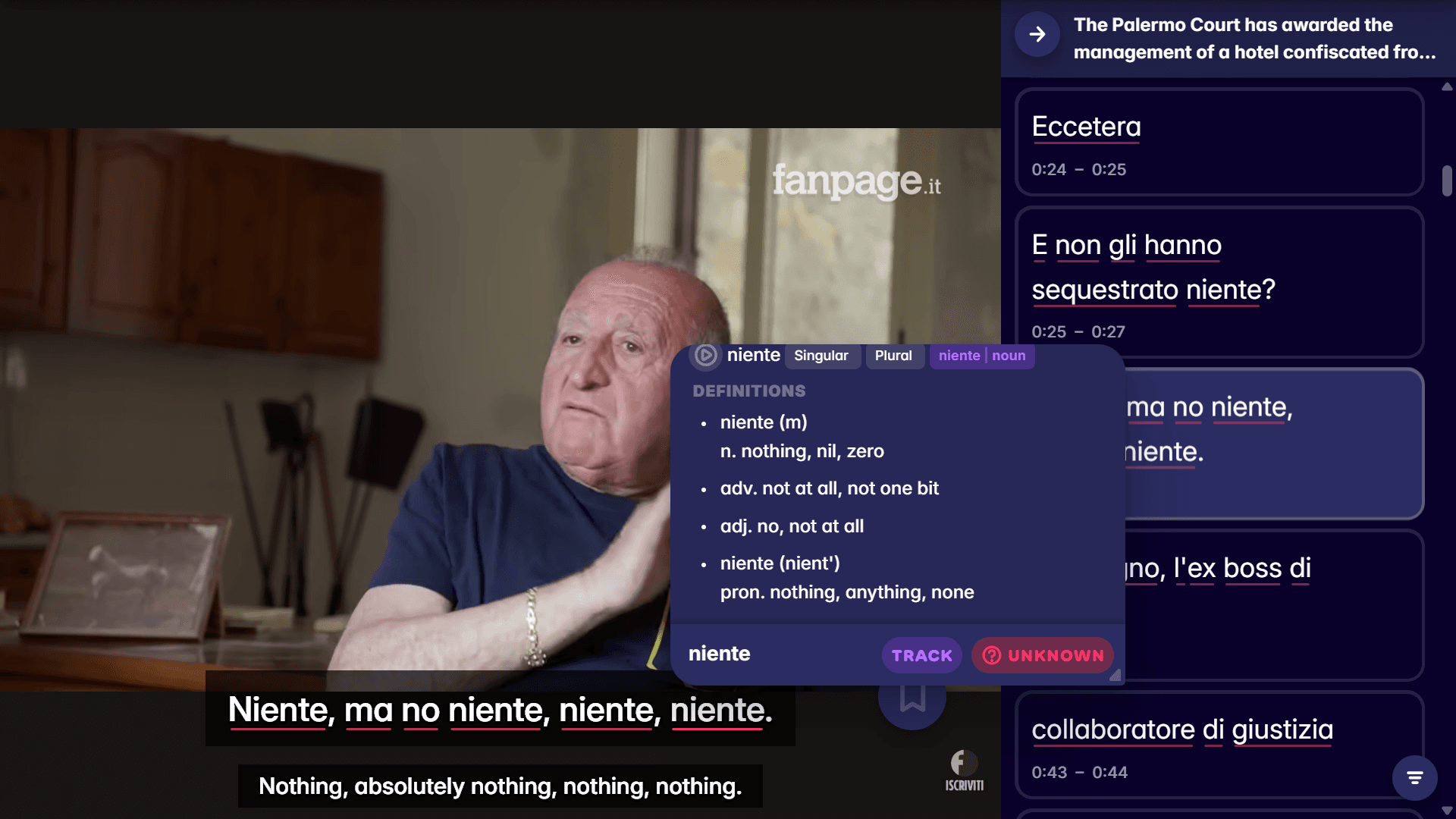
Anyway, whichever language you choose, Migaku's browser extension and app let you look up words instantly while watching French films or Italian cooking shows. Makes immersion learning way more practical than pausing every five seconds to check a dictionary. There's a 10-day free trial if you want to check it out.
 ---
## My honest take on French vs Italian
After working with hundreds of language learners, here's what I've noticed: people who choose based on genuine interest stick with it longer than people who choose based on perceived difficulty. If French culture, literature, or career opportunities genuinely excite you, the pronunciation challenges won't stop you. If Italian art, food, and music light you up, you'll push through the grammar complexities. Ultimately, immersion is what carries you through language learning in the long run, and you would feel more motivated with content you love and enjoy.
> If you consume media in the language you want to learn, and you understand at least some of the messages and sentences within that media, you will make progress. _Period_.
Learn with joy, grow with ease!📖
---
## My honest take on French vs Italian
After working with hundreds of language learners, here's what I've noticed: people who choose based on genuine interest stick with it longer than people who choose based on perceived difficulty. If French culture, literature, or career opportunities genuinely excite you, the pronunciation challenges won't stop you. If Italian art, food, and music light you up, you'll push through the grammar complexities. Ultimately, immersion is what carries you through language learning in the long run, and you would feel more motivated with content you love and enjoy.
> If you consume media in the language you want to learn, and you understand at least some of the messages and sentences within that media, you will make progress. _Period_.
Learn with joy, grow with ease!📖