# German Body Parts: Complete Names of Body Parts in German for Learners
> Here's how to talk about body parts in German with gender and plural form rules. Covers head, torso, arms, legs, plus pronunciation audio.
**URL:** https://migaku.com/blog/language-fun/german-body-parts-vocabulary-guide
**Last Updated:** 2026-03-12
**Tags:** vocabulary, phrases, listicle
---
[Learning German](https://migaku.com/learn-german) body parts is one of those vocabulary sets you'll use constantly, whether you're describing yourself, talking about health issues, or just following along with a fitness video. The German language has specific articles and plural forms for each body part, which can feel overwhelming at first, but once you learn the patterns, it gets way easier.
----
## Basic German grammar for body parts
German body parts follow the same **three-gender system** as all German nouns. You've got der (masculine), die (feminine), and das (neuter), and memorizing which article goes with which body part is honestly half the battle. The good news? Many body parts follow predictable patterns once you start noticing them.
Let's start with the basics. **Der Körper ** means "the body" in German, and it's your foundation for all body part vocabulary. When Germans talk about their bodies, they use the same possessive structure as English, but with those pesky articles attached.
Here's something interesting: German body parts often have completely different plural forms than their singular versions. Der Arm (the arm) becomes die Arme (the arms), but der Fuß (the foot) becomes die Füße (the feet) with an umlaut. You'll see this pattern repeat throughout German vocabulary.
----
## Head and face vocabulary in German language learning
| German | English |
| - | - |
| der Kopf | the head |
| das Auge | the eye |
| die Augen | the eyes |
| die Nase | the nose |
| der Mund | the mouth |
| das Ohr | the ear |
| die Ohren | the ears |
| die Wange | the cheek |
| das Kinn | the chin |
| der Hals | the neck / the throat |
| die Lippe | the lip |
| die Zunge | the tongue |
| der Zahn | the tooth |
| die Zähne | the teeth |
| das Gesicht | the face |
| die Haare | the hair (on your head) |
----
## Body part vocabulary for the torso
The torso contains some of the most important internal and external body parts you'll need to know, especially if you ever need to visit a doctor in a German-speaking country.
| German | English |
| - | - |
| der Bauch | the stomach / the belly (external part) |
| die Brust | the chest / the breast (depending on context) |
| der Rücken | the back |
| die Schulter | the shoulder |
For internal organs, German uses specific vocabulary that's worth learning:
| German | English |
| - | - |
| das Herz | the heart |
| die Lunge | the lung |
| der Magen | the stomach (internal organ) |
| die Leber | the liver |
| die Niere | the kidney |
----
## German words for arms and hands
| German | English |
| - | - |
| der Arm | the arm |
| die Arme | the arms (plural) |
| der Ellbogen | the elbow (literally "elbow-bow") |
| die Hand | the hand |
| der Finger | the finger |
| die Finger | the fingers (plural) |
| das Handgelenk | the wrist (literally "hand-joint") |
| der Daumen | the thumb |
| der Zeigefinger | the index finger (literally "pointing finger") |
| der Mittelfinger | the middle finger |
| der Ringfinger | the ring finger |
| der kleine Finger | the little finger / pinky |
| der Nagel | the nail |
| die Faust | the fist |
----
## Legs and feet in German language
| German | English |
| - | - |
| der Fuß | the foot |
| die Füße | the feet (plural) |
| das Bein | the leg |
| die Zehe / der Zeh | the toe |
| das Knie | the knee |
| die Hüfte | the hip |
| der Oberschenkel | the thigh (literally "upper leg") |
| der Unterschenkel | the lower leg / shin |
| das Fußgelenk | the ankle (literally "foot-joint") |
| die Ferse | the heel |
| die Sohle | the sole (of the foot) |
----
## Learn German expressions and idioms related to body parts
German uses body part vocabulary in tons of idioms and expressions, just like English does. Learning these gives you more natural-sounding German.
- "Das geht mir auf die Nerven" literally means "that goes on my nerves" but translates to "that gets on my nerves." Die Nerven (the nerves) appears in several emotional expressions.
- "Hals und Beinbruch" (neck and leg break) is how Germans say "break a leg" for good luck.
- "Daumen drücken" (press thumbs) means "keep your fingers crossed," using der Daumen in a completely idiomatic way.
- "Ein Auge zudrücken" (close one eye) means to turn a blind eye to something. These expressions make your German sound way more fluent than just knowing the literal translation of body parts.
----
## German vocabulary learning strategies
Learning body parts in German works best when you connect the vocabulary to physical movement or real-world context.
1. Pointing to your der Kopf while saying the word out loud creates stronger memory associations than just [reading flashcards](https://migaku.com/blog/language-fun/flashcard-best-practices-language-learning).
2. The plural forms need special attention. Create a separate study session just for singular-to-plural transformations. Notice patterns like der Arm to die Arme, der Fuß to die Füße, das Auge to die Augen. These patterns repeat across German vocabulary beyond just body parts.
3. Group vocabulary by article gender. Make three lists: all the der body parts, all the die body parts, and all the das body parts. This helps your brain categorize and recall the correct article more naturally.
4. Use the vocabulary in complete sentences, even if you're just talking to yourself. "Ich wasche meine Hände" (I wash my hands) or "Meine Füße sind müde" (My feet are tired). The repetition in context beats isolated word memorization every time.
5. Watch German fitness videos or yoga instructions. The instructor will constantly reference body parts, giving you natural repetition in context. You'll hear "Hebt die Arme" (raise the arms) or "Beugt die Knie" (bend the knees) repeatedly.
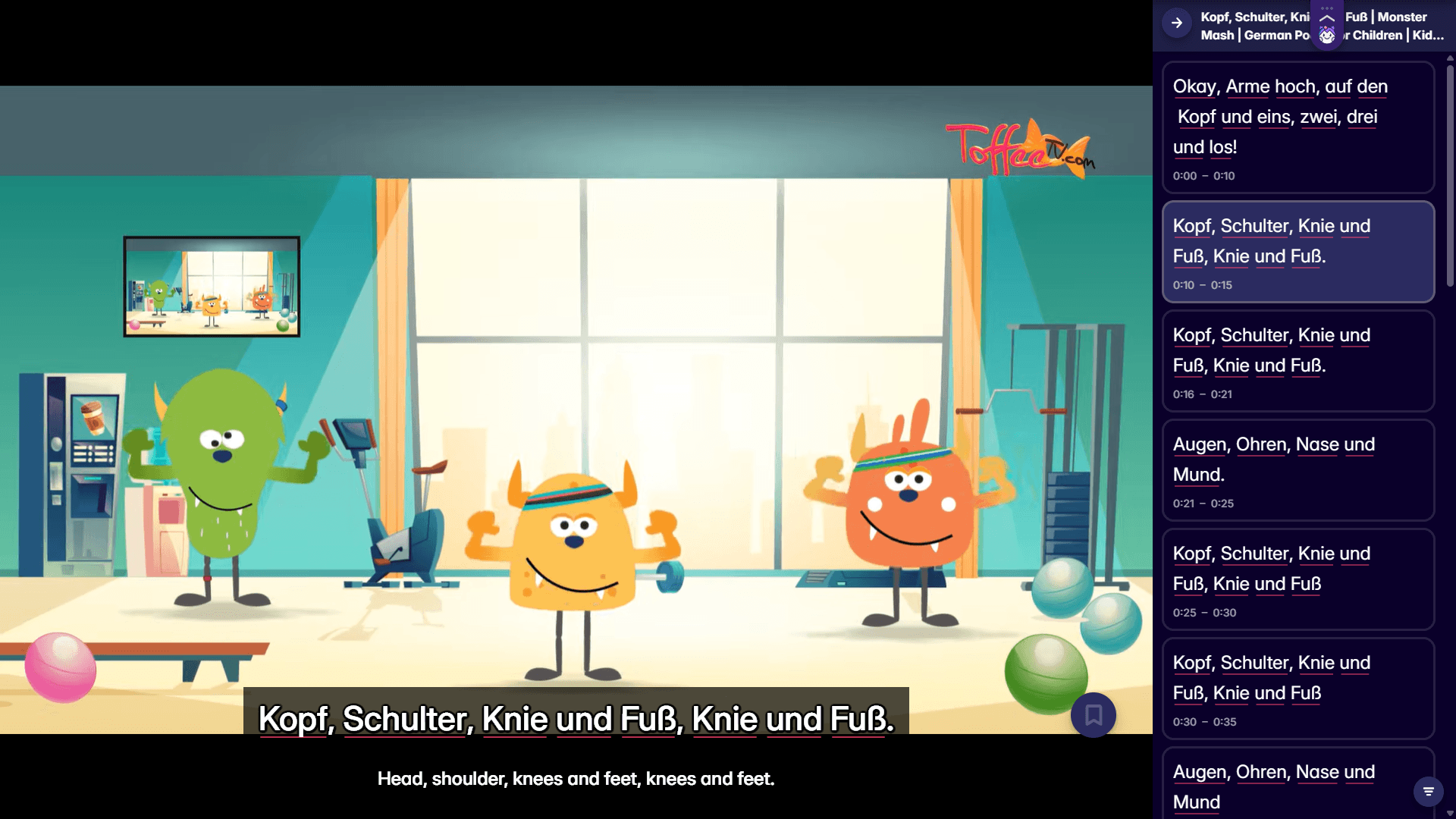
6. Children's songs about body parts exist in German just like in English. "Kopf, Schultern, Knie und Fuß" is the German version of "Head, Shoulders, Knees and Toes." Silly? Maybe. Effective? Absolutely.
Anyway, if you want to actually practice this German vocabulary with real content, Migaku's browser extension and app let you look up words instantly while [watching German shows](https://migaku.com/blog/language-fun/comprehensible-input-method-language-learning) or reading German articles. Makes learning body parts in context way more practical. There's a 10-day free trial if you want to check it out.
 ----
## FAQs
Yeah, there are tons of Quizlet decks for German body parts. They're useful for quick drilling, though I'd recommend creating your own deck with example sentences rather than just using someone else's word list. The act of making the cards helps you remember better.
----
## The fastest way to learn German body parts?
Many learners combine lists with immersion practice to memorize practical vocabulary like body parts. You can start with a list including all the essential words to get a general understanding, and then make extra notes on the list or make flashcard collections as you see more and more body parts words in context when consuming media.
> If you consume media in German, and you understand at least some of the messages and sentences within that media, you will make progress. _Period_.
Small effort builds great progress.
----
## FAQs
Yeah, there are tons of Quizlet decks for German body parts. They're useful for quick drilling, though I'd recommend creating your own deck with example sentences rather than just using someone else's word list. The act of making the cards helps you remember better.
----
## The fastest way to learn German body parts?
Many learners combine lists with immersion practice to memorize practical vocabulary like body parts. You can start with a list including all the essential words to get a general understanding, and then make extra notes on the list or make flashcard collections as you see more and more body parts words in context when consuming media.
> If you consume media in German, and you understand at least some of the messages and sentences within that media, you will make progress. _Period_.
Small effort builds great progress.