# Complete Guide to Comparatives and Superlatives in German
> Learn how to form and use German comparatives and superlatives with -er and -st endings. Includes irregular forms, als vs wie, and practical examples.
**URL:** https://migaku.com/blog/language-fun/german-comparatives-and-superlatives
**Last Updated:** 2026-03-08
**Tags:** fundamentals, grammar
---
Knowing how to make comparisons in [German learning](https://migaku.com/learn-german) opens up a whole new level of expression. You can finally say things like "this coffee is better than that one" or "this is the best Bratwurst I've ever had" without stumbling over your words. German comparatives and superlatives follow pretty logical patterns once you understand the basic rules, and honestly, they're easier than you might think. Let's break down exactly how these work so you can start comparing things like a native speaker.
---
## What are comparative and superlative adjectives in German
Just like in English, German uses comparative and superlative forms to compare things.
> 💡 Definitions 💡
The comparative form lets you compare two things (bigger, faster, better), while the superlative form describes the extreme (biggest, fastest, best).
Here's the thing though: German forms these comparisons differently than English. Instead of adding "more" or "most" before adjectives like we do in English with longer words, **German almost always adds endings directly to the adjective itself**. So you won't say "more interesting" in German. You'll modify the adjective directly.
The basic pattern works like this: **take your base adjective, add -er for the comparative, and add -st or -sten for the superlative.** Pretty straightforward, right?
---
## How to form the comparative in German
> The German comparative is formed by **adding -er to the end of the adjective**. This works for basically every adjective, whether it's short or long.
Here are some examples:
- schnell (fast) becomes schneller (faster)
- klein (small) becomes kleiner (smaller)
- interessant (interesting) becomes interessanter (more interesting)
- kompliziert (complicated) becomes komplizierter (more complicated)
Notice how even long adjectives just get the -er ending? That's actually simpler than English, where we'd say "more complicated" instead of "complicateder."
When you use the comparative form before a noun, you need to add the appropriate adjective ending based on **gender**, **case**, and whether you're using **a definite or indefinite article**. So "schneller" might become "ein schnelleres Auto" (a faster car) or "der schnellere Zug" (the faster train).
### Using "als" in comparative sentences
> When you're comparing two things directly, you use **"als" (than) to connect them**. This is your go-to word for inequality comparisons.
Examples:
- Mein Auto ist schneller als dein Auto.
*My car is faster than your car.*
- Berlin ist größer als München.
*Berlin is bigger than Munich.*
- Deutsch ist einfacher als Russisch.
*German is easier than Russian.*
The word "als" always follows the comparative adjective when you're making this type of comparison. You'll use this construction constantly when speaking German.
### Equality comparisons with "wie"
> Sometimes you want to say things are equal rather than different. For this, German uses **"so...wie" or just "wie" (as...as)**.
Examples:
- Mein Bruder ist so groß wie ich.
*My brother is as tall as me.*
- Diese Aufgabe ist genauso schwer wie die letzte.
*This task is just as hard as the last one.*
The adjective stays in its base form when you use comparatives with "wie" because you're not comparing degrees, you're stating equality.
---
## Forming the superlative in German language
The superlative form in German comes in two flavors, and which one you use depends on how you're using it in the sentence.
### Predicative superlative with "am...sten"
> When the superlative comes after the verb (predicative position), you use the construction **"am + adjective + sten."**
Examples:
- Dieser Berg ist am höchsten.
*This mountain is the highest.*
- Im Sommer sind die Tage am längsten.
*In summer, the days are the longest.*
- Dieses Buch ist am interessantesten.
*This book is the most interesting.*
The "am" part is actually a contraction of "an dem," and the whole construction translates roughly to "at the most (adjective)."
### Attributive superlative with "-st" + endings
> When the superlative adjective comes before a noun, you **add -st (or -est if the adjective ends in -d, -t, -s, -ß, -x, or -z) plus the normal adjective ending**.
Examples:
- das schnellste Auto
*the fastest car*
- der größte Mann
*the tallest man*
- die schönste Stadt
*the most beautiful city*
You need that extra -e- in words like "der interessanteste Film" because otherwise you'd have too many consonants bunched together and it would be impossible to pronounce.
The adjective endings follow all the normal declension rules you'd use for any adjective before a noun. So you might see "des schnellsten Autos" (of the fastest car) in the genitive case.
---
## Irregular comparatives and superlatives in German
Like English has "good, better, best" instead of "good, gooder, goodest," German has some irregular forms you just need to memorize. The good news? There aren't that many.
Here are the most common irregular comparatives and superlatives:
- gut (good) becomes besser, am besten
- viel (much/many) becomes mehr, am meisten
- gern (gladly) becomes lieber, am liebsten
- hoch (high) becomes höher, am höchsten
- nah (near) becomes näher, am nächsten
Some adjectives also add an umlaut in their comparative and superlative forms:
- alt (old) becomes älter, am ältesten
- jung (young) becomes jünger, am jüngsten
- groß (big) becomes größer, am größten
- lang (long) becomes länger, am längsten
- kurz (short) becomes kürzer, am kürzesten
- warm (warm) becomes wärmer, am wärmsten
- kalt (cold) becomes kälter, am kältesten
- stark (strong) becomes stärker, am stärksten
Most single-syllable adjectives with a, o, or u in the stem get this umlaut treatment, but not all of them. Words like "bunt" (colorful) stay as "bunter" without the umlaut. You'll pick up which ones change as you practice.
---
## Using comparatives and superlatives as adverbs
Here's something cool: you can use these same forms as adverbs to describe how an action happens, not just to describe nouns.
When used as adverbs, comparative adjectives don't take any additional endings:
- Er läuft schneller.
*He runs faster.*
- Sie spricht lauter.
*She speaks louder.*
For superlative adverbs, you always use the "am...sten" form:
- Er läuft am schnellsten.
*He runs the fastest.*
- Sie spricht am lautesten.
*She speaks the loudest.*
The difference between adjectives and adverbs matters for form. Compare these:
- Das schnellste Auto (the fastest car) - adjective before noun
- Das Auto fährt am schnellsten (the car drives the fastest) - adverb after verb
---
## Common mistakes to watch out for
1. One thing that trips up English speakers: trying to use "mehr" (more) or "meist" (most) before adjectives like we do in English. German doesn't do this except with "viel" and a few other special cases. You can't say "mehr interessant" for "more interesting." It's always "interessanter."
2. Another mistake is forgetting the adjective endings when the superlative comes before a noun. You need both the superlative marker and the case ending: "der schönste Tag" not "der schönst Tag."
3. Also, watch out for mixing up "als" and "wie." Use "als" after comparatives (schneller als) and "wie" for equality (so schnell wie). Getting these backwards sounds really off to native speakers.
---
## How to practice and learn German comparatives
1. The best way to internalize these patterns is through repetition with real content. Start noticing comparatives and superlatives when you read German texts or watch German videos. Pay attention to which adjectives get umlauts and which stay regular.
2. Try creating your own comparison sentences about things in your daily life. Compare your coffee to your friend's coffee, your commute to your coworker's commute, or today's weather to yesterday's weather. The more you use these forms in context, the more natural they'll become.
3. [Making flashcards](https://migaku.com/blog/language-fun/flashcard-best-practices-language-learning) for the irregular forms helps too, since those just require memorization. Focus especially on the common ones like "gut, besser, am besten" since you'll use them constantly.
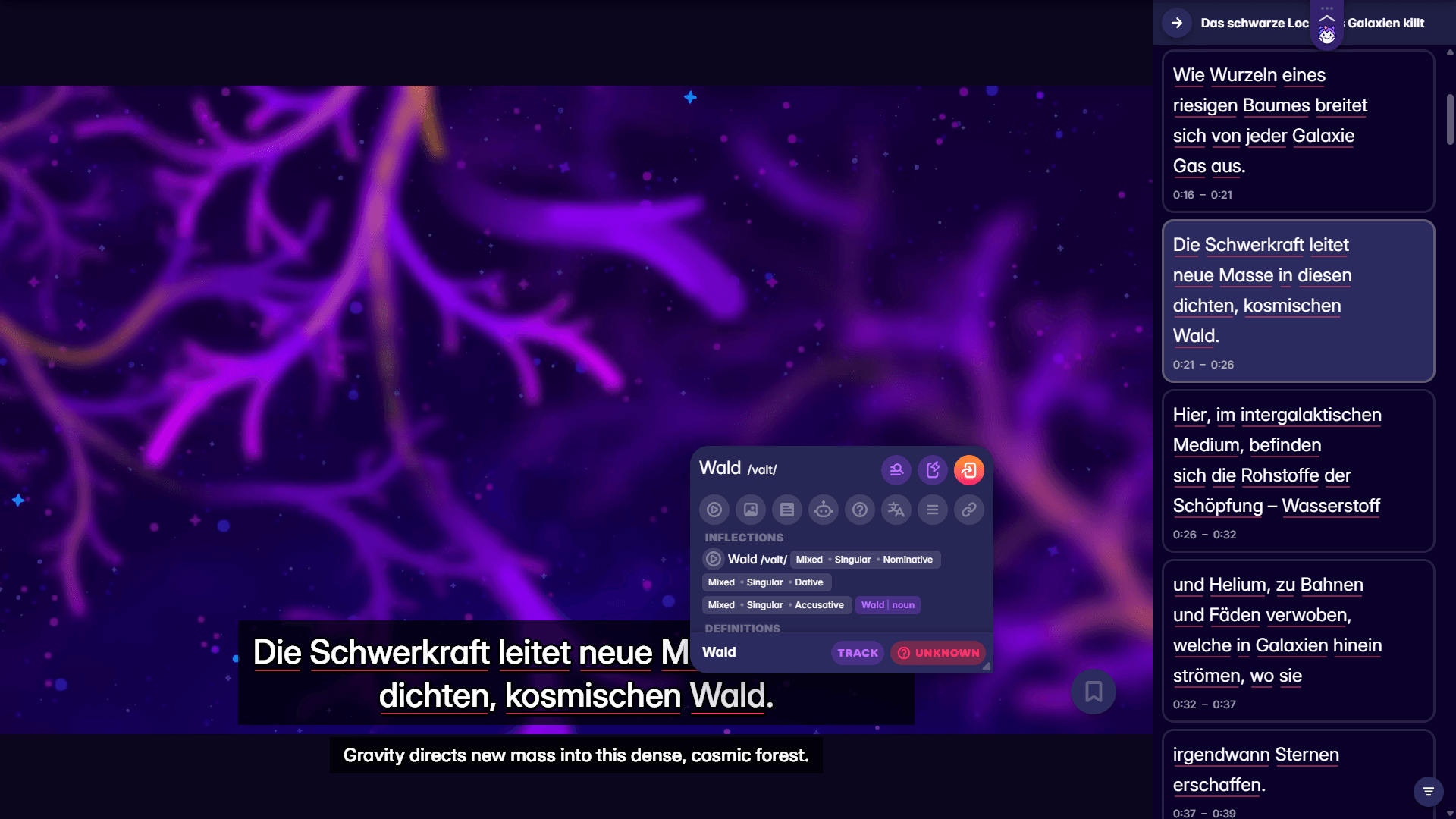
If you want to see these comparative and superlative forms in action while learning German, Migaku's browser extension and app let you look up any word instantly while watching German shows or reading German articles. You'll spot these patterns naturally in real content, which honestly beats memorizing grammar tables any day. There's a 10-day free trial if you want to check it out.
 ---
## Learn comparative and superlative forms through immersion
Once you understand how to form the comparative with -er and the superlative with -st or am...sten, plus you've memorized the handful of irregular forms, you can make comparisons about pretty much anything in German. Mind that understanding the rules does not mean you can actively use them in real conversations yet. Through immersion and time, you will gradually internalize these rules as your second instincts.
> If you consume media in German, and you understand at least some of the messages and sentences within that media, you will make progress. _Period_.
Slow learning lasts.⏰📖
---
## Learn comparative and superlative forms through immersion
Once you understand how to form the comparative with -er and the superlative with -st or am...sten, plus you've memorized the handful of irregular forms, you can make comparisons about pretty much anything in German. Mind that understanding the rules does not mean you can actively use them in real conversations yet. Through immersion and time, you will gradually internalize these rules as your second instincts.
> If you consume media in German, and you understand at least some of the messages and sentences within that media, you will make progress. _Period_.
Slow learning lasts.⏰📖