# German False Friends: Tricky English-German False Friends That Confuse Learners
> Don't get tripped up by these common German false friends. From "Gift" (poison) to "Handy" (phone), avoid embarrassing mistakes with this guide.
**URL:** https://migaku.com/blog/language-fun/german-false-friends
**Last Updated:** 2026-03-05
**Tags:** vocabulary, phrases, comparison
---
We all know what a gift is in the English language. But what about "Gift" in German vocabulary? It means poison or toxin, which is far from what [German learners](https://migaku.com/learn-german) may assume when they first encounter this word. Welcome to the wild world of German false friends, where words that look comfortably familiar in English mean something completely different in German. These sneaky linguistic traps have embarrassed countless learners (myself included), but once you know what to watch for, they're actually pretty fun to spot and remember.
---
## What are false friends anyway
> 💡 False Friends 💡
A false friend is a word in one language that **looks or sounds similar to a word in another language but has a completely different meaning**. Linguists call them "false cognates" because they trick you into thinking they share a common origin or meaning when they don't.
Here's the thing: your brain naturally tries to make connections between languages, especially when they're related like English and German. Both are Germanic languages, so they share tons of actual cognates (words that really do mean the same thing, like "Hand" in both languages). But false friends exploit this helpful pattern recognition and turn it against you.
The result? You confidently use a German word thinking it means one thing, and native Germans give you very confused looks. Sometimes it's just awkward. Other times, like with "Gift," it's downright alarming.
---
## The most common German false friends that trip up English speakers
Let me walk you through the false friends you'll encounter most often. These are the ones that cause problems for pretty much every English speaker [learning German](https://migaku.com/blog/language-fun/easiest-languages-to-learn-for-english-speakers).
### Gift
This is the classic example everyone learns first. In German, "Gift" means poison. The English word "gift" (a present) translates to "Geschenk" in German. So when you see "Giftig" on a label, that's not telling you it's suitable for giving, it's warning you it's toxic.
I've heard stories of learners cheerfully asking where to buy "Gift" for their host family. Yeah, that conversation gets awkward fast.
### Handy
In English, "handy" means useful or convenient. In German, "Handy" (Yes, capitalized because it's a noun) means a mobile phone or cell phone. Germans will talk about their Handy constantly, and no, they're not describing how useful something is.
The weird part? This is actually a pseudo-anglicism. Germans borrowed it from English but gave it a completely different meaning. The English word "handy" translates to "praktisch" or "nützlich" in German.
### Chef
When you hear "Chef" in German, don't think of someone in a kitchen. This German word means boss or manager. The person who cooks your food is a "Koch" (or "Köchin" for a female cook).
So if a German tells you about their Chef, they're talking about their supervisor at work, not complimenting someone's culinary skills.
### Gymnasium
This false friend confuses people constantly. In German-speaking countries, a Gymnasium is an academic high school that prepares students for university. It has nothing to do with sports or physical education. If you want to talk about a place to work out, you'd say "Fitnessstudio" or "Turnhalle" (for a sports hall).
### Bekommen
This verb looks like "become" but means "to get" or "to receive." When a waiter asks "Was bekommen Sie?" they're asking what you'd like to order, not what you're turning into.
The actual German word for "become" is "werden." Mixing these up leads to some genuinely confusing sentences.
### Bald
In German, "bald" means soon, not hairless. "Ich komme bald" means "I'm coming soon." The English word "bald" translates to "kahl" or "glatzköpfig" in German.
### Brave (brav)
Here's one that works in reverse too. The German word "brav" means well-behaved, obedient, or good (usually describing children or pets). It doesn't mean courageous. A "braves Kind" is a well-behaved child, not a courageous one.
The English word "brave" translates to "mutig" or "tapfer" in German.
### Also
This one catches everyone. In German, "also" means "so" or "therefore." It's used constantly in conversation as a filler word or to introduce a conclusion. The English word "also" (meaning "too" or "as well") translates to "auch" in German.
### Fast
The German word "fast" means almost or nearly. "Fast fertig" means almost finished, not quickly finished. The English word "fast" (meaning quick) is "schnell" in German.
### Aktuell
"Aktuell" means current or up-to-date in German, not "actual." When Germans talk about "aktuelle Nachrichten," they mean current news. The English word "actual" usually translates to "eigentlich" or "tatsächlich."
### Sensible
In German, "sensibel" means sensitive (emotionally), not sensible or practical. If someone is "sehr sensibel," they're very sensitive, not particularly practical. The English word "sensible" translates to "vernünftig" or "sinnvoll."
### Eventuell
This looks like "eventually" but means possibly or perhaps. "Eventuell komme ich" means "I might come," not "I'll come eventually." For "eventually," you'd use "schließlich" or "letztendlich."
### Fabrik
A "Fabrik" is a factory, not fabric. Fabric is "Stoff" in German. Pretty straightforward once you know it, but the similarity trips people up initially.
### Sympathisch
This means likeable or nice in German, not sympathetic. "Er ist sehr sympathisch" means he's very likeable. For sympathetic, you'd use "mitfühlend" or "verständnisvoll."
### Dezent
"Dezent" means subtle or discreet, not decent. "Dezente Kleidung" means subtle clothing. The English word "decent" translates to "anständig" or "ordentlich."
### Provision
In German, this means commission (like a sales commission), not supplies or provisions. For provisions or supplies, you'd use "Vorräte" or "Verpflegung."
---
## How to remember the different meanings of English-German false friends
Here's what actually works for remembering these tricky words. Making up memorable associations helps way more than just drilling them.
For "Gift," I always picture someone's horrified face when you hand them poison wrapped in a bow. The shock value makes it stick.
With "Handy," think about how handy it is to have your phone with you. The English meaning actually describes what the German word represents.
For "bald," imagine someone saying "I'll grow hair soon." It's silly enough to remember.
Create mental images that exaggerate the difference. The weirder and more vivid, the better your brain holds onto it.
Another approach: make a personal connection. Did you embarrass yourself with one of these false friends? Good. You'll never forget that one now. I once told someone I'd bring them "Gift" to a party. The confused silence that followed burned that word into my memory forever.
---
## Building your English and German false friends glossary
1. Keep your own list as you encounter these words. Seriously, write them down. The act of maintaining a personal glossary helps cement them in memory.
2. Organize them however makes sense to you. Some people group by theme, others alphabetically, others by how embarrassing the mistake could be.
3. Include example sentences for each. Seeing the German word in context helps way more than just memorizing isolated translations.
4. Add any false friends you personally mess up. Your individual trouble spots matter more than comprehensive lists of every possible false friend.
5. Review your glossary regularly, especially before conversations or writing. A quick scan refreshes your memory and helps you catch mistakes before they happen.
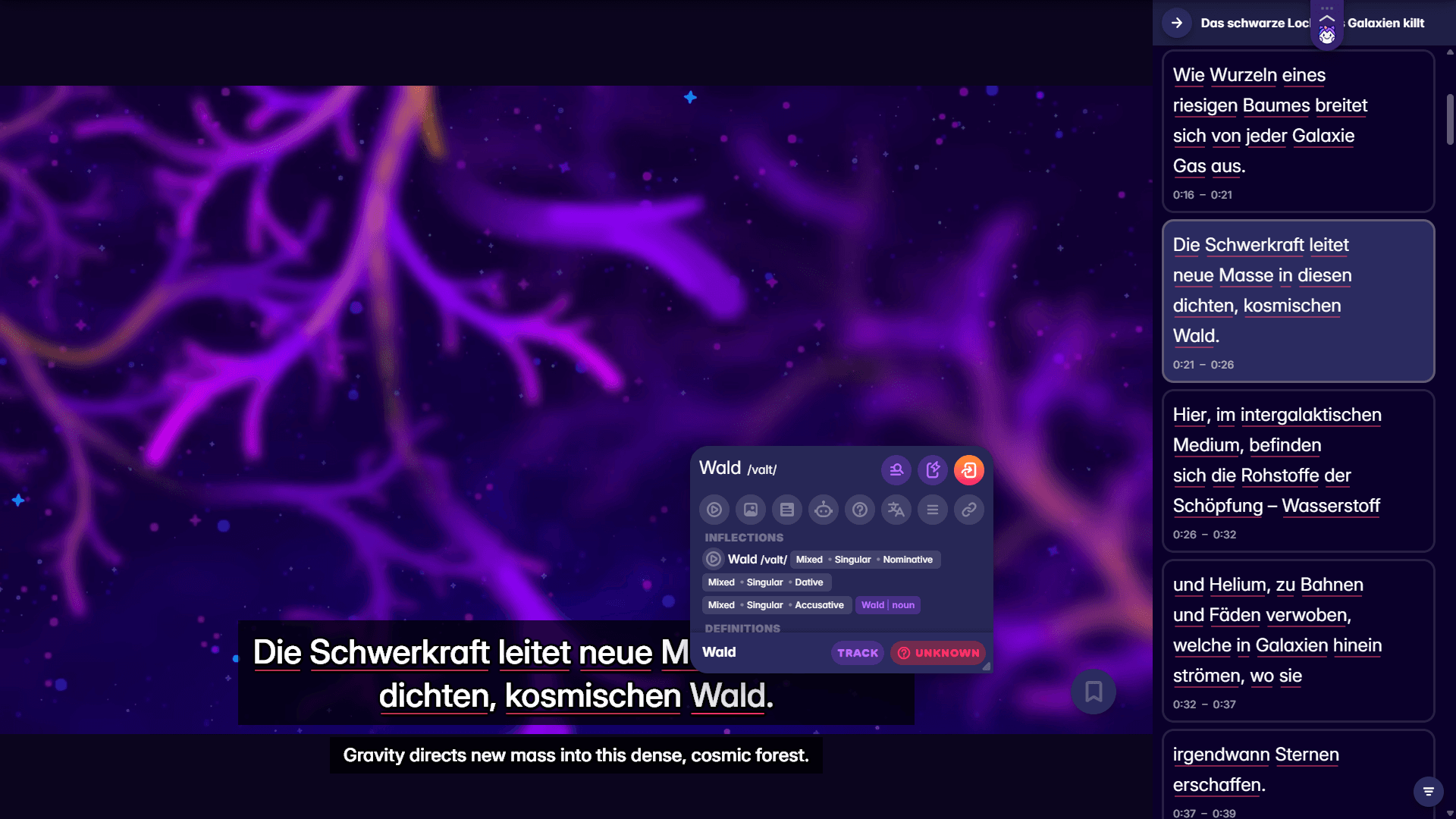
Anyway, if you want to build your German vocabulary faster while avoiding these tricky false friends, Migaku's browser extension and app let you look up words instantly while watching German shows or reading German articles. You can save the tricky ones (including false friends) directly to your flashcard decks. There's a 10-day free trial if you want to check it out.
 ---
## Keep your glossary of false friends between English and German growing
Language learning communities constantly share new examples. The ones I've covered here are the most common, but there are dozens more floating around. Some regional or less common false friends include "Rat" (advice, not the rodent), "Mist" (manure or darn, not mist), and "Art" (type or kind, not art which is "Kunst"). The more you read and listen to German, the more false friends you'll naturally encounter. Each one you discover and learn becomes another tool in your language toolkit.
> If you consume media in German, and you understand at least some of the messages and sentences within that media, you will make progress. _Period_.
A dictionary is a learner’s best friend!📚
---
## Keep your glossary of false friends between English and German growing
Language learning communities constantly share new examples. The ones I've covered here are the most common, but there are dozens more floating around. Some regional or less common false friends include "Rat" (advice, not the rodent), "Mist" (manure or darn, not mist), and "Art" (type or kind, not art which is "Kunst"). The more you read and listen to German, the more false friends you'll naturally encounter. Each one you discover and learn becomes another tool in your language toolkit.
> If you consume media in German, and you understand at least some of the messages and sentences within that media, you will make progress. _Period_.
A dictionary is a learner’s best friend!📚