German Modal Verbs: Complete Guide to Using All 6 Modals in German Grammar
Last updated: April 4, 2026

German modal verbs are probably one of the first things you'll encounter when you start learning German beyond basic phrases. They pop up everywhere, and honestly, they're super useful for expressing what you can do, what you want to do, or what you should do. The good news? There are only six main modal verbs to learn. The slightly annoying news? They conjugate differently from regular verbs, and they change the structure of your sentences. But once you get the hang of them, you'll sound way more natural when speaking German.
- What are modal verbs in German
- How many modal verbs are there in German
- The six German modals and their meanings
- Conjugation of German modal verbs in present tense
- Using modal verbs in sentences
- Modal verbs in the past tense
- Modal verbs and German grammar
- When to use German modal verbs
- Tips for mastering German modal verbs
What are modal verbs in German
💡 Definition 💡
Modal verbs are helping verbs that modify the meaning of the main verb in a sentence. Instead of saying "I go to the store," you might say "I can go to the store" or "I must go to the store." That little modal verb completely changes the meaning, right?
In German, modal verbs work the same way. They team up with another verb (usually in its infinitive form) to express ability, permission, necessity, desire, or obligation. The modal verb gets conjugated based on who's doing the action, while the main verb chills at the end of the sentence in its infinitive form.
Here's the thing about German modal verbs: they're irregular. Each one has its own conjugation pattern in the present tense, and you'll need to memorize them. But they follow similar rules for how they work in sentences, which makes them easier to handle once you understand the basic structure.
How many modal verbs are there in German
German has six main modal verbs that you'll use constantly. Sometimes people mention a seventh one, but let's focus on the core six first:
- können (can, to be able to)
- müssen (must, to have to)
- dürfen (may, to be allowed to)
- sollen (should, to be supposed to)
- wollen (to want to)
- mögen (to like)
Each of these modal verbs has a specific meaning and use case. The seventh modal verb that sometimes gets mentioned is möchten , but technically it's the subjunctive form of mögen. Still, it's used so frequently in everyday German that it deserves attention.
The six German modals and their meanings
Let's break down each modal verb in German and what it actually means when you use it.
können
This modal verb expresses ability or possibility. Think of it as the German equivalent of "can" or "to be able to." You use können when you're talking about something you're capable of doing or something that's possible.
Example:
- Ich kann Deutsch sprechen.
I can speak German.
müssen
When you absolutely have to do something, müssen is your verb. It expresses necessity or obligation. Native speakers use this when there's no way around doing something.
Example:
- Ich muss heute arbeiten.
I must work today.
dürfen
This one's about permission. You use dürfen when asking if something is allowed or stating that you're permitted to do something. It can also express prohibition in its negative form.
Example:
- Darf ich hier parken?
May I park here?
sollen
This modal verb appears when you're supposed to do something, often because someone else said so or it's expected of you. It's less forceful than müssen but still carries a sense of obligation.
Example:
- Ich soll mehr Wasser trinken.
I should drink more water.
wollen
Pretty straightforward, wollen expresses desire or intention. You use it when you want to do something.
Example:
- Ich will nach Deutschland reisen.
I want to travel to Germany.
mögen
This modal verb is a bit different. It expresses liking or preference. You'll often see it in its subjunctive form, möchten, which is more polite and means "would like to."
Example:
- Ich mag Pizza.
I like pizza. - Ich möchte ein Bier, bitte.
I would like a beer, please.
Conjugation of German modal verbs in present tense
Here's where things get interesting. Modal verbs in German don't follow the regular conjugation patterns. They have stem changes in the singular forms (ich, du, er/sie/es) but return to the regular stem in plural forms (wir, ihr, sie).
Let me show you the present tense conjugation for all six modal verbs:
können:
- ich kann
- du kannst
- er/sie/es kann
- wir können
- ihr könnt
- sie/Sie können
müssen:
- ich muss
- du musst
- er/sie/es muss
- wir müssen
- ihr müsst
- sie/Sie müssen
dürfen:
- ich darf
- du darfst
- er/sie/es darf
- wir dürfen
- ihr dürft
- sie/Sie dürfen
sollen:
- ich soll
- du sollst
- er/sie/es soll
- wir sollen
- ihr sollt
- sie/Sie sollen
wollen:
- ich will
- du willst
- er/sie/es will
- wir wollen
- ihr wollt
- sie/Sie wollen
mögen:
- ich mag
- du magst
- er/sie/es mag
- wir mögen
- ihr mögt
- sie/Sie mögen
Notice the pattern? The ich and er/sie/es forms are identical for each modal verb, and they lose the umlaut (those dots over the vowels) that appears in the infinitive. The wir and sie/Sie forms look exactly like the infinitive.
Using modal verbs in sentences
When you use modal verbs in German, the sentence structure changes. The modal verb takes the second position in the sentence (because German loves its verb-second rule), and the main verb goes to the end of the sentence in its infinitive form.
💡Basic structure: Subject + Modal Verb + Other Stuff + Main Verb (infinitive)
Example:
- Ich kann heute nicht kommen.
I can't come today.
The modal verb "kann" is conjugated and sits in the second position, while "kommen" stays in its infinitive form at the end of the sentence.
Another example:
- Sie muss morgen früh aufstehen.
She must get up early tomorrow.
The modal verb "muss" is conjugated for "sie," and "aufstehen" remains in the infinitive at the end.
Sometimes you'll see modal verbs without a main verb, especially with mögen and können when the meaning is clear from context.
Example:
- Ich mag das.
I like that. - Ich kann das.
I can do that.
Modal verbs in the past tense
You can conjugate modal verbs in different tenses, and the past tense is pretty common. German has two main past tenses: the simple past (Präteritum) and the present perfect (Perfekt).
For modal verbs, the simple past is actually more common in everyday speech than it is for regular verbs. Here's how you conjugate the modal verbs in simple past:
können → konnte:
- ich konnte
- du konntest
- er/sie/es konnte
- wir konnten
- ihr konntet
- sie/Sie konnten
müssen → musste:
- ich musste
- du musstest
- er/sie/es musste
- wir mussten
- ihr musstet
- sie/Sie mussten
The pattern is similar for all modal verbs. They add -te endings and lose their umlauts. The good news is that the simple past forms are more regular than the present tense forms.
Example:
- Ich musste gestern arbeiten.
I had to work yesterday.
When you use modal verbs in the present perfect tense, things get a bit tricky. If there's another verb in the sentence, you use what's called the "double infinitive" construction.
Example:
- Ich habe gestern arbeiten müssen.
I had to work yesterday.
Notice how both "arbeiten" and "müssen" appear in their infinitive forms at the end? That's the double infinitive. It looks weird at first, but you get used to it.
Modal verbs and German grammar
Modal verbs connect to several other aspects of German grammar. Understanding how they work with different sentence types helps you use them more naturally.
- In questions, the modal verb moves to the first position: Kannst du mir helfen? (Can you help me?)
- In subordinate clauses (sentences that start with words like "weil" or "dass"), the conjugated modal verb goes to the end, right after the infinitive: Ich weiß, dass ich heute arbeiten muss. (I know that I must work today.)
- When you're learning German, you'll notice that modal verbs often appear in subjunctive mood for polite requests. Könnte (could) and möchte (would like) are subjunctive forms that make your requests sound less demanding. Example: Könntest du mir bitte helfen? (Could you please help me?)
When to use German modal verbs
Modal verbs show up constantly in German conversation. You use them whenever you want to express:
- Ability or capability: können is your go-to verb here. Whether you're talking about speaking a language, playing an instrument, or being able to do something because circumstances allow it, können gets the job done.
- Necessity or obligation: müssen expresses strong necessity. You have to do something, there's no choice about it.
- Permission: dürfen is all about what's allowed. You ask "Darf ich?" when you want permission, and you use it to talk about rules and regulations.
- Recommendations or expectations: sollen is softer than müssen. Someone told you to do something, or it's generally expected, but there's less force behind it.
- Desire or intention: wollen and mögen (especially möchten) express what you want. Möchten is more polite, so you'll hear it a lot in restaurants and shops.
Tips for mastering German modal verbs
The best way to learn German modal verbs is through exposure and practice.
- Read German texts, watch German shows, and pay attention to how modal verbs appear in different contexts. You'll start noticing patterns in how native speakers use them.
- Create example sentences for each modal verb using situations from your own life. Instead of memorizing random sentences from a textbook, make sentences about what you can do, what you must do, or what you want to do. Personal connection makes memorization way easier.
- Practice the conjugation patterns until they become automatic. Yeah, it's boring, but knowing these conjugations cold will make speaking German so much smoother. You won't have to pause and think about whether it's "ich kann" or "ich könne."
- Pay attention to word order. German sentence structure feels unnatural at first for English speakers, but modal verbs actually make it easier to practice because the pattern is so consistent: conjugated modal in second position, infinitive at the end.
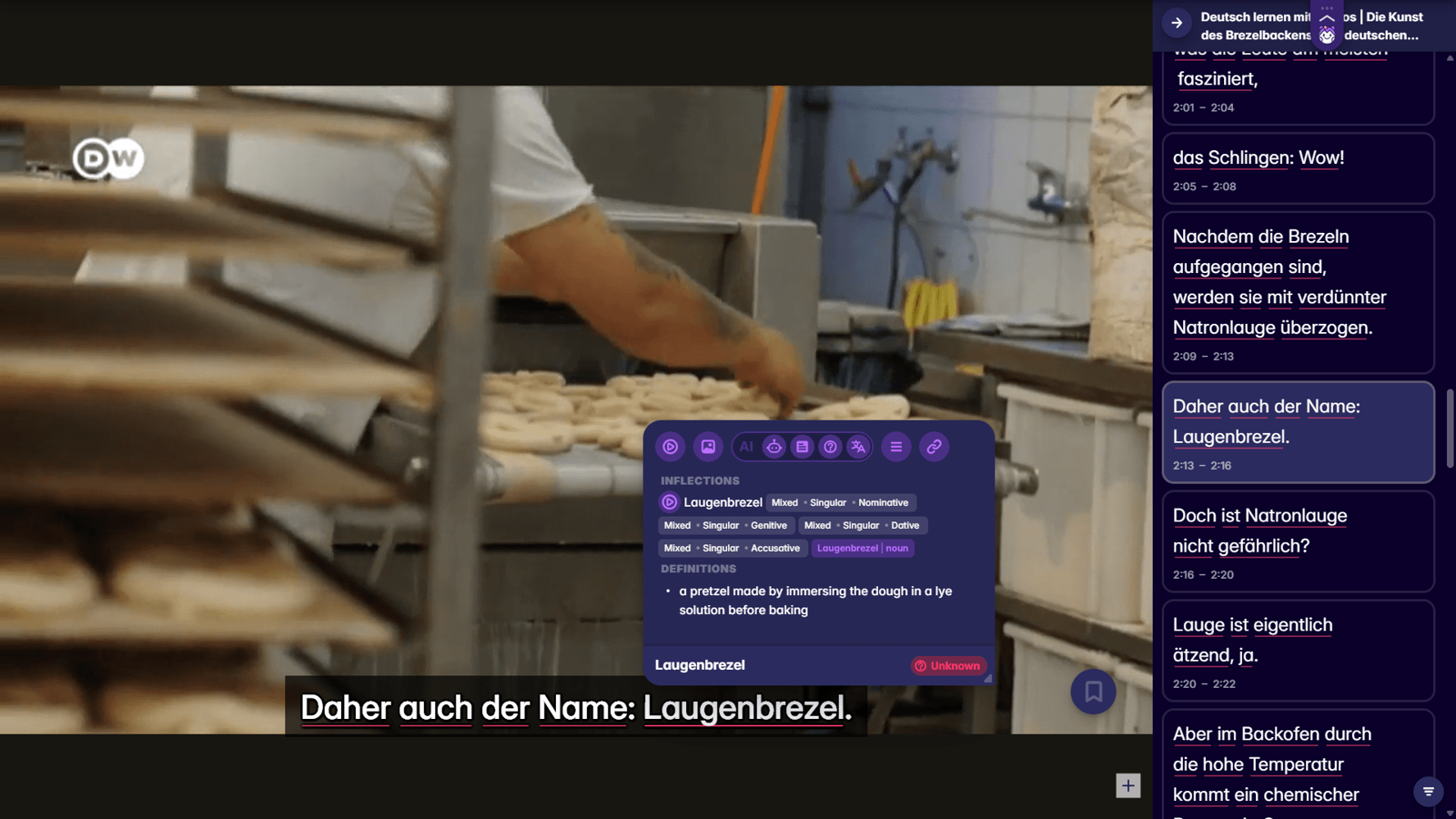
Anyway, if you want to see these modal verbs in action while watching German shows or reading German articles, Migaku's browser extension and app let you look up words and save sentences instantly. Makes learning from real content way more practical. There's a 10-day free trial if you want to check it out.
Your ticket to better German language fluency🎫
The conjugation patterns take some practice, sure. But once you've got them down, you can express so much more than just simple statements. You can talk about abilities, obligations, permissions, and desires with confidence. And on top of that, you can understand more German sentence structures in any media content.
If you consume media in German, and you understand at least some of the messages and sentences within that media, you will make progress. Period.
A solid foundation is the key to lasting progress!