# German Passive Voice Explained: How to Form and Use It Correctly
> Form and use the German passive voice across all tenses with werden and modals, and master Vorgangspassiv vs. Zustandspassiv with examples.
**URL:** https://migaku.com/blog/language-fun/german-passive-voice
**Last Updated:** 2026-03-27
**Tags:** fundamentals, grammar
---
The German passive voice trips up a lot of learners because it works differently than English in some key ways. You need to know how to form it with "werden" plus the past participle, how it changes across different tenses, and when to actually use it versus the active voice. This guide breaks down everything you need to master when [learning German](https://migaku.com/learn-german) passive voice, from basic present tense constructions to tricky modal verb combinations and the difference between process and state passives.
----
## What is the German passive voice
The passive voice in German shifts the focus from who's doing an action to **what's being done or who's receiving the action**. Instead of saying "The teacher explains the lesson," you'd say "The lesson is explained." Pretty straightforward concept, right?
Here's the thing though. German actually has two types of passive constructions: the **Vorgangspassiv** (process passive) and the **Zustandspassiv** (state passive).
- The Vorgangspassiv focuses on the action itself happening.
- The Zustandspassiv emphasizes the state or condition resulting from that action.
Most of the time when people talk about German passive voice, they mean the Vorgangspassiv. This is the one you'll use most often in everyday German, and it's formed using the verb "werden" plus a past participle.
The passive voice in German shows up way more often in formal writing, news articles, academic texts, and professional contexts than in casual conversation. When you're speaking with friends, you'll mostly stick to active constructions. But if you want to read German newspapers or understand official documents, you absolutely need to recognize and understand passive structures.
----
## How to form the passive voice with "werden"
> 💡The basic formula for forming the passive in German is actually pretty simple: **conjugate "werden" in the appropriate tense**, then **add the past participle of the main verb at the end of the clause**.
Let's start with a basic example in present tense:
- Active: Der Lehrer erklärt die Lektion. (The teacher explains the lesson.)
- Passive: Die Lektion wird erklärt. (The lesson is explained.)
Notice what happened here? The accusative object from the active sentence (die Lektion) became the subject of the passive sentence. The verb "werden" gets conjugated to match this new subject (wird), and the main verb (erklären) appears as its past participle (erklärt) at the end.
The agent (the person doing the action) often gets dropped in passive sentences because you either don't know who did it or it doesn't matter. **When you do want to mention the agent, you use "von" plus the dative case**:
- Die Lektion wird vom Lehrer erklärt.
*The lesson is explained by the teacher.*
You can also **use "durch" when the agent is more of an impersonal force or means**:
- Das Haus wurde durch einen Sturm zerstört.
*The house was destroyed by a storm.*
----
## Passive voice across different tenses
The passive voice works in all the major German tenses, and you need to know how to form each one. The key is understanding how "werden" conjugates in each tense.
### Present tense passive
For present tense, conjugate "werden" in the present and add the past participle:
- Ich werde gefragt (I am asked)
- Du wirst gefragt (You are asked)
- Er/Sie/Es wird gefragt (He/She/It is asked)
- Wir werden gefragt (We are asked)
- Ihr werdet gefragt (You all are asked)
- Sie werden gefragt (They are asked)
Example:
- Das Auto wird repariert.
*The car is being repaired.*
### Simple past passive
For simple past (Präteritum), use the past tense forms of "werden" (wurde, wurdest, wurde, wurden, wurdet, wurden):
- Das Auto wurde repariert.
*The car was repaired.*
- Die Bücher wurden gelesen.
*The books were read.*
The simple past passive shows up constantly in written German, especially in news reports and formal narratives.
### Perfect tense passive
Here's where things get a bit tricky. The perfect tense passive uses "sein" as the auxiliary verb (not "haben"), plus the past participle of the main verb, plus "worden" (not "geworden").
- Das Auto ist repariert worden.
*The car has been repaired.*
- Die Bücher sind gelesen worden.
*The books have been read.*
That "worden" instead of "geworden" is super important. It's the only time you use this shortened form of the participle.
### Future passive
For future tense, use "werden" twice: once in present tense conjugation, and once as the infinitive at the end, along with the past participle:
- Das Auto wird repariert werden.
*The car will be repaired.*
- Die Bücher werden gelesen werden.
*The books will be read.*
Yeah, seeing "werden" twice in one sentence looks weird at first, but you get used to it.
----
## Understanding Vorgangspassiv vs. Zustandspassiv
This distinction is something that confuses a lot of learners, but it's actually pretty logical once you see the difference.
> 💡The Vorgangspassiv (process passive) uses "werden" and focuses on the action happening. It answers the question "What is being done?"
- Das Fenster wird geöffnet.
*The window is being opened.*
> 💡The Zustandspassiv (state passive) uses "sein" and focuses on the resulting state after an action is complete. It answers "What is the current state?"
- Das Fenster ist geöffnet.
*The window is open.*
Can you tell which example shows the processual passive and which shows the statal passive? The first one (with "wird") shows the process of opening happening right now. The second one (with "ist") shows the window in its current open state.
Here's another comparison:
- Vorgangspassiv: Der Brief wird geschrieben. (The letter is being written.)
- Zustandspassiv: Der Brief ist geschrieben. (The letter is written/completed.)
----
## Using passive voice in German with modal verbs
Modal verbs (können, müssen, sollen, dürfen, wollen, mögen) combine with the passive voice all the time in German, especially in formal or professional contexts.
> 💡The structure is: **modal verb (conjugated) + past participle + werden (infinitive)**
- Das Auto muss repariert werden.
*The car must be repaired.*
- Die Hausaufgaben können gemacht werden.
*The homework can be done.*
- Der Brief soll geschrieben werden.
*The letter should be written.*
Notice that "werden" stays in its infinitive form at the end, and the modal verb gets conjugated to match the subject.
In past tense with modal verbs, you use the simple past form of the modal:
- Das Auto musste repariert werden.
*The car had to be repaired.*
- Die Hausaufgaben konnten gemacht werden.
*The homework could be done.*
Modal verb constructions with passive voice show up constantly in instructions, regulations, and professional communication. You'll see them everywhere in the German language once you start looking for them.
----
## The impersonal passive construction
German has this cool feature called the impersonal passive where there's no specific subject at all. You use **"es"** as a placeholder subject, or just start with the verb if something else occupies the first position.
- Es wird getanzt.
*There is dancing. / Dancing is happening.*
- Hier wird nicht geraucht.
*No smoking here. / Smoking is not done here.*
You can also form it without "es" if another element starts the sentence:
- Heute wird gefeiert!
*Today we celebrate! / Celebrating is happening today!*
This construction works great for general statements about activities or rules where you don't need to specify who's doing the action. It's super common on signs, in announcements, and in casual speech when describing events.
The impersonal passive can even work with intransitive verbs (verbs that don't take an accusative object):
- Es wird viel gelacht.
*There is much laughing.*
- Jetzt wird geschlafen!
*Now it's time to sleep! / Sleeping happens now!*
----
## When to use the passive voice in German language
Understanding when German speakers actually use the passive voice helps you sound more natural. You wouldn't use it the same way in every situation.
The passive voice works best when:
1. The agent is unknown or irrelevant: "Mein Fahrrad wurde gestohlen." (My bike was stolen.) You don't know who stole it, so passive makes sense.
2. You want to emphasize the action or result rather than the doer: "Das Gebäude wurde 1850 gebaut." (The building was built in 1850.) The building matters more than who built it.
3. You're writing formally or academically: "Die Ergebnisse werden analysiert." (The results are being analyzed.) Scientific and academic German loves passive constructions.
4. You want to sound more objective or impersonal: "Es wird empfohlen, dass..." (It is recommended that...) Removes personal opinion.
In everyday conversation, Germans tend to use active voice way more often. They might use "man" (one/people) instead of passive:
- Active with "man": Man spricht hier Deutsch. (One speaks German here./People speak German here.)
- Passive: Hier wird Deutsch gesprochen. (German is spoken here.)
Both work, but the "man" construction often sounds more natural in casual speech.
----
## Common mistakes to watch out for
1. One big mistake learners make is using "geworden" instead of "worden" in perfect tense passive constructions. Remember: it's always "worden" in passive voice perfect tense, never "geworden."
2. Another common error is forgetting to conjugate "werden" properly to match the subject. The verb "wird" only works for er/sie/es subjects.
3. Some learners also try to use passive voice way too much because they're used to how often it appears in English. German actually prefers active constructions in many situations where English might use passive.
4. Also, don't confuse the Zustandspassiv (sein + participle) with regular adjectives. "Die Tür ist geschlossen" can mean either "The door is closed" (state passive) or just describe the door's state. Context usually makes it clear.
----
## Master the passive through immersion
The best way to internalize passive voice patterns is seeing them repeatedly in context.
1. Reading German news sites, [watching German shows with subtitles](https://migaku.com/blog/language-fun/best-german-shows-for-language-learners), and consuming authentic content exposes you to how native speakers actually use passive constructions.
2. When you encounter passive sentences in the wild, try mentally converting them to active voice and back again. This mental exercise builds your grammatical flexibility.
3. You could also keep a collection of passive voice examples you find in real German content. Seeing the variety of contexts where passive voice appears naturally helps you develop an intuition for when to use it yourself.
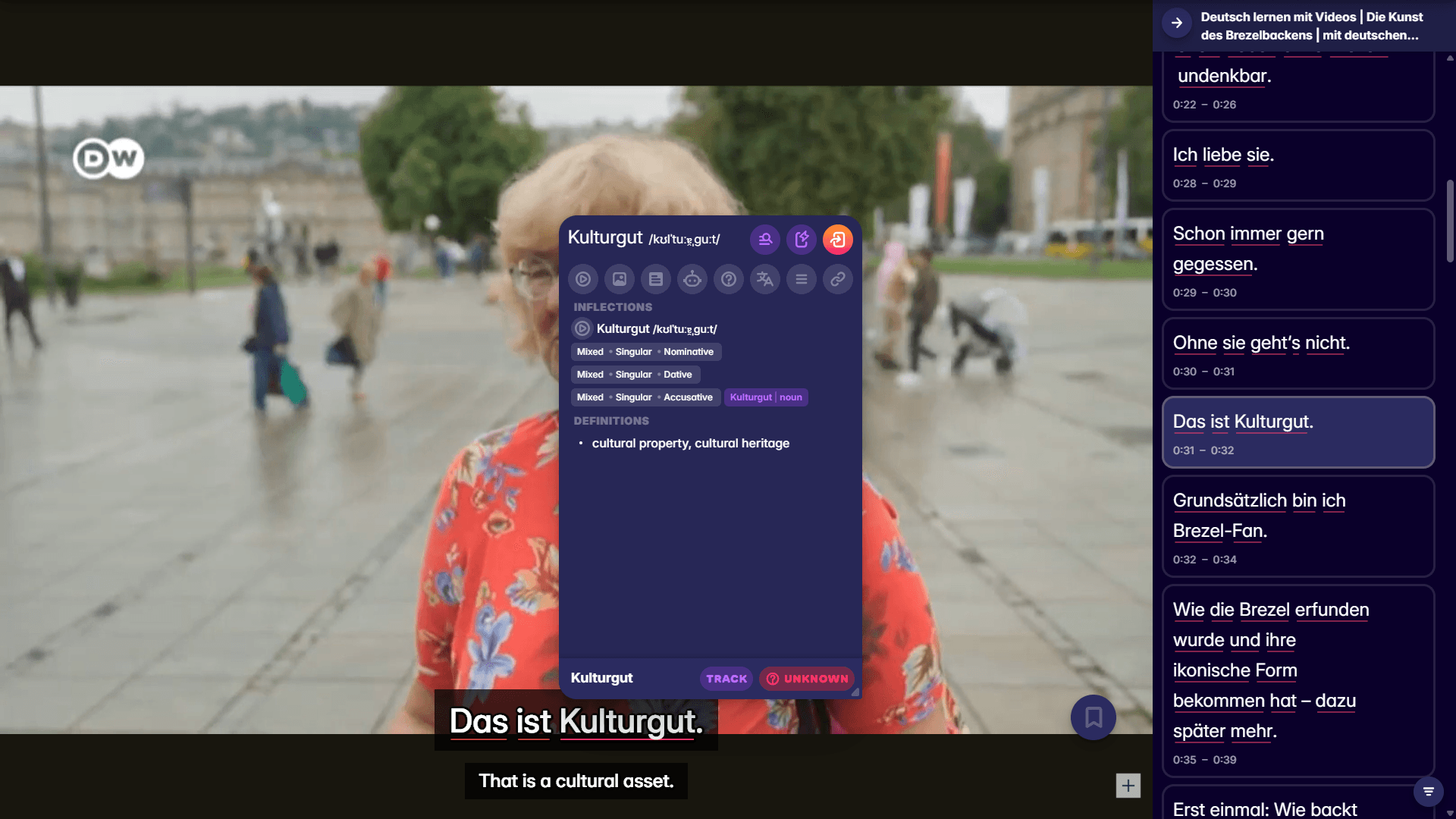
If you want to practice spotting passive constructions in real German content, Migaku's browser extension and app let you look up any word or phrase instantly while reading articles or watching videos. You can save examples directly to your flashcards and build your passive voice recognition naturally. There's a 10-day free trial if you want to check it out.
 ----
## Getting comfortable with German grammar patterns
The passive voice is just one piece of the [larger German grammar puzzle](https://migaku.com/blog/language-fun/best-german-learning-apps), but it's a significant one. Once you can form the passive confidently across different tenses and with modal verbs, you'll find reading and understanding formal German becomes way easier.
Don't stress about memorizing every rule perfectly upfront. Focus on recognizing the patterns (werden + participle, worden in perfect tense, modal + participle + werden) and you'll gradually internalize the system through exposure and practice.
> If you consume media in German, and you understand at least some of the messages and sentences within that media, you will make progress. Period.
The beginning is always the hardest.🫡
----
## Getting comfortable with German grammar patterns
The passive voice is just one piece of the [larger German grammar puzzle](https://migaku.com/blog/language-fun/best-german-learning-apps), but it's a significant one. Once you can form the passive confidently across different tenses and with modal verbs, you'll find reading and understanding formal German becomes way easier.
Don't stress about memorizing every rule perfectly upfront. Focus on recognizing the patterns (werden + participle, worden in perfect tense, modal + participle + werden) and you'll gradually internalize the system through exposure and practice.
> If you consume media in German, and you understand at least some of the messages and sentences within that media, you will make progress. Period.
The beginning is always the hardest.🫡