# German Prepositions: Dative and Accusative Explained With Example Sentences
> Learn common German prepositions with dative and accusative cases. Clear examples, two-way prepositions, and the motion vs. location rule explained simply.
**URL:** https://migaku.com/blog/language-fun/german-prepositions-dative-accusative
**Last Updated:** 2026-03-30
**Tags:** fundamentals, grammar
---
If you're [learning German](https://migaku.com/learn-german), you've probably noticed that prepositions can feel like a minefield. Unlike English prepositions, German ones come with a twist: they control which case the following noun takes. Some always use accusative, some always use dative, and some sneaky ones switch between both depending on context. The good news? Once you understand the pattern, it actually makes sense. Let's break down the most common German prepositions and figure out when to use which case.
----
## Understanding how German prepositions work
Here's the thing about prepositions in German: they're not just little words that show relationships between things. **Each preposition demands that the noun following it appears in a specific grammatical case.** This is pretty different from English prepositions, which don't change the form of nouns at all.
In German, you're dealing with four cases: nominative, accusative, dative, and genitive. When it comes to prepositions, you'll mainly work with three of them. The preposition itself determines which case you need, and that case then affects the article and sometimes the noun ending.
Think of it this way: the preposition is the boss, and it tells the noun what form to take. Once you memorize which prepositions go with which cases, you'll start building sentences with way more confidence.
----
## Accusative prepositions you'll use constantly
Some prepositions always take the accusative case, no exceptions. There are nine main ones, and honestly, you'll use these all the time in everyday German.
The classic accusative prepositions are:
| German | English |
| - | - |
| durch | Through |
| für | For |
| gegen | Against |
| ohne | Without |
| um | Around / At |
| bis | Until |
| entlang | Along |
| wider | Against |
| betreffend | Concerning |
Here are some examples:
- Ich gehe durch den Park.
*I'm walking through the park.* (Notice how "der Park" becomes "den Park" in the accusative case)
- Das Geschenk ist für meinen Bruder.
*The gift is for my brother.* (The masculine article "mein" gets that accusative ending)
- Wir fahren um die Stadt.
*We're driving around the city.* (The feminine article stays "die" but you can see the accusative in other genders)
- Er kommt ohne seinen Hund.
*He's coming without his dog.* (Again, that accusative ending on "seinen")
These prepositions often indicate **movement toward something or a direction**, which is a helpful mental shortcut. When you're moving through, for, or around something, accusative tends to pop up.
----
## Dative prepositions and when to use them
Dative prepositions are just as common, and they always require the dative case. The main ones are:
| German | English |
| - | - |
| aus | Out of / From |
| außer | Except for |
| bei | At / Near |
| mit | With |
| nach | After / To |
| seit | Since |
| von | From / Of |
| zu | To |
| gegenüber | Opposite |
Let's see them in action:
- Ich komme aus der Schweiz.
*I come from Switzerland.* (The feminine "die Schweiz" becomes "der Schweiz" in dative)
- Er wohnt bei seinen Eltern.
*He lives with his parents.* (That dative plural ending shows up clearly)
- Sie fährt mit dem Bus.
*She's traveling by bus.* (The masculine "der Bus" becomes "dem Bus")
- Wir gehen zu einem Restaurant.
*We're going to a restaurant.* (The neuter article takes the dative form "einem")
- Nach der Schule spielen wir Fußball.
*After school we play soccer.* (Another dative feminine article)
The dative case often appears with prepositions that **indicate location or a static position** rather than movement toward a goal. It's also common with prepositions showing **accompaniment or origin**.
----
## Two-way prepositions in German that switch cases
Now we get to the tricky part. Nine prepositions in German can take either accusative or dative, depending on what you're trying to say. These are called two-way prepositions or Wechselpräpositionen.
The nine two-way prepositions are:
| German | English |
| - | - |
| an | At / On |
| auf | On |
| hinter | Behind |
| in | In |
| neben | Next to |
| über | Over / Above |
| unter | Under |
| vor | In front of |
| zwischen | Between |
The rule is actually pretty logical once you get it.
- If you're describing movement toward a destination or a change of location, use accusative.
- If you're describing a static location where something already is, use dative.
Check out the difference:
- Ich hänge das Bild an die Wand.
*I'm hanging the picture on the wall.* (Accusative because the picture is moving to the wall)
- Das Bild hängt an der Wand.
*The picture is hanging on the wall.* (Dative because it's already there)
- Sie geht in die Küche.
*She's going into the kitchen.* (Movement, so accusative)
- Sie ist in der Küche.
*She is in the kitchen.* (Location, so dative)
- Er legt das Buch auf den Tisch.
*He's putting the book on the table.* (The book is moving, accusative)
- Das Buch liegt auf dem Tisch.
*The book is lying on the table.* (Static location, dative)
This motion versus location distinction is super helpful. Ask yourself: is something moving to a new place (accusative) or staying put (dative)?
----
## Common verbs that pair with specific cases
Certain verbs in German naturally pair with specific prepositions, and you need to memorize these combinations along with their cases. The verb often determines which preposition you'll use, and that preposition then controls the case.
For example:
- "warten auf" (to wait for) always uses "auf" with accusative: "Ich warte auf den Bus." (I'm waiting for the bus.)
- "denken an" (to think of) uses "an" with accusative: "Ich denke an dich." (I'm thinking of you.)
- "sprechen mit" (to speak with) uses "mit" with dative: "Ich spreche mit dem Lehrer." (I'm speaking with the teacher.)
- "fragen nach" (to ask about) uses "nach" with dative: "Er fragt nach dem Weg." (He's asking about the way.)
These verb-preposition combinations don't always translate directly from English, which is why they trip people up. You can't always guess which preposition a German verb uses based on English. You just have to learn them as units.
----
## Genitive prepositions in German grammar
While we're focusing on dative and accusative, you should know that genitive prepositions exist too. They're less common in everyday speech, but you'll see them in formal writing.
Common genitive prepositions include:
| German | English |
| - | - |
| während | During |
| wegen | Because of |
| trotz | Despite |
| statt / anstatt | Instead of |
| außerhalb | Outside of |
- Während des Sommers reisen wir viel.
*During the summer we travel a lot.* (That genitive case shows up in "des Sommers")
- Wegen des Regens bleiben wir zu Hause.
*Because of the rain we're staying home.* (The masculine genitive "des Regens" is pretty clear)
In spoken German, people often use dative instead of genitive with these prepositions, especially in casual conversation. You'll hear "wegen dem Regen" instead of "wegen des Regens" all the time. The formal version uses the genitive case, but the dative version is becoming more accepted.
----
## Pronouns and how they change with prepositions
Prepositions don't just affect nouns and articles. They also determine which form of a pronoun you'll use. Personal pronouns have accusative and dative forms that you need to match with the preposition.
For example:
- "ich" (I) becomes "mich" in accusative and "mir" in dative. So you'd say "für mich" (for me, accusative preposition) but "mit mir" (with me, dative preposition).
- "Du" (you) becomes "dich" (accusative) and "dir" (dative).
- "Er" (he) becomes "ihn" (accusative) and "ihm" (dative).
Here's how it looks in sentences:
- Das Geschenk ist für dich.
*The gift is for you.* (Accusative pronoun with accusative preposition)
- Ich gehe mit dir.
*I'm going with you.* (Dative pronoun with dative preposition)
- Ich denke an ihn.
*I'm thinking about him.* (Accusative pronoun because "an" takes accusative when paired with "denken")
Getting these pronoun forms right makes your German sound way more natural. It's one of those details that separates beginners from intermediate speakers.
----
## How to learn German prepositions and cases
Memorizing lists is one thing, but actually using these prepositions correctly takes practice. Here are some strategies that actually work.
1. First, learn prepositions in context, not in isolation. Don't just memorize "für = for." Instead, learn whole phrases like "für mich" (for me) or "für dich" (for you). This way, you're absorbing the case automatically.
2. Second, use mnemonics for the accusative and dative-only prepositions. Many learners use songs or acronyms. For accusative, some people remember "FUDGEBOW" (für, um, durch, gegen, entlang, bis, ohne, wider). For dative, try "aus, außer, bei, mit, nach, seit, von, zu" as a rhythm.
3. Third, practice with the two-way prepositions using real situations. Physically move objects around and describe what you're doing: "Ich stelle die Tasse auf den Tisch" (putting it there, accusative). Then describe where it is: "Die Tasse steht auf dem Tisch" (it's there, dative).
4. Fourth, pay attention to prepositions when you're consuming German media. When you hear a preposition in a show or read one in an article, notice which case follows it. This [passive recognition builds intuition](https://migaku.com/blog/language-fun/active-vs-passive-listening-language-learning) over time.
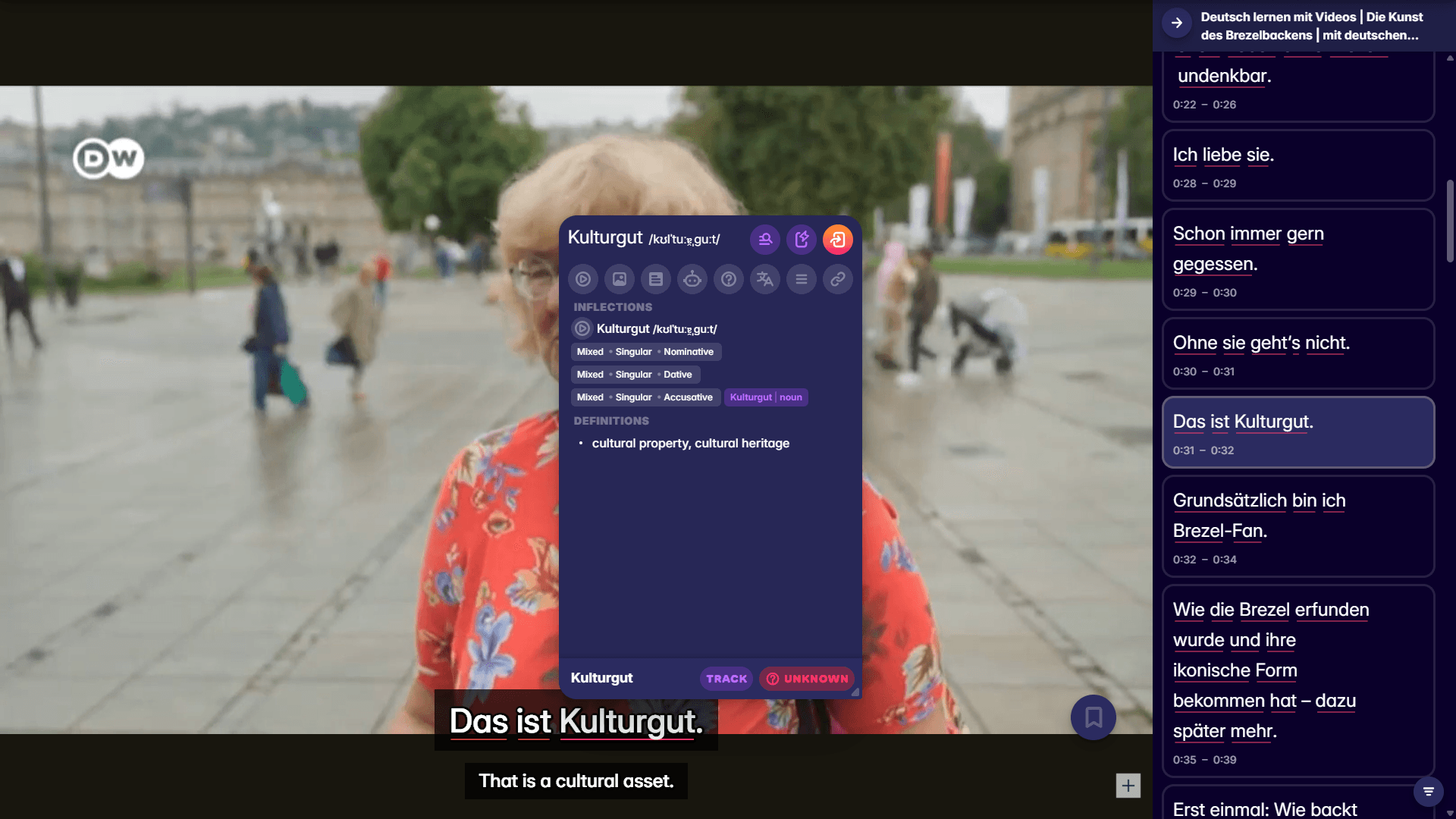
Anyway, if you want to practice these prepositions with real German content, Migaku's browser extension and app let you look up words and save sentences instantly while watching shows or reading articles. Makes learning from context way more practical. There's a 10-day free trial if you want to check it out.
 ----
## FAQs
German has somewhere around 100+ prepositions total if you count all the formal, archaic, and rarely-used ones. But realistically? You'll get by with knowing about 30 to 40 common ones really well. The core set includes the nine accusative prepositions, nine dative prepositions, nine two-way prepositions, and maybe another ten genitive prepositions for formal contexts. That's roughly 37 prepositions that cover the vast majority of situations you'll encounter.
----
## Prepositions are your gateway to German language fluency
Once you've memorized which prepositions take which cases, and you've internalized the motion versus location rule for two-way prepositions, you'll find yourself using them correctly without much conscious thought. The best approach? [Learn them in context](https://migaku.com/blog/language-fun/best-language-learning-methods), practice with real-life sentences, and expose yourself to tons of German input. Don't try to memorize abstract rules. Instead, learn phrases and patterns that you can actually use in conversation.
> If you consume media in German, and you understand at least some of the messages and sentences within that media, you will make progress. *Period*.
With enough practice, nothing feels impossible. 💪
----
## FAQs
German has somewhere around 100+ prepositions total if you count all the formal, archaic, and rarely-used ones. But realistically? You'll get by with knowing about 30 to 40 common ones really well. The core set includes the nine accusative prepositions, nine dative prepositions, nine two-way prepositions, and maybe another ten genitive prepositions for formal contexts. That's roughly 37 prepositions that cover the vast majority of situations you'll encounter.
----
## Prepositions are your gateway to German language fluency
Once you've memorized which prepositions take which cases, and you've internalized the motion versus location rule for two-way prepositions, you'll find yourself using them correctly without much conscious thought. The best approach? [Learn them in context](https://migaku.com/blog/language-fun/best-language-learning-methods), practice with real-life sentences, and expose yourself to tons of German input. Don't try to memorize abstract rules. Instead, learn phrases and patterns that you can actually use in conversation.
> If you consume media in German, and you understand at least some of the messages and sentences within that media, you will make progress. *Period*.
With enough practice, nothing feels impossible. 💪