# German Professions Vocabulary: Lists of Occupations for German Beginners
> Learn essential German professions vocabulary with masculine/feminine forms, common jobs like doctor and engineer, plus examples for conversations.
**URL:** https://migaku.com/blog/language-fun/german-professions-vocabulary
**Last Updated:** 2026-03-11
**Tags:** vocabulary, phrases
---
Learning job titles in German opens up a ton of practical conversations, whether you're networking, explaining what you do for a living, or just chatting about careers. [The German language](https://migaku.com/learn-german) has some interesting quirks when it comes to professions, especially with gendered forms that change based on who's doing the job. This guide covers the most common professional vocabulary you'll use, plus the grammar rules on how to use this vocabulary naturally.
---
## How German profession vocabulary works
German handles job titles differently than English. **Every profession has both masculine and feminine forms**, which you pick based on the person's gender.
- The masculine form is usually the base word, like "Lehrer" (teacher).
- The feminine version adds "-in" to the end, making it "Lehrerin." Pretty straightforward once you get the pattern down.
Here's the thing though. Some professions change slightly when you add that feminine ending. If the masculine form ends in "-er," you just tack on "-in" to get "-erin." A male doctor is "Arzt," and a female doctor is "Ärztin." Notice how the vowel changed there? That's called **an umlaut shift**, and it happens with certain professions.
The plural forms get even more specific. When talking about a mixed group or multiple people in a profession, you'd traditionally use the masculine plural. But modern German increasingly uses both forms or gender-neutral alternatives. You'll see job postings written as "Lehrer/Lehrerin" or "Lehrer (m/w/d)" where the letters indicate male, female, or diverse.
---
## Common German professions you'll use constantly
Let's start with the professions that come up in everyday conversation. These are the jobs you'll hear about when meeting new people or discussing what your friends and family do.
- The word for doctor is **"Arzt" ** (masculine) or **"Ärztin" ** (feminine). If you're talking about going to see your doctor, you'd say "Ich gehe zum Arzt" or "Ich gehe zur Ärztin" depending on their gender. The article changes too, which is another layer to track.
- Teacher translates to **"Lehrer" ** or **"Lehrerin." ** This one's super common since education comes up frequently.
- A student would be **"Student" ** or **"Studentin" ** if they're in university, but **"Schüler" ** or **"Schülerin" ** for younger students still in school.
- Engineer is **"Ingenieur" ** or **"Ingenieurin." ** The pronunciation takes some practice since it comes from French originally. You'll find engineers working in all sorts of fields, from mechanical to software, and Germans are pretty proud of their engineering reputation.
- Lawyer is **"Anwalt" ** or **"Anwältin." ** Notice that umlaut shift again from "a" to "ä" in the feminine form. This happens with several professions and you just have to memorize which ones do it.
- For nurse, you'd say **"Krankenpfleger" ** (masculine) or **"Krankenschwester" ** (feminine), though "Krankenpfleger" is becoming more common for both genders in professional contexts. The literal translation of "Krankenschwester" is "sick sister," which sounds pretty old-fashioned when you think about it.
---
## Office and business professions
The corporate world has its own set of vocabulary that's essential if you're working in Germany or doing business there.
- Manager stays pretty similar as **"Manager" ** or **"Managerin," ** borrowed directly from English. Same goes for "Chef" or "Chefin" for boss, though this can also mean "chief" depending on context.
- Secretary is **"Sekretär" ** or **"Sekretärin." ** You'll also hear **"Assistent" ** or **"Assistentin" ** for assistant roles.
- Accountant translates to **"Buchhalter" ** or **"Buchhalterin," ** which literally means "book holder." Makes sense when you think about keeping the books.
- Salesperson is **"Verkäufer" ** or **"Verkäuferin." ** This covers everything from retail workers to sales representatives. If you walk into a store and need help, you're looking for a Verkäufer.
- Entrepreneur is **"Unternehmer" ** or **"Unternehmerin." ** The verb "unternehmen" means "to undertake," so an entrepreneur is literally someone who undertakes business ventures.
---
## German words for traditional trades and skilled professions
Germany has a strong apprenticeship system, so trade professions carry a lot of respect. These jobs require serious training and certification.
- The word for mechanic is **"Mechaniker" ** or **"Mechanikerin." ** If your car breaks down, you're heading to a "Autowerkstatt" (auto workshop) to see a mechanic.
- Plumber is **"Klempner" ** or **"Klempnerin." **
- Electrician is **"Elektriker" ** or **"Elektrikerin." **
- Carpenter translates to **"Schreiner" ** or **"Schreinerin" ** in southern Germany, but **"Tischler" ** or **"Tischlerin" ** in northern regions. Both mean the same thing, just regional preference.
- Baker is **"Bäcker" ** or **"Bäckerin," ** and you'll find these on practically every street corner in German cities.
- Chef (the cooking kind) is **"Koch" ** or **"Köchin." ** Another umlaut shift from "o" to "ö" in the feminine form.
- Butcher is **"Metzger" ** or **"Metzgerin," ** though you might also hear **"Fleischer" ** or **"Fleischerin" ** depending on the region.
---
## Creative and artistic occupations in German language
Creative professions follow the same gendered patterns but sometimes feel more modern since many are newer job categories.
- Artist is **"Künstler" ** or **"Künstlerin." ** This covers painters, sculptors, and visual artists generally.
- Musician is **"Musiker" ** or **"Musikerin." **
- Actor is **"Schauspieler" ** or **"Schauspielerin." ** The "Schau" part means "show" and "Spieler" means "player," so literally a "show player."
- Writer is **"Schriftsteller" ** or **"Schriftstellerin," ** which breaks down to "writing creator."
- Author can also be **"Autor" ** or **"Autorin," ** borrowed from Latin.
- Photographer is **"Fotograf" ** or **"Fotografin." **
- Designer is **"Designer" ** or **"Designerin," ** another English borrowing that's been adapted.
- Architect is **"Architekt" ** or **"Architektin." **
---
## Learn German healthcare and medical professions
The medical field has specific vocabulary that's useful to know, especially if you're living in Germany and need healthcare.
- Dentist is **"Zahnarzt" ** or **"Zahnärztin," ** literally "tooth doctor."
- Surgeon is **"Chirurg" ** or **"Chirurgin." **
- Pharmacist is **"Apotheker" ** or **"Apothekerin." ** The pharmacy itself is an "Apotheke," and these are distinct from drugstores ("Drogerie") which sell cosmetics and toiletries but not prescription medications.
- Veterinarian is **"Tierarzt" ** or **"Tierärztin," ** literally "animal doctor."
- Psychologist is **"Psychologe" ** or **"Psychologin," ** and therapist is **"Therapeut" ** or **"Therapeutin." **
---
## Technology and modern professions
Newer professions, especially in tech, often borrow from English but still get gendered German endings.
- Programmer is **"Programmierer" ** or **"Programmiererin." **
- Software developer might be **"Softwareentwickler" ** or **"Softwareentwicklerin." **
- IT specialist is **"IT-Spezialist" ** or **"IT-Spezialistin." **
- Data scientist is usually just **"Data Scientist" ** with the German articles, though you might see **"Datenwissenschaftler" ** or **"Datenwissenschaftlerin" ** in more formal contexts.
- Web designer is **"Webdesigner" ** or **"Webdesignerin." **
---
## German vocabulary of service industry and hospitality
Service jobs have their own vocabulary that comes up frequently in daily life.
- Waiter is **"Kellner" ** or **"Kellnerin," ** though "Ober" is an old-fashioned term for waiter you might still hear.
- Flight attendant is **"Flugbegleiter" ** or **"Flugbegleiterin." **
- Hairdresser is **"Friseur" ** or **"Friseurin" ** (or "Friseuse" for feminine, from French).
- Hotel manager is **"Hotelmanager" ** or **"Hotelmanagerin." **
- Taxi driver is **"Taxifahrer" ** or **"Taxifahrerin." **
- Bus driver is **"Busfahrer" ** or **"Busfahrerin." ** The "-fahrer" ending literally means "driver" and gets attached to whatever vehicle they're operating.
---
## Employment terms and workplace vocabulary
Beyond specific job titles, you'll need related employment vocabulary to talk about work situations.
| German | English |
| - | - |
| Beruf | Job / Occupation (the most common word) |
| Arbeit | Work (general term) |
| Arbeitsplatz | Workplace |
| Vollzeit | Full-time |
| Teilzeit | Part-time |
| Freiberufler / Freiberuflerin | Freelancer |
| Praktikant / Praktikantin | Intern |
| Lebenslauf | CV / Resume (literally "life run" or the course of your life) |
| Bewerbung | Job application |
| Vorstellungsgespräch | Interview (literally "introductory conversation") |
| Gehalt | Salary (for salaried positions) |
| Lohn | Wages (for hourly wages) |
| Chef / Vorgesetzter | Boss (Vorgesetzter is more formal, meaning "one placed before") |
---
## Using profession words and phrases in sentences
Knowing the words is one thing, but using them correctly in context matters just as much.
- When someone asks what you do, they'll say "Was sind Sie von Beruf?" (formal) or "Was machst du beruflich?" (casual).
- You'd answer with "Ich bin" plus the profession: "Ich bin Lehrer" (I'm a teacher). Notice you don't use an article here like you would in English. You don't say "Ich bin ein Lehrer," just "Ich bin Lehrer."
- If you're talking about someone else's job, you'd say "Er ist Arzt" (He's a doctor) or "Sie ist Ingenieurin" (She's an engineer).
- When asking what someone does, you might say "Als was arbeitet er?" (What does he work as?) or "Was macht sie beruflich?" (What does she do professionally?).
- To say where you work, use "Ich arbeite bei" plus the company or "Ich arbeite als" plus the profession. For example, "Ich arbeite bei Siemens als Ingenieur" (I work at Siemens as an engineer).
---
## Changes in German profession vocabulary over time
German profession vocabulary has evolved, especially regarding gender-neutral language. Traditional grammar used masculine forms as the default for mixed groups or unspecified gender, but this has been changing.
You'll now see job postings with both forms listed: "Wir suchen einen Lehrer/eine Lehrerin" or abbreviated as "Lehrer/in." More recently, gender-neutral options like "Lehrer*in" (with an asterisk) or "Lehrer:in" (with a colon) have appeared, though these remain controversial and aren't universally accepted.
Some professions have shifted away from gendered terms entirely. "Krankenschwester" (literally "sick sister") for nurse is being replaced by "Pflegefachkraft" (care professional) in official contexts. Flight attendant used to be "Stewardess" for women, but "Flugbegleiter" is now standard for all genders.
New professions get added to the language constantly. Twenty years ago, "Social Media Manager" didn't exist. Now it's a common job title that gets used in German with German articles and sometimes a German ending for the feminine form.
---
## Tips for learning and remembering profession in German
The gendered forms seem overwhelming at first, but patterns emerge quickly. Most professions just add "-in" for feminine forms. The ones with umlaut shifts (Arzt/Ärztin, Koch/Köchin) are common enough that you'll [internalize them through repetition](https://migaku.com/blog/language-fun/active-vs-passive-listening-language-learning).
1. Group professions by industry when studying. Learning "Arzt, Krankenpfleger, Apotheker" together makes more sense than random vocabulary lists. Your brain connects related concepts more easily.
2. Practice using professions in complete sentences rather than isolated words. "Meine Schwester ist Ärztin" (My sister is a doctor) sticks better than just memorizing "Ärztin."
3. Pay attention to professions when [watching German content](https://migaku.com/blog/language-fun/best-german-shows-for-language-learners) or reading articles. News stories often mention what people do for work, giving you context for how these words get used naturally.
4. The compound words in German actually make some professions easier to remember. "Zahnarzt" is literally "tooth doctor," which is more memorable than an arbitrary word. "Flugbegleiter" is "flight companion." Breaking compounds into their parts helps retention.
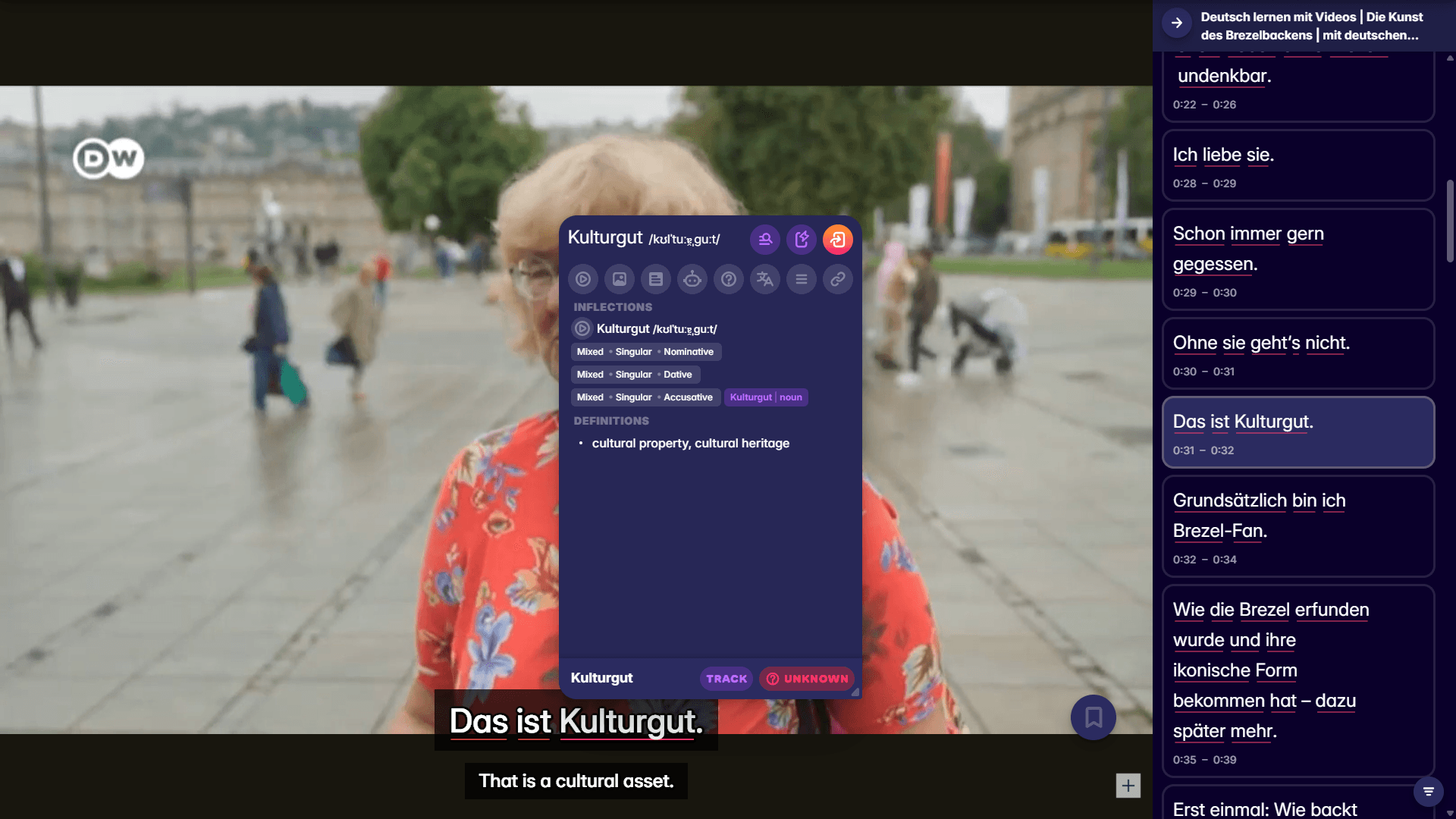
Anyway, if you want to actually practice this vocabulary with real German content, Migaku's browser extension and app let you look up profession terms instantly while watching shows or reading articles about people's careers. Makes learning from context way more practical. There's a 10-day free trial if you want to check it out.
 ---
## Use media content to help you learn common professions
Memorizing lists of nouns is challenging, and this rote memory in general is just not helping with long-term memory. If you have a clear idea of what professions you will come into contact with most in your career or future life in Germany, start by watching videos, movies, reality shows, or documentaries about them. Media content gives you more than just profession nouns. It offers words related to the profession and context to help you understand the working environment.
> If you consume media in German, and you understand at least some of the messages and sentences within that media, you will make progress. _Period_.
Learn patiently. Grow steadily.📖📑
---
## Use media content to help you learn common professions
Memorizing lists of nouns is challenging, and this rote memory in general is just not helping with long-term memory. If you have a clear idea of what professions you will come into contact with most in your career or future life in Germany, start by watching videos, movies, reality shows, or documentaries about them. Media content gives you more than just profession nouns. It offers words related to the profession and context to help you understand the working environment.
> If you consume media in German, and you understand at least some of the messages and sentences within that media, you will make progress. _Period_.
Learn patiently. Grow steadily.📖📑