# German Relative Clauses: How to Form Relative Clauses in German Grammar
> Form German relative clauses with the right pronouns, cases, and word order. Clear examples for nominative, accusative, dative, and genitive.
**URL:** https://migaku.com/blog/language-fun/german-relative-clauses-formation-guide
**Last Updated:** 2026-03-31
**Tags:** fundamentals, grammar
---
German relative clauses can feel like a puzzle when you start to [learn German](https://migaku.com/learn-german), but once you understand the pattern, they become second nature. The key is knowing which relative pronoun to use based on the gender, case, and number of the noun you're referring back to. This guide breaks down everything you need to form relative clauses in German, from choosing the right pronoun to getting the verb position correct. Let's jump in.
----
## What is a relative clause in German
**A relative clause gives you extra information about a noun in the main clause.** Think of it as a way to add detail without starting a completely new sentence.
Here's a simple example:
- Der Mann, der dort steht, ist mein Lehrer.
*The man who stands there is my teacher.*
The relative clause here is "der dort steht." It tells you which man we're talking about. Without it, you'd just have "Der Mann ist mein Lehrer," which works fine but gives you less context.
In German, relative clauses have the following rules:
1. They always start with a relative pronoun (like der, die, or das).
2. They're always separated from the main clause by a comma.
3. The verb in the relative clause goes to the end, which is different from normal German word order. This verb position rule trips up a lot of learners at first, but you'll get used to it.
4. The relative clause can describe any noun in your sentence. It could be the subject, the direct object, or even an object of a preposition. The case of the relative pronoun depends on its function within the relative clause itself, which we'll get into soon.
----
## German relative pronouns and the der, die, das system
The relative pronoun you choose depends on three things: **the gender** and **number of the noun you're referring to**, and **the case that pronoun needs within the relative clause**.
Most of the time, German relative pronouns look exactly like the definite article (der, die, das). Here's the full table:
**Masculine:**
- Nominative: der
- Accusative: den
- Dative: dem
- Genitive: dessen
**Feminine:**
- Nominative: die
- Accusative: die
- Dative: der
- Genitive: deren
**Neuter:**
- Nominative: das
- Accusative: das
- Dative: dem
- Genitive: dessen
**Plural (all genders):**
- Nominative: die
- Accusative: die
- Dative: denen
- Genitive: deren
The genitive and dative plural forms (dessen, deren, denen) are the ones that differ from regular definite articles. Everything else matches what you already know.
Here's the thing: the gender and number come from the noun in the main clause, but the case comes from the role the pronoun plays in the relative clause. You need to figure out both pieces of information separately.
----
## Understanding cases in relative clauses
This is where learners get confused, so let's break it down step by step.
The case of your relative pronoun depends on what job it's doing in the relative clause.
- Is it the subject? Then you need nominative.
- Is it the direct object? Then you need accusative.
- Is it receiving the action indirectly? That's dative.
### Nominative case
Let's look at nominative first. When the relative pronoun is the **subject** of the relative clause, you use the nominative case.
- Die Frau, die Deutsch spricht, kommt aus Berlin.
*The woman who speaks German comes from Berlin.*
Here, "die" is nominative because it's the subject of "spricht" within the relative clause. The woman is doing the speaking.
### Accusative case
For accusative, the relative pronoun acts as the **direct object** within the clause.
- Der Film, den ich gestern gesehen habe, war super.
*The film that I saw yesterday was great.*
The pronoun "den" is accusative because it's the object of "gesehen habe." I saw what? The film.
### Dative case
Dative shows up when the relative pronoun is **an indirect object** or **follows certain verbs and prepositions** that require dative.
- Der Mann, dem ich geholfen habe, war sehr nett.
*The man whom I helped was very nice.*
The verb "helfen" takes a dative object, so we use "dem" here.
### Genitive case
Genitive relative pronouns (dessen, deren) show **possession** or **relationship**.
- Das ist der Student, dessen Buch ich gefunden habe.
*That's the student whose book I found.*
The book belongs to the student, so we use the genitive "dessen."
----
## Relative clauses in German with prepositions
When a preposition appears in your relative clause, the case of the relative pronoun depends on that preposition. Each German preposition governs a specific case (or sometimes two cases, depending on context).
Let's say you want to say:
- Die Stadt, in der ich wohne, ist schön.
*The city in which I live is beautiful.*
The preposition "in" requires dative when indicating location, so "der" is the dative feminine form. The noun "Stadt" is feminine, and we need dative because of the preposition.
Another example with accusative:
- Das Thema, über das wir gesprochen haben, war interessant.
*The topic about which we spoke was interesting.*
The preposition "über" takes accusative, and "Thema" is neuter, so we use "das" in the accusative case (which looks the same as nominative for neuter nouns).
Sometimes the preposition can move to the front of the relative pronoun, or it can stay where it would naturally appear in the sentence. German is pretty flexible here, though putting it at the front sounds more formal.
- Der Freund, mit dem ich ins Kino gehe...
*The friend with whom I go to the cinema...*
You could technically say "Der Freund, dem ich mit ins Kino gehe..." but that sounds awkward. Keep the preposition with the relative pronoun at the start of the clause.
----
## Word order and verb placement in German grammar
This is crucial: in a relative clause, **the conjugated verb always goes to the end**. Always.
In a normal German main clause, the verb is in second position: "Ich sehe den Mann." But in a relative clause, it moves: "...der den Mann sieht."
If you have a separable verb, it stays together at the end: "Der Zug, der um 8 Uhr ankommt..." (The train that arrives at 8 o'clock...)
With modal verbs or perfect tense, you get a verb cluster at the end. The conjugated verb (the modal or auxiliary) comes last.
- Das Buch, das ich lesen muss...
*The book that I must read...*
- Die Frau, die nach Berlin gefahren ist...
*The woman who traveled to Berlin...*
This verb-final position is the same rule that applies to subordinate clauses in German generally. Relative clauses are just one type of subordinate clause, so they follow the same pattern.
----
## Types of German relative clauses and their functions
There are actually several ways to categorize relative clauses, though the formation rules stay the same.
1. **Restrictive relative clauses** narrow down which specific noun you're talking about. "Der Student, der Deutsch lernt, ist fleißig." This tells you which student, the one learning German specifically.
2. **Non-restrictive relative clauses** add extra information but don't define which noun. "Mein Bruder, der in Hamburg wohnt, besucht mich morgen." You already know which brother (you only have one, or it's clear from context), and the clause just adds detail.
In German, both types use the same structure and punctuation, unlike English where you might use "that" versus "which."
You can also have relative clauses referring to entire previous statements. For these, you use "was" instead of der/die/das. "Er hat die Prüfung bestanden, was mich sehr gefreut hat." (He passed the exam, which made me very happy.) The "was" refers to the whole fact that he passed.
----
## Common mistakes to watch out for
1. Learners often pick the wrong case because they look at the noun in the main clause instead of figuring out the function within the relative clause. Remember: gender and number come from the main clause noun, but case comes from the relative clause function.
2. Another common error is forgetting to put the verb at the end. English relative clauses keep normal word order ("the man who is standing there"), so English speakers naturally want to do the same in German. You have to consciously move that verb to the end every single time.
3. Some people also forget the comma. In German, you must separate the relative clause from the main clause with a comma. There's no flexibility here.
4. Watch out for "was" as a relative pronoun. You use "was" when referring to indefinite pronouns (etwas, nichts, alles) or entire clauses, not specific nouns. "Alles, was ich sage..." (Everything that I say...) But don't use "was" for regular nouns with gender.
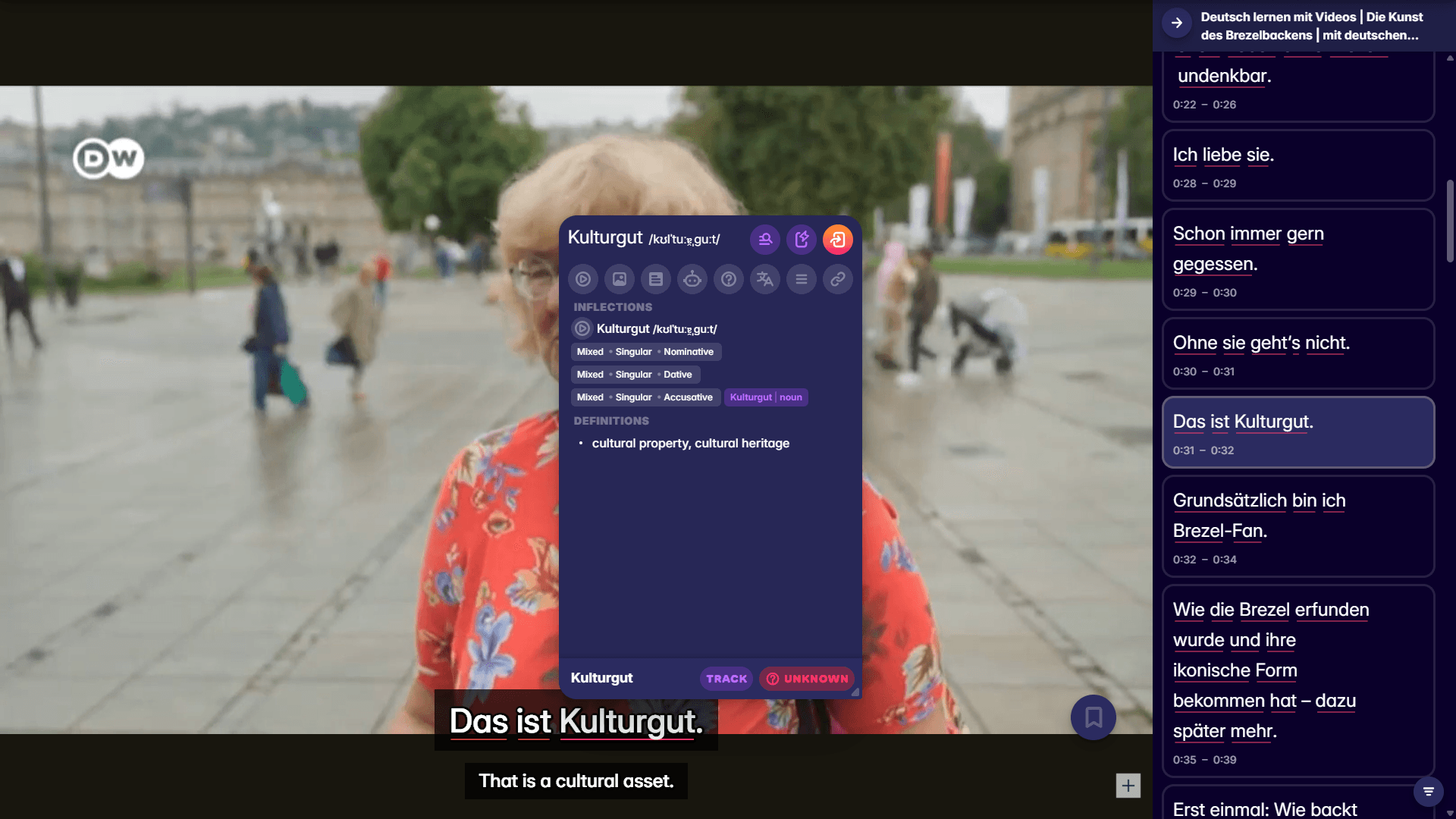
If you want to practice relative clauses with real German content, Migaku's browser extension and app let you look up any word or phrase instantly while [watching shows or reading articles](https://migaku.com/blog/language-fun/best-german-shows-for-language-learners). You can save example sentences with relative clauses straight to your flashcards. There's a 10-day free trial if you want to check it out.
 ----
## Your next steps with relative pronouns in German
Relative clauses are one of those [grammar](https://migaku.com/blog/language-fun/german-grammar-guide) points that seem complicated on paper but become intuitive with practice. The key is understanding the logic and consuming media extensively until you have seen how native speakers use them hundreds of times. Once you internalize the rules, you don't need to think about them to put them to use.
> If you consume media in German, and you understand at least some of the messages and sentences within that media, you will make progress. *Period*.
Practice. That’s the only way to fluency.📚
----
## Your next steps with relative pronouns in German
Relative clauses are one of those [grammar](https://migaku.com/blog/language-fun/german-grammar-guide) points that seem complicated on paper but become intuitive with practice. The key is understanding the logic and consuming media extensively until you have seen how native speakers use them hundreds of times. Once you internalize the rules, you don't need to think about them to put them to use.
> If you consume media in German, and you understand at least some of the messages and sentences within that media, you will make progress. *Period*.
Practice. That’s the only way to fluency.📚