# How to Use German Separable Verbs in German Grammar (With Examples)
> Learn how German separable verbs work across tenses. Covers prefix rules, separation patterns, and the difference from inseparable verbs.
**URL:** https://migaku.com/blog/language-fun/german-separable-verbs-guide
**Last Updated:** 2026-03-10
**Tags:** fundamentals, conjugation, grammar, verbs
---
German separable verbs can feel weird at first. You're reading along, everything makes sense, and then suddenly part of the verb just teleports to the end of the sentence. If you're [learning German](https://migaku.com/learn-german) and wondering why verbs split apart like this, you're in the right place. I'll walk you through exactly how separable prefix verbs work, which prefixes do this splitting thing, and how to use them across different tenses without getting confused.
---
## What are separable verbs in German
> 💡 Definition 💡
A separable verb in German is basically **a verb with a prefix** attached that **splits off** and moves to a different position in the sentence.
Think of verbs like "aufstehen" (to get up) or "anrufen" (to call). When you use these in a sentence, the prefix separates from the main verb and typically lands at the end of the sentence.
Here's a quick example: "Ich stehe um 7 Uhr auf" (I get up at 7 o'clock). The infinitive is "aufstehen," but in the sentence, "auf" splits off and moves to the end. The main verb "stehe" gets conjugated and stays in the normal verb position.
This happens because German has pretty strict rules about word order, and separable prefixes follow a specific pattern that you'll get used to with practice.
---
## How do you know if a prefix or verb is separable
The **stress pattern** tells you everything. When you pronounce a separable verb, the accent falls on the prefix. Say "AUFstehen" out loud. You emphasize the "AUF" part, right? That stress on the prefix is your clue that it separates.
Compare this to inseparable verbs like "verstehen" (to understand). Here, the stress falls on the main verb: "verSTEHen." The prefix "ver" stays attached no matter what.
- **Inseparable prefixes** include **ver, be, ge, er, ent, emp, miss, and zer**. These never split off.
- **Common separable prefixes** include **auf, ab, an, aus, ein, mit, nach, vor, zu, zurück, and weg**.
Most of these can also work as standalone prepositions or adverbs, which makes sense when you think about it. They add a directional or descriptive meaning to the base verb.
---
## Separable vs inseparable prefixes
Understanding the difference between separable and inseparable prefixes saves you tons of confusion.
- **Separable prefixes usually have a concrete, literal meaning.** The prefix auf can mean "up" or "open," ab means "off" or "down," ein means "in," and so on.
- **Inseparable prefixes tend to change the meaning of the verb in less predictable ways.** Take "stehen" (to stand). Add "auf" and you get "aufstehen" (to get up), which makes logical sense. But add "ver" and you get "verstehen" (to understand), which doesn't have an obvious connection to standing.
- **Some prefixes can be both separable and inseparable** depending on the verb, which is honestly annoying. Prefixes like **um, unter, über, durch, and wieder** fall into this category. For example, "umfahren" with stress on "um" (UMfahren) means to knock down, but "umfahren" with stress on "fahren" (umFAHren) means to drive around. You just have to learn these case by case.
> 💡 A Practical Tip 💡
If the prefix could exist as its own word with meaning (like auf, an, mit), it's probably separable.
If it's just a syllable that doesn't mean anything on its own (like ver, be, ent), it stays attached.
---
## Using separable verbs in present tense
In the present tense, the pattern is straightforward.
> You conjugate the main verb and put it in the second position (because German loves that verb-second rule), and the prefix goes to the end of the sentence.
Let's look at "anrufen" (to call):
- Ich rufe meine Mutter an.
*I call my mother.*
- Du rufst deinen Freund an.
*You call your friend.*
- Er ruft später an.
*He calls later.*
- Wir rufen morgen an.
*We call tomorrow.*
The verb "rufen" gets conjugated normally based on the subject, and "an" hangs out at the end. This happens in main clauses, which are your standard, independent sentences.
Another example with "aufmachen" (to open):
- Ich mache das Fenster auf.
*I open the window.*
- Sie macht die Tür auf.
*She opens the door.*
Pretty straightforward once you get the hang of it. The tricky part is remembering to send that prefix to the end of the sentence, especially when you're speaking and trying to construct sentences on the fly.
---
## Separable verbs in past tense
The simple past (Präteritum) works the same way as the present tense.
> Conjugate the main verb in past tense, keep it in second position, and the prefix still goes to the end of the sentence.
Using "ankommen" (to arrive):
- Ich kam gestern an.
*I arrived yesterday.*
- Der Zug kam pünktlich an.
*The train arrived on time.*
With "ausgehen" (to go out):
- Wir gingen am Samstag aus.
*We went out on Saturday.*
- Sie ging mit Freunden aus.
*She went out with friends.*
The pattern stays consistent, which is nice. You're just conjugating the main verb in a different tense while the prefix does its thing at the end.
---
## Perfect tense and the participle in German grammar
Here's where things get slightly different.
In the perfect tense (Perfekt), you need the past participle, and that's where the separable prefix shows up again. The participle formation for a separable verb puts "ge" between the prefix and the main verb. **Regular pattern: prefix + ge + verb stem + t/en**
> The prefix stays attached to the participle, and the whole thing goes to the end because that's where participles live in German sentences. You'll use the auxiliary verb (haben or sein) in the conjugated position, and the participle hangs out at the end.
Look at "aufstehen" (to get up):
- Infinitive: aufstehen
- Past participle: aufgestanden
- Example: Ich bin um 6 Uhr aufgestanden. (I got up at 6 o'clock.)
Another one with "anrufen" (to call):
- Infinitive: anrufen
- Past participle: angerufen
- Example: Hast du ihn angerufen? (Did you call him?)
---
## Separable verbs in subordinate clauses
Subordinate clauses flip the script.
> In a clause introduced by words like "weil" (because), "dass" (that), or "wenn" (when/if), the verb goes to the end, and separable verbs reunite with their prefixes.
Compare these:
- Main clause: Ich stehe früh auf. (I get up early.)
- Subordinate clause: Ich bin müde, weil ich früh aufstehe. (I'm tired because I get up early.)
The infinitive form comes back together in subordinate clauses. The prefix and verb become one unit again at the end of the clause.
More examples:
- Er sagt, dass er morgen anruft.
*He says that he'll call tomorrow.*
- Wenn du ausgehst, ruf mich an.
*When you go out, call me.*
This reuniting happens because the entire verb structure moves to the end in subordinate clauses, so there's no need for separation.
---
## Modal verbs and infinitives with zu
> When you use a modal verb (können, müssen, wollen, etc.) with a separable verb, the separable verb stays in its infinitive form and goes to the end of the sentence as one complete unit.
Examples:
- Ich muss heute früh aufstehen.
*I have to get up early today.*
- Kannst du mich später anrufen?
*Can you call me later?*
- Wir wollen am Wochenende ausgehen.
*We want to go out on the weekend.*
The modal verb gets conjugated and takes the second position, while the separable verb infinitive stays together at the end.
When you use "zu" with infinitives (similar to "to" in English), it goes between the prefix and the main verb.
Examples:
- Es ist Zeit aufzustehen.
*It's time to get up.*
- Vergiss nicht anzurufen.
*Don't forget to call.*
- Ich habe keine Lust auszugehen.
*I don't feel like going out.*
The pattern is: **prefix + zu + verb**. This only happens with separable verbs. Inseparable verbs just get "zu" in front of the whole thing: "zu verstehen," "zu beginnen."
---
## Most common separable verbs in German language
Learning the most frequently used separable verbs gives you the biggest bang for your buck. Here are some you'll encounter constantly:
| Verb Prefix | German Verb | English |
| - | - | - |
| an | anrufen | to call |
| | ankommen | to arrive |
| | anfangen | to begin |
| | anmachen | to turn on |
| auf | aufstehen | to get up |
| | aufmachen | to open |
| | aufhören | to stop |
| | aufpassen | to pay attention |
| aus | ausgehen | to go out |
| | ausmachen | to turn off |
| | aussehen | to look / to appear |
| | aussteigen | to get off / to get out |
| ein | einladen | to invite |
| | einkaufen | to shop |
| | einschlafen | to fall asleep |
| | einsteigen | to get in / to get on |
| mit | mitkommen | to come along |
| | mitbringen | to bring along |
| | mitmachen | to participate |
| zurück | zurückkommen | to come back |
| | zurückgeben | to give back |
| | zurückfahren | to drive back |
These verbs cover everyday situations, so getting comfortable with them makes a huge difference in your ability to communicate.
---
## Tips for mastering German separable verbs
1. Practice with complete sentences, not just vocabulary lists. You need to see how the separation works in context to really internalize it. Reading German texts and noticing where the prefixes land helps your brain pick up the pattern naturally.
2. When you learn a new verb in German, always check whether it's separable or inseparable. Don't just memorize "anfangen" as a word, understand that "an" separates and where it goes in different sentence types.
3. Pay attention to stress when listening to native speakers. That accent on the prefix is your reliable indicator. Train your ear to hear the difference between separable and inseparable verbs.
4. Create your own example sentences using separable verbs in different tenses. Write out how the same verb works in present, past, perfect, and in subordinate clauses. Seeing the full range helps you conjugate automatically when speaking.
5. [Use flashcards](https://migaku.com/blog/language-fun/anki-settings-for-language-learning) that show the verb in context, not just the infinitive form. A card that says "aufstehen" on one side and "to get up" on the other doesn't teach you much about usage. Better to have "Ich stehe um 7 Uhr ___" with "auf" as the answer.
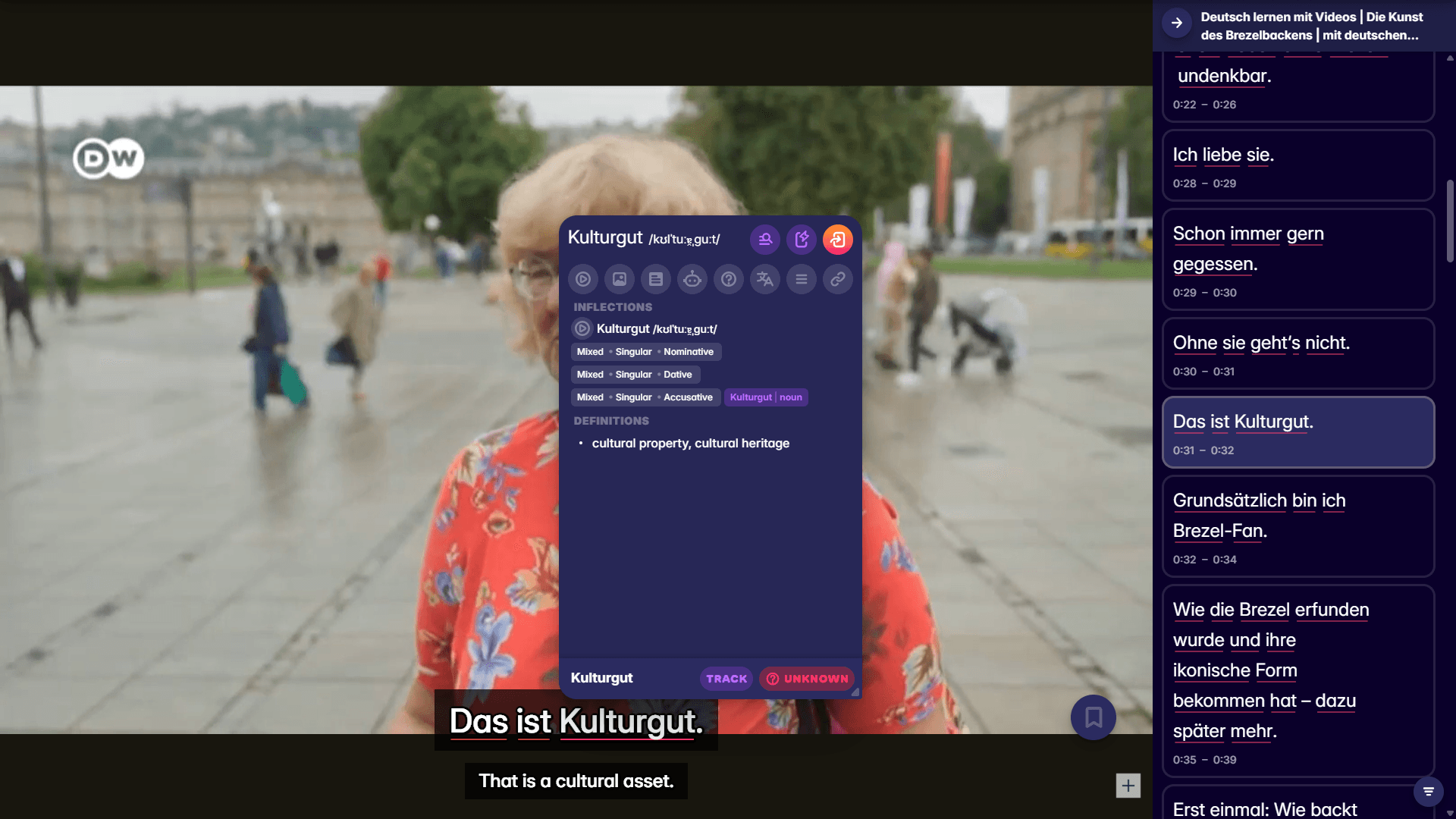
Anyway, if you're serious about getting fluent with German verbs and [grammar](https://migaku.com/blog/language-fun/german-grammar-guide), Migaku's browser extension and app let you look up words and save example sentences while watching German shows or reading articles. You can build your vocabulary with real context instead of just drilling verb tables. There's a 10-day free trial if you want to check it out.
 ---
## Consume media until you can use separable verbs confidently
[Reading helps tremendously](https://migaku.com/blog/language-fun/comprehensible-input-method-language-learning). When you see separable verbs used thousands of times correctly in books, articles, or subtitles, your brain starts to expect that pattern. You'll begin to feel when something sounds right or wrong. Watching videos with subtitles helps as well. The key is to actively recall the rules, not just reading or watching passively.
> If you consume media in German, and you understand at least some of the messages and sentences within that media, you will make progress. _Period_.
Mastery comes with repetition.
---
## Consume media until you can use separable verbs confidently
[Reading helps tremendously](https://migaku.com/blog/language-fun/comprehensible-input-method-language-learning). When you see separable verbs used thousands of times correctly in books, articles, or subtitles, your brain starts to expect that pattern. You'll begin to feel when something sounds right or wrong. Watching videos with subtitles helps as well. The key is to actively recall the rules, not just reading or watching passively.
> If you consume media in German, and you understand at least some of the messages and sentences within that media, you will make progress. _Period_.
Mastery comes with repetition.