# German Weather Vocabulary: Talk About the Weather in German
> Learn essential German weather vocabulary, including nouns, verbs, adjectives, and phrases, to talk about weather conditions naturally in conversations.
**URL:** https://migaku.com/blog/language-fun/german-weather-vocabulary
**Last Updated:** 2026-03-05
**Tags:** vocabulary, phrases
---
Ever been in Germany and wondered how locals talk about the weather? You're walking through Berlin, trying to make small talk with someone at a café, and suddenly you realize you have no idea how to say "It's raining cats and dogs" or even just "It's cold today." [Learning german](https://migaku.com/learn-german) weather vocabulary gives you an instant conversation starter and makes you sound way more natural when you're living or [traveling in German-speaking countries](https://migaku.com/blog/language-fun/german-travel-phrases-essential-guide).
---
## Basic German weather nouns
Let's start with the fundamental weather words. These are the building blocks for talking about the weather in German.
**das Wetter** means "the weather" itself. You'll use this constantly: "Wie ist das Wetter?" (How's the weather?)
Here are the essential precipitation and weather condition nouns:
| German | English |
| - | - |
| der Regen | Rain |
| der Schnee | Snow |
| die Sonne | Sun |
| der Wind | Wind |
| der Nebel | Fog |
| der Sturm | Storm |
| das Gewitter | Thunderstorm |
| der Hagel | Hail |
| die Wolke | Cloud |
| der Donner | Thunder |
One thing that trips up English speakers: German nouns have genders. You need to learn whether a word is der (masculine), die (feminine), or das (neuter). The good news? Once you know the gender, you can use these words in all kinds of sentences.
Some weather words have interesting patterns. Notice how "der Regen" (the rain) becomes "regnen" (to rain) as a verb. Same with "der Schnee" (the snow) and "schneien" (to snow). Pretty logical once you see the pattern.
---
## Temperature vocabulary and expressions
Temperature talk is a massive part of weather conversations. Germans use Celsius exclusively, so if you're from the US, you'll need to get comfortable with that system. 20°C is comfortable, 30°C is hot, and 0°C is freezing.
Here are your key temperature adjectives:
| German | English |
| - | - |
| heiß | Hot |
| warm | Warm |
| kühl | Cool |
| kalt | Cold |
| eiskalt | Ice cold / Freezing |
You can say "Es ist heiß heute" (It's hot today) or "Es ist kalt draußen" (It's cold outside). The word "draußen" means "outside" and shows up all the time in weather chat.
For more specific temperature talk, you'd say "Es sind 25 Grad" (It's 25 degrees). Notice the plural "sind" because you're talking about multiple degrees.
"Mir ist warm" (I'm warm) versus "Es ist warm" (It's warm outside). The first one describes how you feel personally, while the second describes the actual weather. Same goes for "Mir ist kalt" versus "Es ist kalt."
---
## Essential weather verbs and how they work
German weather verbs work a bit differently from English ones. Most weather verbs are impersonal, meaning they use "**es**" (it) as the subject.
The most common weather verbs:
| German | English |
| - | - |
| regnen | To rain |
| schneien | To snow |
| hageln | To hail |
| donnern | To thunder |
| blitzen | To lightning |
| frieren | To freeze |
| tauen | To thaw |
You'd say "Es regnet" (It's raining), "Es schneit" (It's snowing), or "Es hagelt" (It's hailing). Super straightforward once you get the pattern.
One verb that's a bit different: "**scheinen**" means "to shine" and you use it for the sun. "Die Sonne scheint" (The sun is shining). Here you actually use "die Sonne" as the subject instead of just "es."
Another useful verb is "**werden**" which means "to become" or "to get." You can say "Es wird kalt" (It's getting cold) or "Es wird warm" (It's getting warm). This works great when you're talking about changing weather conditions.
---
## Adjectives for describing weather conditions
Beyond basic temperature words, you need adjectives that describe what the weather actually looks like and feels like.
Here are the weather words you'll use most:
| German | English |
| - | - |
| sonnig | Sunny |
| wolkig | Cloudy |
| bewölkt | Overcast |
| regnerisch | Rainy |
| stürmisch | Stormy |
| neblig | Foggy |
| windig | Windy |
| trocken | Dry |
| nass | Wet |
| feucht | Humid / Damp |
You can combine these with "Es ist" to make simple sentences: "Es ist sonnig" (It's sunny), "Es ist wolkig" (It's cloudy), "Es ist windig" (It's windy).
Germans also distinguish between different types of cloudiness. "Wolkig" means there are some clouds, while "bewölkt" means it's heavily overcast. Pretty useful distinction when you're trying to figure out if you need an umbrella.
For describing how weather feels, you might hear "**schwül**" (muggy or humid and hot), "**mild**" (mild), or "**ungemütlich**" (unpleasant or uncomfortable). That last one is very German. They'll straight up call weather "ungemütlich" when it's that gross combination of cold, wet, and windy.
---
## Understanding the weather forecast in German
When you check **der Wetterbericht** (the weather report) or **die Wettervorhersage** (the weather forecast), you'll encounter some specific vocabulary.
Common forecast phrases include:
- Wie wird das Wetter morgen?
*What will the weather be like tomorrow?*
- Was ist die Wettervorhersage für heute?
*What is the weather forecast for today?*
- Es soll regnen.
*It's supposed to rain* (uses "sollen" to indicate what's predicted).
You'll also hear about "**Höchsttemperatur**" (maximum temperature) and "**Tiefsttemperatur**" (minimum temperature).
Weather forecasts often mention "**Niederschlag**" (precipitation) and "**Niederschlagswahrscheinlichkeit**" (probability of precipitation). Yeah, German loves its compound words.
Regional terms matter too. In northern Germany near the coast, you'll hear about "die Nordsee" (North Sea) and "die Ostsee" (Baltic Sea) affecting weather patterns. Southern Germany near the Alps has completely different weather, with terms like "Föhn" (a warm, dry wind from the Alps that can cause headaches and weird moods).
---
## Storms, extreme weather, and natural phenomena
Germany gets some intense weather, especially thunderstorms in summer and occasional winter storms. Here's the vocabulary you need for extreme conditions.
| German | English |
| - | - |
| das Unwetter | Severe weather or storm |
| der Orkan | Hurricane-force storm |
| der Blitz | Lightning |
| der Donner | Thunder |
| das Glatteis | Black ice |
| die Überschwemmung | Flood |
| die Dürre | Drought |
For describing intensity, you can use "**stark**" (strong or heavy): "Es regnet stark" (It's raining heavily) or "starker Wind" (strong wind).
Germans take weather warnings seriously. You'll hear about "**Unwetterwarnungen**" (severe weather warnings) on the news and weather apps. The Deutscher Wetterdienst (German Weather Service) issues these regularly.
One phenomenon that's very German: "**Schmuddelwetter**." This isn't extreme weather, but it's that miserable, gray, drizzly, muddy weather that makes you want to stay inside. Germans have a word for it because they experience it so often, especially in fall and winter.
---
## Common weather phrases and idioms
Like any language, German has idiomatic expressions related to weather. These make you sound way more natural.
- "Es regnet in Strömen" literally means "it's raining in streams" (similar to "it's pouring").
- "Es regnet Bindfäden" means "it's raining strings" (another way to say it's pouring heavily).
---
## Seasonal weather vocabulary
Each season brings specific weather patterns and vocabulary in German-speaking countries.
| German | English |
| - | - |
| der Frühling | Spring |
| der Sommer | Summer |
| der Herbst | Fall / Autumn |
| der Winter | Winter |
- **Spring** weather vocabulary includes: "April, April, der macht was er will" (April does what it wants), a phrase Germans use because April weather is super unpredictable. You'll also hear about "Frühlingsregen" (spring rain) and "Tauwetter" (thaw).
- **Summer** brings "Hitze" (heat), "Sommerhitze" (summer heat), "Hitzewelle" (heat wave), and "Schwüle" (mugginess). Germans complain a lot when summer gets too heiß, especially since many buildings don't have air conditioning.
- **Fall** means "Herbststürme" (autumn storms), "Nieselregen" (drizzle), and "Laubfall" (leaves falling). The weather gets "trüb" (dreary) and "grau" (gray).
- **Winter** vocabulary includes "Frost" (frost), "Schneefall" (snowfall), "Schneesturm" (snowstorm), "Glatteis" (black ice), and "Eisregen" (freezing rain). You'll hear "Es friert" (It's freezing) constantly from November through March in many regions.
---
## Practical conversations about weather
Let's look at how these weather words work in real conversations. Small talk about weather is completely normal in Germany, just like in English-speaking countries.
German weather sentences typically follow these patterns:
- Subject + Verb: "Es regnet" (It rains/It's raining)
- Subject + sein + Adjective: "Es ist kalt" (It is cold)
- Subject + werden + Adjective: "Es wird warm" (It's getting warm)
A typical exchange:
- Person A: "Wie ist das Wetter heute?"
*How's the weather today?*
- Person B: "Ziemlich kalt und regnerisch. Und bei dir?"
*Pretty cold and rainy. And where you are?*
- Person A: "Hier scheint die Sonne, aber es ist windig."
*The sun's shining here, but it's windy.*
When making plans, weather comes up constantly:
- Sollen wir spazieren gehen, wenn das Wetter besser wird?
*Should we go for a walk when the weather gets better?*
- Hoffentlich regnet es morgen nicht.
*Hopefully it won't rain tomorrow.*
- Das Wetter soll am Wochenende schön werden.
*The weather is supposed to get nice on the weekend.*
Germans are pretty realistic about weather. You'll often hear "typisch deutsch" (typically German) when describing gray, rainy weather. They're not always optimistic about weather prospects, which honestly makes sense given the climate in many parts of Germany.
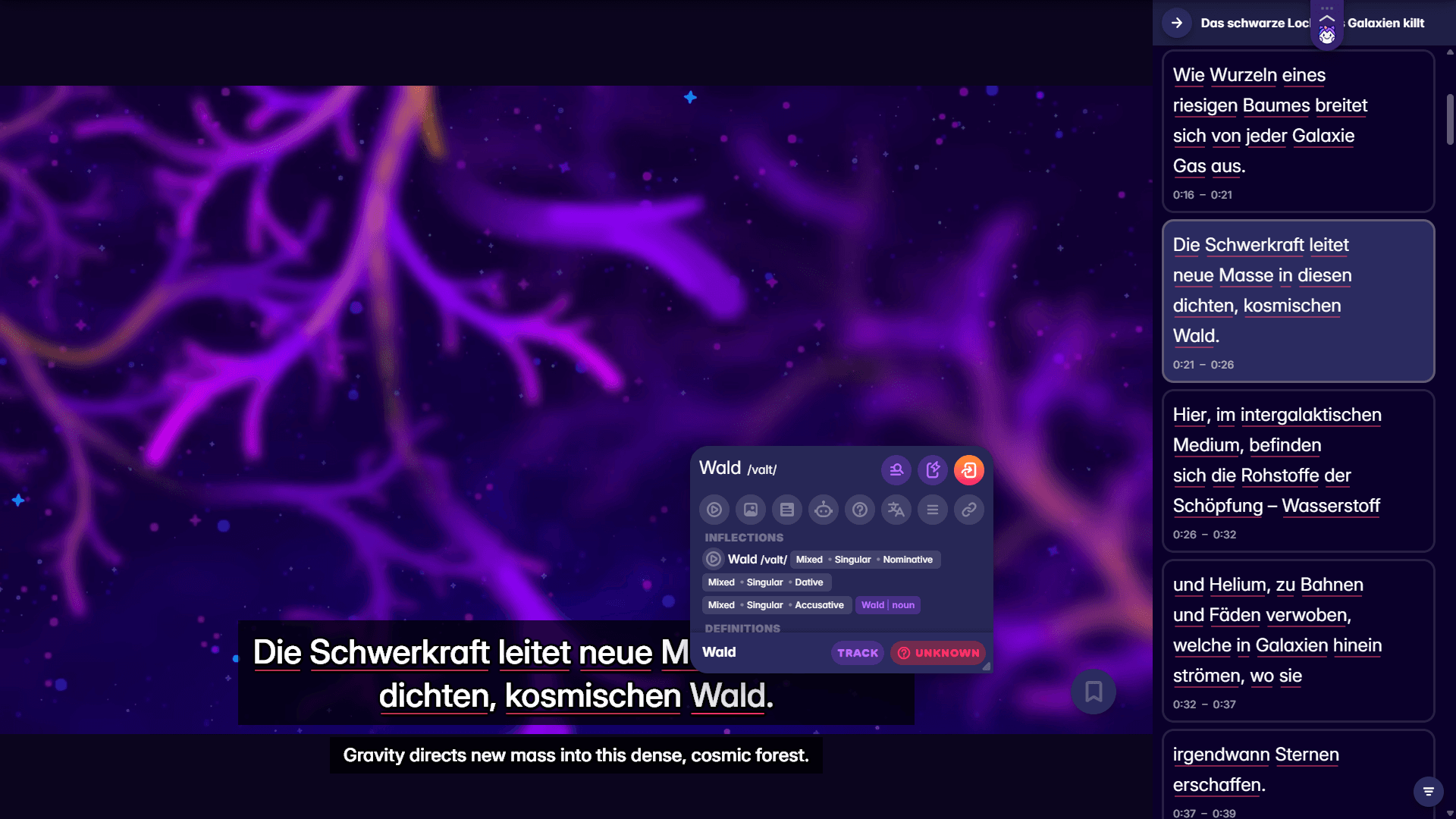
If you want to actually practice this vocabulary with real German content, Migaku's browser extension and app let you look up weather terms (and anything else) instantly while watching German news, shows, or reading articles online. You can save words directly to your learning deck and see them in actual context. There's a 10-day free trial if you want to check it out.
 ---
## Consider it practical to learn common German weather words
Here's the thing: weather vocabulary shows up everywhere. When you learn German, you'll hear weather-related words in news broadcasts, casual conversations, apps, videos, and even in literature. It's one of those practical topics that bridges the gap between textbook learning and real-world usage. And it is not hard to remember them because of how frequently they appear in day-to-day conversations and media content.
> If you consume media in German, and you understand at least some of the messages and sentences within that media, you will make progress. _Period_.
Simple words matter.🌤️
---
## Consider it practical to learn common German weather words
Here's the thing: weather vocabulary shows up everywhere. When you learn German, you'll hear weather-related words in news broadcasts, casual conversations, apps, videos, and even in literature. It's one of those practical topics that bridges the gap between textbook learning and real-world usage. And it is not hard to remember them because of how frequently they appear in day-to-day conversations and media content.
> If you consume media in German, and you understand at least some of the messages and sentences within that media, you will make progress. _Period_.
Simple words matter.🌤️